Family: Saturn
Saturn IB
Launch statistics
- 0
- Total launches
- 0
- Successes
- 0
- Failures
- —
- Success rate


The Saturn IB was the "uprated Saturn I" that NASA commissioned to test the Apollo spacecraft in Earth orbit before the Saturn V was ready. A two-stage vehicle with a spotless record, it carried the first Apollo crew, the three Skylab crews and the American half of Apollo-Soyuz.
Three-view drawing

History
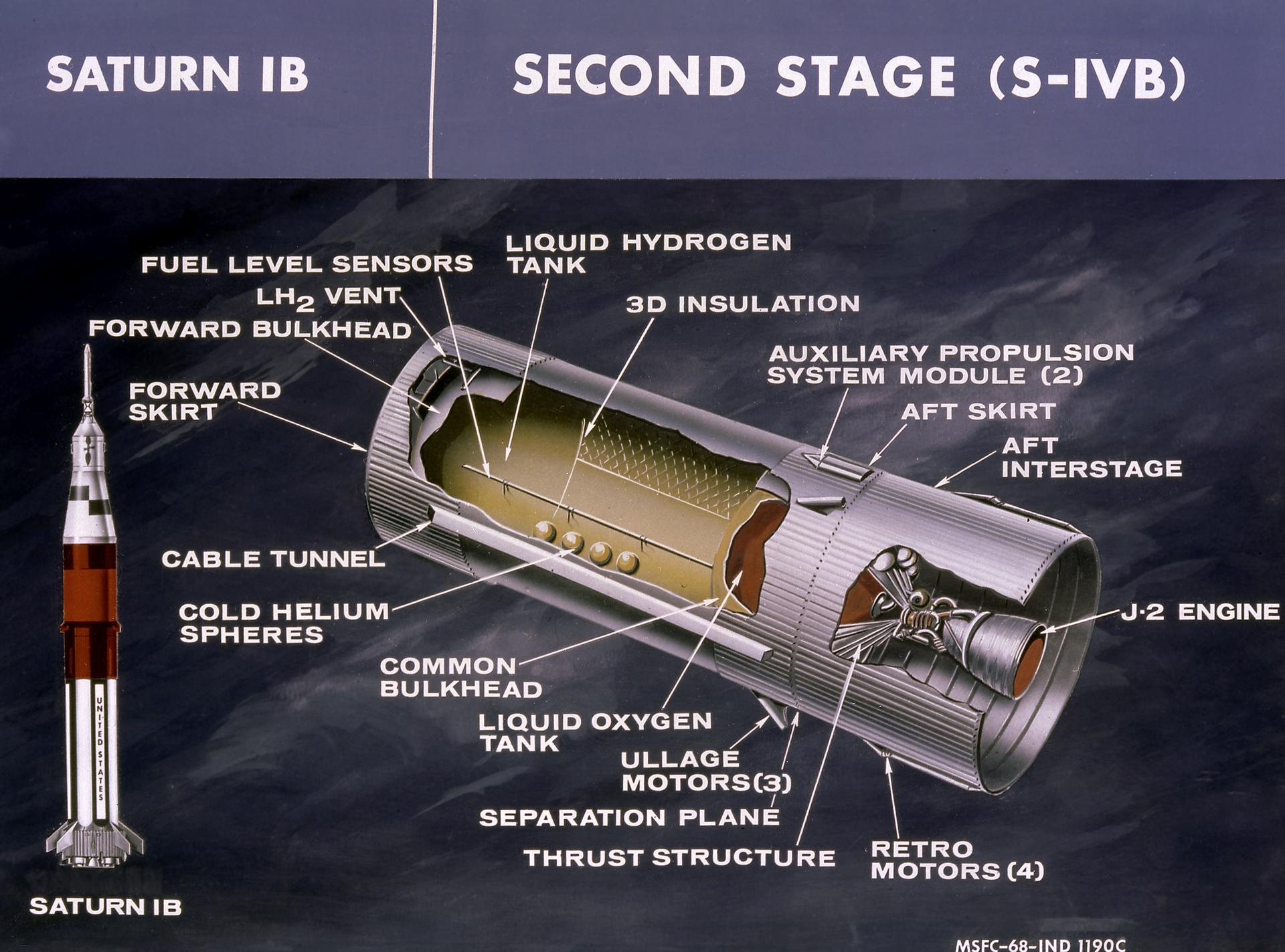
The Saturn IB was not a new design but an update of the Saturn I. The key was swapping the second stage: in place of the S-IV came the S-IVB, which went from 400 to 890 kilonewtons of thrust and more than doubled total impulse. The first stage, the S-IB, also raised the thrust of the original S-I and increased the propellant load by 3.1 %. The result was to lift the Saturn I's low Earth orbit capability from 20,000 to 46,000 pounds — around 21,000 kilograms — enough to fly a half-fuelled Apollo command and service module or a fully fuelled Lunar Module. The S-IB carried eight H-1 engines burning kerosene and liquid oxygen, and the S-IVB a single J-2 burning liquid hydrogen and oxygen; they were built by Chrysler and by the Douglas Aircraft Company at Huntington Beach, California, respectively.
Sharing the S-IVB with the Saturn V was an engineering decision with consequences: both rockets offered the Apollo spacecraft the same interface. The difference lay in how the propellant was used. On the Saturn V the S-IVB burned only part of its load to reach Earth orbit and could be restarted for trans-lunar injection; on the Saturn IB it needed all of its propellant to reach orbit and never relit. One flight, AS-203, was even launched without a payload precisely so that residual liquid hydrogen would be left in the tank and its behaviour in weightlessness could be observed, a measurement needed to design the restartable Saturn V version.
The rocket flew two uncrewed sub-orbital command and service module missions to a height of about 162 kilometres, one uncrewed orbital Lunar Module mission and the first crewed orbital CSM mission, first planned as Apollo 1 and eventually flown as Apollo 7. In 1973, the year after the lunar programme ended, three Saturn IBs ferried their crews to the Skylab station, and in 1975 the last of them launched the American portion of the Apollo-Soyuz Test Project. Another was readied for a hypothetical Skylab rescue that was never needed; the remaining vehicles in NASA's inventory were scrapped after Apollo-Soyuz. At 43.2 metres tall without payload and 589,770 kilograms in mass, the Saturn IB closed its record with a hundred per cent success rate.
Launch timeline
| Date | Launch site | Outcome | Payload |
|---|
Versions
| Saturn IB (Apollo flights, 1966–1968) | Saturn IB (final production run, 1973–1975) | |
|---|---|---|
| First launch | February 26, 1966 | May 25, 1973 |
| Last launch | October 11, 1968 | July 15, 1975 |
| Height | 43.2 m Best value in this row | 43.2 m Best value in this row |
| Diameter | 6.6 m Best value in this row | 6.6 m Best value in this row |
| Mass | 589,770 kg Best value in this row | 589,770 kg Best value in this row |
| Liftoff thrust | 7,100 kN Best value in this row | 7,100 kN Best value in this row |
| Stages | 2 Best value in this row | 2 Best value in this row |
| LEO capacity | 19,000 kg | 21,000 kg Best value in this row |
| Reusable | No | No |
Images