Family: Long March
Long March 7A
Launch statistics
- 16
- Launches (as of July 27, 2026)
- 3
- Successes
- 1
- Failures
- 75.0 %
- Success rate




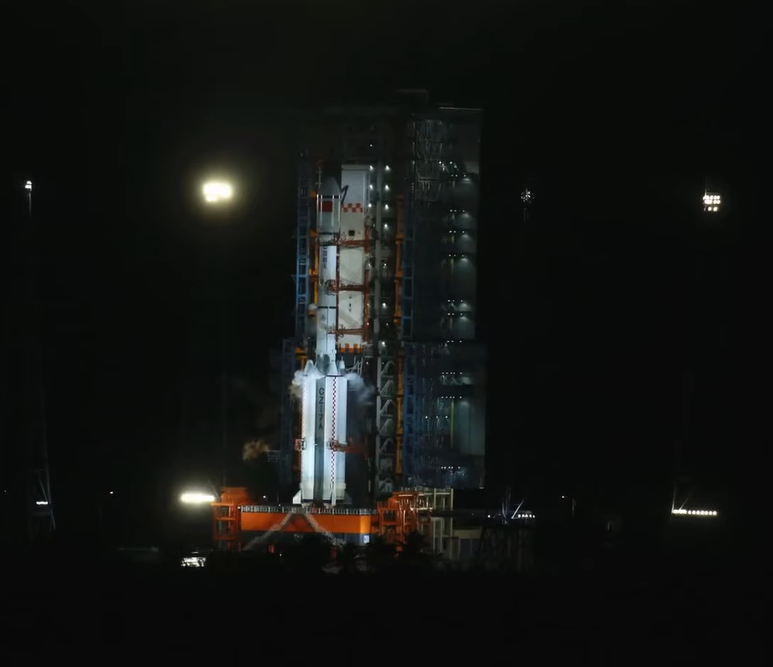





The Long March 7A (CZ-7A or LM-7A) is not a stand-alone rocket but a specific configuration of the Long March 7 family, the medium-lift liquid-fuelled launcher developed by China's space industry and first flown on 25 June 2016. The baseline vehicle is a two-stage design with a 3.35 m diameter core and four 2.25 m strap-on boosters, all burning kerosene and liquid oxygen, abandoning the hypergolic propellants used by the Long March 2 and 3 families. What sets the 7A configuration apart is the addition of a cryogenic third stage burning liquid hydrogen and liquid oxygen, 3.0 m in diameter and driven by two YF-75 engines, inherited directly from the third stage of the Long March 3B. Stacked on the same boosters and the same two lower stages of the CZ-7, that high-energy upper stage turns a launcher optimised for low orbits into one capable of direct injection to higher-energy orbits. The full stack stands 60.13 m tall and weighs 573,000 kg at liftoff, against 53.1 m and 597,000 kg for the two-stage baseline. The family was designed to be modular: it can fly with 0, 2 or 4 boosters and accepts optional upper stages such as the Yuanzheng-1A, so that performance can be dialled between 4,000 and 13,500 kg to low Earth orbit, 2,000 and 8,000 kg to Sun-synchronous orbit and 4,000 and 7,000 kg to geostationary transfer orbit. The CZ-7A operates from pad LC-2 at the Wenchang launch centre on Hainan island and is used mainly for missions to geostationary transfer orbit.
History
From the base family to the 7A variant
The Long March 7 project began in 2008 within CALT. The original idea was to re-engine the Long March 2F with the new YF-100 and YF-115 to move from N2O4/UDMH to kerosene and liquid oxygen, but the switch triggered so many changes that the effort was merged with the medium version of the Long March 5 project. In 2010 the programme was officially renamed Long March 7 and, according to its managers, required eleven new major technologies; it was also the first Chinese development carried out entirely in digital 3D, from computer-aided design straight to computer-aided manufacturing. The CZ-7 maiden flight was performed successfully on 25 June 2016 from Wenchang.
The hydrogen stage
A 2013 presentation of variants already envisaged a family coded CZ-7##, in which the first digit gave the number of core stages (2 or 3) and the second the number of boosters (0, 2 or 4). The three-stage configuration with a cryogenic upper stage promised to raise payload to geostationary transfer orbit to around 7,000 kg, a 25% increase over the Long March 3B. The CZ-7A has realised exactly that concept since 2020.
Flight record
The first CZ-7A lifted off on 16 March 2020 at 13:34 UTC from Wenchang carrying the XJY-6 payload. Two hours later official sources announced that the flight had failed, without giving a cause; outside observers later speculated about a loss of pressurisation in one of the four boosters roughly 168 seconds into the flight. Launch preparations had continued despite measures taken against COVID-19 in China. The second vehicle flew successfully on 11 March 2021 with the Shiyan-9 satellite, intended to test space environmental monitoring technologies. The configuration has since flown regularly, almost always towards geostationary transfer orbit, and as of 23 June 2026 had accumulated 16 launches with 15 successes and one failure.
Launch timeline
| Date | Launch site | Outcome | Payload |
|---|---|---|---|
| Aug 10, 2026, 12:02 PM | 201 | Failure | Chinese communication geostationary satellite for unknown purposes. |
| Jul 29, 2026, 11:50 AM | 201 | Success | Tianlian is a Chinese data tracking and relay communications geostationary satellite series. The TL-3 (Tian Lian 3) satellites are the 3rd generation of China's geostationary orbit data relay satellites, based on the DFH-4E geostationary satellite bus. They will be used to support real-time communications between orbiting satellites/rockets in-flight and ground control stations. This system replaces/supplements the current network of ground-based space tracking and telemetry stations and space tracking ships. |
| Jun 23, 2026, 2:10 AM | 201 | Success | Chinese classified satellite claimed to be for communication technology test purposes. Actual mission not known. |
| May 26, 2026, 4:16 PM | 201 | Success | Chinese classified satellite claimed to be for communication technology test purposes. Actual mission not known. |
Images