Family: Long March 2
Long March 2F/G
Launch statistics
- 29
- Launches (as of July 27, 2026)
- 1
- Successes
- 0
- Failures
- 100.0 %
- Success rate
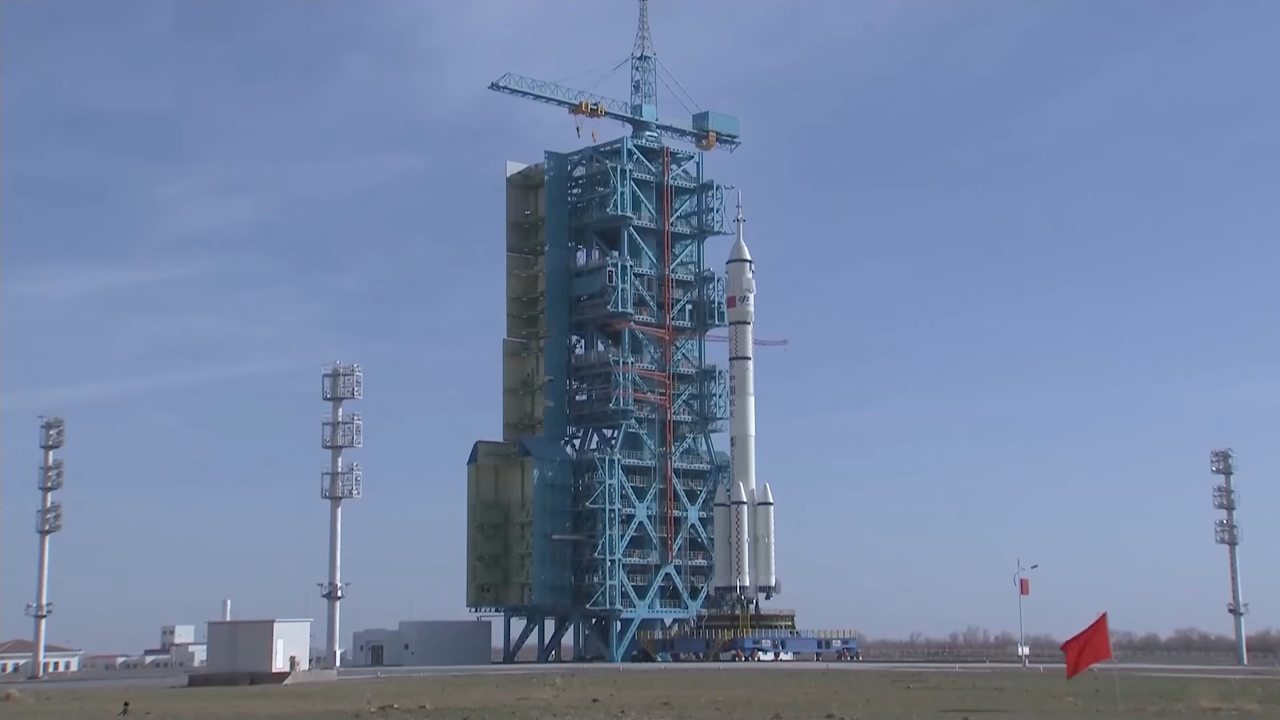

The Long March 2F/G is the upgraded configuration of the Long March 2F that China now uses for all of its crewed flights. The CZ-2F is a human-rated, two-stage, hypergolic-fuelled medium-lift launcher developed by CALT; it has launched the Shenzhou spacecraft on all 22 flights of the Shenzhou programme and is one of three in-service orbital rockets worldwide to have launched multiple crews, alongside Russia's Soyuz-2 and the US Falcon 9. After the flight of Shenzhou 3, President Jiang Zemin named the rocket "Shenjian" (神箭, "Divine Arrow"). Development of the upgraded versions was approved in 2004 and produced two branches: the 2F/G, which retains the launch escape system and flies crewed missions, and the 2F/T, which omits the escape tower and carries a larger 4.2 m fairing for bulky uncrewed payloads such as the Tiangong-1 and Tiangong-2 laboratories or the Chinese reusable experimental spaceplane. The changes reached core systems: booster propellant tanks were redesigned with conical upper sections instead of elliptical domes, increasing propellant capacity and improving low Earth orbit performance, and booster separation was delayed from 140 to 153 seconds after liftoff. The 2F/G is 58.34 m long, lifts off at 479.8 tonnes, uses a 3.8 m diameter fairing and places 8.15 tonnes into low Earth orbit. It flies from complex SLS-1 in launch area LA-4 at the Jiuquan Satellite Launch Center. The whole CZ-2F family has flown 29 launches with no failures.
History
From the Long March 2E to a human-rated rocket
The CZ-2F derives from the Long March 2E, itself based on the Long March 2C, in a lineage whose origins trace back to the Soviet R-2 missile. Externally the two look alike, but the 2F added redundant systems to improve safety, structural modifications to support the heavier fairing required by the Shenzhou capsule, and an advanced fault monitoring and diagnosis system — in other words, a launch escape system. It was also the first Chinese-made rocket to be assembled and rolled out to its pad vertically. It first flew on 19 November 1999 with Shenzhou 1, and on 15 October 2003 it carried Shenzhou 5, China's first crewed spaceflight.
Vibration and its cure
During the Shenzhou 5 mission, Yang Liwei experienced discomfort caused by heavy vibration during launch. Later modifications reduced the problem, but it reappeared on Shenzhou 6, prompting further design changes. According to chief designer Jing Muchun, engine pipelines were altered to adjust their frequency and a new pressure accumulator design produced evident results, with vibration reduced by more than 50%. By Shenzhou 14, chief designer Gao Xu stated that incremental improvements had brought vibration levels down to those comparable to riding in a car on a highway.
The 2F/G era and Tiangong
The upgraded variants first launched on 29 September 2011 carrying the Tiangong-1 space laboratory. The 2F/G proper has flown every Shenzhou mission since Shenzhou 8 on 31 October 2011. Since Shenzhou 12 the rocket has operated in a dual-vehicle standby mode at Jiuquan to support emergency crew return from the Tiangong space station: one launch vehicle stays prepared as a backup while another is assigned to the scheduled mission. Preparation time was cut from 49 days for Shenzhou 12 to 35 days by Shenzhou 15.
Launch timeline
| Date | Launch site | Outcome | Payload |
|---|---|---|---|
| May 24, 2026, 3:08 PM | Launch Area 91 (SLS-1 / 921) | Success | Shenzhou 23 will be the 23rd flight of the Shenzhou program. |
Versions
Images