Family: Ariane
Ariane 64
Launch statistics
- 3
- Launches (as of July 27, 2026)
- 2
- Successes
- 0
- Failures
- 100.0 %
- Success rate
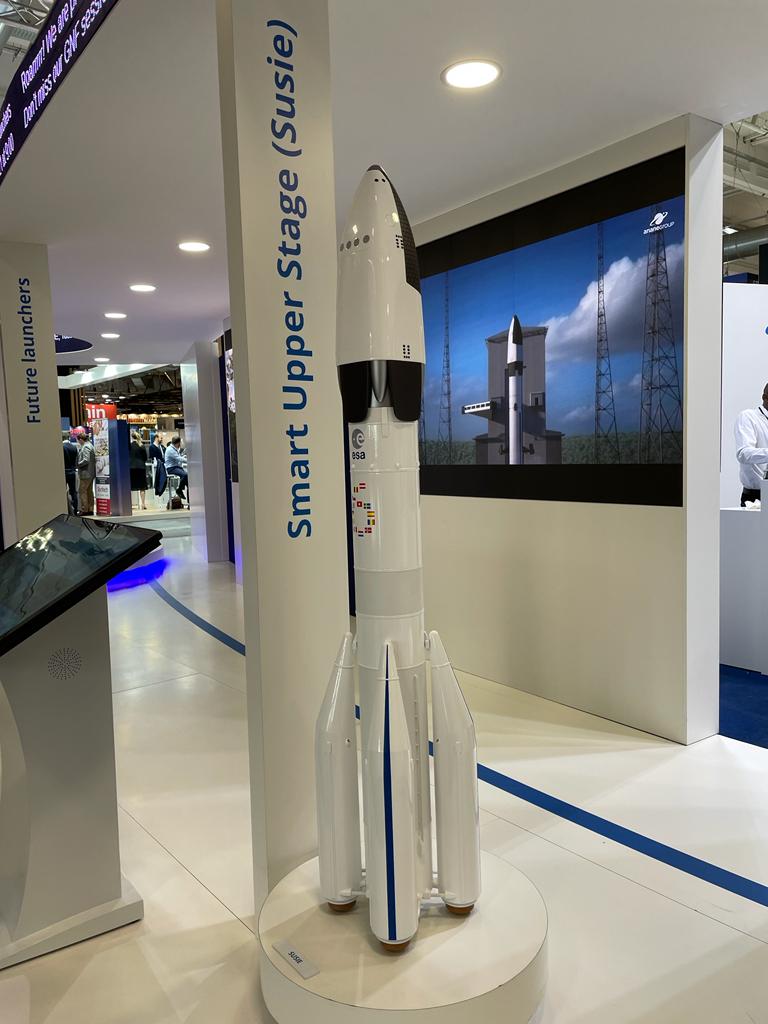
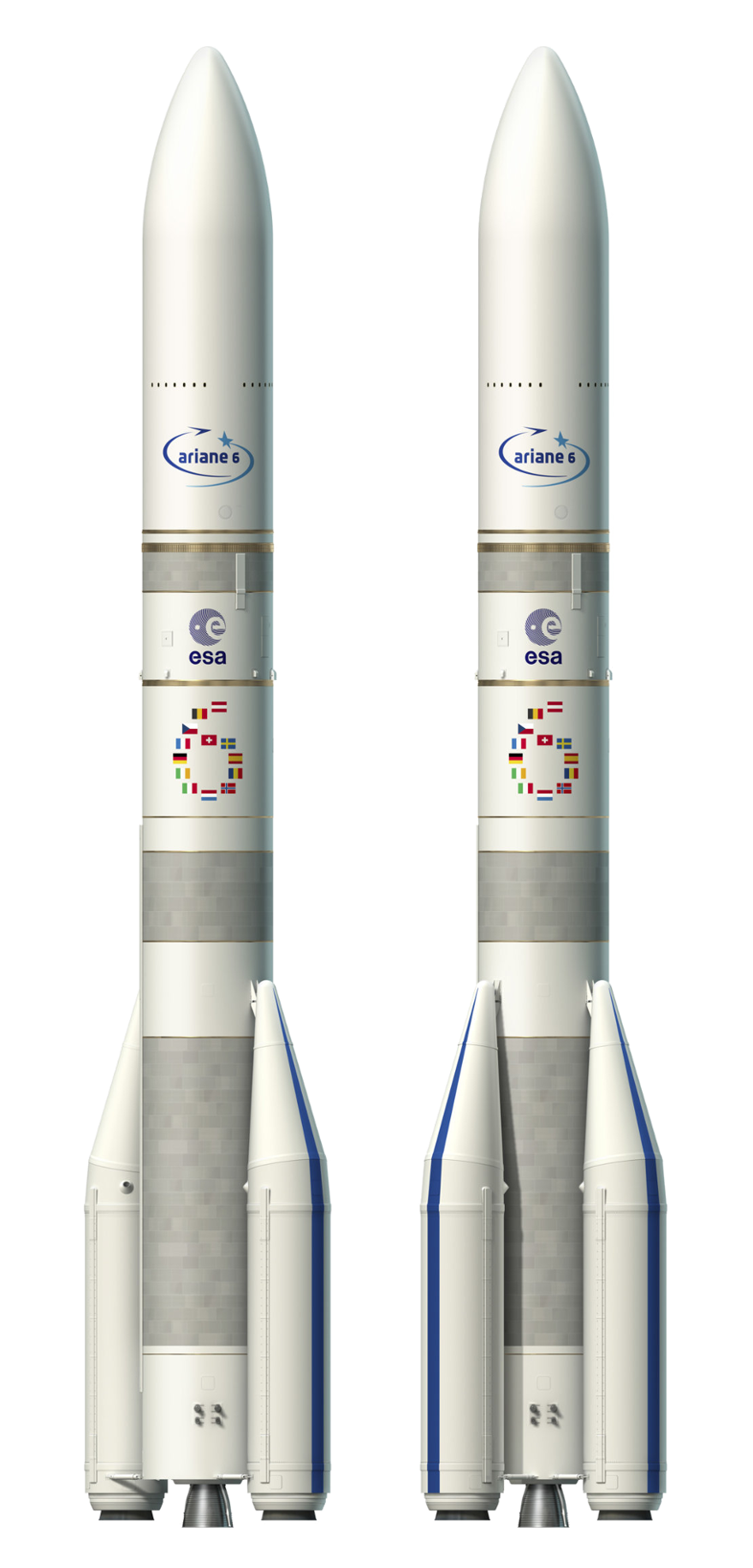
Ariane 64 (A64) is the heavy configuration of Ariane 6, the European expendable launch system developed for the European Space Agency and CNES, manufactured by a consortium of European companies led by ArianeGroup and operated by Arianespace as the replacement for Ariane 5. It is not a separate rocket: Ariane 6 is offered in variants distinguished by the number of solid rocket boosters strapped to the same central body, and the 64 is the one that carries four, against two on Ariane 62. The vehicle stands 63 m tall and 5.4 m in diameter, and comprises two liquid hydrogen and liquid oxygen stages: the lower module, with a single Vulcain 2.1 engine of 1,370 kN and roughly 140 tonnes of propellant, and the upper module, driven by a Vinci engine of 180 kN able to burn for up to 900 seconds and to restart up to five times. With its four P120C boosters, Ariane 64 weighs about 860,000 kg at liftoff and can place 21,650 kg into low Earth orbit, 11,500 kg into geostationary transfer orbit, 15,500 kg into Sun-synchronous orbit and 8,600 kg onto a lunar transfer trajectory. Like Ariane 5, it can launch two geosynchronous satellites together. The P120C is a solid motor shared with Europe's small launcher and an improved version of the P80 used on the original Vega; each unit holds about 142 tonnes of propellant. A later evolution, Ariane 64L Block 2, replaces those boosters with the P160C, extended by one metre to carry an additional 14 tonnes of propellant, and introduces an uprated 200 kN Vinci. The A64 launch cost was estimated at €115 million in 2018.
Three-view drawing
History
Programme conception
Ariane 6 was conceived in the early 2010s as a replacement for Ariane 5. Following definition studies in 2012, ESA announced in July 2013 an architecture known as PPH, with solid-motor lower stages and a cryogenic upper stage, capable of lifting up to 6,500 kg to geostationary transfer orbit. In December 2014 the current configuration, with liquid stages and strap-on solid boosters, was selected over the all-solid alternative. The project's primary contributors were France (55.3%), Germany (21%) and Italy (7.6%), with the remaining work distributed among ten other participating countries.
Delays and debut
The debut was planned for 2020, but the schedule slipped repeatedly: to 2021 in May 2020, to the second quarter of 2022 after an additional request for €230 million in October 2020, then to late 2022, to 2023 and finally to 2024. The first flight, in the two-booster Ariane 62 configuration, took place on 9 July 2024; the launch succeeded, but the upper stage could not complete its final deorbit burn and the mission was recorded as a partial failure. The second launch, on 6 March 2025, successfully delivered the CSO-3 reconnaissance satellite.
Debut of the four-booster configuration
The Ariane 64 configuration did not fly until 12 February 2026, on mission VA267 from the ELA-4 complex at the Guiana Space Centre. It carried 32 satellites of the Amazon Leo constellation, and also introduced the long fairing. Mission VA268 followed on 30 April 2026, again with 32 satellites, and on 17 June 2026 the first Ariane 64L Block 2 flew with P160C boosters and 36 satellites, the heaviest payload ever launched by an Ariane. The programme was designed to raise the annual cadence from seven to eleven missions and, measured as cost per kilogram to orbit, has achieved a 40% reduction, although it has drawn criticism over its development cost and its lack of reusability.
Launch timeline
| Date | Launch site | Outcome | Payload |
|---|---|---|---|
| Jun 17, 2026, 12:21 PM | Ariane Launch Area 4 | Success | Amazon Leo, formerly known as Project Kuiper, is a mega constellation of satellites in Low Earth Orbit that will offer broadband internet access, this constellation will be managed by Kuiper Systems LLC, a subsidiary of Amazon. This constellation is planned to be composed of 3,276 satellites. The satellites are projected to be placed in 98 orbital planes in three orbital layers, one at 590 km, 610 km and 630 km altitude. 36 satellites will be carried on this Ariane 6 launch. |
| Apr 30, 2026, 8:57 AM | Ariane Launch Area 4 | Success | Amazon Leo, formerly known as Project Kuiper, is a mega constellation of satellites in Low Earth Orbit that will offer broadband internet access, this constellation will be managed by Kuiper Systems LLC, a subsidiary of Amazon. This constellation is planned to be composed of 3,276 satellites. The satellites are projected to be placed in 98 orbital planes in three orbital layers, one at 590 km, 610 km and 630 km altitude. 32 satellites are carried on this launch. |
Versions
| Ariane 62 (A62) | Ariane 64 (A64) | Ariane 64L Block 2 (A64L) | |
|---|---|---|---|
| First launch | July 9, 2024 | February 12, 2026 | — |
| Height | 63 m Best value in this row | 63 m Best value in this row | — |
| Diameter | 5.4 m Best value in this row | 5.4 m Best value in this row | — |
| Mass | 530,000 kg | 860,000 kg Best value in this row | — |
| Liftoff thrust | 9,560 kN | 19,120 kN Best value in this row | — |
| Stages | 2 Best value in this row | 2 Best value in this row | 2 Best value in this row |
| LEO capacity | 10,350 kg | 21,650 kg Best value in this row | — |
| GTO capacity | 4,500 kg | 11,500 kg Best value in this row | — |
| Reusable | No | No | No |
Images