Project Mercury · NASA · Uncrewed
Little Joe 2
- December 4, 1959
- Launch date
- 11 min
- Duration
- Success
- Outcome
-1600.webp)

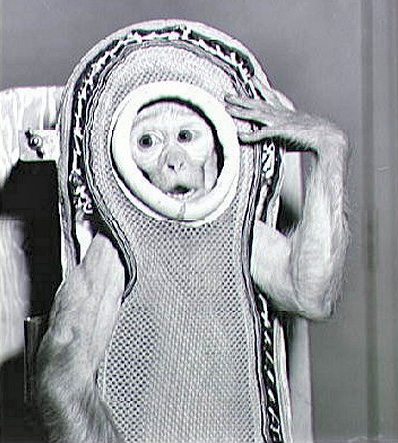
Little Joe 2 (LJ-2) was an uncrewed suborbital qualification flight of Project Mercury, launched on 4 December 1959 from Wallops Island, Virginia, with a rhesus monkey named "Sam" riding inside a boilerplate Mercury capsule. It was never meant to reach orbit. It was a deliberately cheap rehearsal designed to answer, before any pilot was put at risk, two linked questions: how the capsule-and-escape-tower combination behaved during a high-altitude abort, and what such a sequence did to a living passenger. The flight rode a Little Joe booster, the cluster of solid-fuel rockets that Langley Research Center had conceived precisely to make testing affordable. Four Pollux and four Recruit motors were packed into an airframe 48 feet tall and 6.66 feet in diameter, weighing at most 41,330 pounds and able to lift a payload of up to 3,942 pounds. Each vehicle cost on the order of $200,000 and could fly from facilities Wallops Island already had, with no call on Cape Canaveral. For an eleven-minute flight the objective list was long: to measure the motions of the spacecraft-escape tower combination during a high-altitude abort, to observe entry dynamics with no control system working, to record the physiological effects of acceleration on a small primate, to check drogue parachute operation, and to exercise the recovery operation itself. Telemetry was arranged to return on the order of 80 channels of data. The sequence ran almost exactly as written. Timers triggered the abort 59 seconds into the flight, at roughly 96,000 feet and Mach 5.5; the escape motor fired on cue and pulled the capsule away at about Mach 6 to an apogee of 53.03 statute miles — 280,000 feet — with a maximum range of 194.40 statute miles and a total lift-off-to-impact time of 11 minutes 6 seconds. Recovery took about two hours, and "Sam" came out of the Atlantic in good condition. NASA recorded every mission objective as met. LJ-2 was the first flight of the programme to combine a realistic high-altitude abort with a live passenger and a complete recovery, and its data — including the internal and external noise measurements taken aboard — fed both the qualification of the escape system and the design of the cabin that astronauts would later occupy. Its direct successor, Little Joe 1B carrying "Miss Sam", flew on 21 January 1960.
Payload
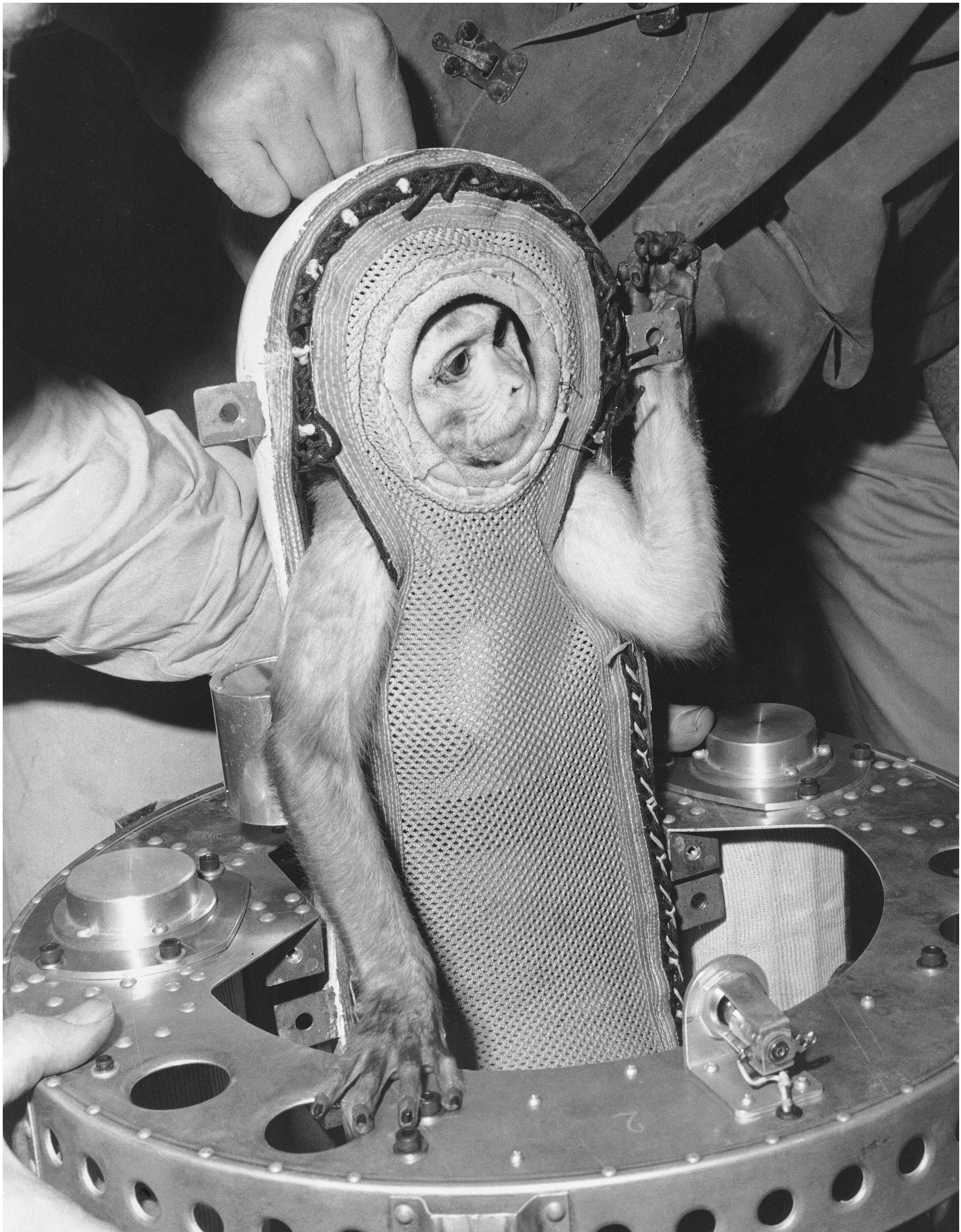
The payload of Little Joe 2 was a Mercury boilerplate capsule —a structural mock-up built by McDonnell, without the full onboard systems of a production spacecraft— with a launch mass of 1,007 kg, topped by the escape tower and its Grand Central solid-fuel motor. The available sources give no serial number for this article, which does not appear in the register of Mercury spacecraft assigned to missions; the boilerplate itself is preserved on display at Air Power Park in Hampton, Virginia. Inside rode the passenger that made the flight famous: "Sam", an American-born rhesus macaque (Macaca mulatta) supplied by the School of Aviation Medicine in San Antonio, Texas —whose name he carried as an acronym— placed in his container to determine the physiological and psychological effects of acceleration and weightlessness on a small primate; he withstood up to 12 g and some three minutes of weightlessness, and was recovered alive and in good condition. With him flew a biopack provided by the Air Force School of Aviation Medicine, agreed in late November 1959, holding barley germination track plates, nerve cells from a rat, tissue cultures and other specimens of that kind. Instrumentation was kept to what the test required: telemetry was set up to record some 80 bits of information during the flight, and the drogue and main parachutes were aboard, their reliability being itself one of the mission objectives.
History
A cheap rocket for a programme in a hurry
Project Mercury began with a built-in contradiction: qualifying a crewed spacecraft demanded dozens of test flights, and there was neither the money nor the front-line boosters to fly them. Langley Research Center supplied the way out. In January 1958 Max Faget and Paul Purser had worked out on paper how to cluster four solid-fuel Sergeant rockets — already in routine use at Wallops — to push a capsule above the stratosphere. The idea was shelved, but in August 1958 William Bland and Ronald Kolenkiewicz went back to those preliminary designs for a cheap cluster capable of lifting full-scale, full-weight capsule models.
The name came off the drawing boards themselves. The first cross-sections showed four circles, and the designers called the project "Little Joe" after the craps throw of a double deuce. When four smaller circles were later added for the Recruit motors, the nickname had already stuck, reinforced by the four large stabilising fins jutting from the airframe. The name is generally attributed to Maxime Faget.
The vehicle existed for economic reasons. Little Joe could be built for roughly a fifth of the basic cost of a Redstone, had far lower operating costs, could be developed and delivered in far less time, and — no small matter — could be launched from facilities Wallops Island already possessed. It was the first of only two booster systems designed specifically and solely for crewed capsule qualification, and one of the pioneering operational launch vehicles to use the rocket-cluster principle. With four modified Sergeants — called Castor or Pollux depending on the modification — and four supplemental Recruit motors firing in different sequences, take-off thrust varied widely from profile to profile.
From drawing board to launcher
The administrative record of the Little Joe programme is unusually well documented. In November 1958 the Space Task Group put a support proposal for the Little Joe phase to Langley; Langley was receptive and on 5 December formally confirmed its willingness to take part, absorbing the contracting for engineering, construction, services, data processing, analysis and reporting. Twelve companies answered the November 1958 invitation to bid on the airframe. North American Aviation's Missile Division won the contract on 29 December 1958, and by 31 December the letter of intent for fabricating the test-vehicle airframes was in place, with deliveries planned every three weeks from June 1959. On 23 January 1959 further funds were made available to Langley Research Center for the Little Joe development programme; the remainder of the total programme cost had already been transferred to it in an earlier operation.
The flight test plan was drafted on 29 January 1959 and updated on 14 April. Its primary objectives already foreshadowed what LJ-2 would carry out: investigating flight dynamics, checking drogue parachute operation, determining the physiological effects of acceleration on a small primate, and, to some degree, checking the spacecraft's aerodynamic characteristics. That same January it was noted that some Little Joe flights would carry animal payloads, pigs and small primates among them.
The stumbles that came first
LJ-2 arrived after an uneven run. On 21 August 1959, during the countdown of the first scheduled Little Joe launch, the escape rocket fired prematurely 31 minutes before the intended lift-off: the spacecraft rose to about 2,000 feet and came down some 2,000 feet from the launch site, the cause being a faulty escape circuit. On 4 October 1959, LJ-6 did fly as intended, with objectives centred on the integrity of the airframe and motor system, launcher operation, the validity of the calculated wind corrections, performance and drag data, and the destruct system; the flight lasted 5 minutes 10 seconds and reached 37.12 statute miles of altitude and 79.4 statute miles of range. On 4 November 1959, LJ-1A repeated the high-aerodynamic-load abort test that LJ-1 had never managed to perform, but the dynamic buildup during the manoeuvre proved too low.
By December, then, two central questions were still open: how the combination behaved in a genuine high-altitude abort, and how a living organism took the complete sequence. NASA's internal paperwork refers to the flight as "Little Joe Test No. 3 (LJ-2)", a test numbering distinct from the vehicle's public designation.
Why carry a primate
The biomedical objective was not ornamental. American aerospace medicine had already accumulated experience with primates on ballistic flights — Albert I, a rhesus macaque, had flown above 63 km in 1948 — but what was missing was knowledge of how a living body absorbed the specific sequence an astronaut would face if the booster failed: ascent acceleration, escape motor firing, separation, uncontrolled free fall, drogue deployment, splashdown, and the wait for rescue.
The chosen passenger was "Sam", an American-born rhesus monkey (Macaca mulatta) from the School of Aviation Medicine in San Antonio, Texas; his name is an acronym of that institution. Popular accounts put the acceleration he endured at up to 12 g and his time in weightlessness at about three minutes.
The biopack and the run-up
The flight carried a second experiment alongside the primate. On 27 November 1959 the Air Force School of Aviation Medicine agreed to provide a biopack for the Little Joe 2 flight; the package held barley track plates, nerve cells from a rat, tissue culture and other specimens of that kind. The intent was to use every minute of the profile to expose biological material to its acceleration and radiation environment.
On that same 27 November, the Arnold Engineering Development Center tested the Grand Central solid-fuel rocket motor used to propel the Mercury escape system, to verify ignition at altitude and to determine the combustion-chamber pressure-time curve. The very component whose behaviour LJ-2 was about to demonstrate in flight was being characterised on a test stand barely a week beforehand.
4 December 1959: the flight
LJ-2 lifted off from Wallops Island. Timers began the abort sequence 59 seconds into the flight, at roughly 96,000 feet and Mach 5.5 — in mid-ascent and in a realistic emergency regime. The escape motor ignited as planned and pulled the spacecraft away at about Mach 6, carrying it to an apogee of 53.03 statute miles. Every other sequence operated as planned.
The official Mercury flight data summary records for LJ-2 a maximum altitude of 280,000 feet (53.03 statute miles; 46.08 nautical miles), a maximum range of 194.40 statute miles, a maximum velocity of 5,720 feet per second earth-fixed and 6,550 feet per second space-fixed — 4,465.9 miles per hour in the space-fixed frame — and a flight duration of 11 minutes 6 seconds measured from lift-off to impact. Telemetry had been set up to record on the order of 80 bits of information during the trip.
Recovery and the passenger's condition
Spacecraft recovery was completed in about two hours from lift-off. Splashdown was in the Atlantic, and the destroyer USS Borie made the pick-up, retrieving the capsule with the monkey alive and intact. NASA recorded that the primate passenger, "Sam", withstood the trip and the recovery in good condition, and logged every mission objective as met.
That detail — recovery counted as an objective in its own right rather than as an afterthought — explains why the flight was considered complete only once the animal was aboard ship. Open-sea retrieval was one of the programme's genuine unknowns, and the next flight would exercise the helicopter variant.
What LJ-2 contributed to qualifying the capsule
The worth of LJ-2 lies not in its altitude, modest beside Big Joe 1 or the later Redstone flights, but in the combination of conditions it reproduced for the first time: a real high-altitude abort, entry dynamics with no control system, drogue deployment, a live passenger and an at-sea recovery, all in one mission and all working.
Its data kept working after the flight. On 1 February 1960 a study of the external and internal noise of space capsules was completed, covering the acoustic environments of missiles and space vehicles — rocket engine noise, air boundary layers, on-board equipment — and drawing, among other sources, on measurements taken during the Big Joe I and Little Joe 2 flight tests. NASA's view at that point was still that the internal noise level was too high for pilot comfort, and the Space Task Group asked for data on noise transmission through the structure of an actual production spacecraft. It is a good illustration of how a qualification flight does not close a question so much as turn it into a measurable requirement.
Continuity: Miss Sam and the road to crewed flight
On 21 January 1960, Little Joe 1B lifted off from Wallops with another rhesus monkey, "Miss Sam", aboard. Its objectives repeated those of LJ-1 and LJ-1A — the flights lost to premature firing and to insufficient dynamic buildup — and added a physiological study of the primate focused on the effects of the rapid onset of reverse acceleration during an abort at maximum dynamic pressure; the Mercury helicopter recovery system was exercised as well. All sequences operated as planned: the spacecraft reached a peak altitude of 9.3 statute miles, a range of 11.7 statute miles and a maximum speed of 2,021.6 miles per hour, and thirty minutes after launch a Marine recovery helicopter set the capsule and its occupant down at Wallops Station, with "Miss Sam" in good condition.
With LJ-2 and LJ-1B the programme closed out its block of abort tests with a live passenger and could turn to the Redstone and Atlas qualification flights that would carry Ham, Enos and finally the astronauts.
Surviving hardware and disagreements between sources
The boilerplate Mercury spacecraft used on the Little Joe 2 mission is displayed at the Airpower Park and Museum in Hampton, Virginia.
The figures call for care. Popular sources give the apogee as 55 miles (88 km) in running text and 53 miles in the summary box of the same article, whereas the official Mercury flight data summary gives 280,000 feet, that is 53.03 statute miles, which matches the value recorded for this mission in this encyclopedia. The NASA figure has been adopted here. Likewise, booster thrust is cited as 250,000 pounds in the project chronology and as almost 230,000 pounds (1,020 kilonewtons) of maximum design thrust in secondary sources; both are reported here for what they are, two different numbers from two different provenances.
Images
Elsewhere
- Wikimedia CommonsProject Mercury — Little Joe test: Sam launched using a rhesus monkey (C-1959-52201) ↗
- Wikimedia CommonsMonkey Sam before the flight on Little Joe 2, in the Mercury fiberglass contour couch (B60-00036) ↗
- Wikimedia CommonsSam the monkey after his ride in the Little Joe 2 spacecraft, recovered by a Navy destroyer (S-63-19199) ↗
- American SpacecraftLittle Joe 2 spacecraft that launched the rhesus monkey Sam, on display at Air Power Park and Museum, Hampton VA ↗
- AlamySam, a rhesus monkey who, on December 4, 1959, flew on the Little Joe 2 in the Mercury program to 53 miles high ↗