Project Gemini · NASA · Crewed
Gemini VII
- Dec 4, 1965, 7:30 PM
- Launch date
- 2
- Crew size
- 13 days 18 hr
- Duration
- Success
- Outcome







-1600.webp)


Gemini VII was the fourth crewed flight of the Gemini program, the twelfth crewed American spaceflight and the twentieth crewed spaceflight in the world counting Soviet missions and the X-15 flights above the Kármán line. Frank Borman and James A. Lovell Jr. lifted off from Launch Complex 19 at Cape Kennedy on 4 December 1965 at 19:30:03 UTC aboard a Titan II GLV and completed 206 orbits before splashing down in the Atlantic southwest of Bermuda on 18 December at 14:05:04 UTC. They spent 13 days, 18 hours, 35 minutes and 1 second in space: 330 hours, 35 minutes and 1 second in the reckoning of SP-4203. The mission was conceived as the endurance test of the program. If a crew had to survive the length of a lunar voyage and come back fit to work, somebody had to prove it first in low Earth orbit, and that was the assignment. Gemini VII carried twenty experiments, more than any other Gemini mission, eight of them medical, and introduced the lightweight G5C suit, designed so that it could be taken off inside a cabin that Borman and Lovell described as little roomier than the front seat of a car. The failure of the Agena target vehicle on 25 October 1965, which left Gemini VI with nothing to dock with, turned the endurance flight into something more: NASA decided to launch the alternate Gemini VI-A mission while Gemini VII was still in orbit and to use Borman and Lovell as the target. On 15 December, Walter Schirra and Thomas Stafford closed in until they were stopped about 40 metres from Gemini VII with no relative motion between the two spacecraft, the first crewed space rendezvous in history. The two crews flew together for more than three revolutions of the Earth, at ranges that came down to thirty centimetres. The last three days, with the visitors gone, were the hardest: two thrusters failed, the fuel cell delivered only partial power and the mission came close to ending early. Even so, the retrorockets fired, the reentry was flown under computer guidance and the spacecraft came down 11.8 kilometres from the aiming point. Half an hour later Borman and Lovell walked onto the deck of the carrier USS Wasp under their own power. Their endurance record stood until Soyuz 9 in June 1970, and Gemini VII remained the longest American crewed flight until Skylab 2 in 1973.
Objectives
The mission's stated priorities were five: to demonstrate a two-week flight, to perform stationkeeping with the second stage of the Gemini launch vehicle, to evaluate the shirt-sleeve environment and the lightweight pressure suit, to act as the rendezvous target for Gemini VI-A, and to demonstrate a controlled re-entry close to the planned landing point.
Payload
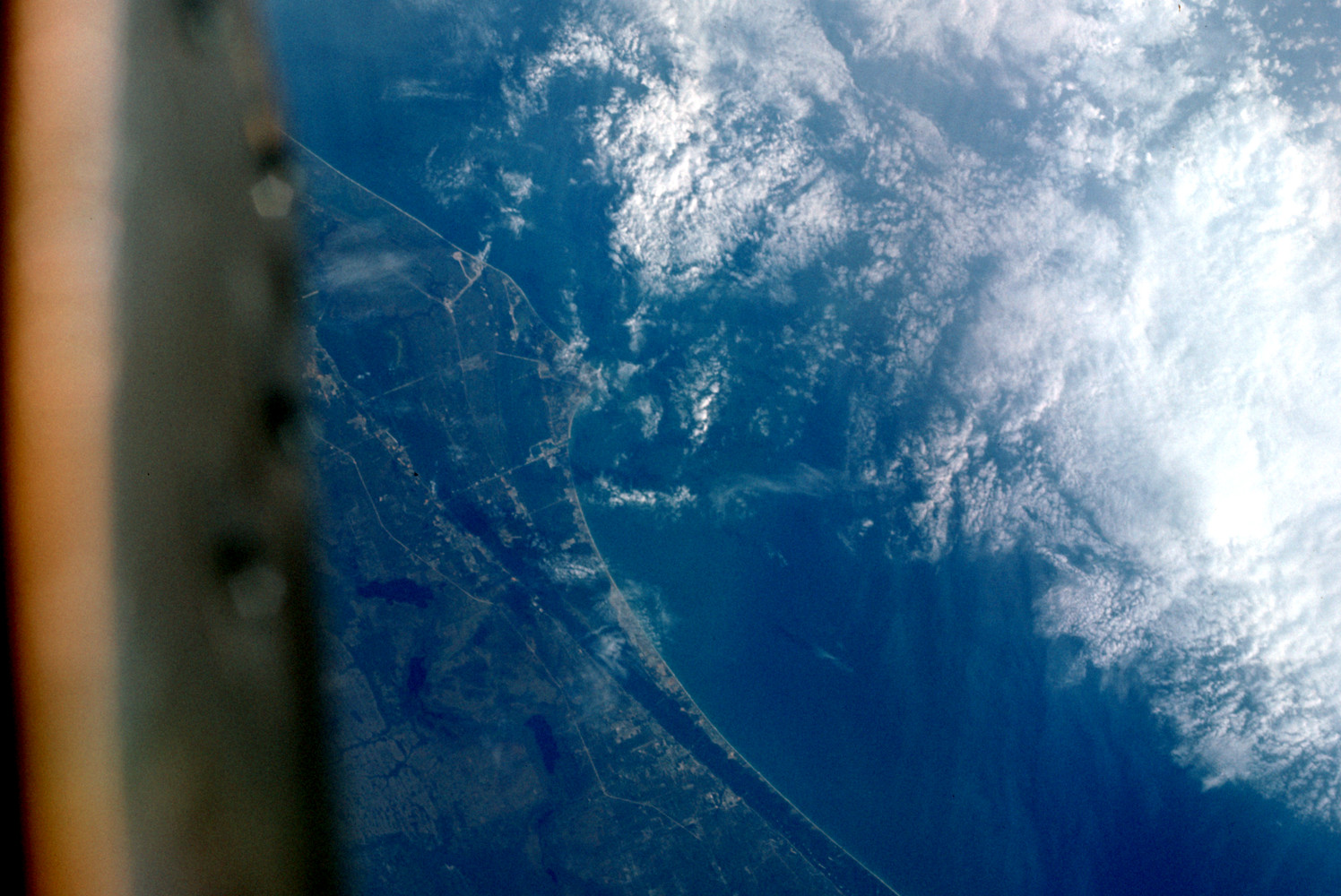
Beyond the Gemini spacecraft carrying Frank Borman and James Lovell, the mission flew a programme of three scientific, four technological, four spacecraft and eight medical experiments. The scientific set included synoptic terrain photography, synoptic weather photography and visual acuity in the space environment; the lightweight pressure suit and the MSC-4 optical communications experiment were among the technological items.
History
An endurance flight turned into a double mission
When NASA parcelled out the big tasks of the Gemini program, the seventh mission drew the least glamorous and the most necessary one: fourteen days in orbit, the longest flight planned in the whole program. There was nothing spectacular about it. The purpose was medical and engineering: to find out whether two men could spend inside a tiny cabin the time a lunar expedition would take, and come back physically able to do their job. While the Agena target vehicle that was to allow docking kept giving trouble, the order of the flights was reshuffled more than once; the program history itself acknowledges that the target vehicle's difficulties forced a rearrangement of mission tasks.
On 25 October 1965, at pad 14, a General Dynamics team ran the countdown of the Atlas that was to put the Agena for Gemini VI into orbit. The target was lost, and the mission with it: no target meant no docking. NASA's answer was one of the boldest decisions of the program. Rather than wait for another Agena, an alternate mission, Gemini VI-A, would be launched while Gemini VII was in space, and Borman and Lovell's spacecraft itself would serve as the passive target. The decision changed the character of the long flight: it was no longer only an endurance test but half of a double operation. It also imposed new conditions, since it limited the propellant the crew could spend on experiments and on stationkeeping with their own booster, and it required modifications. Over an early-November weekend, target acquisition and orientation lights, a radar transponder, a spiral antenna and a voltage booster were installed on Spacecraft 7.
The crew
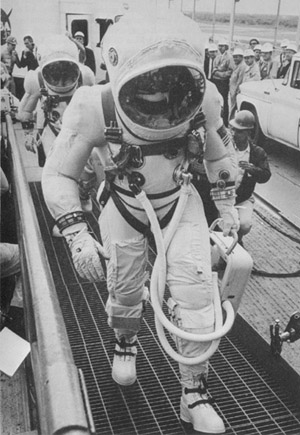
The selection had been made long before. The program had begun to follow a leap-frog pattern in which the backup crew of one mission became the prime crew of a later flight. On 1 July 1965 NASA picked the Gemini IV backup crew, Frank Borman and James Lovell, to fly Gemini VII, with Edward White and Michael Collins as alternates; Collins was the first member of the third astronaut class, selected in October 1963, to be named to a flight. For Borman, the command pilot, and for Lovell, the pilot, this was a first spaceflight. On the ground the capsule communicators were Charles Bassett, Alan Bean, Eugene Cernan and Elliot See, the last of them the voice that accompanied the launch and much of the daily routine.
Borman and Lovell prepared by talking directly to the men who had already been through something like what awaited them. They worked with the Gemini IV pilots and talked with the Gemini V crew, and from those conversations came most of their practical decisions: what to take, how to prepare physically and psychologically, how to organise their time. White and McDivitt had come back fatigued; Cooper and Conrad tired and bored. Both crews stressed the same point: sleeping in alternate shifts, with one man awake while the other rested, did not work. Borman and Lovell resolved to sleep and work together.
Packing for a fortnight
Preparing Gemini VII was to a large extent an exercise in domestic logistics. Prescribing tasks for fixed times during a flight had proved useless on previous missions, so Borman and Lovell lifted off with what was in essence a flight plan outline: experiments and other tasks would be carried out only when the flight controllers and the crew could fit the job to the opportunity. The only prescheduled tasks fell between launch and stationkeeping, the first four hours of a 330-hour mission.
The other innovation, warmly welcomed, was adjusting the sleep-eat-work-relax cycle to the crew's more normal, Earthbound habits. Borman and Lovell had two work periods each day, coinciding with morning and afternoon in the United States Central Standard Time zone; the schedule also fitted the specialised activities of the three flight controller shifts, devoted respectively to executing the flight plan, to analysing systems performance and the supply of consumables, and to keeping up with what had been done and planning the next segment.
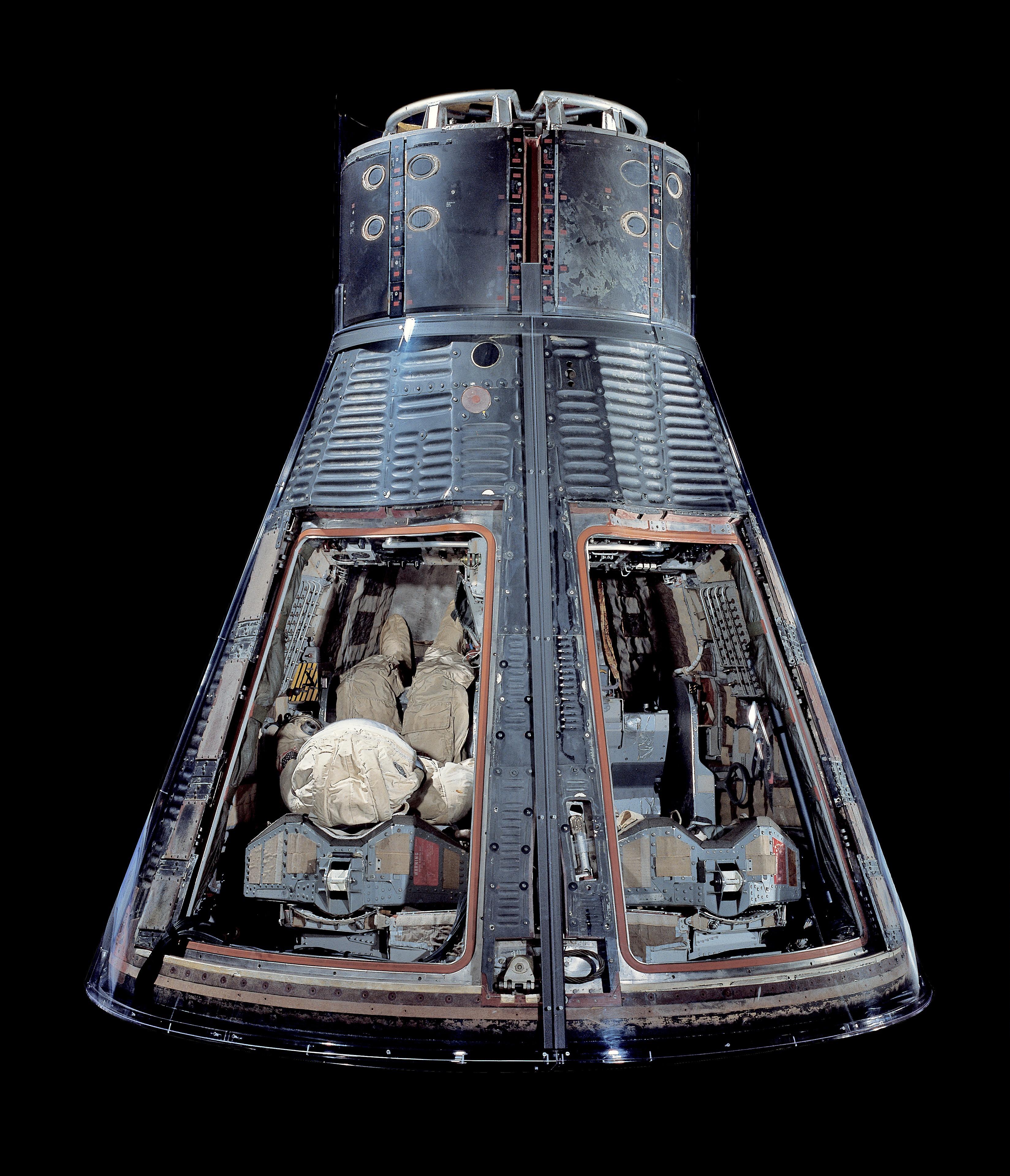
Stowage was a problem of its own. On a two-week flight, unfinished meals and food wrappers could quickly clutter the cabin, as Cooper and Conrad had learned in eight days. Kenneth Kleinknecht, deputy manager of the program office, went with Borman and Lovell to St. Louis, where Spacecraft 7 was going through its test phases, to help them hunt for more room. The solution to the garbage problem was as simple as it was revealing: waste paper from their meals would go behind Borman's seat for the first seven days and behind Lovell's for the next seven. The crew practised stowing for launch, orbit and reentry until they were sure they knew where to put every scrap of paper.
The lightweight G5C suit
Even more significant than the stowage plan was the suit. In early June 1965 McDonnell started a test program to see whether astronauts could ride almost suitless in space: Gordon Cooper and Elliot See, wearing standard Air Force flight suits fitted with medical monitoring plugs, helmets wired for Gemini communications and oxygen masks connected to emergency bottles, flew in the altitude chamber in St. Louis to simulated heights of 36 000 metres. Both astronauts were elated with the results; McDonnell personnel were uneasy, because in actual flight the cabin temperature might go too high.
At a management meeting between the Manned Spacecraft Center and McDonnell the following month, another possibility was studied. James V. Correale, of the Crew Systems Division, suggested a lightweight pressure garment similar in operation to the G3C intravehicular suit. That soft suit would not allow the pilots to complete a mission if the cabin lost oxygen pressure, but it would give them enough margin of safety to reach a recovery area. McDonnell's test results showed that the spacecraft environmental system actually worked more efficiently with the suits off, yet NASA and contractor engineers disliked leaving the crew so vulnerable: the best way to put out a fire in space was to depressurise the cabin, out of the question with the men unsuited, and they needed protection if they had to use the ejection seats. Hence the speed with which Correale's idea was taken up.
The decision, made in August 1965, came too late to benefit the Gemini V crew but in time for Gemini VII. To produce a more comfortable garment, the David Clark Company removed as much corsetry as possible from the Gemini pressure suit, which weighed 10.7 kilograms. The new suit was designed to be taken off in flight without demanding too much energy or space, and a soft cloth hood fastened to the torso with zippers replaced the fibreglass shell helmet. Working with the Crew Systems Division, the contractor cut the weight by a third, although the resulting 7.3 kilograms was still somewhat heavy. In evaluation and training sessions, however, Borman and Lovell found the new garment handy: the soft hood could be zipped open, and the complete suit could be removed and laid on the side of the seats without having to be stowed away. If the spacecraft systems performed properly, the crew would take the suits off after the second day and wear them only for the critical phases of the mission: rendezvous, reentry and landing. Use of the lightweight suit, designated G5C, was approved in August, and qualification was completed by November.
Twenty experiments, eight of them medical
Gemini VII carried more experiments than any other flight in the program. Since it was the last long-duration mission, its medical experiments were particularly important in assessing man's capabilities for the lunar landing program: of the twenty experiments, eight were medical, a higher ratio than in any other Gemini flight. The crew did not greet them with enthusiasm. Two of them, the calcium balance study and the inflight sleep analysis, were better suited to a clinic than to a small spacecraft cabin.
The very name of the inflight electroencephalogram made the astronauts nervous: although it was merely a study of sleeping habits, the EEG was normally used to diagnose subtle disturbances such as incipient epilepsy or brain tumours, and the pilots were wary of how the results might be interpreted. Renaming it inflight sleep analysis solved only half the problem, because normal hair growth would dislodge the scalp sensors after 48 hours and the information had to be gathered at the worst possible time, the first night, when most people have difficulty sleeping in a new environment anyway.
The calcium balance study struck them as an equal nuisance: it required a complete record of body intake and wastes for 9 days before the flight, the 14 days of the flight and 4 days afterwards. Before and after the mission a nutritionist from the National Institutes of Health limited what they could eat and drink and weighed out their meals in grams. Almost a month of that regimen appealed to nobody. The other medical experiment making its debut was the bioassays of body fluids, intended to study the effect of spaceflight on body fluid chemistries that might be affected by physical and mental stress, through the analysis of urine samples.
Outside the medical field, in the scientific, technological and defence categories, only three experiments were being flown for the first time; the other nine were repeated from Gemini IV and V. Two of the new ones were technological: an in-flight laser transmitter to be aimed at a laser beacon at the White Sands Test Facility in New Mexico, to establish optical communications from space, and landmark contrast measurements of selected areas around the world, primarily coastlines, which might be useful to Apollo for guidance and navigation. The third was a Defense experiment to determine the value of star occultation measurements for spacecraft navigation.
4 December 1965
Four years earlier the chimpanzee Enos had barely completed two circuits of the Earth. Borman and Lovell were about to try for more than two hundred in a fortnight. On 4 December 1965 they entered the spacecraft and settled in their couches, checking systems and listening over the communications circuits until they heard the erector go clanking downward. Promptly at 2:30 in the afternoon, local time, the booster rose from the pad. There was no doubt about it, Lovell said: the countdown of CapCom Elliot See, the vibration of the launch vehicle and the noise of the engines all told him he was going someplace.
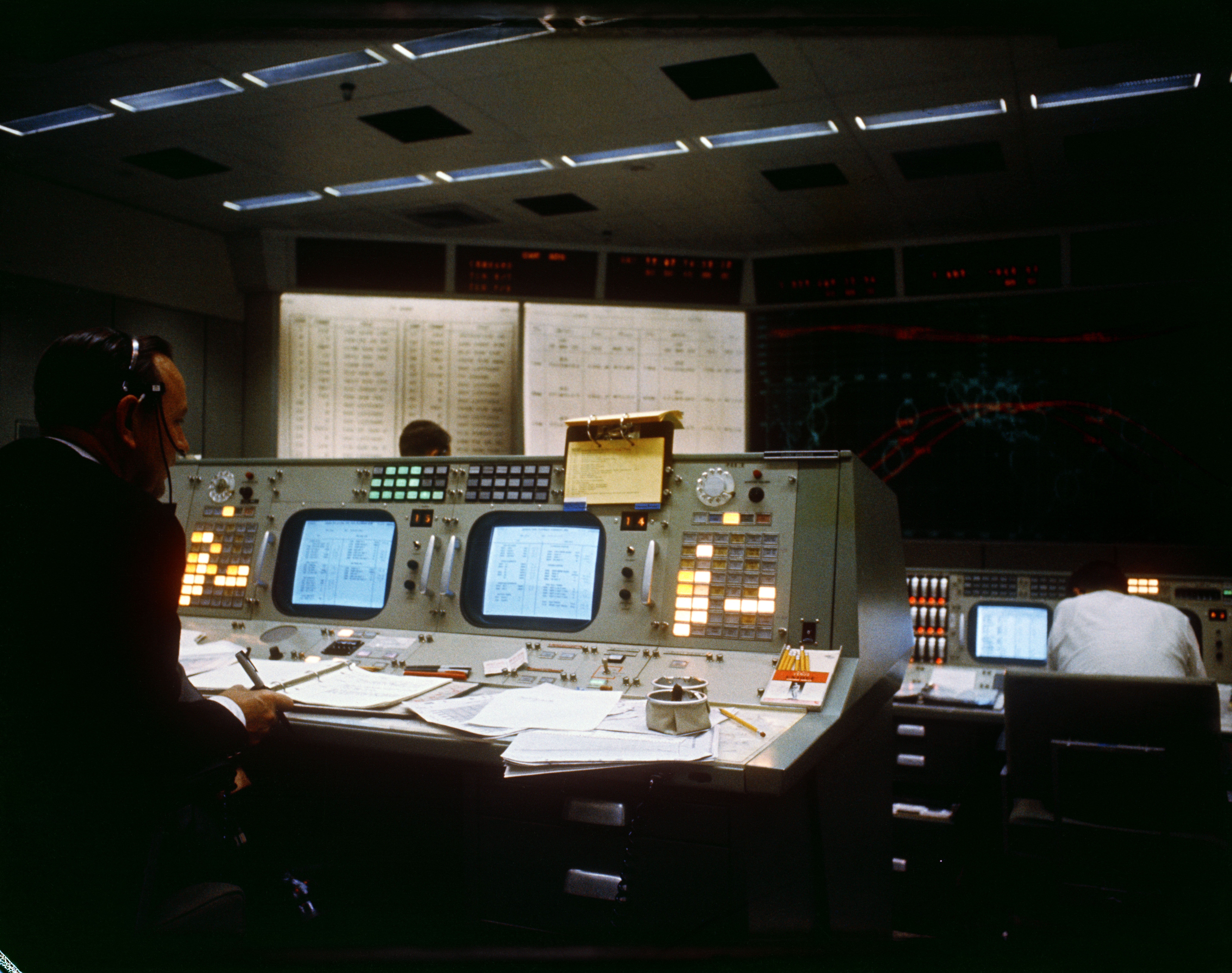
The Titan II performed nominally. Slight pogo vibrations were detected from T+110 seconds, but unlike Gemini V, where the crew suffered momentary vision and speech problems, Borman felt only a very light shaking and Lovell nothing at all. The booster rolled toward its programmed launch azimuth of 83.6 degrees and Gemini VII slid with only minor deviations into its planned 160-kilometre keyhole.
Shortly after the spacecraft cut loose from its booster, a little over six minutes from liftoff, Borman wheeled around to find the launch vehicle. Two seconds of thrust had been enough for the separation manoeuvre; five more seconds put him in position for stationkeeping. The afternoon Sun glared through the windows, but in less than 30 seconds he saw the booster. Fuel was spewing from a broken line, first forming globules and then crystallising into cascades of flakes, while the Titan II bounced and jumped about the sky, occasionally eclipsing the Sun in a brilliant contrast. For 15 minutes the crew took turns at formation flying and picture taking. Stationkeeping was easy, but chasing the tumbling second stage was costing more fuel than Borman liked, and at 15 metres he was too close to such unpredictable motion. He fired the thrusters and moved away. It was the second attempt at that manoeuvre: on Gemini IV it had failed because of the limited knowledge at the time of the orbital mechanics involved.
Life aboard
Half an hour into the flight the experiments began, with cardiovascular conditioning cuffs snapped on Lovell's legs. About seven in the evening they turned from sightseeing to housekeeping, and at half past nine they ate their first meal in space. Intermittently, air-to-ground communications dealt with an irksome fuel cell warning light that blinked on and off. As night fell below and traffic from the ground grew less frequent, the crew managed to catnap. Borman's suit was warmer than he had expected and he had to turn the control knob to the coldest setting.
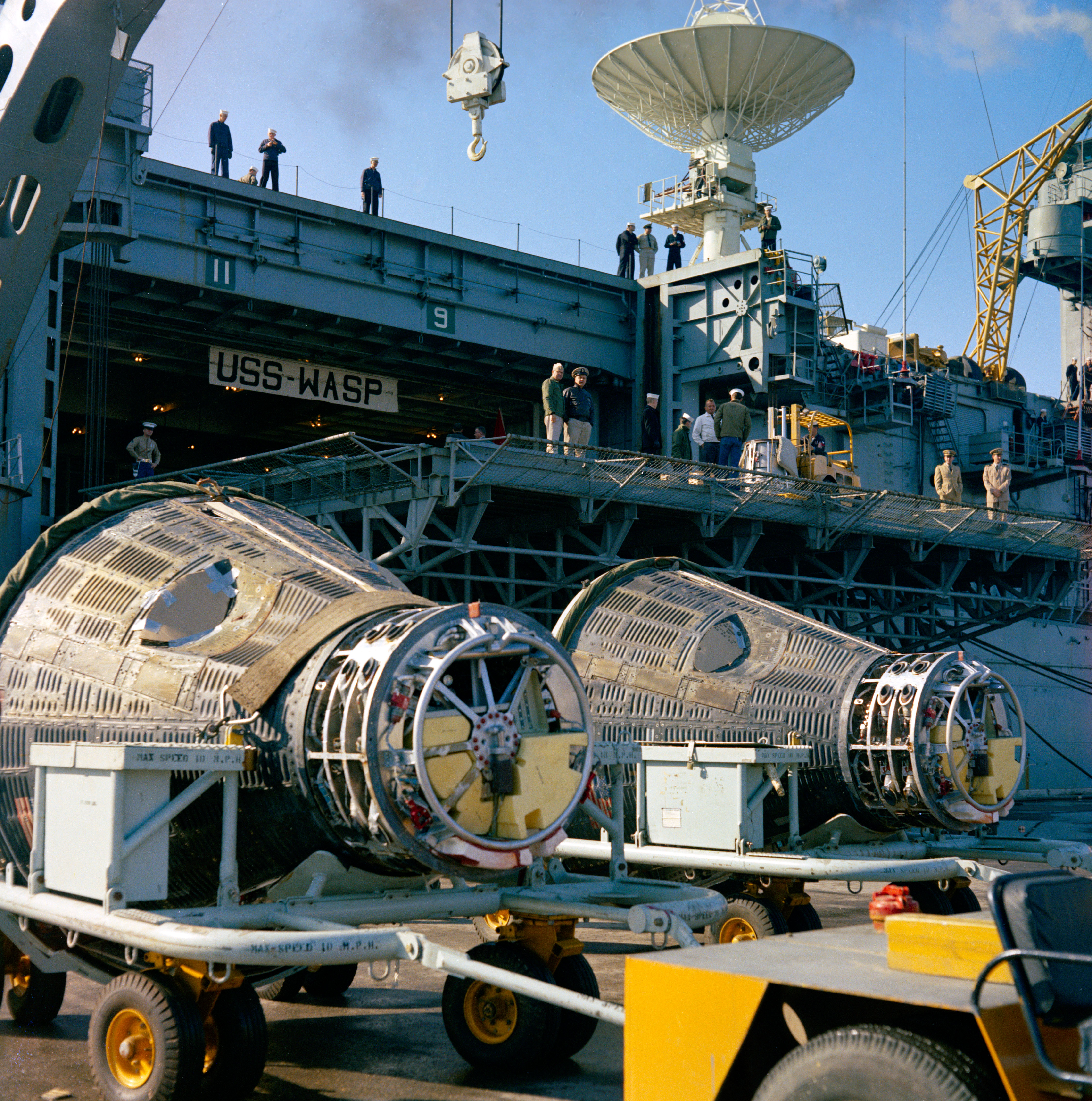
The next morning, at 9:06, See told the crew it was time to go to work. Systems reports were run through, their physical well-being was discussed and the day's experiment load was assigned. Along with Mission Control's analysis of the warning light came the news: the theme song of the men aboard the carrier Wasp, football scores and a collision between two airliners over New York. Borman remarked that it looked safer up there than down below, and Lovell reminded him that they were not down yet.
The lessons of Gemini V gave the two men better hygiene than their predecessors had enjoyed. They showered with an anti-dandruff shampoo for two weeks before the flight to curb the problem of skin flakes accumulating inside the spacecraft, and removing the pressure suits in flight also helped keep their skin from drying out. They carried sanitation wipes, which proved highly beneficial. Odours were not a problem except when they opened the storage bins where waste was stowed.
In their postflight debriefing, Borman and Lovell noted that the food rations had generally been of good quality, but they strongly disliked the freeze-dried protein bites and advised against including them on future missions. They asked for more breakfast items, for the avoidance of bite-sized food that could produce crumbs loose in the cabin and for better packaging of some items. Because of the length of the mission, Gemini VII carried a significantly larger supply of food than previous flights, and the astronauts often found it difficult to remove the tightly packed containers, some of which had not even been stowed in the order of the day they were meant to be eaten.
As part of the in-flight medical experiments, the crew had to collect and save some of their bodily wastes for post-flight analysis, a task they described as less than enjoyable. The urine collection device proved particularly difficult and unpleasant to use, above all because of its habit of leaking, which happened several times during the flight. Borman later suggested adding a tube and valve mechanism to release urine straight into space, an idea that would be realised on the Apollo command module. The crew also objected strongly to the requirement that they record every use of drinking water, arguing that the meter on the water hose was enough to gauge how much they had consumed.
The argument about the suits
The debate over suits on or suits off had started before launch and went on for nearly six days into the mission. Both astronauts had planned to remove their suits after a two-day check of the environmental system. That changed when George Mueller got wind of it: he objected strongly, and Robert Seamans agreed that one crewman should be suited at all times. Either pilot could take his suit off for up to 24 hours, but during launch, rendezvous and reentry both were to be suited.
Some 45 hours into the flight Lovell began removing his suit, a simple action that took more than an hour in such crowded quarters. Both men had stuffy noses and burning eyes by then, and Borman complained of being too warm; with Lovell's suit off, however, the general cabin environment improved. Borman agreed to stay suited despite his discomfort, because Lovell, the larger of the two, had more trouble getting the suit off and on in a cabin little roomier than the front seat of a car. Even sitting with his suit completely unzipped and his gloves off, Borman sweated while Lovell remained dry; Lovell tried some special lightweight coveralls but took them off after fifteen minutes because it was simply too hot.
One hundred hours into the flight, Borman asked the flight controller aboard the tracking ship Coastal Sentry Quebec to talk to Christopher Kraft about taking off his suit. Knowing of Mueller's opposition, he cautioned Eugene Cernan on the next pass over Houston to discuss the request with Donald Slayton first and not to present it as an emergency. Meanwhile the controllers were trying to arrange the opposite, getting Lovell to put his suit on and Borman to take his off so that the surgeons could compare the effects of both conditions. The crew wanted to wait until the rendezvous with Gemini VI-A was over, but Kraft insisted, and after 146 hours of flight Borman finally agreed; two hours later it was his turn to sit in suitless comfort while Lovell sweltered. Wikipedia places that relief at 148 hours into the flight, a figure consistent with the previous one.
The question worked its way up the chain of command. The daily mission evaluation reports had become tinged with concern about how alert the crew would be for the coming rendezvous. When Borman made his request through Cernan, Mission Director Schneider relayed it to Mueller in Washington, who asked Medical Director Charles Berry for a comparative analysis of the two astronauts and polled the members of the Gemini Design Certification Board. Kurt H. Debus, Wernher von Braun and Ben Funk all agreed that the reasons for being unsuited outweighed those for being suited, and Berry reported that blood pressure and pulse rates were closer to normal with the suits off. The pilots got their wish and the debate ended.
The parking orbit and the view from the window
Despite Borman's discomfort, spacecraft operations proceeded efficiently. The crew conducted experiments, evaluated systems, worked, slept, ate, exercised and rested; good spirits were bolstered by family reports, the daily See and Haney newscasts and the preparations for the visitors from VI-A. Borman voiced some concern about the fuel needed to get into position, but four orbital adjustment manoeuvres worked well. After five days the spacecraft was in a nearly circular orbit of 300 kilometres, with a theoretical orbital lifetime of more than 100 days: more than stable enough for a passive target. At the epoch of 9 December 1965 its parameters were a perigee of 299 kilometres and an apogee of 302, with an inclination of 28.9 degrees and a period of 90.54 minutes.
On their 31st orbit, Borman and Lovell observed the underwater launch and exhaust trail of a Polaris missile fired by the submarine USS Benjamin Franklin off Florida. There was also an episode that was never resolved: Borman suddenly radioed Houston that they had a bogey at ten o'clock high. Mission Control asked whether it was the booster or an actual sighting, and Borman clarified that there was debris up there and that this was an actual sighting. The crew described millions and trillions of visible particles moving three or four miles from the cabin, and Lovell spoke of a bright, tumbling object. The source was never determined.
15 December 1965: the first space rendezvous
On 15 December the mood among planners, pilots and ground crews was one of high anticipation. If on this third attempt Gemini VI-A went into orbit, a world first might be chalked up. Soviet endurance records had been shattered in two successive American missions, but achieving rendezvous carried direct navigational significance for Apollo as well. Having a friendly target, one that could point its transponder and talk back as VI-A called out its course and speed, created an atmosphere of confidence.
At 8:37 in the morning Gemini VI-A rose from its pad, after a three-day delay caused by a malfunction and an engine shutdown immediately after ignition. Schirra urged it upward by will power alone. At engine cutoff Stafford checked the computer and read 7 830 metres per second: they were on their way. Borman and Lovell, passing near Cape Kennedy, saw nothing but clouds, though they soon learned from the Canary Islands communicator that VI-A's orbital parameters were 161 by 259 kilometres. A few minutes later, flying over Tananarive, they saw the contrail of the launch and caught a brief glimpse of the visitors' spacecraft. They put on their suits and waited for company.
The rendezvous profile, dubbed M equals 4 by the mission planners, scheduled the catchup during the fourth revolution of VI-A: six hours of manoeuvring. At insertion the chase vehicle trailed its target by 1 992 kilometres. Over New Orleans, after 94 minutes in space, Schirra ignited the thrusters to speed up by 4 metres per second; perigee stayed the same, apogee rose to 272 kilometres and, being nearer to Earth and so moving faster, VI-A now lagged only 1 175 kilometres behind. Near Carnarvon, at 2 hours 18 minutes ground elapsed time, he began a phase adjustment that added 19 metres per second and raised his perigee to 224 kilometres; less than half an hour later, over the Pacific, he turned 90 degrees to the right and fired to push VI-A into the same plane as Gemini VII, narrowing the distance to 483 kilometres.
Three hours 15 minutes into the mission, See told Schirra that radar contact should soon be possible. The signal flickered and then locked solid at 434 kilometres. Over Carnarvon, at 3 hours 47 minutes, the aft thrusters fired for 54 seconds to add 13 metres per second, leaving an almost circular orbit of 270 by 274 kilometres; in slant range the two spacecraft were then 319 kilometres apart. At 3 hours 51 minutes Schirra placed VI-A in the computer rendezvous mode, and at 5 hours 4 minutes he exclaimed that there was a real bright star out there that must be Sirius. It was not Sirius: it was Gemini VII, reflecting the Sun's rays from 100 kilometres away.
From there VI-A began thrusting directly toward its target, closing at better than three kilometres every minute and a half. Schirra made two midcourse corrections twelve minutes apart, at 5 hours 32 minutes and 5 hours 44 minutes, and six minutes later, at a range of 900 metres, began braking with the forward thrusters. In the terminal stage the VI-A astronauts saw the stars Castor and Pollux, the twins of the Gemini constellation, aligned with their sister ship. Then Spacecraft 7 flashed into the sunlight, almost too bright to look at: from 200 metres it resembled a carbon arc light. Following the braking and translation manoeuvre, VI-A coasted until the two vehicles were 40 metres apart with no relative motion between them. At 2:33 in the afternoon of 15 December 1965, the world's first crewed space rendezvous was a fact. In Mission Control the flight controllers waved small flags and lit cigars.
The official program history takes care to dispel an earlier misunderstanding: when two Vostok spacecraft passed within a few kilometres of one another in August 1962, some believed a rendezvous had been accomplished. It had not. The two spacecraft were in different orbital planes, nor could they manoeuvre to stop the relative motion between them; in the comparison of the source itself, it was good shooting from the pad, not a rendezvous. Schirra put it plainly: rendezvous is not over until you are completely stopped, with no relative motion between the two vehicles, at a range of about 40 metres. From there on it is stationkeeping.
Borman and Lovell had been fascinated by the fireworks of VI-A's thrusters during braking and startled by a twelve-metre tongue of flame. There was a second surprise: Borman told Schirra that he had a lot of stuff around his back end, and minutes later Schirra returned the compliment. Cords and stringers three to five metres long streamed and flapped behind both spacecraft. The rendezvous manoeuvres had cost VI-A only 51 kilograms of fuel, leaving Schirra 62 per cent in his tanks. Borman and Lovell were not so wealthy: Flight Control told them to stop manoeuvring when the VII tanks dropped to an 11 per cent supply.
For more than three revolutions of the Earth the two spacecraft stayed at ranges of from 0.30 metres to 90 metres. VI-A approached once to examine the loose stringers; on another occasion they flew nose to nose. Schirra and Stafford swapped the controls back and forth because the Sun streamed so brightly through first one window and then the other. When it was time for Borman and Lovell to perform an experiment, the visitors moved out twelve metres and parked; on one occasion, for some twenty minutes, neither crew bothered to touch the steering handle, so stable was the relative position. On the first night pass the two ships faced each other at distances of between 6 and 18 metres, and the visibility Schirra had worried about turned out to be excellent: docking light, handheld penlight and even VII's cabin lights were clearly visible. Using what he called his eyeball ranging system, Schirra flew an in-plane flyaround of VII out to 90 metres, decided that was too far to be called stationkeeping and hurriedly brought VI-A back within 30 metres. Velocity inputs as low as 0.03 metres per second provided very precise manoeuvring, and from that fine control he and Stafford concluded that docking with a target vehicle would be no problem.
As bedtime approached, VI-A flipped blunt-end forward and fired to impart a small separation speed; the crews eventually settled down 16 kilometres apart. Borman, who frequently caught sight of VI-A in the distance, remarked to the tracking ship Rose Knot Victor that they had company that night. The following day, after Stafford excitedly reported an object that looked like a satellite in polar orbit, the strains of Jingle Bells came over the circuit, played on a harmonica and small bells the VI-A crew had smuggled aboard. Gemini VII was about to begin its twelfth day and the visitors were going home. Schirra signed off saying they would see them on the beach, flipped VI-A blunt-end forward, jettisoned the equipment section and let retrofire follow automatically. VI-A landed about 13 kilometres from its planned impact point, the first successfully controlled reentry, and did it in full view of live television beamed from the Wasp, after 16 revolutions and 25 hours, 15 minutes, 58 seconds.
The home stretch
With the guests gone, Borman and Lovell realised their incentive had gone with them. Almost three days were left and the mission began to drag: fourteen days inside that spacecraft were, in their words, a long haul in a short frame. In drifting flight Borman read some of Mark Twain's Roughing It and Lovell part of Drums along the Mohawk by Walter D. Edmonds, chosen partly because they had nothing to do with the space program. Lovell also left a reflection on legs, the part of the body most affected by weightlessness: in that spacecraft, he said, they used their legs for nothing at all.
A few minutes after Jingle Bells the two men took off their suits. Then they had to see about a thruster problem: when Borman tried to fire thrust chambers 3 and 4, only whitish, unburnt fuel streamed out. The pitch thrusters stopped the spacecraft from yawing and numbers 11 and 12 also helped, although they were a little too strong for fine control. One of the non-working thrusters was tested after the flight and found to have the old-style 90-degree laminate layup in the thrust chamber instead of the new 6-degree design that had solved the burnout problem.
The thrusters were merely annoying; the fuel cell was a greater concern. Despite the warning light during the first revolution, the cell had provided enough electrical power for the spacecraft to operate normally for 126 hours. The ground analysis team, with an operating model set up in St. Louis, helped keep it going, but power output was only partial by the end of the twelfth day. The next day the warning light burned continuously and the cell threatened to quit altogether: Gemini VII might have to end early with a landing in the Pacific, precisely what the crew disliked, since it meant missing the fourteen-day goal. Test results in St. Louis showed that the electrical system would carry them all the way. Relieved, Borman slept better than on any other night in space.
Reentry, splashdown and recovery
The last day was spent packing. Before retrofire the ground stations kept the crew busy for two hours on the reentry checklist, and flight surgeon Berry reminded them to elevate their feet and pump their legs. Borman broke in to say that he and Lovell wanted to get out of the spacecraft as soon as possible: they had no desire to wait around to be stylishly hoisted aboard a carrier.
Retrofire came in darkness near Canton Island in the Pacific. Lovell later described the peculiar apprehension of that moment: if something happens in an aeroplane, something happens, you come down; but if the retrorockets fail to fire, nothing happens at all, you just sit up there, and that is a unique kind of apprehension. The first retrorocket fired automatically and on time, the next two followed in quick succession and, after a pause, the fourth. Lovell greeted the jolts with relief, calling it one big hurdle over with.
From Houston, See told them to fly a 35-degree left bank until computer guidance cut in. A surprised Lovell reminded Borman that 53 degrees had been planned; Borman questioned See, who confirmed the 35 degrees. By that time the computer was already commanding the spacecraft and Borman was following the needles, banking left and right. Postflight evaluators noted that the flight controllers had been wrong and had given Borman an erroneous bank angle. Borman rolled the spacecraft head down to use the horizon as a guide, but he could see nothing from his window and had to depend entirely on his instruments and on Lovell, who finally saw the horizon after about six and a half minutes and began calling out adjustments. Borman concluded that reentering was definitely a two-man job, because there was no way to follow the needles and watch the horizon at the same time.
After so long without weight, the onset of the g forces felt like a ton, although in that long, shallow glide they never rose higher than 3.9 g, against an average of 7.7 g for the Mercury-Atlas orbital flights. The reentry control system held Gemini VII steady until the drogue parachute came out, and the rocking that followed gave the crew a shaking. When Lovell opened the snorkel, smoke and an acrid smell filled his hood and made his eyes water. They hit the water with a heavy thud. On 18 December 1965, after 330 hours, 35 minutes, 1 second, Gemini VII came to rest on what Lovell called the good old aqua firma, missing the target by 11.8 kilometres; Wikipedia gives the same distance as 6.4 nautical miles.
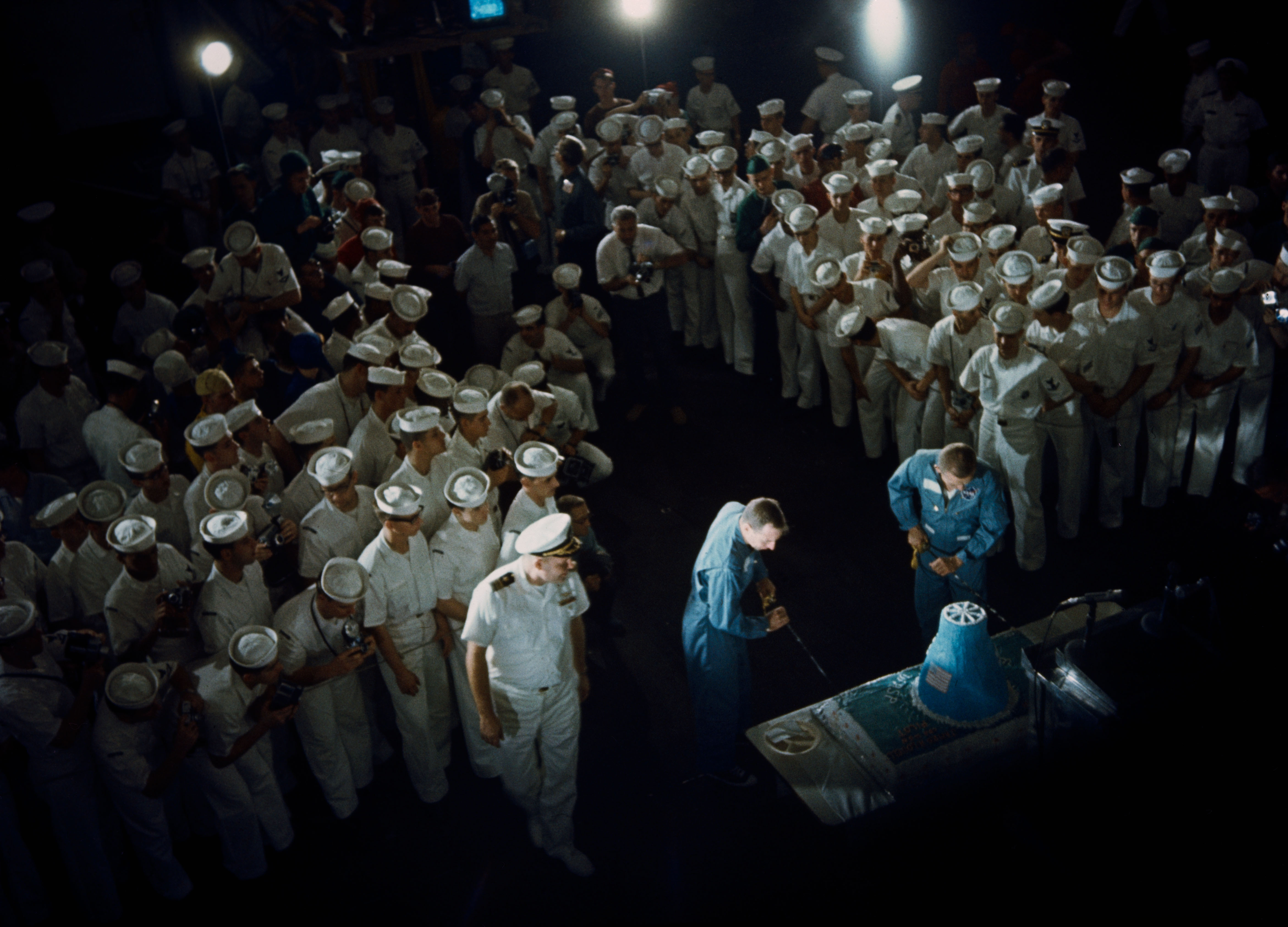
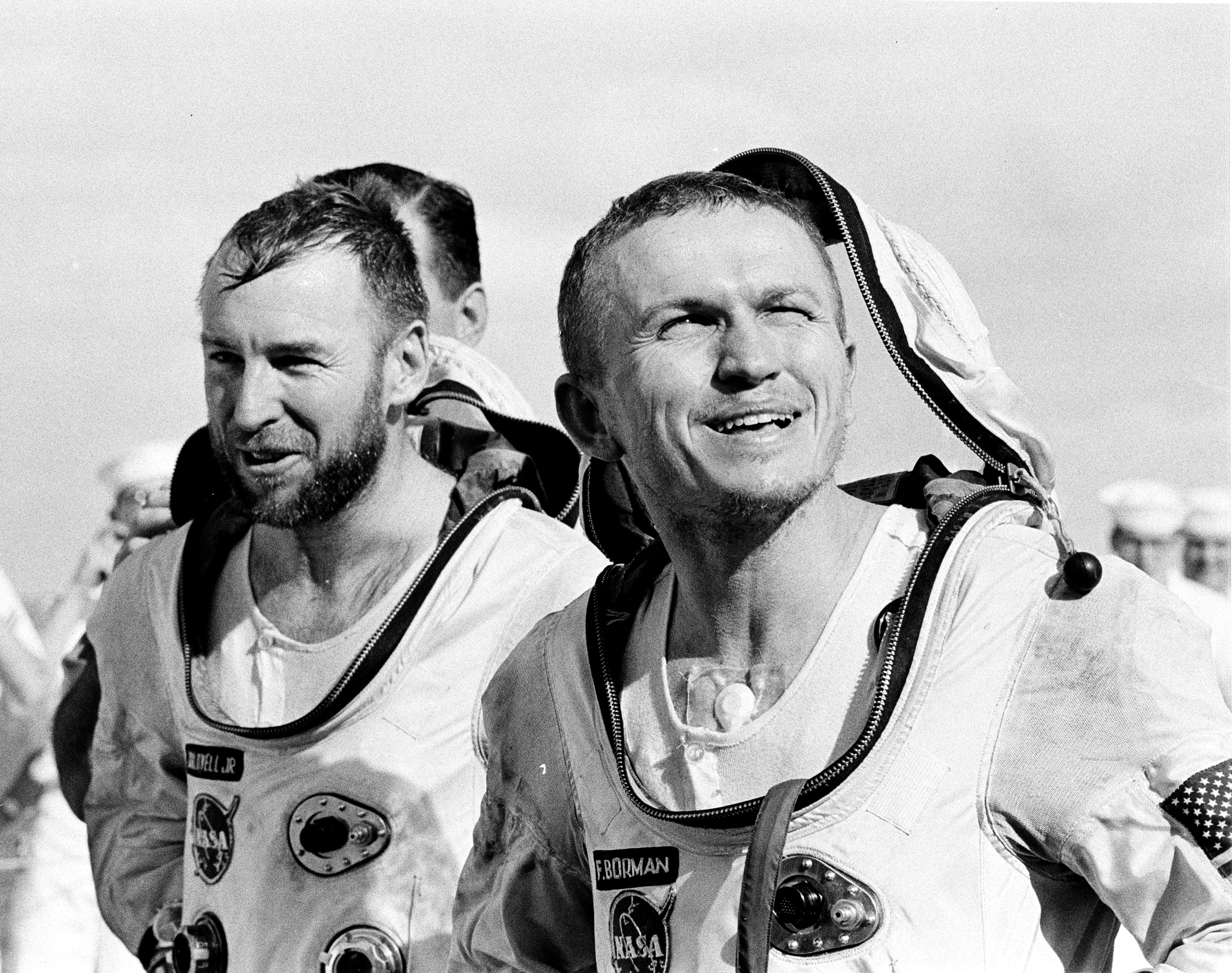
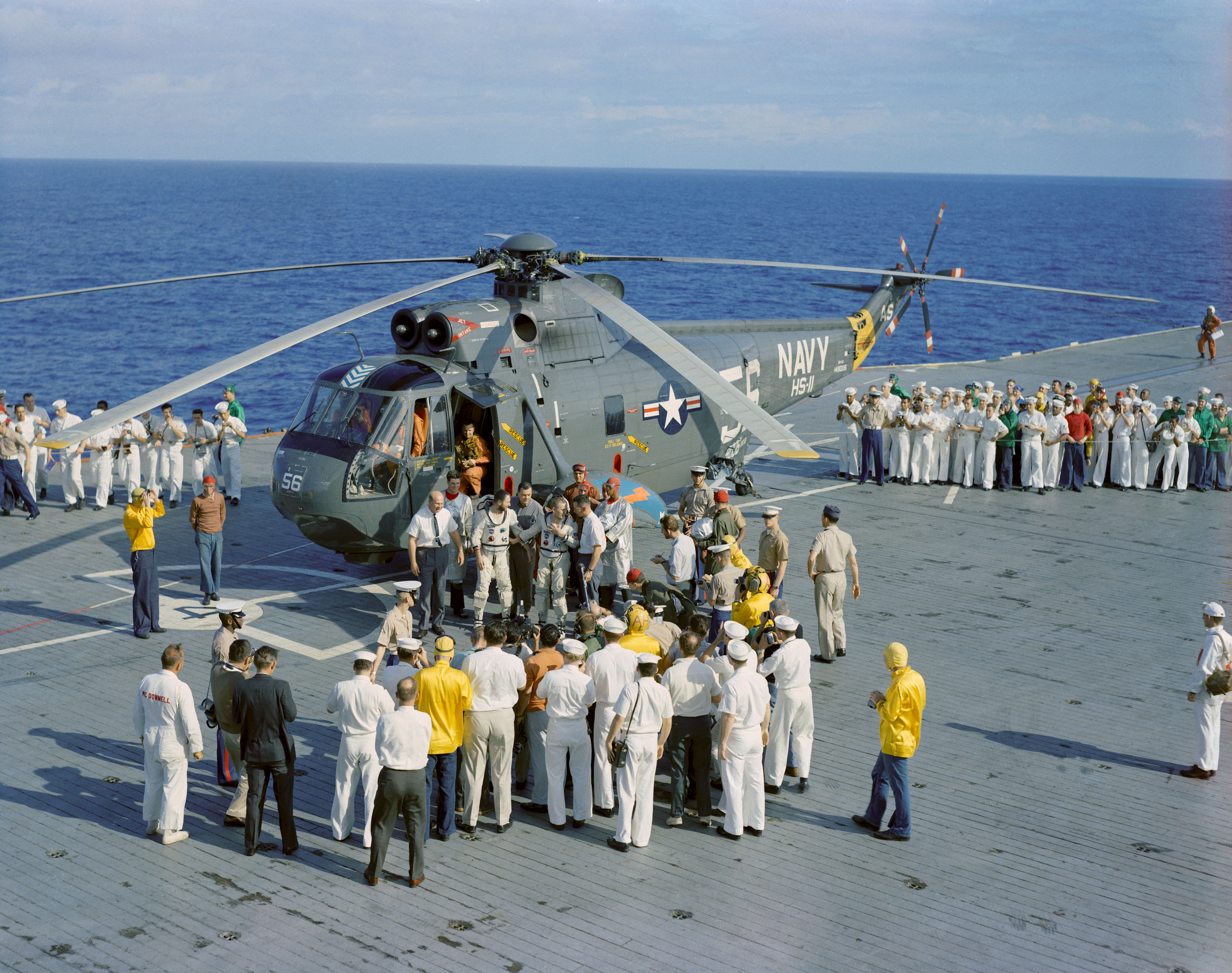
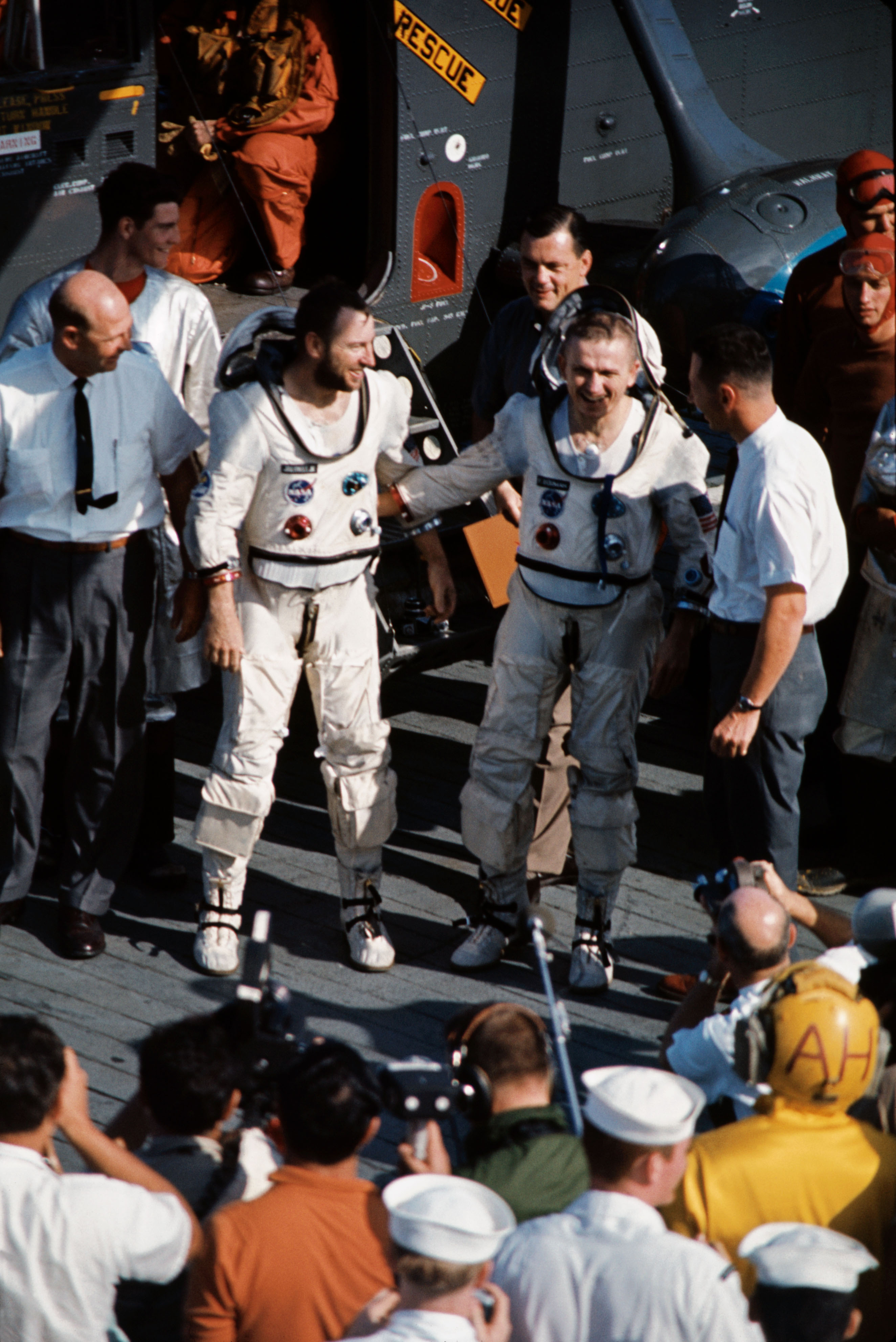
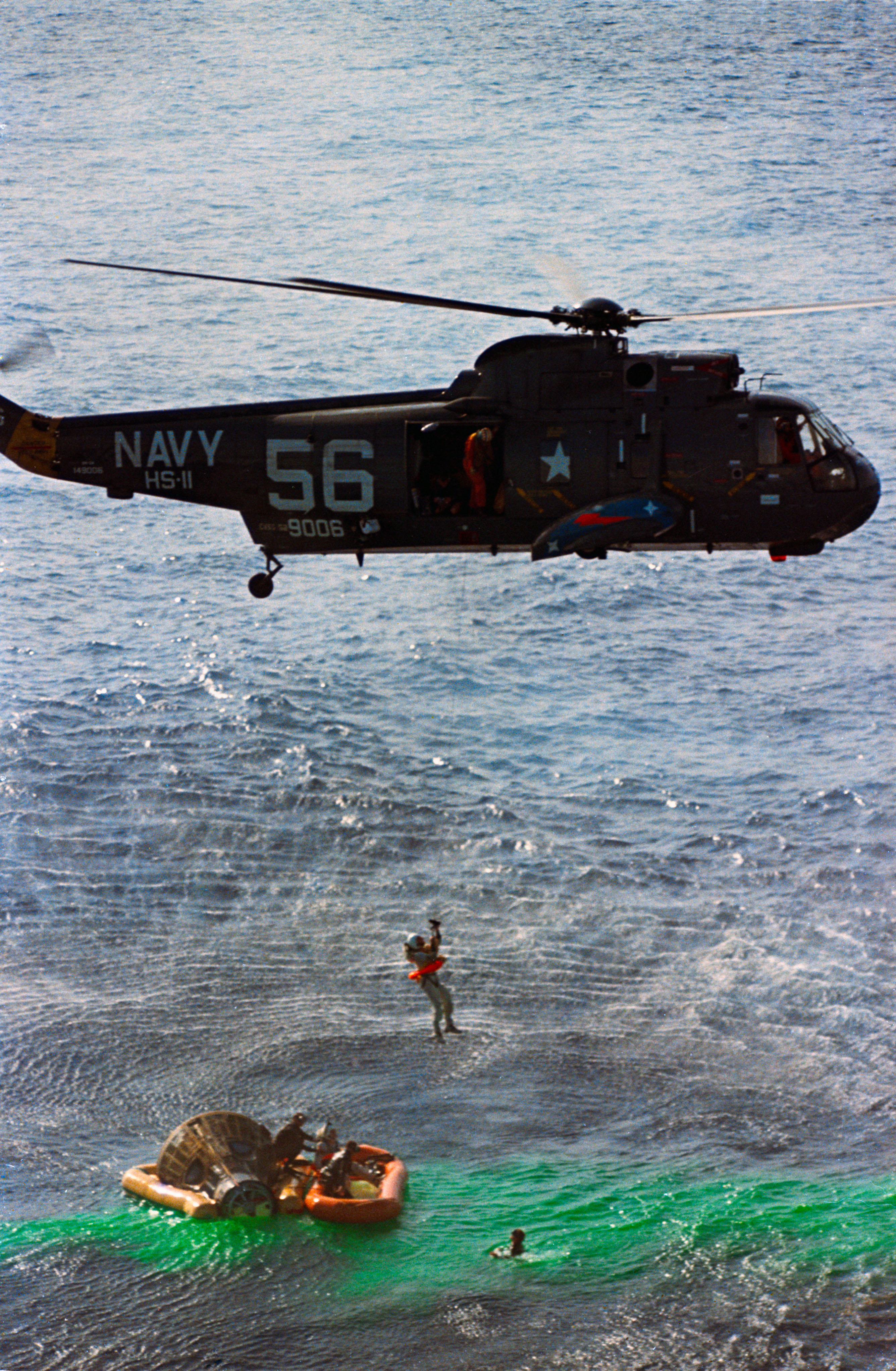
Borman felt a little dizzy, Lovell not at all. He suggested getting out of their suits, since it was warm in the spacecraft, but the effort was just too great and they turned on the oxygen repressurisation valve instead. The pararescuemen were already working on the flotation collar and the recovery helicopters were hovering nearby. Half an hour after landing, Borman and Lovell were greeted aboard the USS Wasp, the second spacecraft crew the carrier had snared in a few days. They came onto the deck tired but happy, walking slightly stooped and a little gimpy-legged, partly because of their pressure suits and the ship's roll but mostly because they were plain weary. During recovery they joked to Mission Control about getting married, after so long together in space. The Department of Defense support for the VII and VI-A missions had involved 10 125 personnel, 125 aircraft and 16 ships.
What the doctors said
The medical result was what was at stake, and it was good. Berry was jubilant that the most miraculous thing was also the simplest: that they could get out of the spacecraft without flopping on their faces, climb into the helicopter and walk across the carrier deck. They were in better physiologic shape than the Gemini V crew: their tilt-table responses were not as bad and did not last as long, looking far more like four-day than eight-day responses, and the calcium loss was the same way. They maintained their total blood volume, though in a peculiar manner, still losing red-cell mass but replacing it with plasma, evidence that there had been enough time for an adaptive phenomenon to take place. In the detailed examination the physicians found that Lovell, who had worn the cardiovascular cuffs, had less blood pooling in his legs than Borman. After a good night's sleep aboard ship, both men looked rested and said they were.
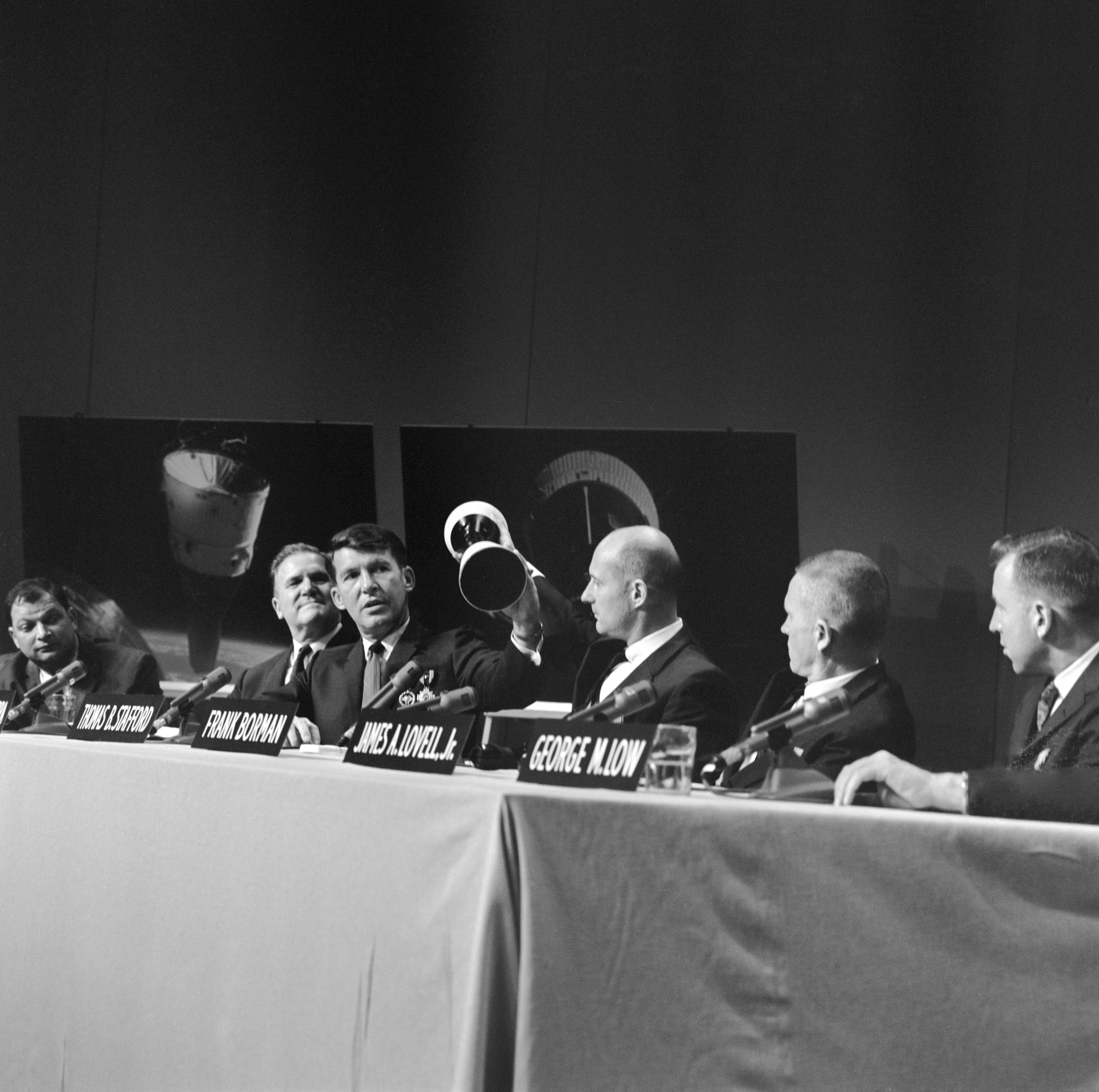
The practical conclusion was the one NASA needed: provided the crew came through in good physical condition, it could be assumed that an Apollo team could fly safely to the Moon and back. Robert Gilruth summed it up at the postrecovery press conference of 18 December. It had been a fabulous year for crewed spaceflight, he said, with ten men put into orbit and brought back since March, with the long duration demonstrated despite the doubts of many, with extravehicular activity, with rendezvous, with controlled reentry and with a whole raft of scientific experiments accomplished.
Records, insignia and legacy
The National Aeronautic Association, representing the Fédération Aéronautique Internationale, certified four crewed spaceflight achievements for Gemini VII and VI-A together: longest distance in orbit, longest duration in orbit, distance in group flight and duration in group flight. The endurance record stood until Soyuz 9 in June 1970, and Gemini VII remained the longest American crewed flight until the Skylab 2 mission of May and June 1973.
The mission patch, designed by the Houston artist and animator Bill Bradley, features an Olympic torch symbolising the marathon-like length of the flight, together with a small stylised image of a Gemini spacecraft and the Roman numeral VII. The crew did not put their names on the patch, although souvenir versions did include the flight and crew names. The backup crew produced their own spoof: an unlit torch, a lighter and the question of whether Frank and Jim needed a light.
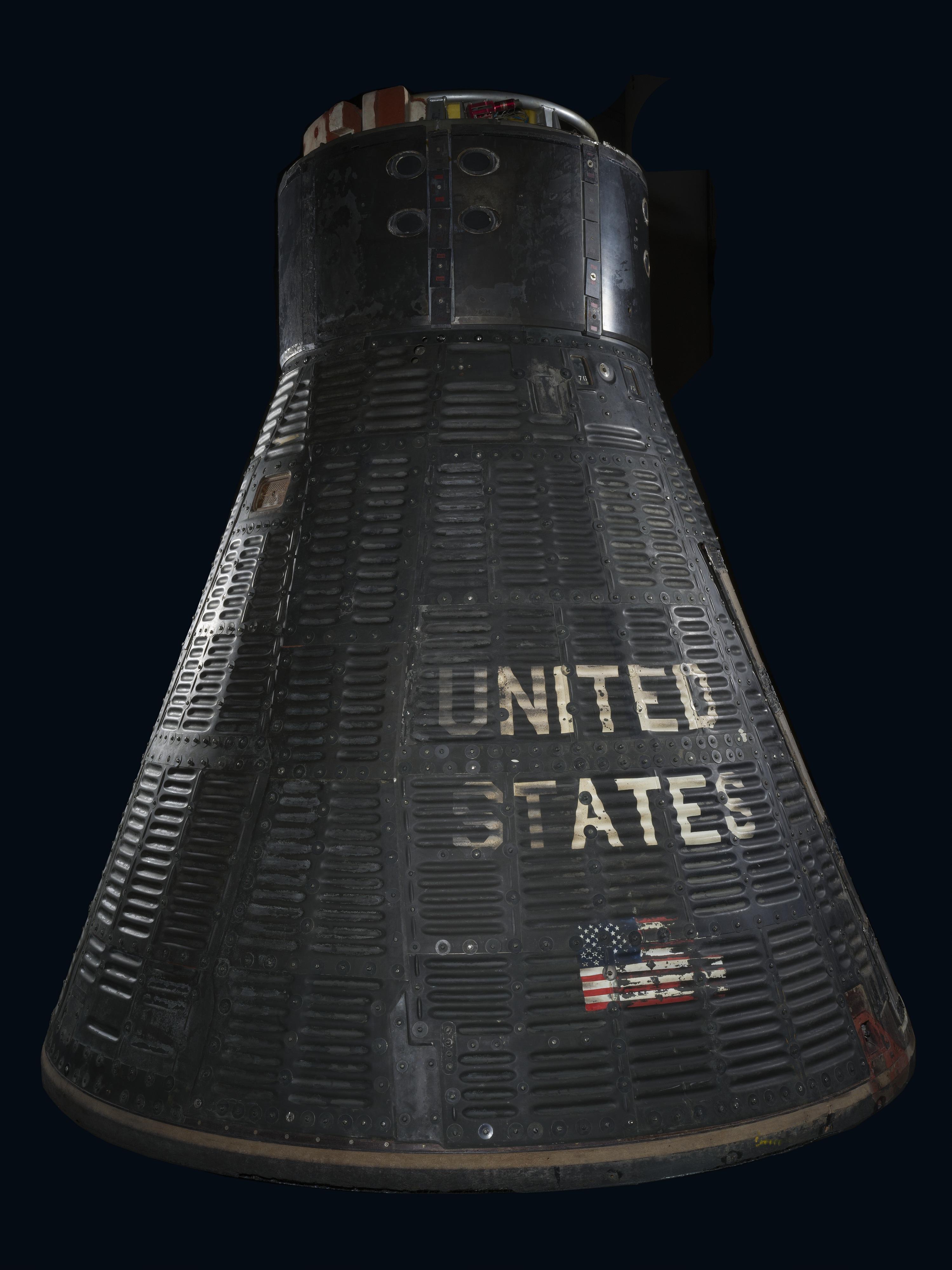
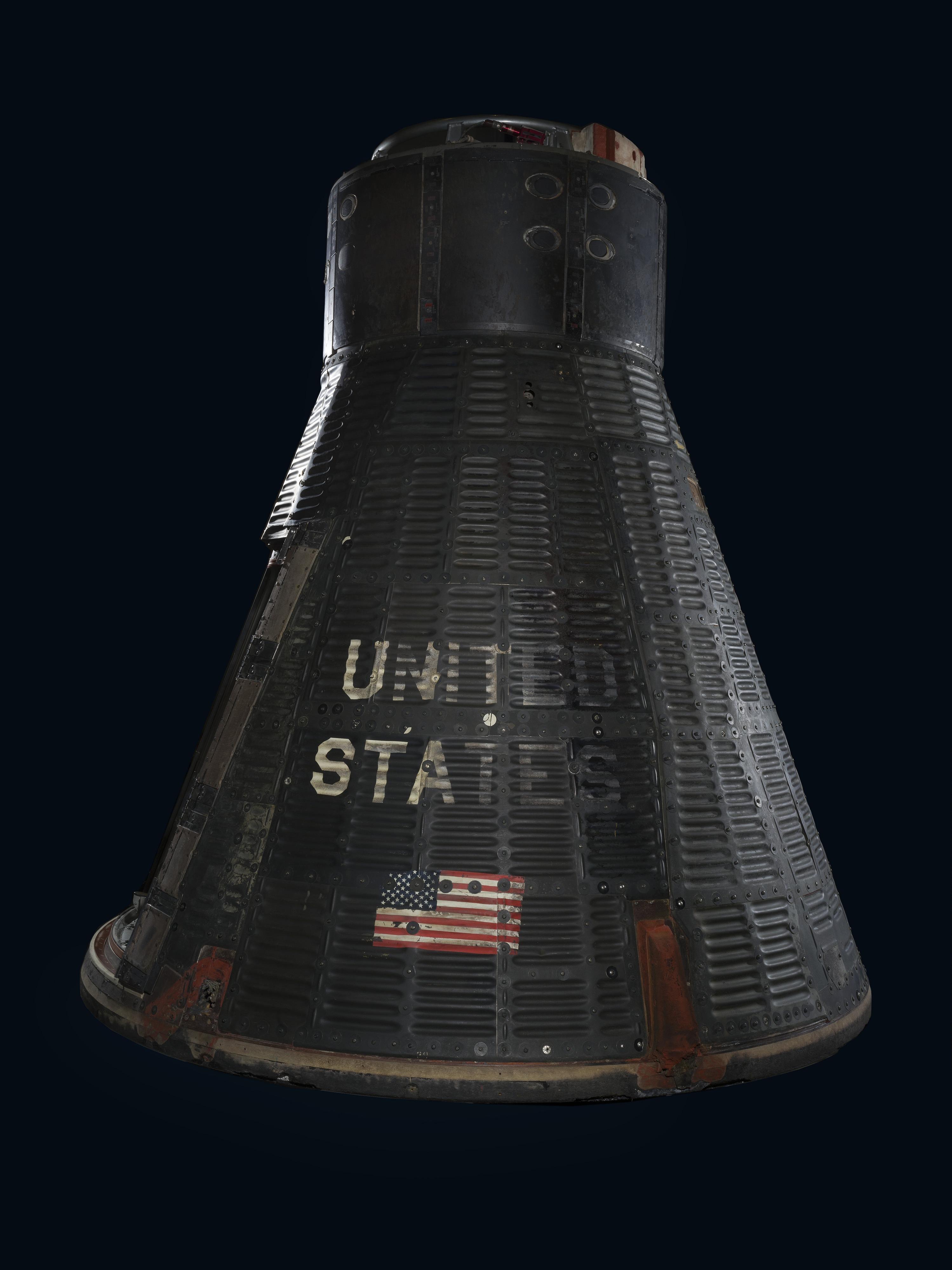
The cumulative effect of that run of successes had an unlooked-for consequence: crewed spaceflight became almost commonplace and the novelty wore off, to the point where who did what and when tended to blur. NASA had achieved, perhaps more than it intended, the goal implied in the Project Development Plan of December 1961: to put spaceflight on something like a routine basis. Then came the ceremonies. President Johnson asked Borman and Schirra to make an eight-nation good-will tour of the Far East, while engineers at the Manned Spacecraft Center prepared a Gemini Midprogram Conference to discuss the results of the first seven missions of the program. The spacecraft flown by Borman and Lovell is on display at the National Air and Space Museum in Washington.
Images