Project Gemini · NASA · Crewed
Gemini VI-A
- Dec 15, 1965, 1:37 PM
- Launch date
- 2
- Crew size
- 1 day 1 hr
- Duration
- Success
- Outcome


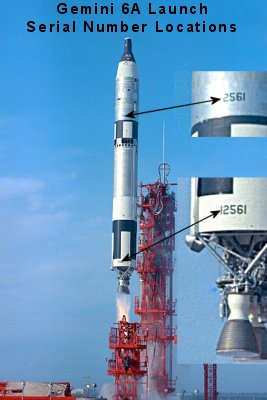


Gemini VI-A is the mission that achieved the first space rendezvous in history on 15 December 1965: two crewed spacecraft manoeuvring deliberately until they came to a stop facing each other, with no relative motion between them, roughly 40 metres apart. Walter M. Schirra Jr. flew as command pilot and Thomas P. Stafford as pilot, lifting off from Pad 19 at Cape Kennedy on a Titan II GLV. It was not the mission that had been planned. Gemini VI was meant to rendezvous and dock with a separately launched Agena target vehicle, GATV-5002; on 25 October 1965 that Agena failed to reach orbit and the mission lost its target while the crew was already waiting on the pad. The way out was radical: turn Gemini VII itself, which was about to spend fourteen days in orbit with Frank Borman and James A. Lovell Jr., into the rendezvous target. Gemini VI-A was born from that decision, a reflown mission that required the same launch pad to be readied twice within days. On 12 December 1965 the countdown reached zero and the Titan shut down almost as soon as it had lit: an electrical tail plug dropped from the base of the launch vehicle 1.2 seconds in and started the onboard clock as though the vehicle had lifted off. Schirra, who had felt no motion at all, chose not to pull the ejection D-ring even though the clock was running. That judgement, made in seconds on top of a fuelled rocket, saved the mission: the launch vehicle was undamaged and could try again three days later. On 15 December Gemini VI-A reached orbit and, in less than six hours of flight, ran the full closing sequence until it came to rest alongside Gemini VII. The two spacecraft then flew in formation for more than three revolutions at ranges that dropped below a metre, without ever docking: there was no mechanism for it and docking was never the objective. Before departing, Stafford announced in an alarmed voice an unidentified object in polar orbit, and the crew finished the joke by playing "Jingle Bells" on a harmonica and hand bells. The mission ended on 16 December 1965 with the first successfully controlled reentry of an American crewed flight: Gemini VI-A splashed down about 13 kilometres from its planned impact point and was recovered by the aircraft carrier USS Wasp, with Schirra choosing to stay inside the capsule as it was hoisted aboard and the whole scene carried live on television from the ship.
Objectives
The priorities of Gemini VI-A were to demonstrate on-time launch procedures, closed-loop rendezvous capability and stationkeeping techniques with Gemini VII. Other objectives were to evaluate the spacecraft's reentry guidance capabilities and to conduct spacecraft systems tests and four experiments.
Payload
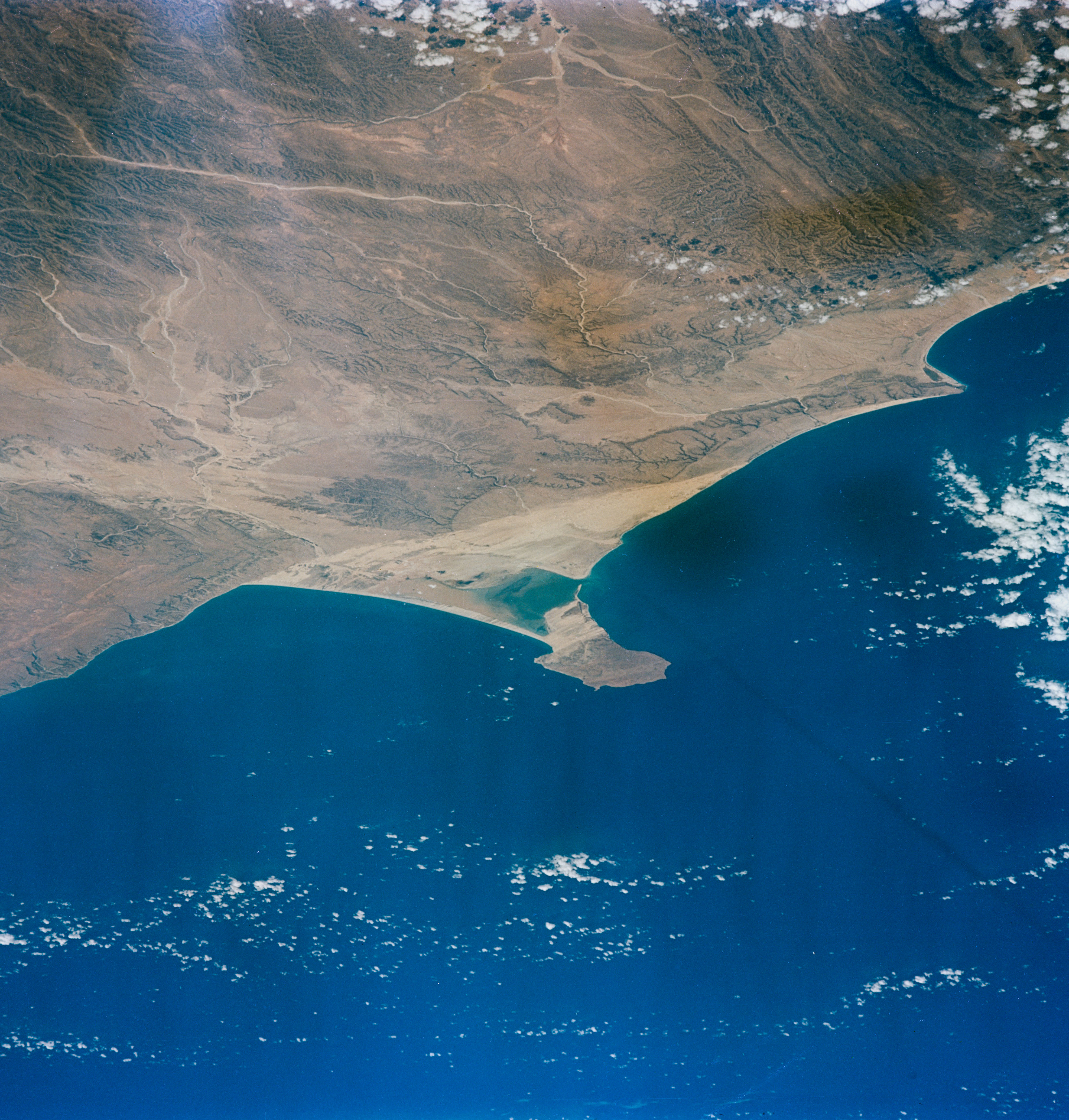
Spacecraft Gemini 6, with a launch mass of 3,546 kg, flown by Walter M. Schirra Jr. as command pilot and Thomas P. Stafford as pilot, equipped for the closed-loop rendezvous with Gemini VII. It carried four experiments: synoptic terrain photography, synoptic weather photography and dim light photography — the three scientific ones — plus a measurement of radiation inside the spacecraft that was only partly completed.
History
From Gemini VI to Gemini VI-A: the target that never reached orbit
The original plan for Gemini VI was the one the programme had been chasing since its conception: to rendezvous and dock in orbit with an Agena target vehicle, GATV-5002, launched separately on an Atlas from a different pad shortly before the crewed spacecraft. Docking was one of Gemini's reasons to exist, because without it there was no way to validate the technique underpinning the mission mode chosen to reach the Moon.
On 25 October 1965 that sequence broke at its first link. The Agena lifted off and was lost: it never reached orbit, and with it went the target of a mission whose crew, Walter M. Schirra Jr. and Thomas P. Stafford, was already aboard its own spacecraft awaiting launch. The countdown stopped that same day. Gemini VI had not failed; it had simply been left with nothing to rendezvous with, and a replacement target vehicle was weeks away.
The idea that turned a lost mission into a new experiment
The way out that emerged over the following days changed the nature of the mission itself: if no Agena was available, the target could be another Gemini spacecraft. Gemini VII, with Frank Borman and James A. Lovell Jr. aboard, was about to spend fourteen days in orbit on a biomedical endurance flight; a crewed spacecraft staying up that long was as good a target as any Agena for demonstrating rendezvous, even though it offered nothing to dock with.
The decision reordered the programme: Gemini VII would fly first and Gemini VI would become Gemini VI-A, launched afterwards to go and find it. The problem was not conceptual but one of infrastructure. Gemini had a single launch pad, Pad 19 at Cape Kennedy, and two crewed missions had to fly from it barely a week apart. While Gemini VII sat on the pad awaiting launch, welders and repair crews stood by ready to move in the moment it left. The damage from the 4 December 1965 launch turned out to be minimal: normal painting and cleaning were skipped and the effort went into replacing critical instrumentation. The launch team erected GLV-6 and mated the spacecraft to it in a single day, complete with the standard procedures, tests and reviews. As Borman and Lovell passed over Cape Kennedy, Gemini VII's radar transponder was also interrogated to make sure it would answer the transmissions of the spacecraft that was going to chase it.
The pace was such that 56 hours into the Borman-Lovell mission the possibility appeared of launching on the eighth day rather than the ninth as planned. A computer problem briefly cooled those hopes, but with a new part installed the final simulated flight test ran start to finish without trouble, and on 9 December programme management was convinced the launch could be made a day early.
Twelve December: the pad abort
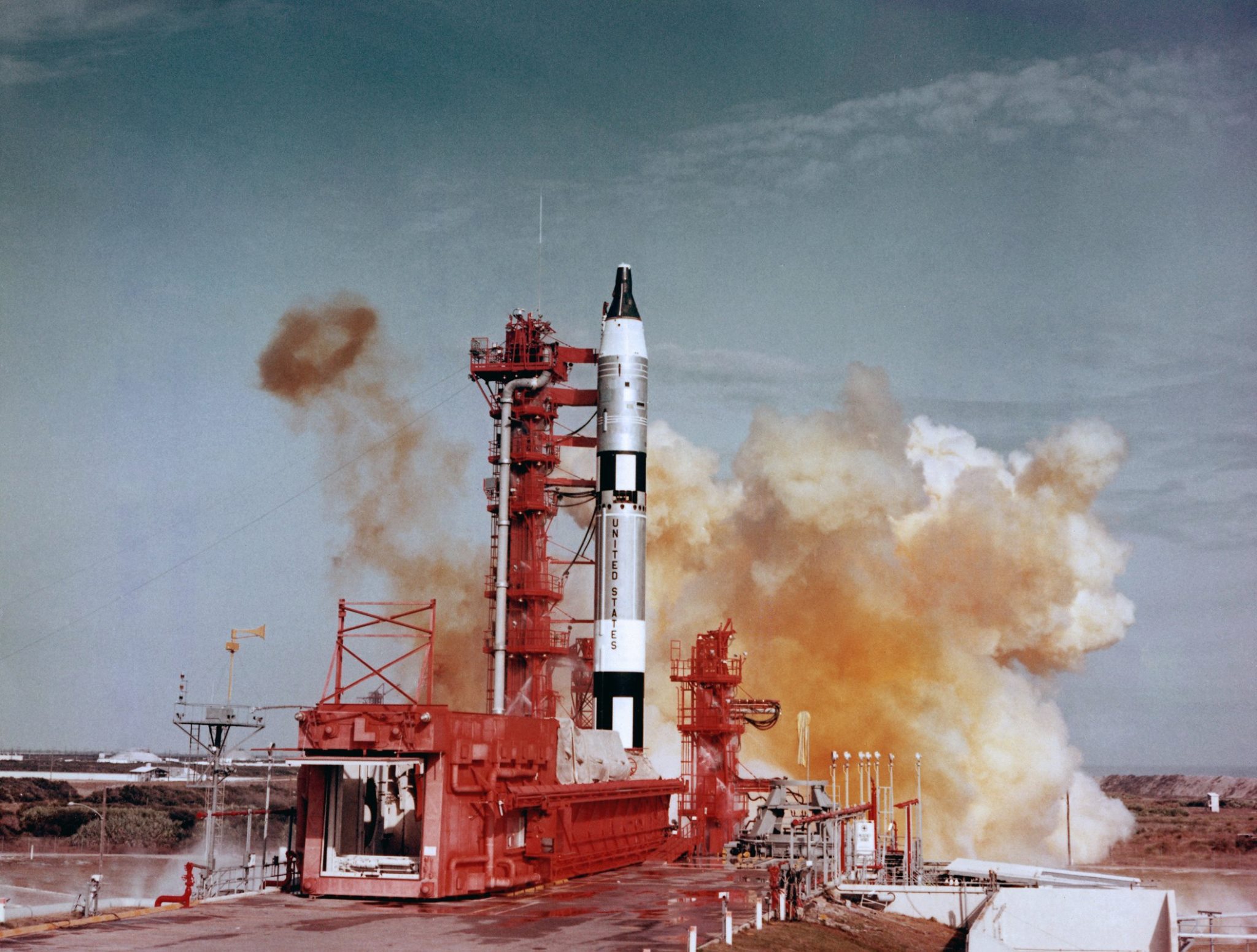
On Sunday 12 December 1965 Schirra and Stafford went through the hatches of Spacecraft 6 and into their couches for a second time. The countdown ran trouble-free and at 9:54 a.m., precisely on time, the launch vehicle roared into life. The roar was strangled almost at once.
At 1.2 seconds an electrical tail plug dropped from the base of the booster and activated the airborne programmer, a cockpit clock that was not supposed to start until the vehicle had lifted off. Because there had been no upward movement, the valves closed to stop propellant from gushing into the engines. The malfunction detection system had sensed something wrong and had shut the engines down.
What followed was one of the most suspense-filled moments of the entire programme. If there was ever a time to use the ejection seats to get clear of a cocked and dangerous rocket, this looked like it. Kenneth Hecht, chief of the Gemini escape, landing and recovery office and a long-time ejection seat specialist, was surprised that the crew did not eject, because that is what the ground rules called for if applied to the letter: if the clock was right, the vehicle had left the ground. And had it climbed even a few centimetres, the engine shutdown would have brought 136 tonnes (150 tons) of propellants in a fragile metal shell crashing back onto the pad, with no escape from the fire that would follow.
Neither Schirra nor Stafford had felt the motion cues a real liftoff produces. Schirra, who as command pilot was the one who would pull the D-ring, decided not to despite the ticking clock. His reading was a test pilot's: GLV-6 had not moved, therefore the clock was wrong. At the critical moment his voice came over the radio without a trace of emotion to report that fuel pressure was lowering, and Martin's launch vehicle test conductor, Francis X. Carey, answered just as flatly. A single hint of panic in either voice might have pushed the crew into pulling the D-ring.
The decision cut both ways. Stafford later explained that what worried him was the acceleration of an off-the-pad abort, more than 20 g, needed to throw the seat onto a stable trajectory far enough from the booster to do any good: even a mentally prepared astronaut could be badly hurt, and he expected months of a bad back, though he would be alive. Schirra for his part conceded that if the booster had been about to blow, or if they really had lifted off and settled back onto the pad, there would have been no choice at all between death and the ejection seat.
Once the smoke cleared and it was apparent the booster was not going to explode, the erector came back up. Guenter Wendt and his McDonnell team hurried back to the white room they had so recently left, checked cabin pressure, made sure the crew had safed the seat pyrotechnics, opened the hatches and helped out two astronauts with disappointment etched on their faces.
The plastic dust cover left inside the gas generator
The Martin and Air Force teams immediately began recycling the launch vehicle for another attempt four days later. As far as they knew, the only thing wrong was a tail plug that had dropped out prematurely. A check through the records left no doubt the plug had been properly twisted into its detents, but testing showed that some plugs did not fit as tightly as others and pulled out more easily; from then on the harder-to-remove plugs, with a safety wire added, became standard for Gemini.
The press clamoured for explanations and Merritt Preston was chosen to give them, precisely because, being known as a spacecraft expert rather than a launch vehicle one, he could not be expected to know the technical detail and would not be forced into guessing. His news conference was well received and nobody pressed him: reporters shared with programme officials the belief that this had been a case of a plug pulling out, that the malfunction detection system had worked as it should and that the crew had stayed cool.
The file, however, was not closed. Routinely examining the engine thrust-trace data, engineers saw that the start looked normal but that strange squiggles further along the graph suggested thrust had decayed before the plug dropped out. The call caught John Albert as he was leaving for the meeting where the launch turnaround was to be discussed; he detoured to pick up a copy of the graph and took it with him. A telephone call went out at once to the Aerojet-General plant in Sacramento, whose analysis tentatively placed the problem in the vicinity of the gas generator. By seven o'clock that evening of 12 December, Aerojet engineers at the Cape were searching the engine piece by piece. They worked all night without success, and when Charles Mathews came by at nine the next morning their haggard faces told him as much. Just as he was asking what Aerojet intended to do next, an excited engineer came running in with the answer: a dust cover accidentally left inside the engine.
The trail led back months, to the Martin plant in Baltimore. When the gas generator had been removed for cleaning and the check valve at the oxidizer inlet taken off, technicians had put a plastic cover in the gas generator port to keep dirt out, and the cap was overlooked when the unit was reinstalled. The location of the check valve, on top of the engine just under the tankage where it cannot be seen and all work is done with mirrors and by touch, effectively prevented anyone from finding it. With the fault identified, the gas generator was cleaned and put back in GLV-6 on 13 December; it had suffered no damage.
The open question was whether VI-A could still be launched in time to rendezvous with VII. At the time of the shutdown recycling was expected to take four days, but within five hours of the failure Elliot See told the Gemini VII crew that launch was being targeted for the third day, 15 December, with a mighty effort to cut the 96-hour recycle to 72 hours. It succeeded. The friendly target was still waiting patiently upstairs.
Fifteen December: the orbital chase
On 15 December 1965 Gemini VI-A finally lifted off and the part that really mattered began: reaching another spacecraft in orbit through calculated manoeuvres rather than accurate aim from the pad. The chase was a succession of short burns, each with a precise function in orbital mechanics.
Ninety-four minutes into the flight, over New Orleans, Schirra fired the thrusters to gain 4 metres per second. Perigee stayed where it was, but the acceleration kicked apogee up to 272 kilometres and, flying lower and therefore faster, Gemini VI-A now lagged only 1,175 kilometres behind Gemini VII. At 2 hours 18 minutes ground elapsed time, near Carnarvon, he began a phase adjustment with a twofold purpose: to cut the distance and to raise the chaser's perigee to 224 kilometres, adding 19 metres per second. Less than half an hour later, over the Pacific, he turned the spacecraft 90 degrees to the right, southward, and fired again to move into the same orbital plane as Gemini VII; the gap was down to 483 kilometres.
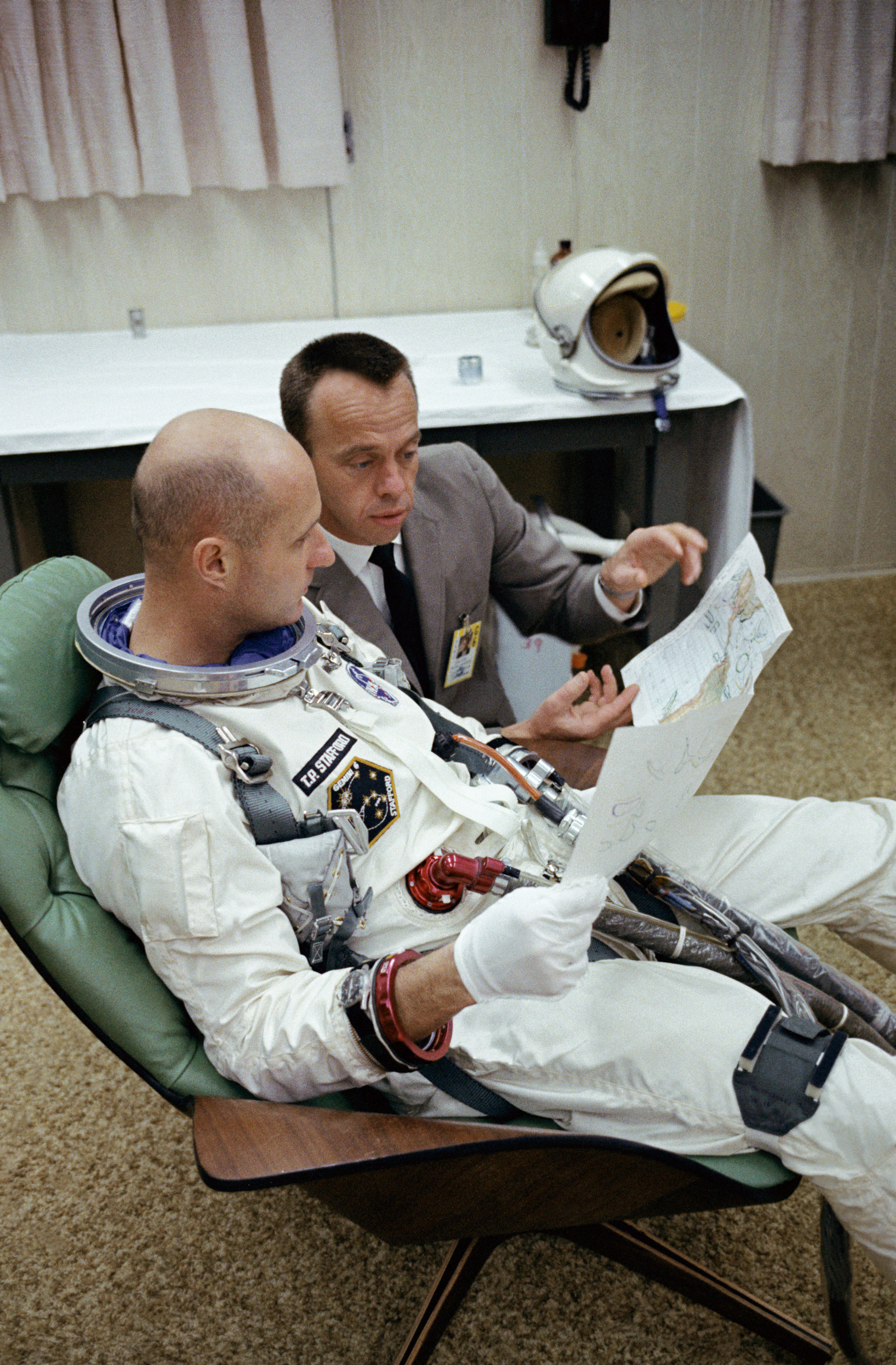
At 3 hours 15 minutes Elliot See warned from the ground that radar contact should be possible shortly. The crew got a flickering signal first and then a solid lock-on at a range of 434 kilometres. Over Carnarvon, at 3 hours 47 minutes, the aft thrusters fired for 54 seconds to add 13 metres per second: the result was an almost circular orbit measuring 270 by 274 kilometres, with the two spacecraft 319 kilometres apart in slant range and closing slowly. At 3 hours 51 minutes Schirra and Stafford placed the spacecraft in the computer rendezvous mode.
While the lower vehicle gained slowly on its target, Schirra dimmed the lights on his side to improve outside visibility. At 5 hours 4 minutes he exclaimed that there was a really bright star out there that had to be Sirius: it was Gemini VII, reflecting sunlight from 100 kilometres away. The gradual catch-up lasted until 5 hours 16 minutes, by which point the two ships were close enough for Spacecraft 6 to thrust directly at Spacecraft 7; Schirra fired and closed at better than three kilometres every minute and a half, briefly losing sight of Gemini VII as it passed into darkness until he picked up its running lights.
Two midcourse corrections followed twelve minutes apart, at 5 hours 32 and 5 hours 44 minutes. Six minutes later, at a range of 900 metres, Schirra began braking with the forward thrusters. In the terminal phase, in a coincidence nobody had arranged, the astronauts saw the stars Castor and Pollux, which give the Gemini constellation its name, lined up with their sister ship. Then Spacecraft 7 flashed into sunlight and became almost too bright to look at: from 200 metres it resembled a carbon arc light.
The first space rendezvous in history
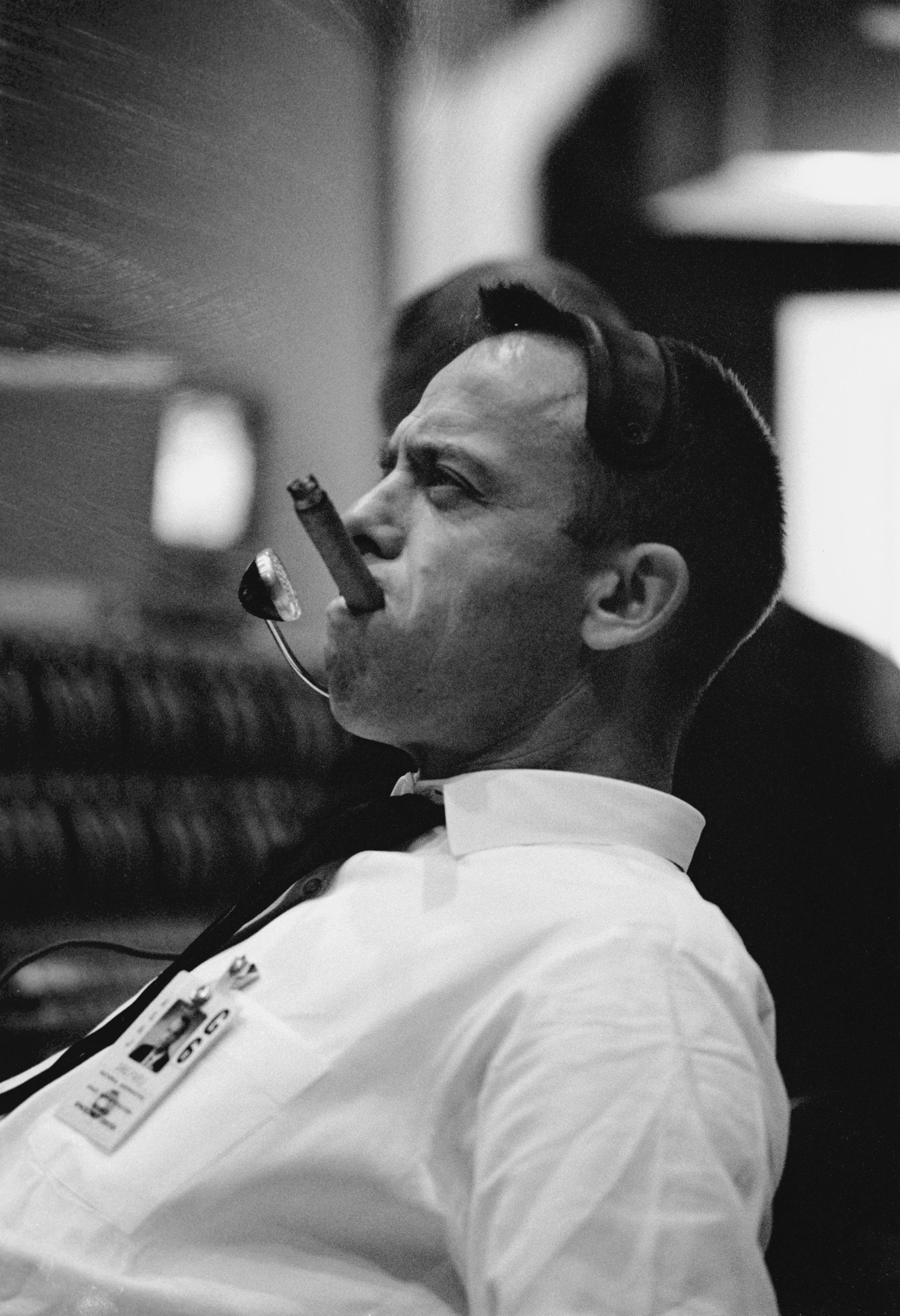
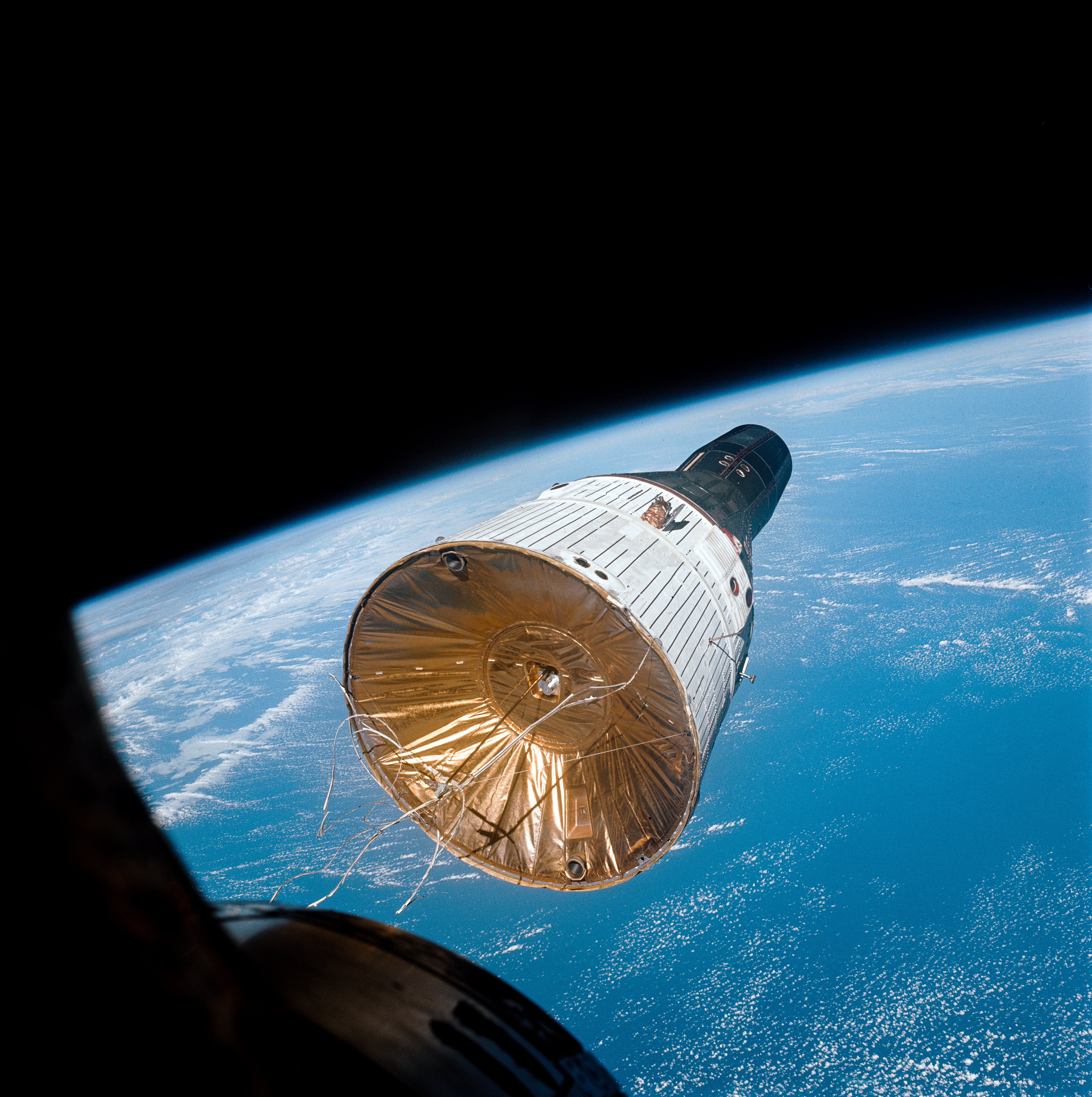
After the braking and translation manoeuvre, Gemini VI-A coasted until the two vehicles were 40 metres apart with no relative motion between them. It was 2:33 p.m. on 15 December 1965 and the world's first crewed space rendezvous was a fact. In Mission Control the flight controllers waved small American flags while Christopher C. Kraft, Robert R. Gilruth and the rest of the jubilant crowd lit cigars.
The distinction matters, because things that were not rendezvous had been called rendezvous before. When Vostok III flew within five kilometres of Vostok IV on 12 August 1962, some people believed, helped along by Pravda dispatches, that a rendezvous had been accomplished; but the two spacecraft were in different orbital planes and could not manoeuvre to stop the relative motion between them. It was good shooting from the pad, not a rendezvous: two bullets passing in the middle of a battlefield. Schirra put it afterwards with the clarity of a man who had just done it: anyone who thinks they have pulled off a rendezvous at three miles is welcome to enjoy themselves; for him rendezvous is not over until you are completely stopped, with no relative motion between the two vehicles, at a range of about 120 feet, or 40 metres. From there on, he said, it is stationkeeping, and flying the spacecraft becomes about as simple as driving a car or pushing a skateboard.
Rendezvous is not docking
It is worth stressing what Gemini VI-A did not do, because the confusion is common. The two spacecraft did not dock and could not have: neither carried a docking mechanism, which was exactly what the lost Agena would have provided. What was demonstrated was the harder part, the one no desk calculation could settle: that a crew can acquire another spacecraft by radar hundreds of kilometres away, compute and fly the sequence of manoeuvres that brings them together, and stop alongside it with precision and with propellant to spare. Docking would have to wait for Gemini VIII, in March 1966.
The cost of the approach was strikingly low: the rendezvous manoeuvres consumed 51 kilograms (113 pounds) of propellant and Schirra still had 62 percent left in his tanks, ample for stationkeeping, flyarounds and parking the spacecraft in specific relative positions. Gemini VII was not so wealthy: Flight Control told Borman and Lovell to stop manoeuvring when their tanks dropped to an 11 percent supply, since days of mission still lay ahead of them.
Formation flight: three revolutions a few metres apart
For more than three Earth revolutions the two spacecraft stayed at ranges from 0.30 metres to 90 metres. Gemini VI-A closed in on one occasion to examine the stringers hanging off the other ship; on another they flew nose to nose. Schirra and Stafford swapped the controls back and forth because the Sun streamed so brightly through first one window and then the other. When it was time for Borman and Lovell to perform an experiment, the visitors moved out twelve metres and parked: on one occasion neither pilot touched the steering handle for some twenty minutes, the spacecraft remaining stable relative to its sister ship.
On the first night pass the two vehicles faced each other at distances ranging from 6 to 18 metres. Schirra had worried about visibility in darkness and it proved excellent: the docking light, a handheld penlight and even Gemini VII's cabin lights were clearly visible. Using what he called his eyeball ranging system, the VI-A crew flew an in-plane flyaround of VII, roving out to 90 metres; judging that too far away to count as stationkeeping, Schirra hurriedly brought the spacecraft back within 30 metres. Both were highly impressed with the control they had: velocity inputs as low as 0.03 metres per second gave very precise manoeuvring, and from that they concluded that nuzzling into and docking with a target vehicle would be no problem.
There were unplanned findings too. Borman and Lovell were fascinated by the fireworks of VI-A's thrusters during braking and startled by a twelve-metre tongue of flame. As the visitors closed in, Borman warned Schirra that he had a lot of stuff around his back end; minutes later, during stationkeeping, Schirra returned the compliment: cords and stringers three to five metres long streamed and flapped behind both spacecraft.
When bedtime approached, Schirra flipped the spacecraft blunt-end forward and fired the thrusters to impart a small separation speed. The two crews settled down 16 kilometres apart, and Borman, who frequently caught sight of Gemini VI-A in the distance, remarked to the Rose Knot Victor tracking ship that they had company that night.
The unidentified object and the serenade
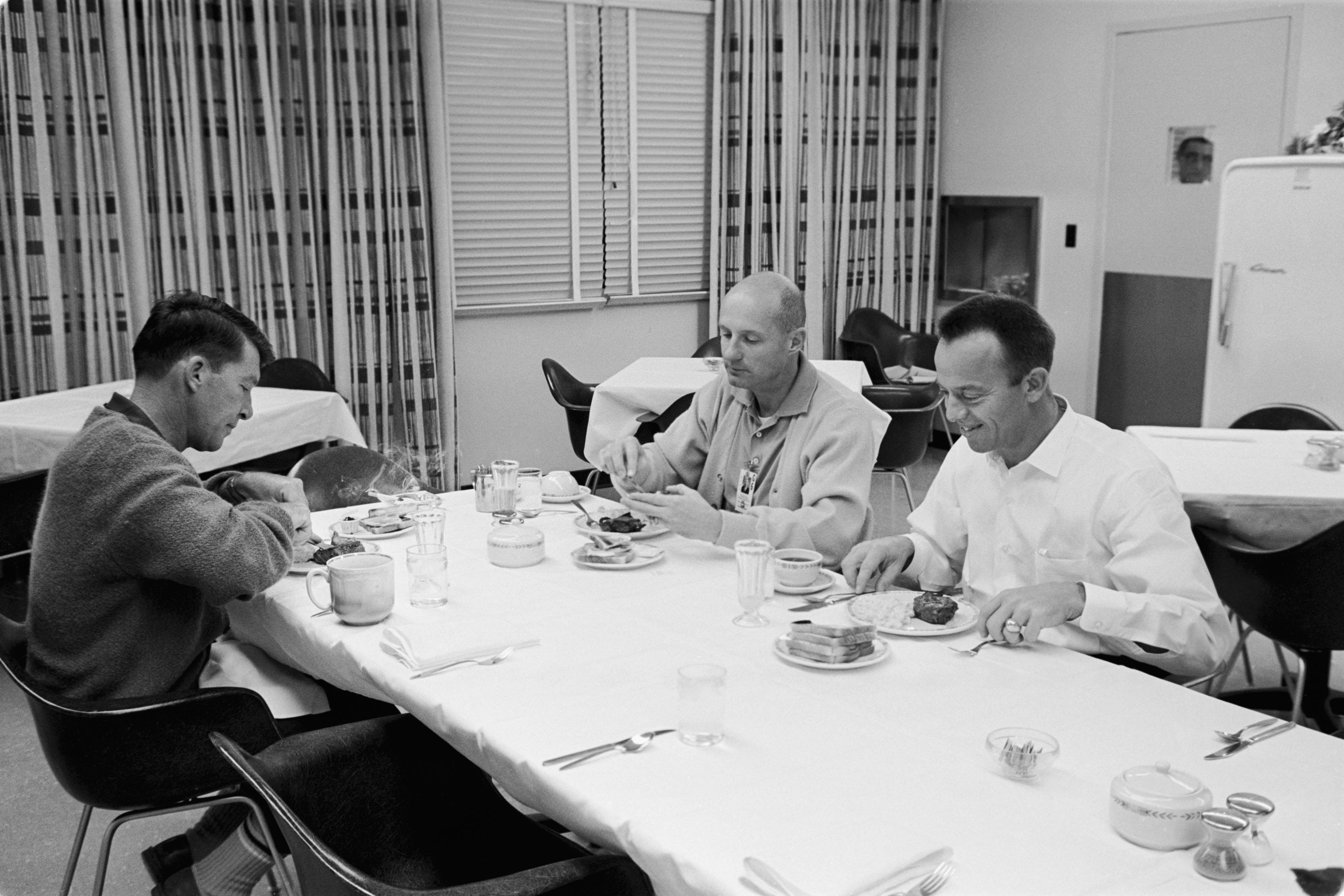
Schirra and Stafford ended the day exhausted and hungry. They ate a good meal and went to sleep. Schirra woke with a stuffy head and a runny nose, glad that the mission was flexible enough to allow landing after a single day of flight if everything had been done: they had achieved all their objectives and, besides, Flight Control needed to concentrate on Gemini VII, whose fuel cell needed help if that mission was to last fourteen days.
Before leaving, Stafford caught everybody's attention for a few minutes. In an excited tone he reported to Gemini VII an object that looked like a satellite going from north to south, probably in polar orbit, apparently about to reenter; he asked them to stand by and suggested he might try to pick the thing up. Over the communications circuit then came the strains of "Jingle Bells" played by the two pilots. Gemini VII was about to begin its twelfth day and VI-A, rendezvous demonstrated in fine fashion, was going home.
The instruments of the joke had been weeks in the making. Michael Kapp, producer of the Bill Dana "Jose Jimenez in Orbit" record album, had given Schirra a small four-hole harmonica on 8 December 1965. The other half of the two-man space band, Stafford, jingled small bells that Frances Slaughter, of the Cape Flight Crew Operations Office, had fastened to his boots as a joke before a training simulation and which he took along to provide the rhythm section. Schirra, already responsible for the corned beef sandwich that had caused such a furore on Gemini III, was asked some time afterwards why he did not get too much static for the harmonica and replied that the timing had been pretty good.
Controlled reentry and recovery by USS Wasp
Schirra signed off telling Borman and Lovell they had done a really good job and that he would see them on the beach. He then flipped VI-A blunt-end forward and jettisoned the equipment section; retrofire followed automatically.
To see Earth's horizon he put the spacecraft in an inverted, heads-down attitude. Nearing the 100,000-metre fringe of the atmosphere he set the bank angle at 55 degrees left and held it until computer guidance took over at 85,000 metres. The spacecraft threatened to overshoot its planned landing point, which had to be countered by banking first left and then right; since the Gemini spacecraft got its greatest lift flying straight ahead, banking cut lift and shortened range. The crew turned the computer off at 24,000 metres, deployed the drogue parachute at 14,000 metres and punched out the main parachute at 3,200 metres.
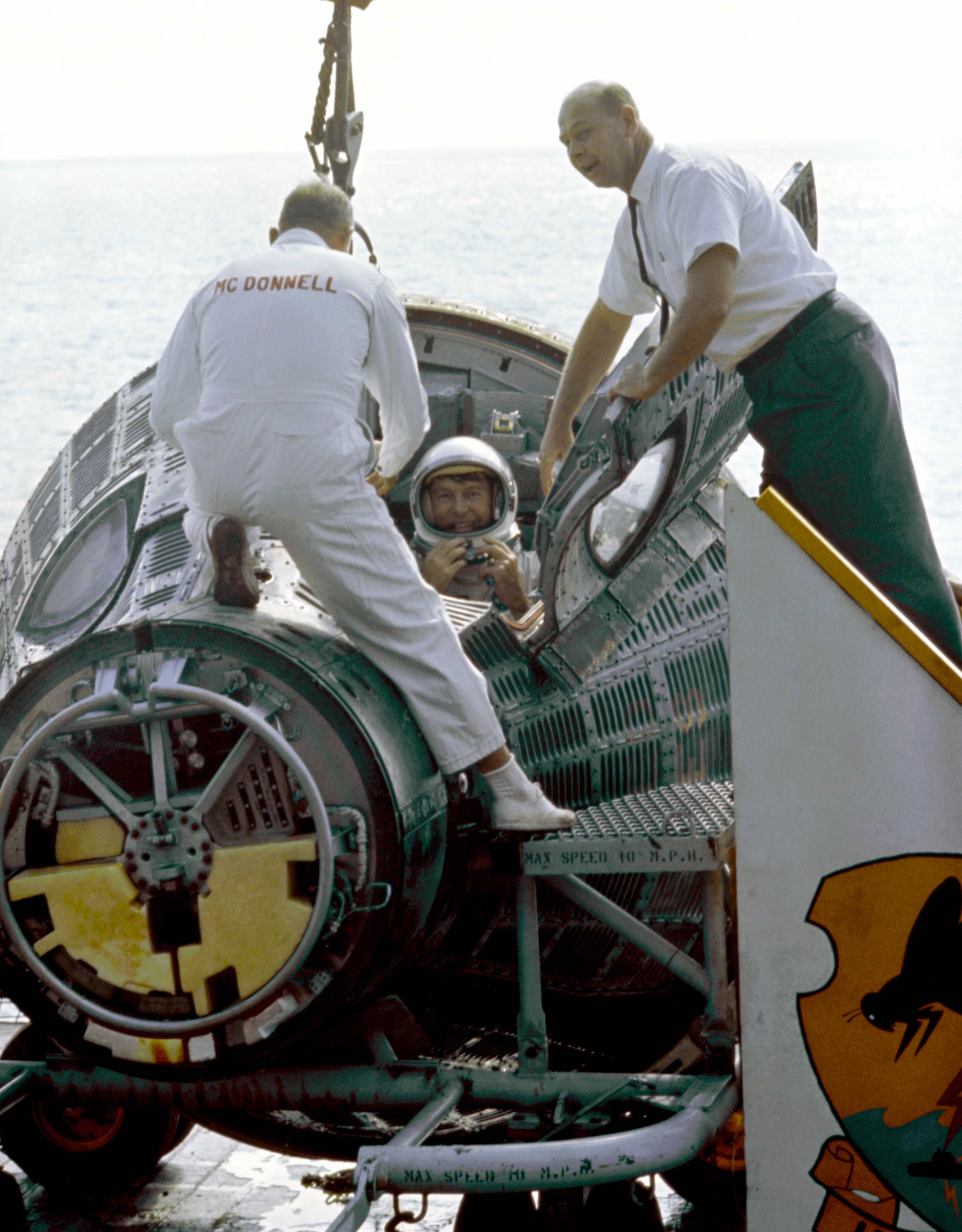
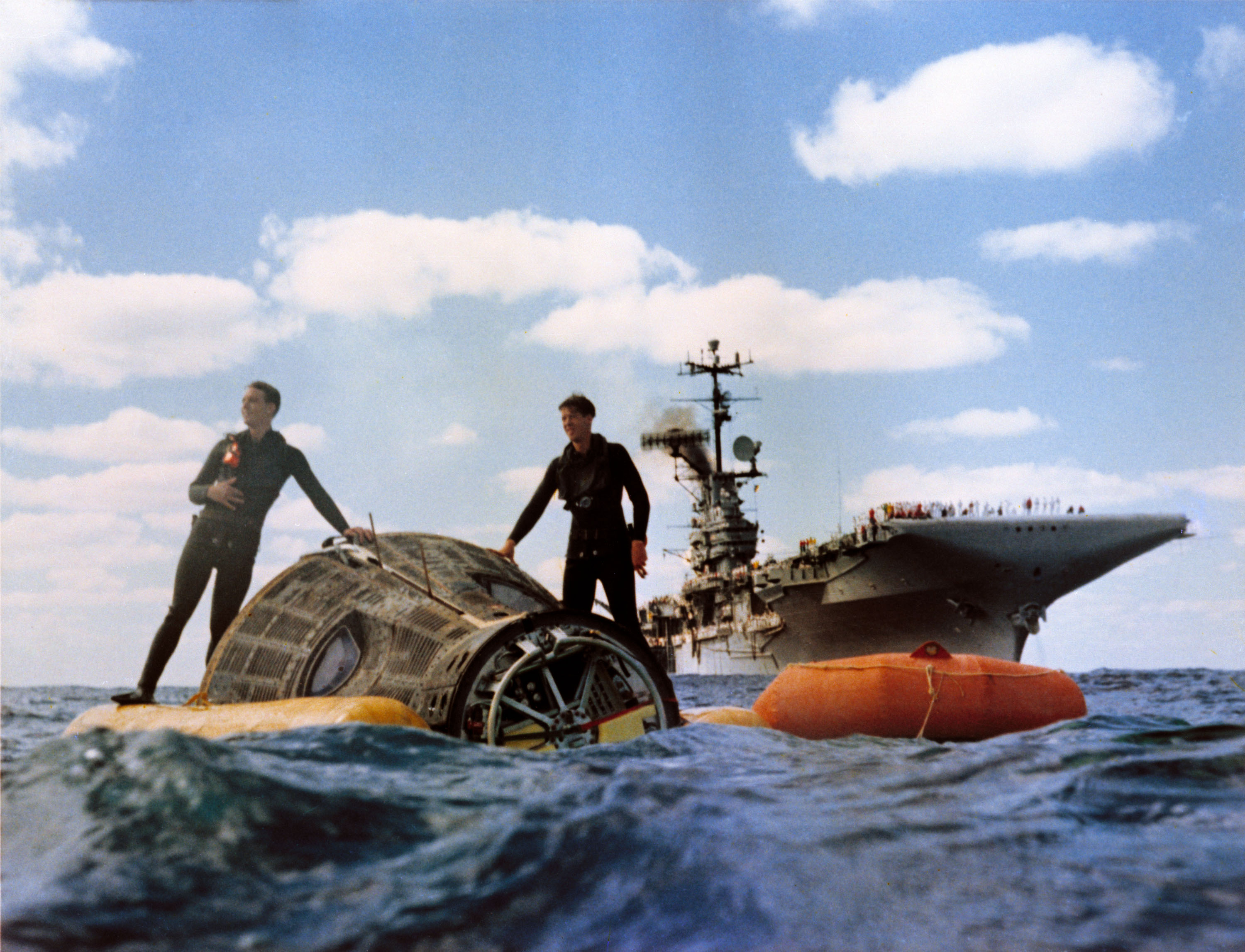
Gemini VI-A landed about 13 kilometres from its planned impact point, recording the first successfully controlled reentry of the programme. And it did so in full view of the world: the scene was beamed live on television from the carrier USS Wasp via satellite transmission. As on his Mercury flight, Schirra elected to remain aboard his spacecraft while it was hauled onto the carrier deck. So, on 16 December 1965, after 16 revolutions and 25 hours, 15 minutes and 58 seconds, the world's first crewed space rendezvous mission became a matter of record.
What Gemini VI-A left behind
The mission is measured badly in flight hours, because it was one of the shortest of the programme, and very well in techniques validated. In a single working day Gemini VI-A showed that orbital rendezvous was a procedure a crew could execute with radar, an onboard computer and thrusters rather than a feat of luck; that the propellant cost of a well-planned approach is a small fraction of what is carried; that formation flight a few metres away is stable and controllable, even at night; and that guided reentry let a crew choose its splashdown point instead of settling for it. Without those four certainties, the lunar orbit rendezvous mission mode would have remained a theoretical bet.
The mission also left a less technical lesson about the place of human judgement. The abort of 12 December was covered by a ground rule that said eject, and the rule, applied to the letter, would have destroyed the mission and exposed the crew to more than 20 g and months of recovery. Schirra contradicted it on the strength of what his body was telling him: the rocket had not moved. Three days later that same spacecraft and that same launch vehicle put the first space rendezvous into the historical record.
Images
Elsewhere
- Smithsonian National Air and Space MuseumArmónica Hohner "Little Lady" de la Gemini VI-A ↗
- Smithsonian National Air and Space MuseumCascabeles de la Gemini VI-A ↗
- Smithsonian National Air and Space MuseumGemini VII fotografiada desde Gemini VI-A ↗
- Smithsonian National Air and Space MuseumEl primer encuentro espacial de la historia ↗
- Internet ArchiveGemini VI Mission Image - Rendezvous with Gemini VII ↗
- Internet ArchiveGemini 6 and Gemini 7 Rendezvous ↗
- NASAGemini VII fotografiada desde Gemini VI-A durante el encuentro ↗
- NASAGalería de la misión Gemini VI-A ↗
- Flickr (NASA on The Commons)Gemini VI Launch ↗
- Flickr (NASA on The Commons)Gemini VI Recovery ↗
- Flickr (NASA on The Commons)Gemini VIA and VII Rendezvous ↗
- Flickr (NASA on The Commons)Gemini Mission Control ↗