Project Gemini · NASA · Crewed
Gemini V
- Aug 21, 1965, 1:59 PM
- Launch date
- 2
- Crew size
- 7 days 22 hr
- Duration
- Success
- Outcome


_fotografiado_desde_la_c%C3%A1psula-1600.webp)


_en_el_Complejo_de_Lanzamiento_19-1600.webp)
-1600.webp)


-1600.webp)


_desplegado_en_%C3%B3rbita-1600.webp)


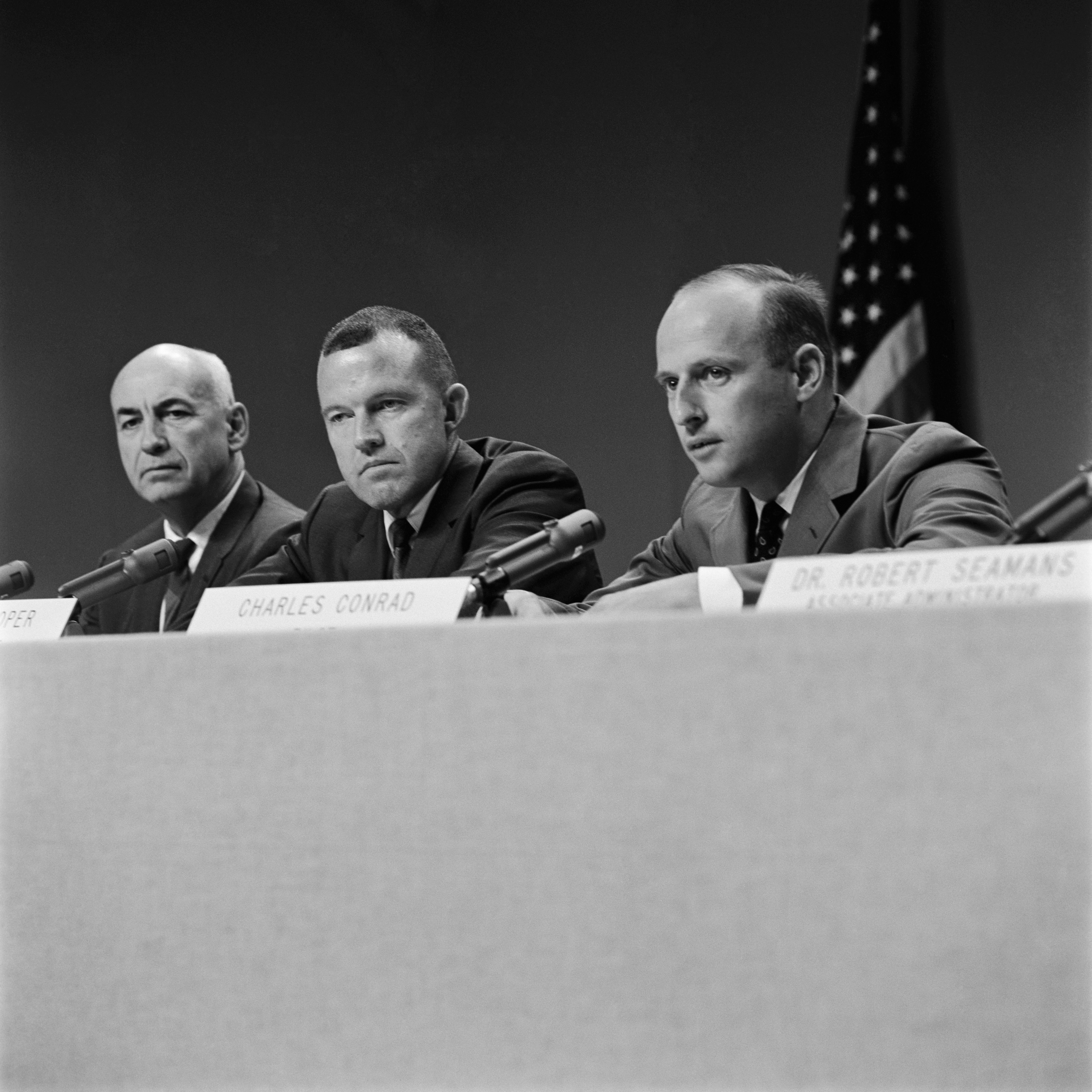
Gemini 5 was the third crewed flight of Project Gemini and the mission with which the United States showed that a crew and its spacecraft could endure in orbit the eight days a round trip to the Moon would take. It lifted off from Complex 19 at Cape Canaveral on 21 August 1965 at 8:59:59 a.m. Eastern time (13:59:59 UT) atop a Titan II, with L. Gordon Cooper Jr. as command pilot and Charles “Pete” Conrad Jr. as pilot; the backup crew was Neil A. Armstrong and Elliot M. See Jr. NASA set as primary objectives the demonstration of a long-duration crewed flight, the evaluation of the effects of prolonged weightlessness on the crew, and the testing of rendezvous procedures and manoeuvres using a rendezvous evaluation pod (REP); secondary objectives included evaluating the fuel cell power system and the rendezvous radar and conducting seventeen experiments. The mission introduced fuel cells as the primary power source of a crewed spacecraft, a technology essential for long flights because a cell keeps producing electricity as long as it is supplied with reactants, unlike the chemical batteries used until then. That very novelty almost ended the flight: only hours after launch the pressure in the oxygen supply tank of the fuel cell system collapsed from a nominal 850 psia to a low of 65 psia, and Cooper, out of radio contact, decided to power the spacecraft down. The REP evaluation was cancelled and for hours an early return was considered. Hastily arranged tests by McDonnell in St. Louis showed the cells could work at low oxygen pressure, the flight directors authorised switching them back on, and the mission went on. Without the REP, Edwin E. “Buzz” Aldrin worked out an alternative from the ground: on the third day Cooper flew the spacecraft to a point in space computed by the controllers, the so-called phantom rendezvous, the first precision manoeuvre in crewed spaceflight. After that the mission wound down: a failure in one of the OAMS thruster blocks forced the cancellation of every experiment that needed propellant, and the spacecraft drifted for the remaining days. Even so the crew completed sixteen of the seventeen planned experiments, including the first orbital photographs of the zodiacal light and the gegenschein. Retrofire came on revolution 120, one revolution earlier than planned because of the storm threatening the recovery area, at 190 hours, 27 minutes and 43 seconds into the flight. Gemini 5 splashed down in the western Atlantic on 29 August at 7:55:13 a.m. Eastern time after a total mission time of 190 hours, 55 minutes and 14 seconds, short of the intended point because of a human programming error in the ground computer. Cooper and Conrad were picked up by the aircraft carrier USS Lake Champlain in good physical shape, and their recovery over the following two days was the argument with which NASA declared the medical fear of prolonged weightlessness dispelled and the lunar mission, in that respect, feasible.
Objectives
The major objectives of Gemini V were to demonstrate a long-duration crewed flight — the mission was designed to last eight days —, to evaluate the effects of long periods of weightlessness on the crew and to test rendezvous capabilities and maneuvers using a rendezvous evaluation pod. Secondary objectives included demonstrating all phases of the guidance and control systems supporting rendezvous and controlled reentry guidance, evaluating the fuel cell power system and the rendezvous radar, testing the ability of either pilot to bring the spacecraft into close proximity with another object, and conducting seventeen experiments.
Payload
Spacecraft Gemini 5, with a launch mass of 3,605 kg, flown by L. Gordon Cooper Jr. as command pilot and Charles “Pete” Conrad Jr. as pilot, together with the fuel cell power system, the rendezvous radar and a rendezvous evaluation pod (REP) released in orbit. The onboard programme comprised seventeen experiments; those carried out included zodiacal light studies, synoptic terrain and synoptic weather photography and a cloudtop spectrometer, plus five medical and seven technological experiments.
History
Eight days as the measure of a lunar voyage
By the summer of 1965 Project Gemini had two good crewed flights behind it: Gemini 3 had proved the two-man spacecraft and Gemini 4 had lasted four days and put Edward White outside the hatch. The question that really mattered for the lunar goal, though, was still open: could a crew and a spacecraft keep working for the eight days it would take to fly to the Moon, land and return? Gemini 5 was designed to answer exactly that. NASA stated it plainly in the mission documentation: the major objectives were to demonstrate a long-duration crewed flight, to evaluate the effects of long periods of weightlessness on the crew, and to test rendezvous capabilities and manoeuvres using a rendezvous evaluation pod. The secondary objectives filled out the picture: demonstration of all phases of the guidance and control systems needed to support rendezvous and controlled reentry guidance, evaluation of the fuel cell power system and the rendezvous radar, testing the capability of either pilot to manoeuvre the spacecraft into close proximity with another object, and conducting seventeen experiments.
The eight-day flight doubled the American record set two months earlier by Gemini 4, and it was made possible by a new technology on board: fuel cells. The difference from a battery is one of kind, not of degree. A battery stores the chemical reactants and, once they are used up, must be recharged or discarded; a fuel cell converts energy from a fuel — liquid hydrogen — into electricity through a chemical reaction with oxygen or another oxidising agent, and keeps producing current as long as it has a fuel supply. Chuck Gay, NASA test conductor for Gemini 5 at the Florida spaceport, summed it up in a 1965 interview: the mission would demonstrate an eight-day long-duration capability for both spacecraft and crew and would, in addition, be the first use of fuel cells to supply spacecraft power during a crewed flight.
That requirement translated into closer scrutiny of the hardware. Gay and a team of specialists conducted nine weeks of capsule factory tests and inspections at McDonnell Aircraft in St. Louis, where the spacecraft was built, and another eight weeks of prelaunch checkouts once it had been flown to Kennedy. “A great deal of knowledge was gained during the four previous Gemini missions, particularly the two manned flights,” Gay said; already rigid specifications were tightened further for Gemini 5 and inspection procedures were more stringent than any used before.
What was decided and what was dropped before flight
Preparing Gemini 5 was as much a chain of programme decisions as a training campaign. Gemini 4 had left several questions to be closed before the next flight: should a fail-safe reentry be flown, should there be an EVA, what suits should the crew wear, could the crew be trained soon enough to shorten launch intervals from three months to two, and could the scientists have their experiments ready in time to integrate them into crew training.
The fail-safe orbit — a trajectory guaranteeing return without depending on the propulsion system — had been planned for all crewed Gemini flights: missions not slated for rendezvous would use spacecraft thrusters to bring the vehicle into the atmosphere, and the others would depend on the Agena. NASA Headquarters had imposed the precaution on Gemini 3, whose crew later had little to say about it; Gemini 4's McDivitt and White, by contrast, lambasted it, because saving fuel for the fail-safe manoeuvre had forced them to limit both operations and experiments. With Gemini 5 slated for eight days and seventeen experiments, Houston wanted to scrub the manoeuvre, and since the retrorockets had fired as advertised even after soaking four days in space, George Mueller agreed.
The second decision was not to repeat an extravehicular activity. White's spacewalk was a hard act to follow and there was little to be gained from merely repeating it, while the environmental system was not ready for anything more advanced. There were further reasons: McDivitt and White had had trouble stowing even the reentry gear, and the eight- and fourteen-day missions coming up would produce even more clutter; the Gemini VI crew wanted to stress only rendezvous and docking. Mueller and William Schneider decided there would be no EVA on the next three missions. The Gemini 5 pilots campaigned instead for more comfort in orbit — flying in helmets, goggles and oxygen masks but without their suits. They lost that battle and wore the G4C extravehicular suits that had been bought for them before the decision to fly an EVA on Gemini 4.
Cooper, Conrad and a training schedule against the clock
Shortening the intervals between missions was part of the problem of getting the crew ready to fly. When plans for speeding up the flight schedule were first studied in September 1964, flight operations and crew training emerged as the most likely stumbling blocks. The study was completed and accepted in January 1965, and by then Gemini 5 still had no crew. Cooper and Conrad were finally named on 8 February, with Neil A. Armstrong and Elliot M. See Jr. as backups. From then on twelve men — the crews for missions 3, 4 and 5 — were lining up for the trainers and simulators, and by the end of June the Gemini 5 training programme was in trouble; matters eased somewhat when the Houston simulator, previously used chiefly to familiarise new crews with Gemini systems in general, was refitted specifically for Gemini 5.
The support team at the consoles included three astronauts serving as capsule communicators: Edwin E. “Buzz” Aldrin in Houston, Virgil I. “Gus” Grissom at the Cape and James A. McDivitt in Houston.
One of the central objectives, the practice rendezvous with the evaluation pod, became more urgent after the doubts raised by Gemini 4. Reviewing that flight, Robert Seamans asked Langley Research Center to study orbital mechanics, especially the complex decisions on attitude and velocity changes and probable fuel usage both with and without computers. Langley engineers reviewed the Gemini 4 results and concluded that the fuel allotted seemed ample for stationkeeping but that the crew had simply not been adequately trained for the job. Paul Purser later put it bluntly: no one was “adequately trained”, in that the differences between motions on Earth and motions in orbit were not intuitively realised or second nature to anyone.
Cooper and Conrad devoted a large part of their training time to that exercise, by then seen as a crucial prelude to Gemini VI and planned to simulate, as closely as possible, the terminal phase of a rendezvous with an Agena. One other item was left over from Gemini 4: the failure of the onboard computer. IBM, the subcontractor, was unable to duplicate the failure on a test computer, and the Gemini 4 computer itself worked perfectly through five hundred tests in St. Louis. Since the trouble remained a mystery, IBM modified the Gemini 5 computer with a manual switch that allowed the areas that might have caused the problem to be bypassed.
The simultaneous countdown and the postponement
Another requirement for the first rendezvous flight that Cooper and Conrad rehearsed was a simultaneous launch countdown, involving their Titan II and spacecraft on pad 19 and an Atlas-Agena on pad 14, to give the launch crew and flight controllers experience in launching two vehicles at precise times. On 22 July the Gemini 5 crew went through the motions of a double launch that accumulated five holds — for propellant tanking, a faulty command panel switch, spacecraft problems, erratic range sequencer performance and spurious pulses received at Lockheed's ground stations — and that lasted 867 minutes instead of the scheduled 505. It did give the needed practice. When the test ended, the lowered erector could not be raised and the crew had to be rescued with the “cherry picker”, a cabin on the tip of a crane that had been used in Mercury and that Cooper had insisted be included in the Gemini programme; riding it down gave him a sense of vindication.
Cooper and Conrad were putting in very long days, and the launch scheduled for 9 August was simply too soon. Astronaut Chief Donald K. Slayton flew to Washington to argue Mueller into delaying the date, and on 21 July Mueller reluctantly agreed to postpone the launch until 19 August. The usual reviews started on 29 July with the spacecraft readiness review, followed by launch vehicle readiness on 16 August, mission on 17 August and flight safety on 18 August. On 19 August, Everett E. Christensen of NASA Headquarters assumed the role of mission director.
Thunderstorms threatened that morning and the operations crew decided to push on and launch if possible; but the predicted storm welled over the pad area and — as had happened with Gemini 2 — a lightning strike near the power facilities caused the spacecraft computer to waver. The erector was finally raised, the crew was helped out of the craft, propellants were drained, pyrotechnics were removed or defused and a 48-hour recycle was begun.
“Eight days or bust”: the covered wagon patch
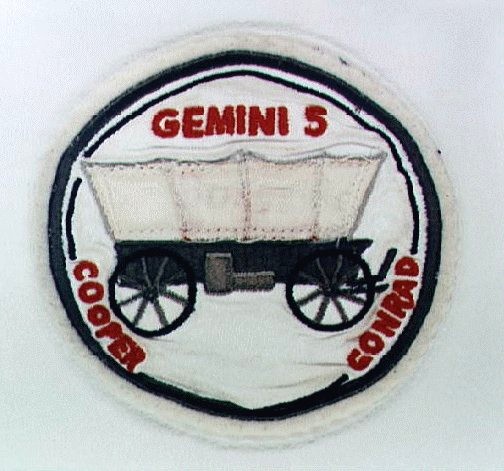
Gemini 5 was the first NASA mission to carry a crew insignia. After Gemini 3, the agency had banned astronauts from naming their spacecraft; Cooper, realising he had never been in a military organisation without an emblem, suggested a mission patch to symbolise the flight, and NASA agreed — the patches acquired the generic name of “Cooper patch”. The motif came from the family: Conrad's father-in-law had whittled a model covered wagon, and the image suggested to Cooper a patch using that motif — a Conestoga wagon, noting the pioneering nature of the flight — with the motto “Eight days or bust” emblazoned across the wagon's side.
A personal appeal to NASA Administrator James Webb led, after much discussion, to approval of the patch but not of the motto. Webb heartily disliked it: if the mission did not go the full eight days, for whatever reason, many would say it had “busted”. In a memo of 14 August 1965 to Deke Slayton, Director of Flight Crew Operations, he approved the concept while stating his reservation about the slogan: “I have a very strong concern about the ‘8 days or bust' motto. I wish it could be omitted. If the flight does not go eight days, there are many who are going to say it was ‘busted.'” The managers' objection was twofold: the motto placed too much emphasis on mission length rather than on the experiments, and the public might see a flight that fell short of the full duration as a failure. Since the patches had already been produced with the motto, a piece of nylon cloth was sewn over the slogan on the versions Cooper and Conrad wore during the flight.
Conrad, who had a reputation for having a punchline on hand, named the mission differently: “Eight days in a garbage can”, the garbage can being the small Gemini cabin, about the size of the front seat of a Volkswagen Beetle.
Launch: the Titan II's Pogo
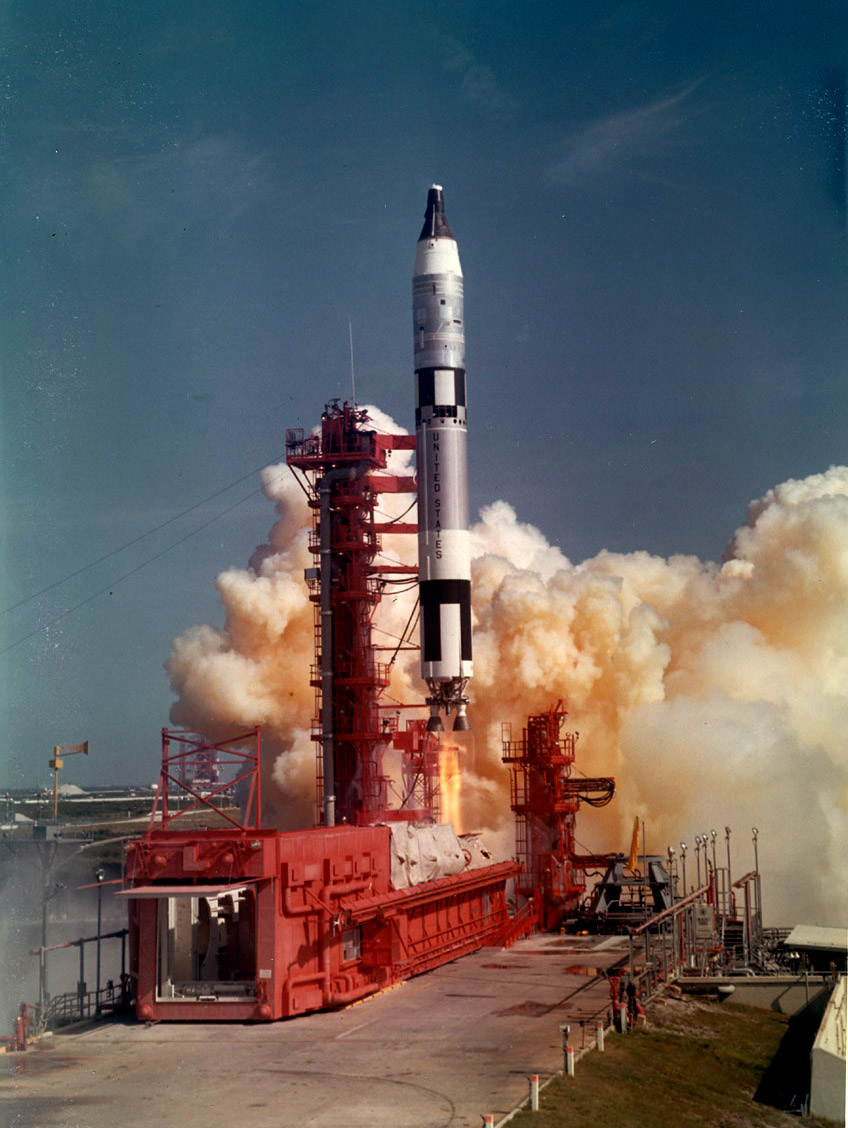
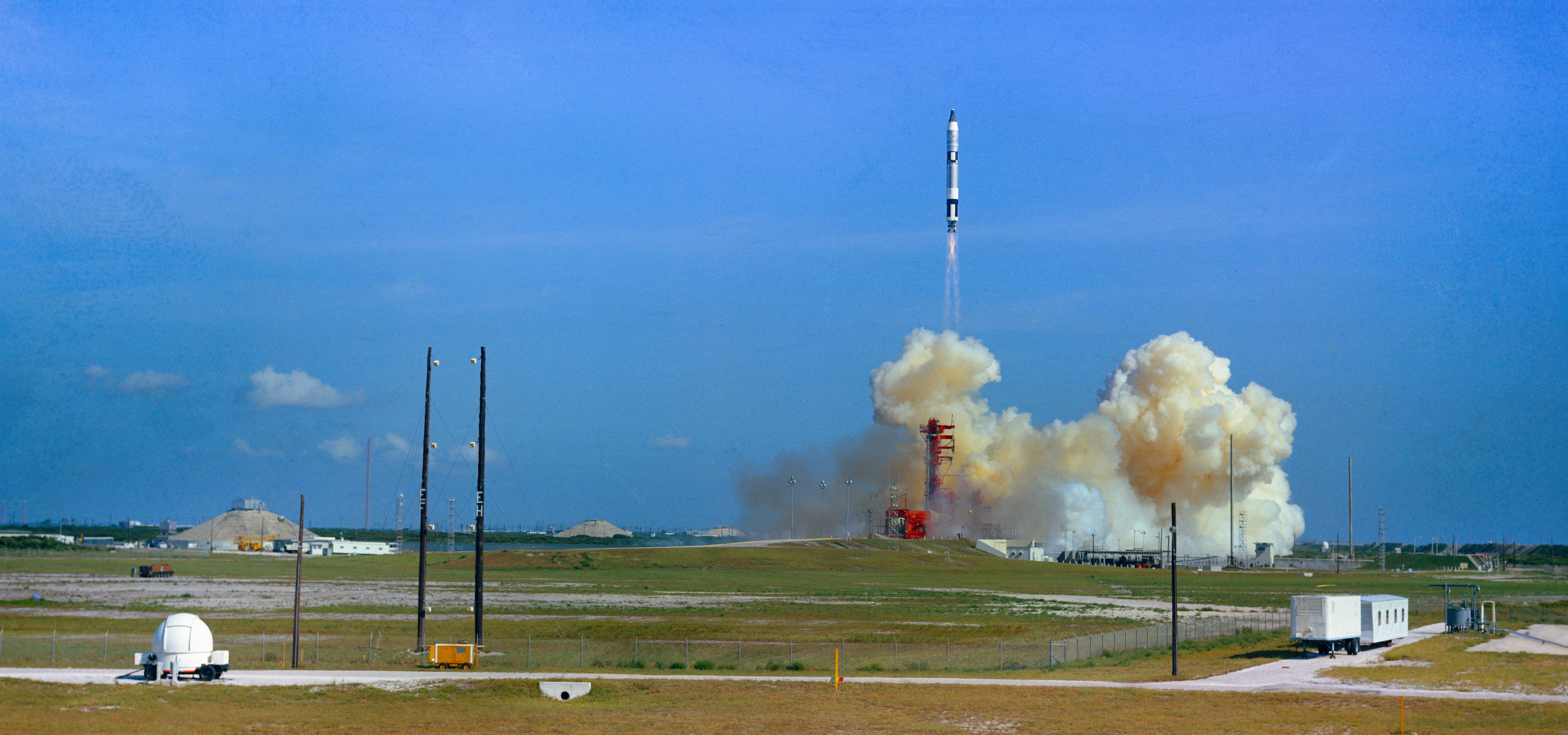
On Saturday 21 August, Guenter F. Wendt, the McDonnell pad leader, hustled Cooper and Conrad into their couches. “We're on our way,” said Cooper as Gemini 5 lifted off from Pad 19 at Cape Kennedy. The modified Titan II started them on a far longer journey than any made by a continent-crossing covered wagon. The start was smooth enough, but then came the bumps of Pogo, the axial vibration of the rocket: peaks of +0.38 g were measured during first stage flight, exceeding the permitted +0.25 g, for a total of about thirteen seconds. Conrad and Cooper found their vision and speech momentarily impaired by the strong vibrations. A few seconds before staging, the bouncing stopped.
Within three days of the launch, analysis of the flight data showed that the oxidizer standpipes had been charged with only ten per cent of the required volume of nitrogen; the fault was quickly traced to prelaunch procedures, which were corrected. It was the only Pogo anomaly to mar a Gemini mission, and severe oscillations did not affect any subsequent flight.
Film of the launch also revealed a series of unexplained light flashes in the first stage exhaust plume, with telemetry showing nothing that could have caused them. Subsequent review of previous Gemini launches and of film from Titan II ICBM tests showed the same flashes; the phenomenon was attributed to the duct tape securing desiccant bags to the turbine exhaust pipe. The top half of the Titan II's first stage, comprising the nitrogen tetroxide tank and its surrounding fuselage, was found floating on the surface of the Atlantic and retrieved; it is now on display in Hangar C at the Cape Canaveral Space Force Museum.
Gemini 5 cut loose from the booster's second stage at 163 kilometres altitude with an orbital apogee of 349 kilometres. NASA's official mission page gives insertion, at 9:05:55, into a 162.0 by 350.1 kilometre orbit; inclination was 32.61 degrees and the period 89.59 minutes. Mass at launch was 3,605 kilograms.
The fuel cell crisis
Because of the mission's length, the supply of oxygen and hydrogen for the fuel cell was a concern from the start. Cooper intended to operate the cells at the lowest possible pressure, but Conrad suddenly noticed the pressure had dropped too low. Flight Control told him to switch on the oxygen heater to raise it and, to his surprise, the needle kept falling. About half an hour after the REP was deployed, McDivitt, as capsule communicator, asked the crew to check the fuel cell heaters to maintain proper pressure in the reactant tanks. “We have checked that,” Cooper replied. “I can't get an increase in amperage when I go to manual O2 fuel cell heater, nor do I get any reading in amperage when I go to auto. The H2 heater works perfectly.”
About thirty-six minutes into the evaluation of the rendezvous system, the crew noticed that the pressure in the oxygen supply tank of the fuel cell system was dropping. At some point earlier in the flight the oxygen supply heater element had failed, and the pressure fell from a nominal 850 psia to a low of 65 psia 4 hours and 22 minutes into the flight. That was still above the 22.2 psia minimum, but it was decided to cancel the REP exercise and power the spacecraft down. Out of communications range, Cooper had to make the decision without help from the ground stations once pressure fell below 138 newtons per square centimetre (200 pounds per square inch): never having seen a fuel cell working at a pressure that low, he was afraid it might stop entirely and reluctantly elected to power down. Without electrical power, rendezvous with the pod was out of the question. The cause of the mishap was believed to be a short circuit in the oxygen tank heater that tripped a breaker.

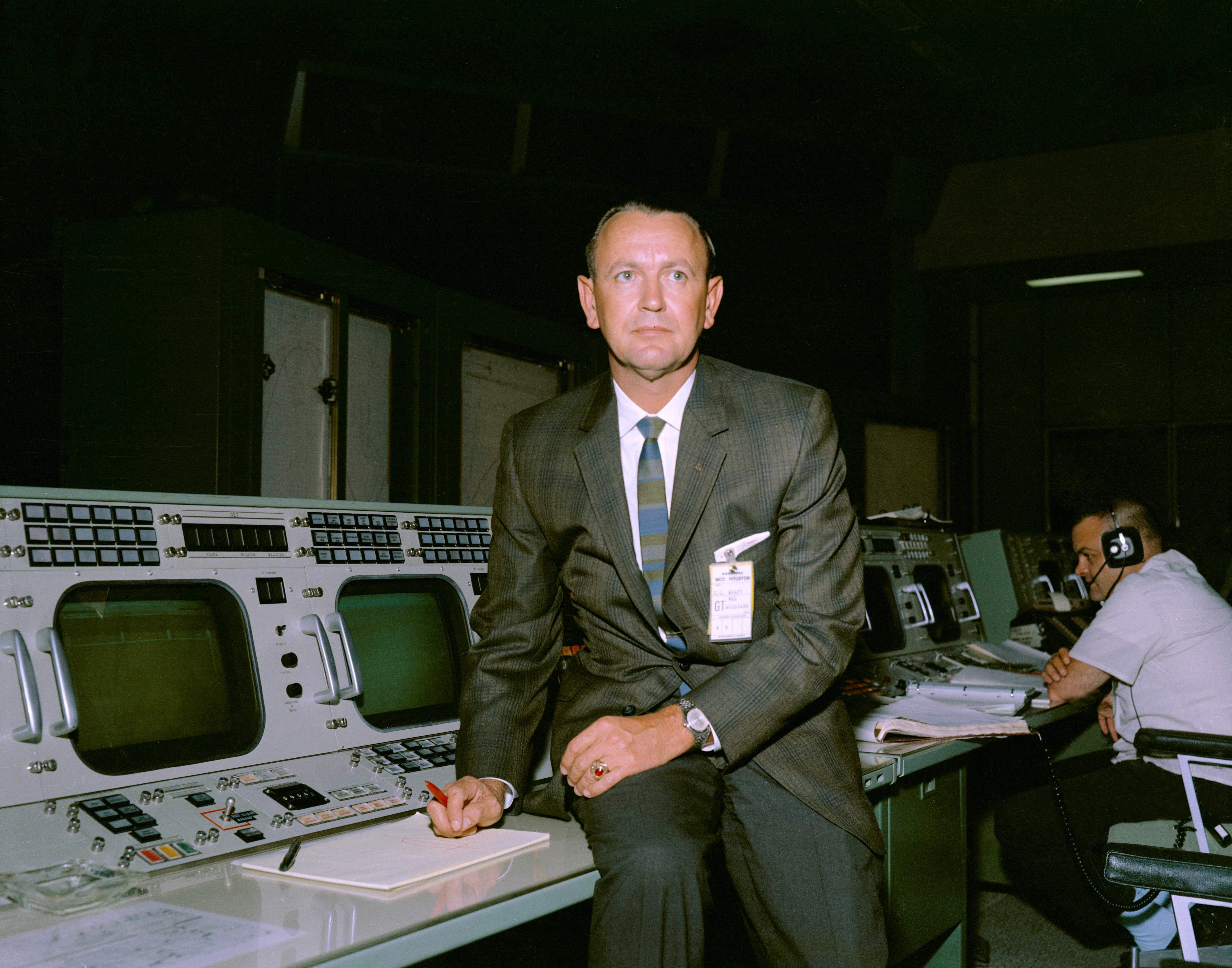
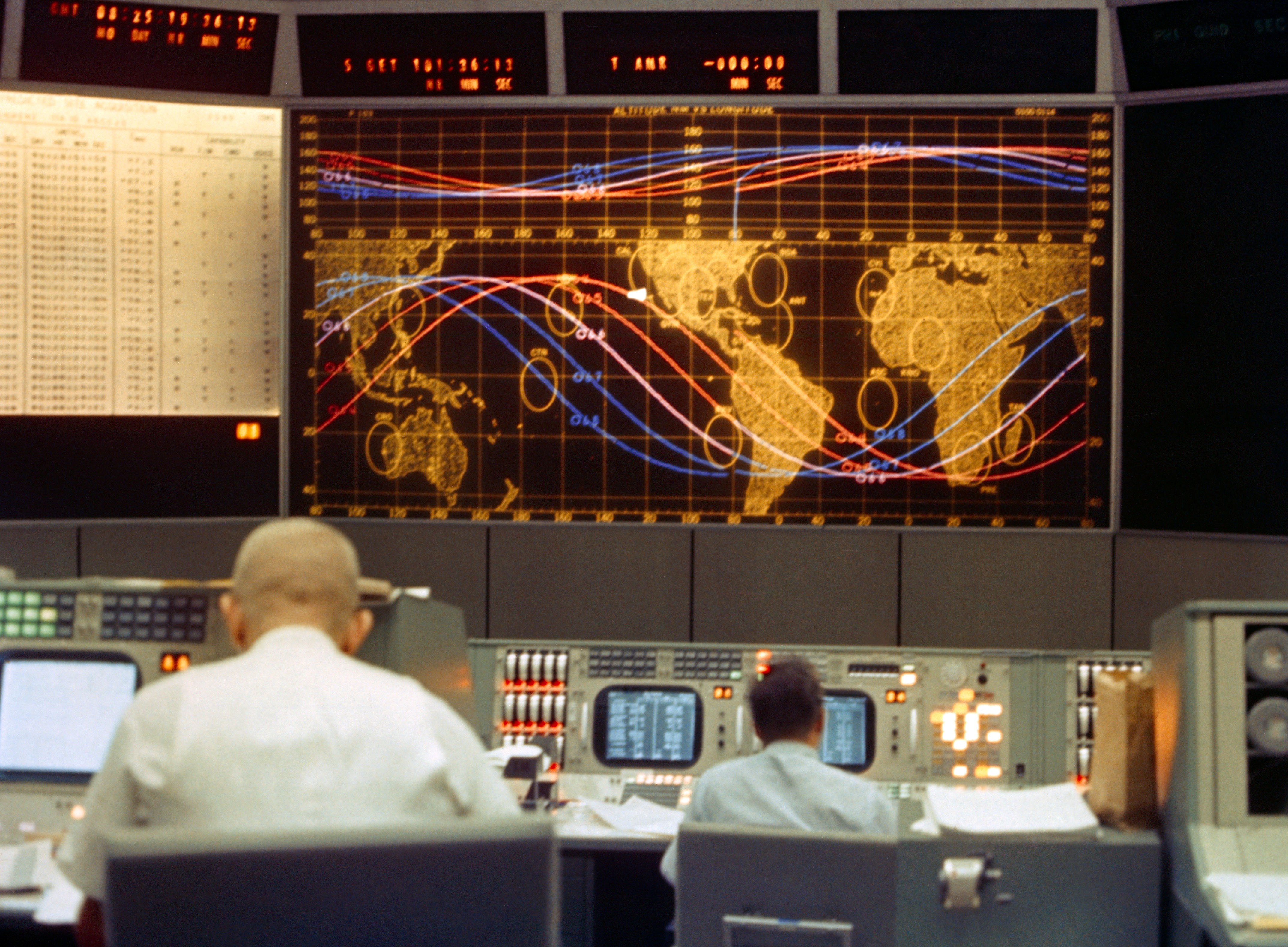
The crew now wondered whether, as Webb had feared, the mission had “busted”, and whether Mission Director Christensen would continue the flight or send them home. Flight Director Christopher Kraft faced his first major problem at the new Mission Control Center. He knew the spacecraft had enough battery power for reentry even if the fuel cell failed completely, but he needed to know whether there would be time to reach a good reentry zone, such as the mid-Pacific near Hawaii on the sixth revolution. While he waited for an answer, the fuel cell pressure dropped to 83 newtons (120 pounds). McDonnell set up a test in St. Louis to find the lowest working pressure for a fuel cell. During the fourth revolution the oxygen pressure stabilised at 49 newtons (71 pounds). About this time Kraft was assured that the batteries were good for thirteen hours, and word came that the low-pressure tests in St. Louis were going well. With those facts in hand, Kraft decided Cooper and Conrad could fly for at least one more day.
Gene Kranz and his team then came on duty. While his problem solvers wrestled with the heater, Aldrin worked with a Mission Planning and Analysis Division team to design manoeuvres for some sort of practice rendezvous, now that the pod was out of the picture, in case the electrical supply could be salvaged. Kranz's team thought it would be safe to operate the cells; when John Hodge arrived, the three flight directors agreed to tell Cooper to turn the electricity back on. They were relieved when the pressure remained stable as the stacks were brought back on the line. Hodge's flight planners gave the crew experiments and systems checks that required more and more power, and the cells held. Thinking they might have to land early, the crew had begun to put things away; now that they were back in business the cabin was soon full of loose gear again.
The REP and the rendezvous that never happened
The first major event of the mission was set for the second revolution. At 2 hours 13 minutes into the flight Cooper yawed the spacecraft ninety degrees and ejected the rendezvous pod; NASA records the REP being released into orbit on 21 August at 16:07:15 UTC. The REP was an optical and electronic duplicate of the Agena planned for later Gemini rendezvous missions, containing a radar transponder, flashing beacons, batteries and an antenna. The plan called for Gemini 5 to manoeuvre away from the instrument package until it was six miles below and fourteen miles behind, and then to rendezvous with it.
Cooper turned the spacecraft to the rear, flipped on the radar and got an immediate signal. The radar scale showed the pod moving off at a relative speed of two metres per second: “We got the REP out,” said Conrad. “It's moving away at four feet a second on our radar.” Conrad had expected it to drift away and trail behind, and was astonished when it went out to the side; finally it started to follow them as they thought it should. By then the heater had still not raised the pressure in the cells and the exercise was cancelled. Four rendezvous radar tests were nevertheless conducted during the mission, starting on revolution 14 on the second day.
The phantom rendezvous on the third day
Cooper and Conrad considered the third day the high point of the flight. They worked steadily on experiments and carried out a series of manoeuvres for a phantom rendezvous. Aldrin, whose Massachusetts Institute of Technology doctoral thesis was titled “Guidance for Manned Orbital Rendezvous”, had worked out a scheme in which the crew rendezvoused with a point in space rather than with an object. Setting up their calculations on the assumption that they were tracking an Agena in a different orbit from the spacecraft, the flight controllers passed information to the crew just as though the target vehicle really existed; using both ground and spacecraft computations, Cooper then manoeuvred Gemini 5 to a rendezvous with that moving point in space, which also gave him a chance to check out the complete manoeuvring system.
Four manoeuvres were tried — apogee adjust, phase adjust, plane change and coelliptical manoeuvre — using the orbit attitude and manoeuvring system (OAMS). Such precise moves were new to crewed spaceflight, and Cooper brought the spacecraft to the exact position Kraft had asked for. It was the first precision manoeuvre in crewed spaceflight. Doubts about being able to accomplish a rendezvous faded, and the mission planners were confident and ready for Gemini VI.
Acid water, dead thrusters and a drifting spacecraft
After the phantom rendezvous the crew powered the electrical systems down again and resigned themselves to drifting, performing experiments when possible. With the inertial guidance platform out of service they had little success, although they did some experiments, performed radar tests and made vision tests: they saw smoke at Laredo, Texas, but did not see a checkerboard pattern that had been laid out for them on a field. In the evening Cooper asked for some uninterrupted sleep and got it, sleeping seven hours to Conrad's five, so that their work day began at a more normal time. It was to be the last busy shift. First they saw a rocket sled test as they flew over Holloman Air Force Base, New Mexico; over Vandenberg on the next pass they sighted the contrail of a chase plane just before glimpsing the ignition of a Minuteman missile; and in the Atlantic they observed their prime recovery carrier, Lake Champlain, with a destroyer astern.
Down in Mission Control, meanwhile, a new problem was causing fresh worries. Since there was no way to dump the fuel cell's product water overboard, its storage tank had been partitioned by a bladder wall, one side holding drinking water and the other storing the acidic liquid. As the crew drank, more room for the fuel-cell discharge was provided. But the cells were producing twenty per cent more fluid than had been foreseen. When an analysis by Kranz's team disclosed that, even at the high rate of production, there would be some room left at the end of the mission, everyone sighed in relief. In general the cells were a success at producing cool drinking water, although the astronauts reported that it carried a high quantity of gas bubbles.
Late in the fifth day came the problem that would shape the rest of the flight: the orbital attitude and manoeuvring system grew sluggish and one thruster quit. Kraft cancelled all experiments that required fuel and the crew turned off the electrical system to help reduce the water buildup. Several possible solutions to the thruster problem were worked out, but none was successful. Cooper and Conrad drifted again through their rest and sleep period, awakening to find that the whole OAMS had become erratic, with two thrusters now stopped. The spacecraft drifted for the rest of the mission, Cooper only turning on the system occasionally to stop excessive tumbling. When things had been working, the crew had been busy; now Conrad mentally kicked himself for not bringing a book.
The failure affected one of the OAMS thruster blocks — the one comprising thrusters 5, 6, 7 and 8 — which malfunctioned repeatedly. The exact reason was never clear and a variety of causes were suggested. NASA's mission page describes the sequence from the other end: on day five thruster number 7 became inoperative and manoeuvring system operation became sluggish; thruster number 8 failed the next day and the system became increasingly erratic.
Cold was another constant. While Gemini 5 drifted, the cabin got cold; the crew turned the airflow on low and continued to shiver. This was the opposite of the Mercury flights, where the capsule had tended to overheat. The suit coolant circuit seemed cold too, so they took the hoses off and stopped the flow inside the suits. As the spacecraft tumbled, the sight of the stars spinning outside the window bothered them until Cooper covered the windows and blocked out the view. Sleeping went no better than for McDivitt and White: at first they tried sleeping alternately, but the dozer was soon disturbed by the ground calling “Gemini 5, Gemini 5, Gemini 5”, and since there would be radio transmissions as long as one of them was awake, they decided the schedule would not work; from then on they tried, not altogether successfully, to sleep, eat and work together.
Seventeen experiments and the Defense Department cameras
Despite all the problems, the crew did a creditable job on the experiments: of the seventeen planned, only one had to be scrubbed — D-2, Nearby Object Photography — since it depended on rendezvous with the pod.
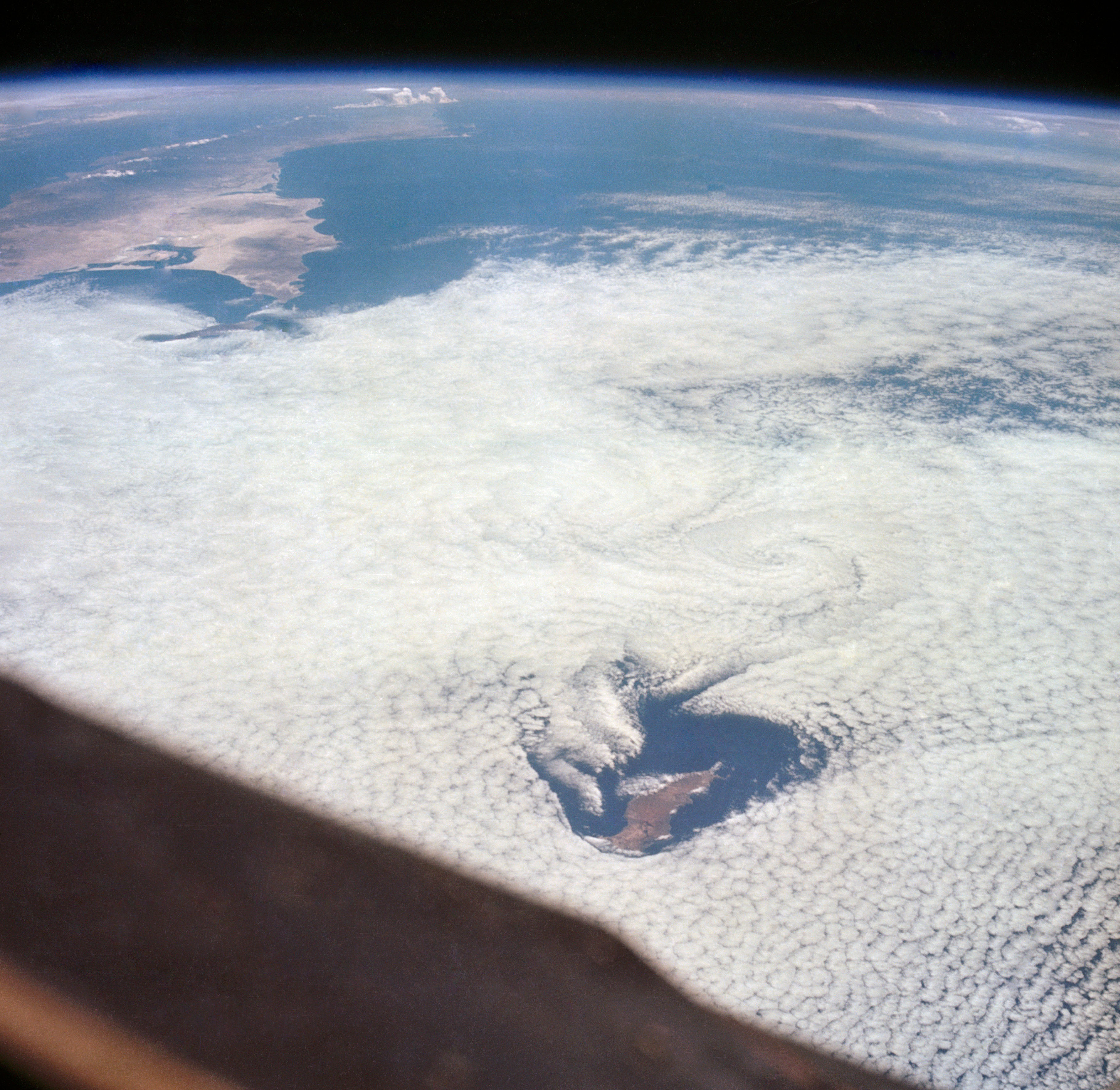
Two complementary Department of Defense experiments were successful. Experiment D-1, Basic Object Photography, proved that the crew could acquire, track and photograph celestial bodies. Weather conditions somewhat hampered D-6, Surface Photography, but Cooper and Conrad did obtain photographs of Merritt Island, Florida; Tampico, Mexico; Rocas Island, Brazil; and Love Field, Dallas, Texas. Defense experiments D-4/D-7, Celestial Radiometry and Space Object Photography, were combined to make irradiance measurements on celestial and terrestrial backgrounds and on rocket plumes. The final defence experiment, S-8/D-13, Visual Acuity/Astronaut Visibility, combined the use of an inflight vision tester with the observation of rectangular marks in fields near Laredo, Texas, and Carnarvon, Australia; weather and operational problems made ground observations difficult, and while they never were able to see the Carnarvon field, the Laredo pattern was partially read on the 48th revolution. The tester showed that the crew's vision did not change during the eight-day flight.
On the scientific side, Cooper obtained the first photographs of the light of the moonless sky — the zodiacal light and the gegenschein — as experiment S-1, making a series of stepped exposures and taking two pictures of the gegenschein, the faint nebulous light opposite the Sun. Like their predecessors, Cooper and Conrad took synoptic terrain and weather photographs with the onboard Hasselblad camera; pictures of the Zagros Mountains showed more detail than the official geologic map of Iran. The crew also provided pictorial cloud studies, including tropical storm Doreen. The other science experiment, S-7, Cloud-Top Spectrometer, proved the feasibility of making cloud altitude measurements from a spacecraft. Taken together, the scientific studies covered zodiacal light, synoptic terrain, synoptic weather photography and the cloud-top spectrometer, in addition to five medical and seven technological experiments.
Flight medicine: the human body over eight days
Gemini 5 carried the same medical experiments as Gemini 4 plus two more: M-1, Cardiovascular Conditioning, and M-9, Human Otolith Function, intended to see whether the ability to perceive the horizontal deteriorated during flight. Postflight responses were not significantly different from those reported before the mission.
For M-1, Conrad wore inflatable leg cuffs which, when activated, pressurised automatically for two minutes out of every six and could be run continuously throughout the flight or turned off. Conrad had some problems with the equipment but felt the cuffs might be useful for extremely long missions: his pulse rate returned to normal faster than Cooper's and he lost four per cent less plasma volume, although this could not be conclusively traced to the cuffs since individual responses differ. Principal investigator Pauline Beery Mack found that both had lost more calcium than the Gemini 4 crew, but was unwilling to predict a trend since “a form of physiological adaptation may occur in longer space flight”.
_fotografiado_desde_la_c%C3%A1psula.jpg)
Life on board left other data. The astronauts did not experience much appetite and averaged about 1,000 calories a day, well below the intended 2,700 calories per day. They reported dandruff as a persistent problem, to the point where loose skin flakes settled on the instrument panel and partially obscured some readouts; this was believed to be due to very low ambient humidity in the cabin drying the skin. Postflight medical examinations showed some loss of red blood cells and plasma: Conrad's circulatory system returned to normal values within two days of the mission, while Cooper took over four days.
Flight surgeon Charles Berry remained worried after the crew had stopped worrying: the trend in plasma volume and calcium losses was increasing on the longer missions. He was aware that the crew had been forced to drift through space for the last three days with little to do, but felt they should have exercised more. Two days later, to his relief, both were physiologically almost back to normal.
The storm, retrofire and the short splashdown
During the mission a storm moved relentlessly toward the planned landing area. Landing area sea-state constraints for Gemini were considerably relaxed from those of Mercury: for Mercury the limits were winds no more than 34 kilometres per hour (18 knots) and waves no more than one and a half metres (five feet); for Gemini, winds up to 47 kilometres (25 knots) and waves up to two and a half metres (eight feet) were acceptable. For Mercury the weather had to be good in all recovery areas — primary, secondary or contingency — a restraint never placed on Gemini; but a spacecraft plainly could not be expected to touch down in a hurricane area. The Weather Bureau recommended bringing Gemini 5 down early to avoid landing too near the storm, and Kranz agreed in plenty of time for the Lake Champlain to reach the new recovery zone.
Because the OAMS was erratic and sometimes inoperable, Kraft allowed the crew to use one of the two rings of the reentry control system to position the spacecraft properly more than one revolution before coming back to Earth. During the 120th pass, Cooper told McDivitt, capsule communicator in Houston for reentry, that Gemini 5 was ready for retrofire.
_desplegado_en_%C3%B3rbita.jpg)
In the darkness near Hawaii on the morning of 29 August, at 190 hours 27 minutes 43 seconds into the mission, the first retrorocket went off followed by the second and the third; after what seemed like an eternity, the fourth fired. Cooper peeked out of the window and felt as if he were sitting “in the middle of a fire”: with the control system thrusters spewing flame in front and the retrorockets firing behind, he discovered that a night reentry had to rely strictly on instruments, with no way of seeing the horizon or a landmark. He and Conrad stayed on instruments until they had passed over the Mississippi in the morning light.
Cooper held the spacecraft at full lift until it reached 120,000 metres altitude and then tilted it to a planned bank angle of 53 degrees. The reentry gauge indicated that they were high and that there might be an overshoot of the landing point; responding to the instrument, Cooper slewed 90 degrees left instead of 53 to create more drag and reduce the landing error, and the g-loads quickly shot from two and a half to seven and a half. At 20,000 metres he punched the drogue parachute button. Unlike Gemini 1, the spacecraft did not oscillate — it was completely stable on the drogue. Cooper then cut in the second control ring thrusters to discard the fuel as the spacecraft came straight down; he and Conrad watched the main parachute unfurl and felt the expected jolt at two-point suspension. In contrast to the McDivitt-White landing, impact was very soft.
Gemini 5 landed 190 hours 55 minutes 14 seconds after launch, 130 kilometres short of the planned landing point. The computer had worked as it should: the error had been human. The Earth's rotation rate is 360.98 degrees per day, but in programming the computer someone had left off the two decimal places and fed the machine just 360 degrees. Cooper's efforts to compensate for what he recognised as an erroneous reading had brought them down closer to the ship than they would otherwise have been.
Recovery and return
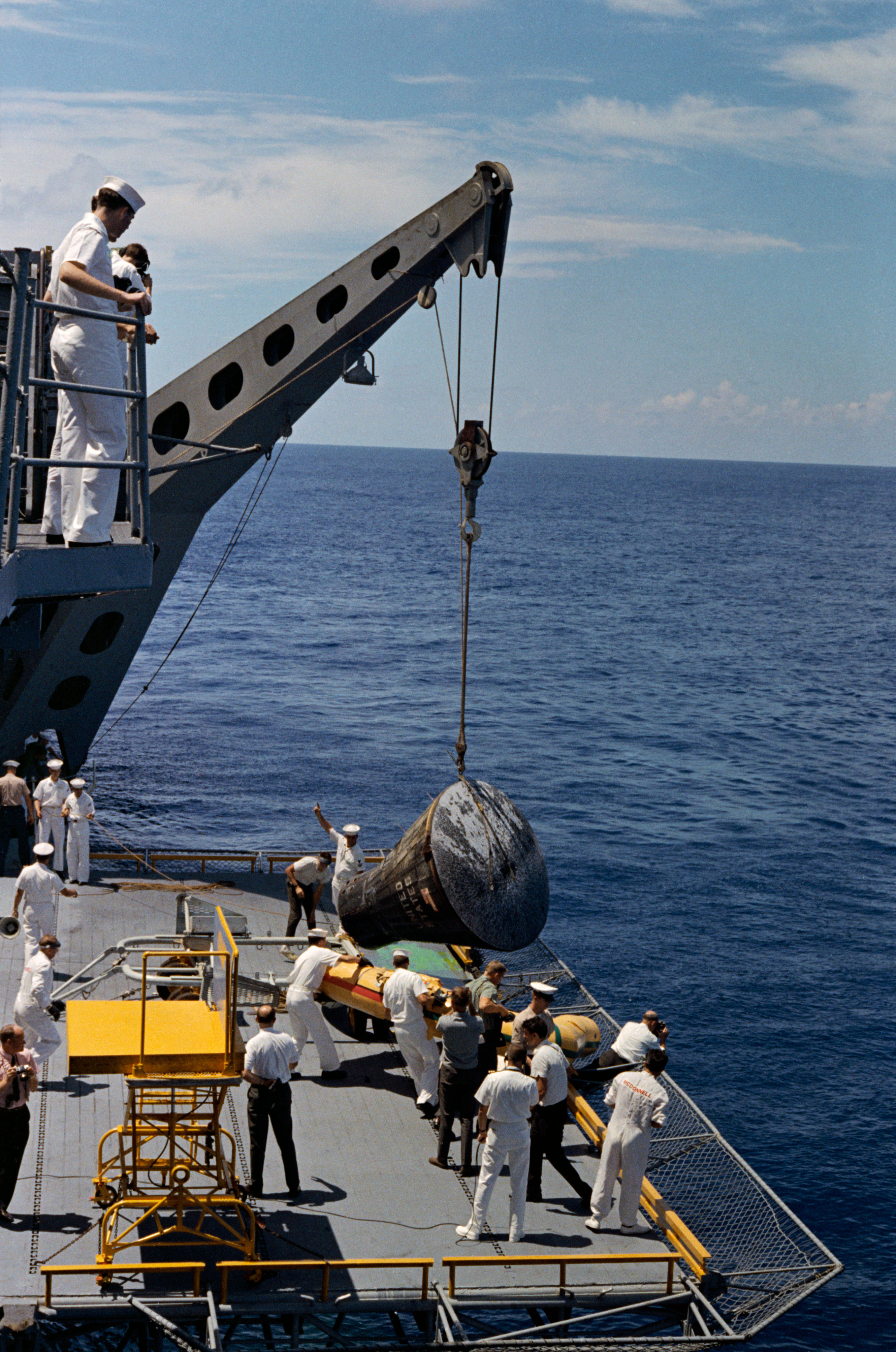
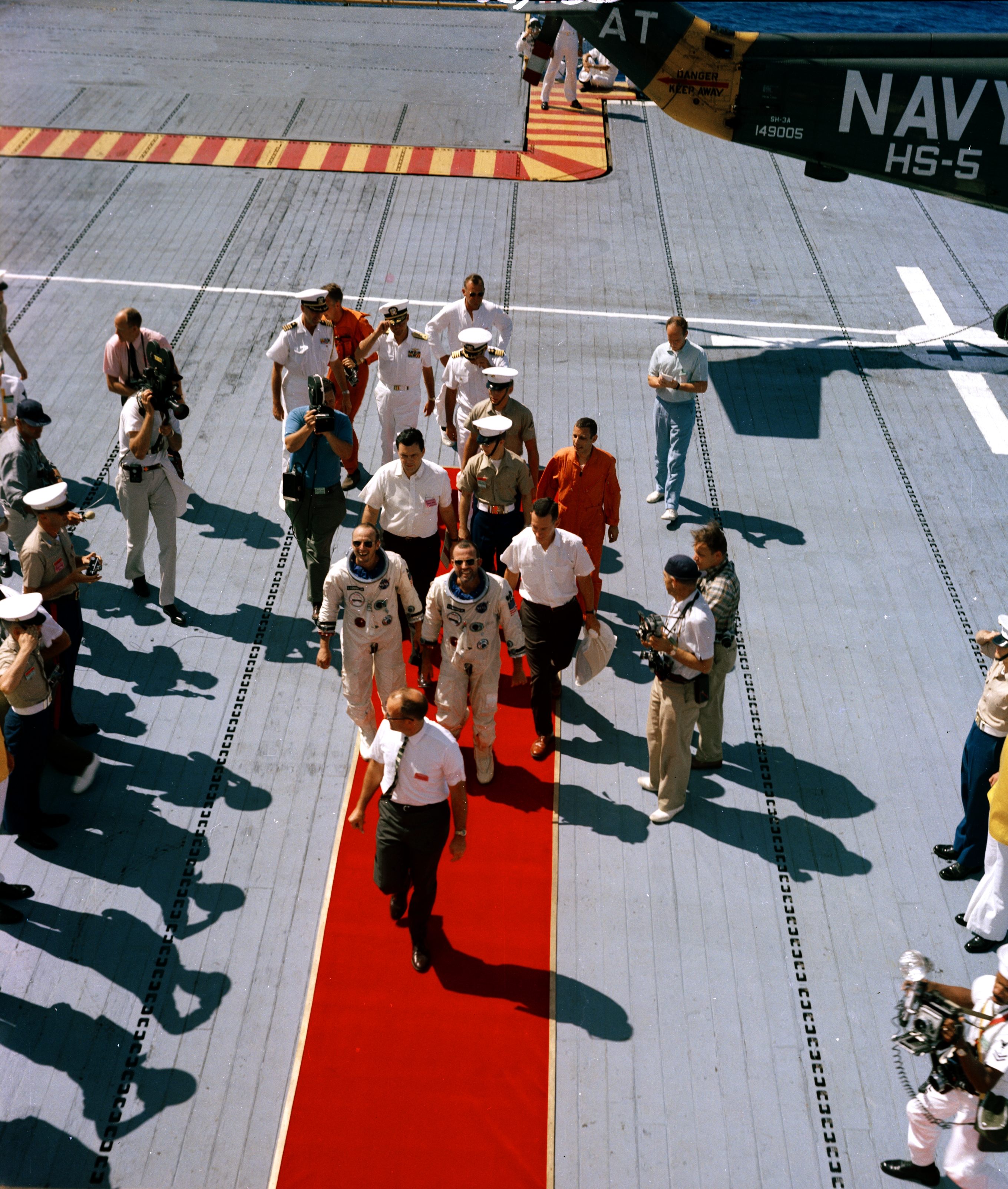
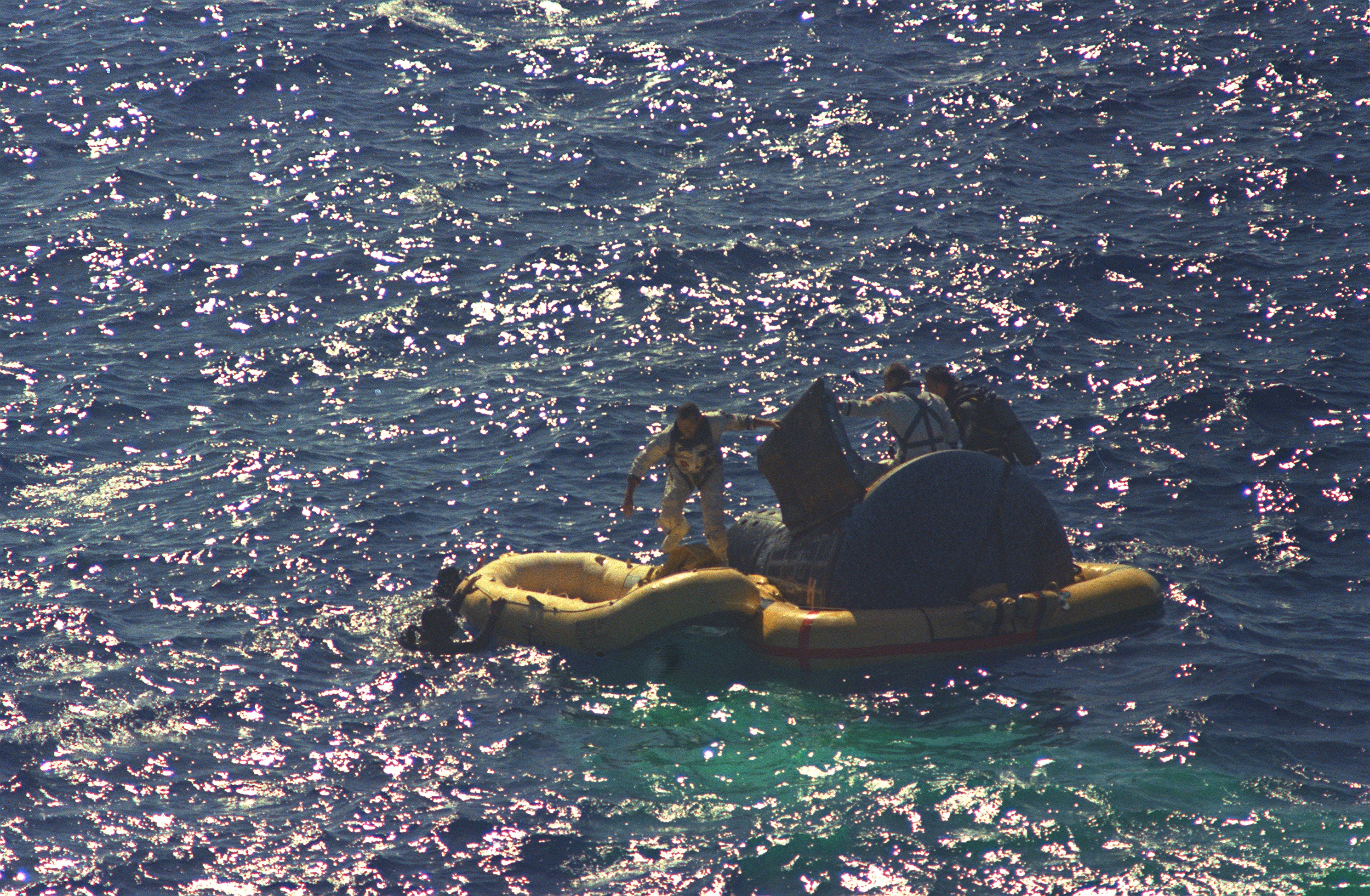
The short landing caused no problems for the U.S. Navy recovery forces. A helicopter soon arrived over the spacecraft and three swimmers dropped into the water. Cooper and Conrad were very comfortable and, with a calm sea, Cooper wanted to stay with the spacecraft on that pleasant summer morning — about 8:30, Cape time — until he learned that the carrier was still 120 kilometres away; then he and Conrad rode the helicopter to the Lake Champlain. The crew arrived on board at 9:26 and the spacecraft was recovered at 11:50. The mission had been supported by Department of Defense resources amounting to 10,265 personnel, 114 aircraft and 19 ships.
The admiral welcomed them aboard ship. Asked what they had been thinking about when it looked as though the fuel cell heater problem might end the mission early, Conrad pointed out a picture he had drawn between the spacecraft seats: a covered wagon halfway over a cliff. The day after splashdown, Cooper and Conrad returned to Kennedy for three days of medical checkups. “It's good to be back here at the place where we spent our last weeks in training,” Cooper said on arrival.
The image that survived from that return — Conrad tweaking Cooper's eight-day beard for the cameramen on the deck of the carrier — captures the tone in which the mission was received: an endurance test passed.
What Gemini 5 proved
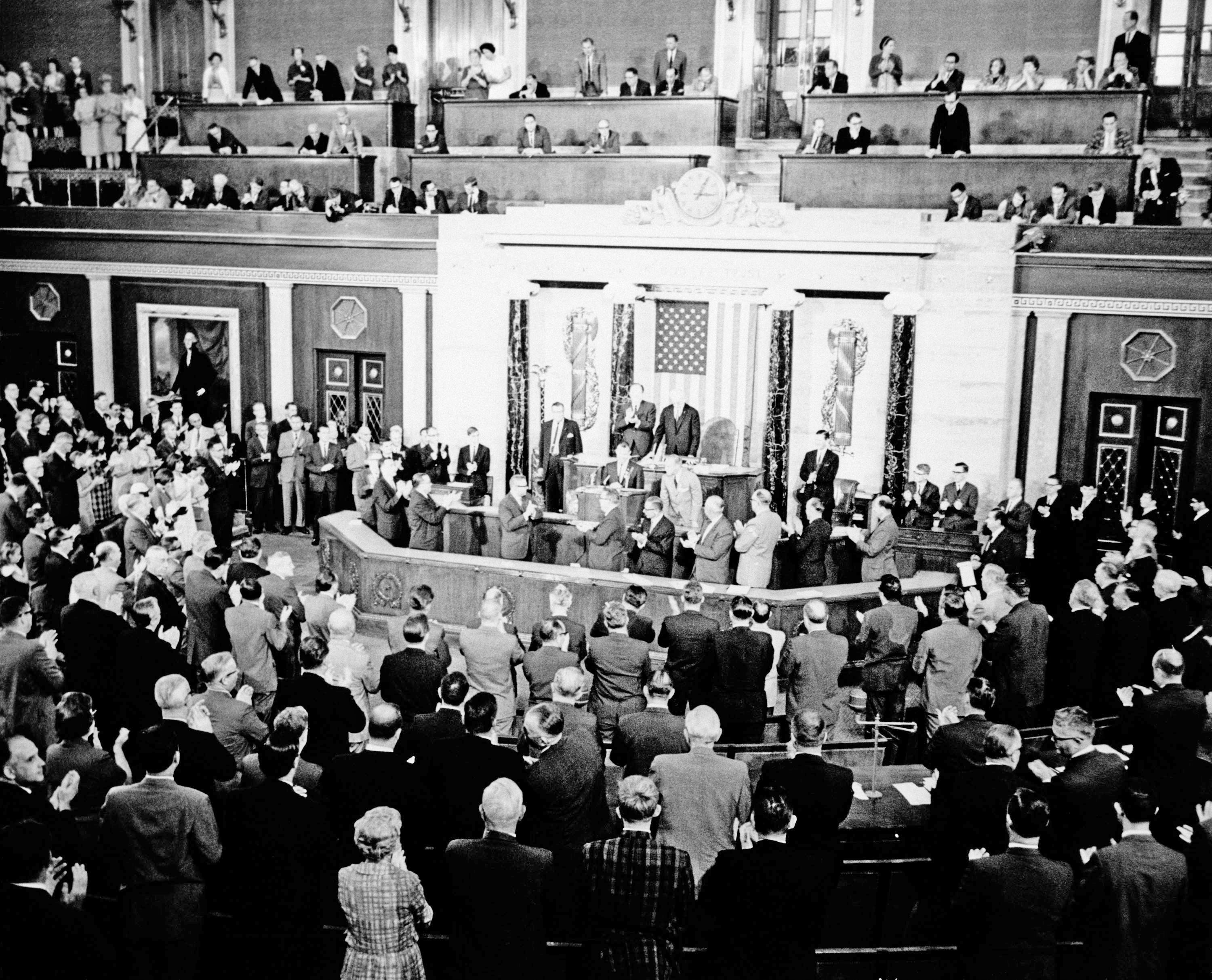
A safe landing and a healthy crew after an eight-day space voyage increased NASA's confidence in achieving its lunar-landing goal during the sixties. In a span of only three months in 1965, and after just two long-duration flights, medical fears of weightlessness began to subside. Hugh Dryden reflected that optimism in his report to the President of 11 September 1965: the primary objective of the Gemini 5 mission, to demonstrate man's ability to function in the space environment for eight days and to qualify the spacecraft systems under those conditions, had been met; the milestone duplicated the period required for a crewed lunar exploration mission and demonstrated the capability of man to withstand prolonged periods of weightlessness. The adaptability of the human body, Dryden wrote, was indicated by the performance of the astronauts: their heartbeat rates gradually dropped to a level significantly lower than their preflight normal rates but, by the fourth day, adapted to the weightless condition and levelled off; on return to Earth the rates were slightly higher than normal, as expected, but returned to normal during the second day. “This has assured us of man's capability to travel to the Moon and return,” he concluded.
By the official accounting, all objectives were achieved except rendezvous with the REP, the pilot tests associated with that rendezvous, and the demonstration of a controlled reentry to a predetermined landing point. The mission demonstrated the human ability to adapt to weightlessness over an extended period and then readapt to normal gravity, and was considered successful.
Gemini 5 also left two personal marks and a collective one. Cooper, a Mercury veteran who had flown more than thirty-four hours and orbited the Earth twenty-two times aboard “Faith 7” in May 1963, became the first person to fly two Earth orbital missions and logged a total of 222 hours in space before retiring from the Air Force and NASA in 1970. For Conrad, selected in 1962 with NASA's second group of astronauts, it was the first of four flights: he would go on to command Gemini XI, Apollo 12 and Skylab 2, logging more than 1,200 hours in space. Wikipedia adds, with reference to duration records, that this was the first time an American crewed mission held the world record for duration, set on 26 August 1965 by breaking the Soviet record set by Vostok 5 in 1963, and that the record might have been one day longer had the mission not been cut short by the approach of Hurricane Betsy.
Postflight activities included a six-nation goodwill tour assigned to the crew by President Johnson. During the trip they attended the International Astronautical Federation Congress in Athens, where they talked with the crew of Voskhod 2, Soviet cosmonauts Alexei Leonov and Pavel Belyayev.
NASA then turned to plans for the rendezvous and docking mission and for the final long-duration flight, both scheduled before the end of the year. The goal of five crewed flights in a single year seemed phenomenal compared with the experience of Project Mercury, but Gemini 4 and Gemini 5 had indeed proved to be, in the words of the programme's historians, pillars of confidence, a solid base from which to build.
The Gemini 5 capsule is on display today at Space Center Houston, in Houston, Texas, on loan from the Smithsonian.
Images