Did you know…
Where was the Arado SC I secretly tested?
Short answer
The aircraft was the Arado SSD I, not an "SC I": it was evaluated at Lipetsk, where it was fitted with a wheeled landing gear to compete against the Heinkel HD 38. That base was where Germany was assembling a clandestine air force. The Heinkel was chosen, and the SSD I was relegated to LVS training duties in 1932.
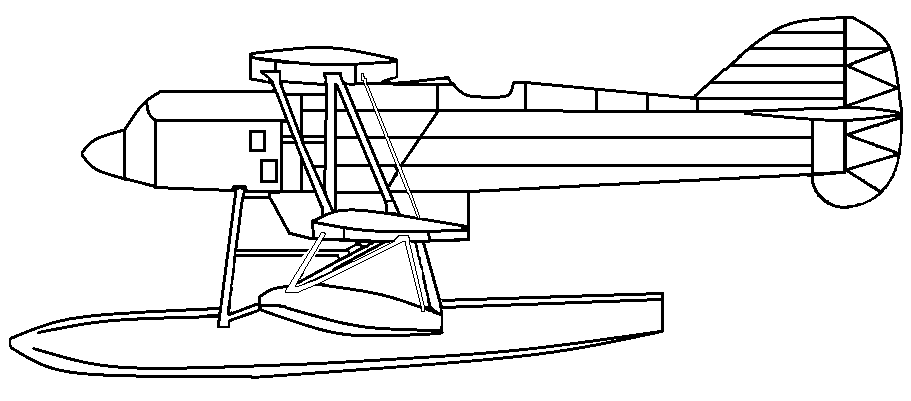
A seaplane fighter designed for the catapult
The Arado SSD I was a single-seat floatplane biplane, produced in 1929 and designed to be launched by catapult from ships at sea. The project came from Walter Rethel's drawing board as an entirely new design, unrelated to the other fighters he had drawn up for Arado in the late 1920s. The configuration was a conventional biplane with unequal, staggered wings, with the upper wing slightly gulled and joined to the top of the fuselage. Flotation was provided by a single large float under the fuselage and two auxiliary floats near the wingtips. Two prototypes were built, and the first made its maiden flight in 1929.
The evaluation at Lipetsk
For the comparative evaluation against the Heinkel HD 38, it was fitted with a simple wheeled landing gear, and that competition took place at Lipetsk. That was where Germany was assembling the clandestine air force meant to be equipped with the Arado SD I.
The verdict and the fate of the type
The aircraft chosen was the Heinkel, and the SSD I was relegated to training duties with the LVS in 1932. The type never entered production.
More questions

Aviation history
Which was the most-produced American fighter of the Second World War?
The Republic P-47 Thunderbolt, of which 15,636 or 15,683 units were built, depending on the source. It was also one of the heaviest fighters of the conflict… more…

Aviation history
Who flew the E-66 at 2,149 km/h?
Konstantin or Vladimir Kokkinaki, depending on the source. Konstantin is credited with the absolute record on a closed 100 km circuit, at 2,148.66 km/h, set… more…

Fly-by-Owen (CC BY SA), vía commons Aviation history
How many I-11Bs were built?
Between 208 and around 450, depending on the source: one of the AISA I-11 reference sheets gives 208 examples built, while All-Aero speaks of around 400 built… more…

Aviation history
How many HH-53s could be converted to Pave Low III?
Eight HH-53C aircraft received an improved systems package and were redesignated HH-53H Pave Low III. The other figure in circulation, nine MH-53H and 32… more…

SCDBob (CC BY SA), vía commons Aviation history
What did the A129 Mangusta's armor protect?
The fuselage: the A129's airframe is armored and, according to All-Aero, designed to protect against 12.7 mm rounds, with partial protection against 23 mm… more…
Fly-by-Owen (CC BY SA), vía commons Aviation history
What landing gear and canopy did the AISA I-11B have?
According to one account, AISA reduced the cockpit canopy and fitted tailwheel gear on the production I-11B. All-Aero claims the opposite: the I-11B was… more…


