Did you know…
How many rockets have exploded?
Short answer
There's no official counter, but orbital launch records show several hundred failures since 1957 out of more than 6,500 attempts: just over 90% of launches have reached orbit. Most failures cluster in the early decades and in test flights of new vehicles (as of September 2026).
A count with no official record
No agency keeps a single tally of "exploded rockets," partly because not every failure ends in an explosion: some vehicles fall into the sea intact, others are destroyed on order of the flight safety officer, and others simply leave their payload in a useless orbit. Independent catalogs that track every orbital launch attempt since Sputnik count more than 6,500 liftoffs and place the overall success rate above 90%, which implies several hundred total or partial failures accumulated over nearly seventy years.
Where the failures cluster
The statistics are heavily skewed toward the early years. Between 1957 and 1962, when the United States and the Soviet Union were learning to build launch vehicles, nearly one in three attempts failed. By the 1970s reliability already hovered around 90%, and today mature vehicles exceed 97%. Current failures fall into two categories: the first flights of a new rocket, often lost by design, and launch vehicles from startups with little accumulated experience.
Explosions that marked an era
Some accidents are part of collective memory. The Soviet N1 failed in all four of its attempts between 1969 and 1972; the second destroyed the pad in one of the largest non-nuclear explosions ever recorded. The Challenger, in 1986, broke apart 73 seconds after liftoff due to a failure in a joint on the solid rocket booster. The first Ariane 5, in 1996, self-destructed because of a software error. More recently, Starship's tests have normalized the loss of vehicles as a development method: SpaceX accepts the destruction of prototypes in exchange for learning faster.
More questions
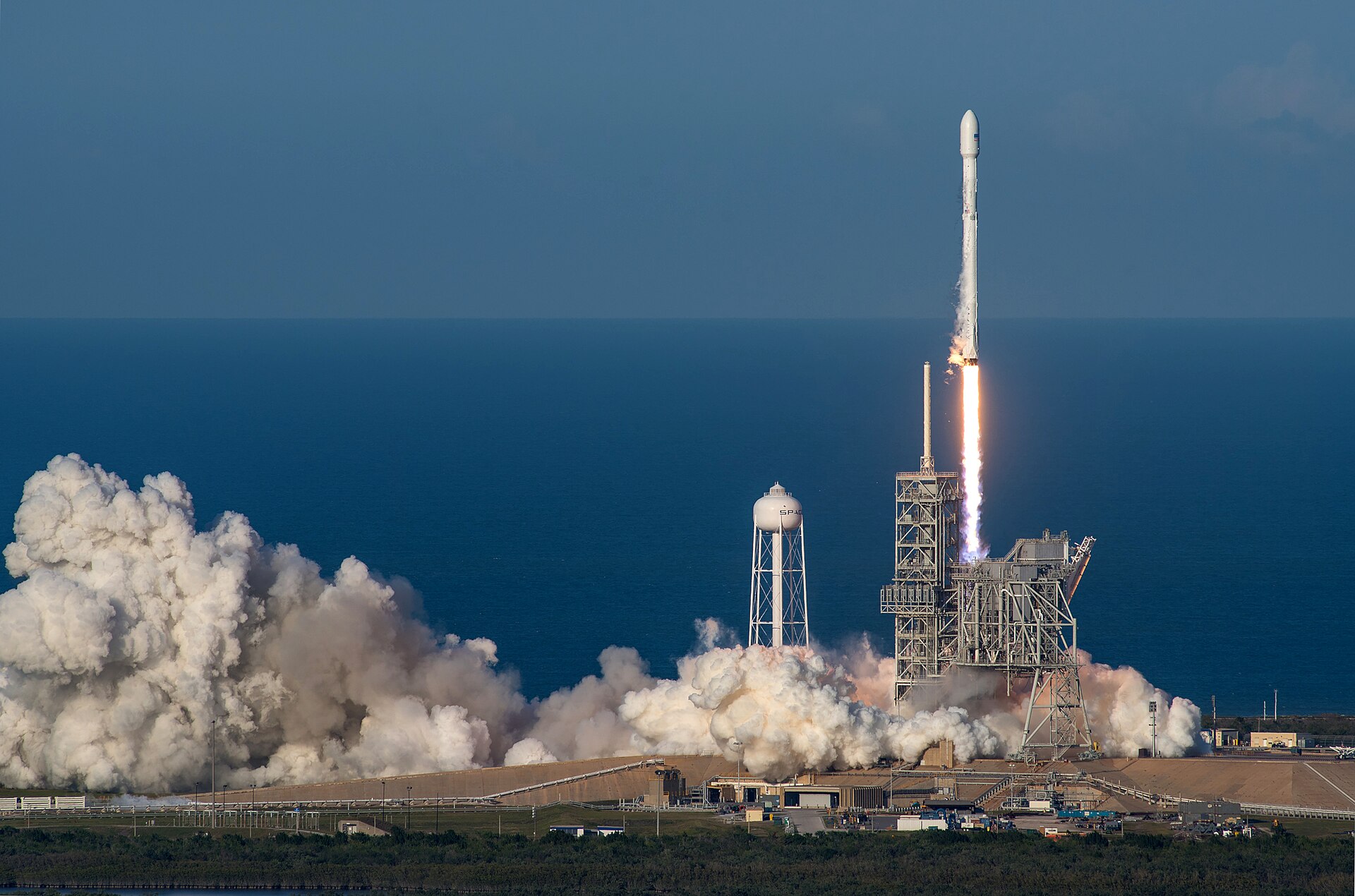
Foto: SpaceX (CC0) Rockets and launches
How many horsepower does the Falcon 9 have?
Rockets aren't measured in horsepower, but in thrust: the Falcon 9's first stage's nine Merlin engines deliver 7,686 kN (1,710,000 lbf) combined at sea level… more…
Foto: SpaceX (CC0) Rockets and launches
How much a rocket weight?
Rockets range from about 13 t for Rocket Lab's Electron to roughly 549 t for Falcon 9, 2,800 t for Saturn V and close to 5,000 t for Starship with its Super… more…

Rockets and launches
What does the saturn v look like?
Saturn V looked like a white needle 110.6 m (363 ft) tall and 10.1 m wide at the base, painted with black roll-pattern stripes, the words UNITED STATES and… more…
Foto: SpaceX (CC0) Rockets and launches
Why do rockets launch from florida?
Rockets launch from Florida because the Cape sits at 28.5 degrees north, low enough to gain about 410 m/s from the Earth's rotation on an eastward launch, and… more…
Foto: SpaceX (CC0) Rockets and launches
How much falcon 9 launch cost?
SpaceX lists a standard Falcon 9 mission at 69.75 million dollars, with the booster recovered (data as of January 2025). Small satellites can share a ride… more…
Rockets and launches
How does the saturn v work?
Saturn V worked by staging: a kerosene first stage with five F-1 engines (about 34,000 kN) lifted the 2,800 t rocket for two and a half minutes, a… more…

