Did you know…
Why is there weightlessness in space?
Short answer
Weightlessness doesn't happen because there's no gravity in space: in the ISS's orbit, Earth pulls almost as strongly as at the surface. What happens is that the station and crew keep falling around the planet; since everything falls at the same rate, nothing presses against a surface anymore. That's called free fall.
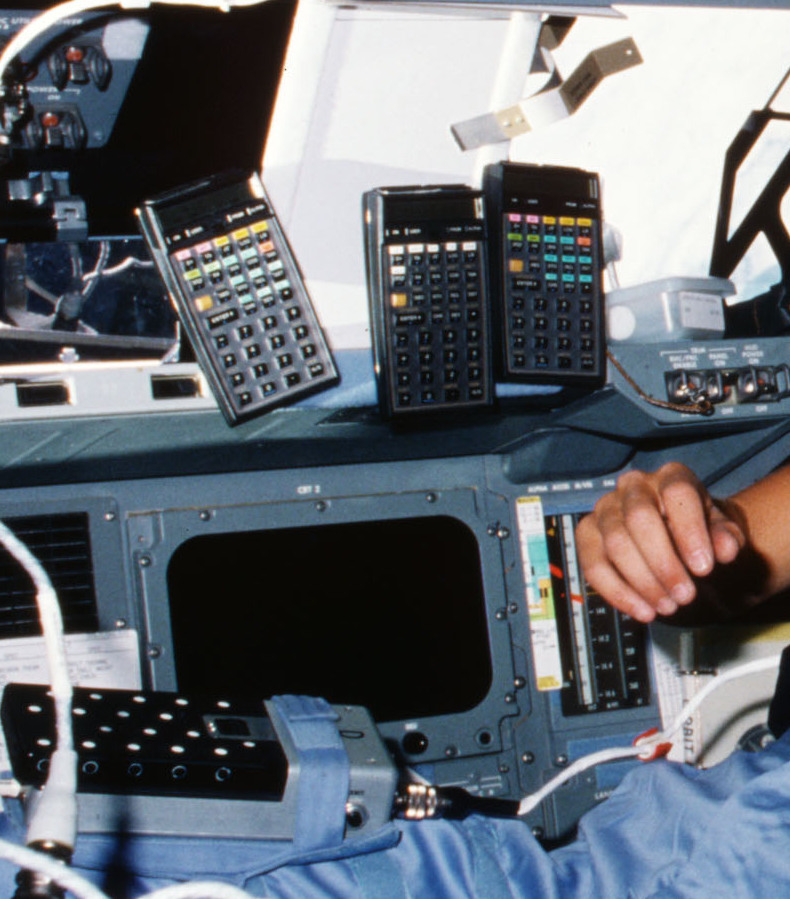
The idea that gravity stops acting beyond the atmosphere is very persistent. In reality, Earth's pull extends without limit; it only decreases with the square of the distance. At just over 400 kilometers of altitude, where the International Space Station orbits, it's barely weaker than at the surface, and it's precisely that pull that keeps the station in its orbit.
A launch that never reaches its destination
An orbit is nothing more than a very, very long throw. If a stone is thrown horizontally, it's seen falling to the ground describing an arc. If it goes fast enough, the Earth's surface curves downward beneath the trajectory just as fast as the stone falls, so it never actually touches the ground. Newton described this with a cannon placed on a very high mountain, long before rockets existed.
The crew falls exactly like their spacecraft. Nothing pushes them against the seat, no floor supports them, and the inner ear no longer detects any direction. The same thing happens in an elevator whose cable breaks, except there the free fall ends within seconds.
Weight disappears, mass remains
Weightless doesn't mean massless. A toolbox has the same inertia on the station as on Earth: it can be pushed with a pinky finger, but stopping it again takes the same effort. That's why astronauts always work tethered, clipped in, or held with velcro tape.
Why it's called microgravity
Free fall is never perfect. Residual atmosphere, orbital maneuvers, fans and crew movements generate tiny accelerations that can still disturb sensitive experiments. That's why specialists prefer to speak of microgravity rather than weightlessness. A laboratory falling without propulsion around the Earth is, nonetheless, much closer to the ideal condition than any facility on the ground.
More questions

Lviatour (CC BY SA), vía commons Astronauts and life in space
What did Neil Armstrong see in the Cueva de los Tayos?
An enormous cave full of life, not an extraterrestrial structure. According to an account by a caver on the team, published in 1979, Armstrong was the guest… more…

Astronauts and life in space
Why do astronauts grow taller in space?
In microgravity, the spine is no longer compressed by body weight: it lengthens and the back's natural curves flatten out. The crew gains a few centimeters… more…

Astronauts and life in space
How do astronauts sleep in space?
Each astronaut on the International Space Station has an individual cabin about the size of a phone booth, with a sleeping bag strapped to the floor, ceiling… more…
Astronauts and life in space
How long do astronauts sleep?
The International Space Station's schedule reserves 8.5 hours of sleep per night for each crew member. In practice, they sleep less: a study published in 2014… more…

Astronauts and life in space
How do astronauts eat in space?
Meals on board are mostly dehydrated foods rehydrated with water from a dispenser, and ready-to-eat thermostabilized dishes warmed in the galley oven, along… more…

Astronauts and life in space
How much money does Alexander Gerst have?
There is no reliable figure for Alexander Gerst's fortune; the amounts on celebrity websites are estimates without basis. What is documented is his… more…


