Did you know…
Why is the sound barrier?
Short answer
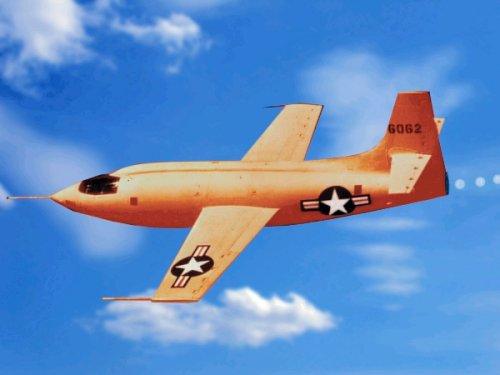
There is no physical wall in the air: the sound barrier is the sharp rise in drag and loss of control that early aircraft met near Mach 1, when shock waves form on the wings before the aircraft itself is supersonic. Thin swept wings, all-moving tails and enough thrust solved it, and the first level supersonic flight came in 1947 with the Bell X-1.
A name for a problem, not a thing
The phrase entered popular language in the 1930s and 1940s, when aircraft first flew fast enough to run into trouble approaching the speed of sound, and reporters turned engineers' talk of a compressibility barrier into something that sounded like a wall. There is no wall. What exists is a region, roughly from Mach 0.8 to Mach 1.2, where the behaviour of air changes character, and aircraft designed for lower speeds behave badly in it. Diving fighters of the Second World War such as the P-38 Lightning met it first: violent buffeting, controls that went stiff, and a nose that tucked down and could not be pulled up.
What the air does
Air flowing over a curved wing accelerates, so local flow reaches Mach 1 while the aircraft is still well below it. Where the flow decelerates back to subsonic speed it does so through a shock wave, a thin surface across which pressure jumps abruptly. Behind the shock the boundary layer separates, lift is lost over that part of the wing, and drag rises several-fold in what engineers call the transonic drag rise. On a conventional tailplane the shock sat exactly where the elevator hinge was, so elevator deflection stopped having any effect. Propellers, whose tips run faster than the aircraft, hit the same problem earlier, which is one reason no propeller-driven aircraft has flown supersonic in level flight.
How it was crossed
The solutions came from theory, wind tunnels and one famous flight. Thin wings and wing sweep delay the onset of local supersonic flow; German research of the 1930s on swept wings was adopted worldwide after 1945. An all-moving horizontal stabiliser, fitted to the Bell X-1 at the suggestion of NACA engineers, restored pitch control. Enough thrust, from rockets or afterburning jets, pushed through the drag rise rather than around it. On 14 October 1947 Chuck Yeager took the X-1 to Mach 1.06 in level flight over the Mojave Desert, and the barrier was shown to be an engineering problem rather than a law of nature. Richard Whitcomb's area rule, published in 1952, then explained why fuselages need to be pinched at the wing root, and within a decade fighters flew at Mach 2 routinely.
What remains of it
Today the barrier survives mostly as cost. Supersonic wave drag is real and permanent, so fuel consumption per kilometre roughly doubles compared with a subsonic jet. The sonic boom persists along the whole ground track, and regulation, not physics, is what keeps civil aircraft subsonic over land.
More questions
Physics of flight
Why does the sound barrier exist?
The sound barrier exists because pressure disturbances travel through air at the speed of sound. Below Mach 1 the air ahead of an aircraft receives warning… more…
Physics of flight
Why does the speed of sound change with altitude?
The speed of sound changes with altitude because it depends on air temperature, and temperature falls as you climb through the troposphere. Colder molecules… more…
Physics of flight
Why do planes need airplane mode?
Airplane mode is required mainly by regulation and caution, not by a proven history of accidents. Regulators such as the FAA and EASA require devices to stop… more…
Physics of flight
How far is the speed of sound?
The speed of sound is a speed, not a distance: in air at 20 °C and sea level it is about 343 m/s (1,235 km/h, 667 kn), so sound covers one kilometre in… more…
Physics of flight
How much is the sound barrier?
The sound barrier is not a price or a quantity: it is the speed of sound, which an aircraft meets at Mach 1. That speed is about 343 m/s (1,235 km/h, 667 kn)… more…
Physics of flight
How does the sound barrier break?
The sound barrier is not broken so much as crossed: an aircraft with enough thrust and a shape that tolerates shock waves accelerates through Mach 1. Chuck… more…