Did you know…
Why does the sound barrier exist?
Short answer
The sound barrier exists because pressure disturbances travel through air at the speed of sound. Below Mach 1 the air ahead of an aircraft receives warning and flows smoothly around it; near Mach 1 that warning can no longer arrive, so air compresses abruptly into shock waves. Those waves cause a steep drag rise and control changes that early aircraft could not overcome.
Sound is the messenger
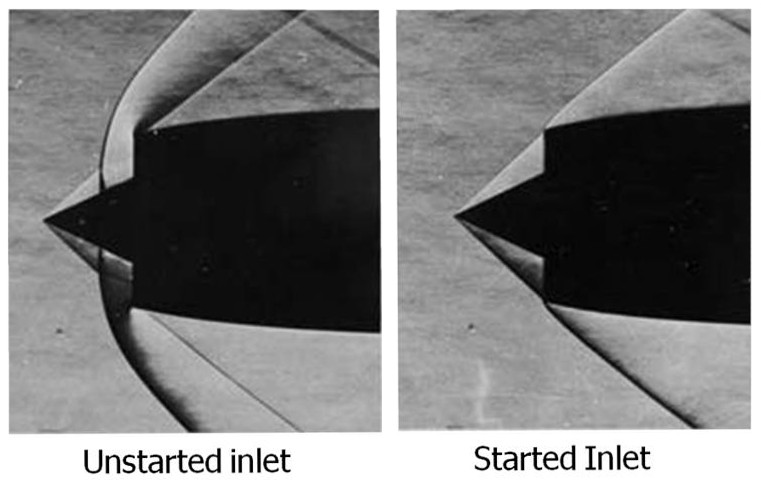
Air is not a solid wall in front of an aircraft; it moves aside because the pressure disturbance from the approaching nose reaches it first and starts it moving. That disturbance travels at exactly the speed of sound, since a sound wave and a pressure signal are the same thing. As long as the aircraft is slower than sound, the signal runs ahead, the air begins to divert before the aircraft arrives, and the flow bends smoothly around wings and fuselage. As the aircraft speeds up, the signal has less of a head start. At the speed of sound it has none: the aircraft arrives at the same instant as its own pressure wave, and the air has no warning at all.
Shock waves and the drag rise
Air that cannot move aside in advance is compressed almost instantly in a very thin layer, a shock wave, across which pressure, density and temperature jump. Creating that jump takes energy that comes from the aircraft, and it appears as a sudden increase in drag, often several times the subsonic value in the transonic range around Mach 0.8 to 1.2. Shocks form first over the wing's curved upper surface, where air is accelerated to local supersonic speed while the aircraft itself is still subsonic. Behind the shock the airflow tends to separate from the surface, producing heavy buffet and a loss of lift. The barrier is therefore not at one exact speed; it is a band of speeds in which the behaviour of the air changes character.
Why it felt like a wall
The name dates from the Second World War, when fast propeller fighters in steep dives reached about Mach 0.8 and met effects nobody had designed for. Shocks over the wing moved the centre of lift rearward, pitching the nose down further into the dive, a tendency called Mach tuck. Hinged elevators sitting in the disturbed air behind a shock lost their authority, so pulling on the stick did nothing, and several aircraft broke up or flew into the ground. Propellers made it worse, because their tips went supersonic before the aircraft did and lost thrust. Engineers knew the physics of bullets and artillery shells, which pass through the region routinely, but it took jet and rocket engines, thin wings and an all-moving tail to give a piloted aircraft the thrust and control to do the same. Once those tools existed, the barrier remained real as a drag rise and a sonic boom, but ceased to be a limit.
More questions
Physics of flight
Why does the speed of sound change with altitude?
The speed of sound changes with altitude because it depends on air temperature, and temperature falls as you climb through the troposphere. Colder molecules… more…
Physics of flight
Why do planes need airplane mode?
Airplane mode is required mainly by regulation and caution, not by a proven history of accidents. Regulators such as the FAA and EASA require devices to stop… more…
Physics of flight
How far is the speed of sound?
The speed of sound is a speed, not a distance: in air at 20 °C and sea level it is about 343 m/s (1,235 km/h, 667 kn), so sound covers one kilometre in… more…
Physics of flight
How much is the sound barrier?
The sound barrier is not a price or a quantity: it is the speed of sound, which an aircraft meets at Mach 1. That speed is about 343 m/s (1,235 km/h, 667 kn)… more…
Physics of flight
How does the sound barrier break?
The sound barrier is not broken so much as crossed: an aircraft with enough thrust and a shape that tolerates shock waves accelerates through Mach 1. Chuck… more…
Physics of flight
How does the sound barrier work?
The sound barrier is the sharp rise in drag and control difficulty an aircraft meets as it nears Mach 1, about 1,062 km/h (573 kn) at cruise altitude. Air… more…