Did you know…
Why does the sound barrier break?
Short answer
The sound barrier is not a physical wall: it is the sharp rise in drag and loss of control that pilots met near the speed of sound (about 1,225 km/h, 661 kn, at sea level). Above it, the air cannot move out of the way in time and piles into shock waves. Aircraft designed for it pass through; the bang heard on the ground is those shocks.
A barrier that is really a regime
Air transmits pressure disturbances at the speed of sound, about 340 m/s (1,225 km/h, 661 kn) at sea level and closer to 295 m/s (1,062 km/h) in the cold air at airliner cruise altitude. An aircraft moving slower than that sends a warning ahead of itself: its pressure field reaches the air in front and the flow parts smoothly. As the aircraft closes on Mach 1 the warning arrives with less and less lead time, and at Mach 1 it does not arrive at all. The air is struck without notice and its pressure, density and temperature change almost instantaneously across a thin surface: a shock wave.
Well before the aircraft as a whole reaches Mach 1, air accelerating over the curved top of the wing goes supersonic locally, so small shocks appear on the wing at flight speeds of about Mach 0.8. The band between roughly Mach 0.8 and 1.2 is the transonic regime, and it is where the trouble lies.
What broke the early jets
In the transonic regime drag rises steeply, sometimes several-fold, because the shocks cost energy and thicken the boundary layer behind them. Worse, the shocks move around on the wing as speed changes, shifting the centre of lift backward and starving the tail of clean airflow. Pilots of late-war piston fighters diving at high speed met heavy nose-down pitching, controls that seemed frozen and violent buffeting; some aircraft broke up. To the engineers of the 1940s the drag rise looked like a wall on the graph, and the press called it the sound barrier.
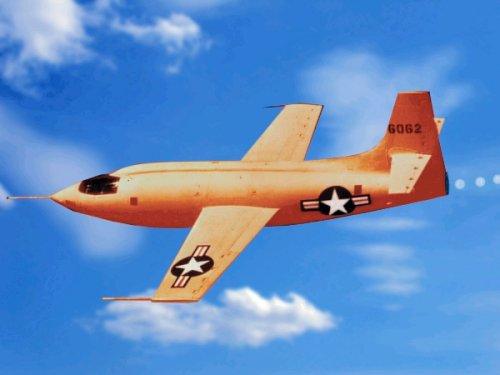
The solution was not brute force alone but geometry: thin wings, sweepback to reduce the effective Mach number seen by the wing, an all-moving tailplane to keep pitch control, and later the area rule, which smooths the change in cross-section along the fuselage. On 14 October 1947 Chuck Yeager took the rocket-powered Bell X-1, shaped like a .50-calibre bullet with straight thin wings, to Mach 1.06 at about 13,000 m (43,000 ft). The barrier was through, and the far side turned out to be calmer: once fully supersonic the flow steadies, and drag, though high, stops rising as sharply.
The bang on the ground
The shock waves do not vanish once an aircraft is past Mach 1; they trail behind it as a cone whose angle depends on the Mach number. Where the cone touches the ground, people hear a sonic boom, typically a double bang from the nose shock and tail shock arriving a fraction of a second apart. That is why the barrier is usually said to be broken rather than crossed: the audible event is a real, sudden release of energy, and it accompanies the aircraft for as long as it stays supersonic.
More questions
Physics of flight
Why does the sound barrier exist?
The sound barrier exists because pressure disturbances travel through air at the speed of sound. Below Mach 1 the air ahead of an aircraft receives warning… more…
Physics of flight
Why does the speed of sound change with altitude?
The speed of sound changes with altitude because it depends on air temperature, and temperature falls as you climb through the troposphere. Colder molecules… more…
Physics of flight
Why do planes need airplane mode?
Airplane mode is required mainly by regulation and caution, not by a proven history of accidents. Regulators such as the FAA and EASA require devices to stop… more…
Physics of flight
How far is the speed of sound?
The speed of sound is a speed, not a distance: in air at 20 °C and sea level it is about 343 m/s (1,235 km/h, 667 kn), so sound covers one kilometre in… more…
Physics of flight
How much is the sound barrier?
The sound barrier is not a price or a quantity: it is the speed of sound, which an aircraft meets at Mach 1. That speed is about 343 m/s (1,235 km/h, 667 kn)… more…
Physics of flight
How does the sound barrier break?
The sound barrier is not broken so much as crossed: an aircraft with enough thrust and a shape that tolerates shock waves accelerates through Mach 1. Chuck… more…