Did you know…
Why does the sound barrier boom?
Short answer
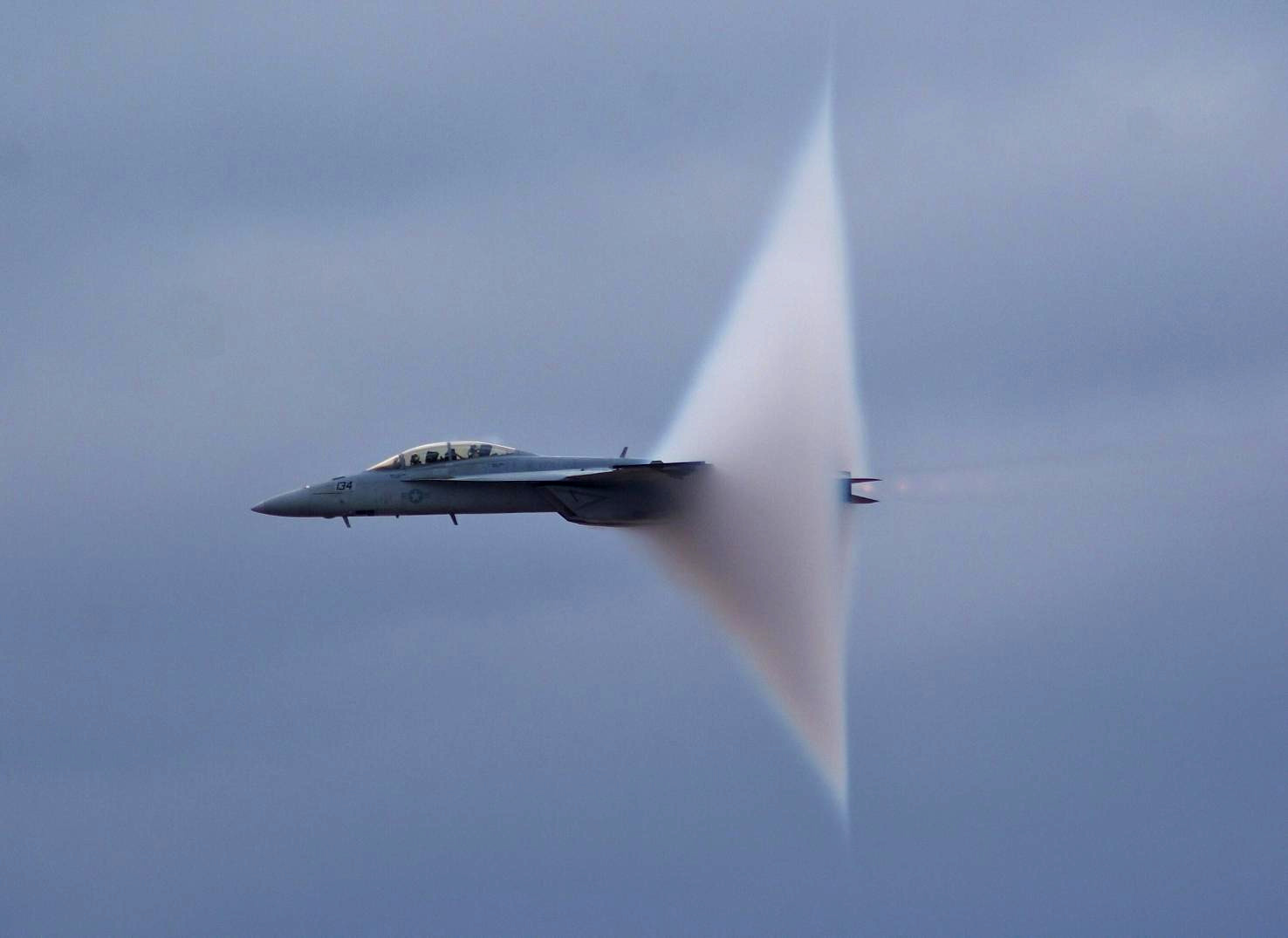
The boom is not the aircraft breaking anything: it is the shock waves that any supersonic aircraft drags behind it, heard as a sudden pressure jump when the cone sweeps past a listener. Nose and tail shocks produce a double bang, and the boom continues along the entire supersonic track, not just at the moment Mach 1 is crossed.
-1600.webp)
A cone, not an explosion
The popular image is of an aircraft punching through a wall of sound with a single bang. The reality is a continuous phenomenon. Every supersonic aircraft drags a cone of shock waves behind it, and the boom is the sound of that cone sweeping across the ground. A listener hears one bang as the cone passes, but a listener 10 km further along the track hears it a few seconds later, and so on for the whole supersonic flight. The crew hears nothing, because the cone trails behind them; a fighter at Mach 1.5 lays down a boom carpet roughly 30 to 50 km wide beneath its path.
What makes the sound
At subsonic speeds pressure disturbances run ahead of the aircraft and spread smoothly. Above Mach 1 they cannot outrun their source, so they stack up into shock waves, thin surfaces where pressure jumps almost instantly. Far from the aircraft the many individual shocks from nose, canopy, wings and tail merge into two: a leading shock where pressure rises sharply and a trailing shock where it snaps back after a dip. Plotted against time this is an N shape, and the ear responds to the two abrupt edges with a double bang about a tenth of a second apart for a fighter, longer for an airliner. Concorde's boom was measured at roughly 100 Pa of overpressure at the ground, enough to rattle windows.
Why crossing Mach 1 seems special
The moment of acceleration through Mach 1 can produce a focused boom. As the aircraft accelerates, shocks generated at slightly different speeds arrive at the ground simultaneously in a narrow zone, and the overpressure there can be several times the steady-state value. That is the origin of the idea that the barrier itself booms. Weather adds another twist: temperature and wind gradients refract the shock, so a boom can be heard well off track or, at low supersonic Mach numbers, not reach the ground at all, because the shock bends upward before it arrives.
Quieting it
Because the boom follows the aircraft everywhere, most countries prohibited civil supersonic flight over land in the 1970s, which confined Concorde to ocean routes. NASA's X-59 experiment reverses the question: by stretching the fuselage and positioning engine and wing so that the individual shocks never coalesce into a sharp N-wave, the aim is a soft thump of about 75 perceived decibels, comparable to a car door closing at a distance.
More questions
Physics of flight
Why does the sound barrier exist?
The sound barrier exists because pressure disturbances travel through air at the speed of sound. Below Mach 1 the air ahead of an aircraft receives warning… more…
Physics of flight
Why does the speed of sound change with altitude?
The speed of sound changes with altitude because it depends on air temperature, and temperature falls as you climb through the troposphere. Colder molecules… more…
Physics of flight
Why do planes need airplane mode?
Airplane mode is required mainly by regulation and caution, not by a proven history of accidents. Regulators such as the FAA and EASA require devices to stop… more…
Physics of flight
How far is the speed of sound?
The speed of sound is a speed, not a distance: in air at 20 °C and sea level it is about 343 m/s (1,235 km/h, 667 kn), so sound covers one kilometre in… more…
Physics of flight
How much is the sound barrier?
The sound barrier is not a price or a quantity: it is the speed of sound, which an aircraft meets at Mach 1. That speed is about 343 m/s (1,235 km/h, 667 kn)… more…
Physics of flight
How does the sound barrier break?
The sound barrier is not broken so much as crossed: an aircraft with enough thrust and a shape that tolerates shock waves accelerates through Mach 1. Chuck… more…