Did you know…
Why do planes use knots?
Short answer
Aviation uses knots because a knot is one nautical mile per hour, and a nautical mile equals one minute of latitude on a chart. That link between speed, distance and coordinates makes navigation arithmetic simple, and ICAO kept the unit as a permitted non-SI exception when the rest of aviation moved to metric.
A unit born on the sea
The knot predates aviation by centuries. Sailors measured speed by paying out a line knotted at regular intervals behind the ship and counting how many knots ran through their hands while a sand glass emptied. The unit that survived is one nautical mile per hour, and the nautical mile is the useful part: it was defined as one minute of arc of latitude, so a distance measured on a chart with dividers could be read directly off the latitude scale printed on the side. Since 1929 the international nautical mile has been fixed at exactly 1,852 m, roughly 1.15 statute miles, close enough to the original geometric definition for practical navigation.
Why aviation adopted it
Early aircraft used whatever their home country used: miles per hour in Britain and the United States, kilometres per hour in most of continental Europe. The shift to knots came with long-range navigation in the 1930s and 1940s, when aircrews borrowed marine charts, marine techniques and marine instructors. Dead reckoning, wind triangles and radio bearings are all easier when speed, distance and coordinates share the same base. Postwar airspace was organised around ICAO, and ICAO's Annex 5 lists the knot, the nautical mile and the foot as non-SI units that may be used alongside metric units for the foreseeable future. Air traffic control, charts, flight plans and instrument approach procedures were built on that convention, and changing it would mean touching every one of them at once.
Where the metric world still shows
Not everyone uses knots. Russia, China and several former Soviet states have historically flown in metres and kilometres per hour, which is why glass cockpits offer switchable units and why flights into those regions still require conversion tables and careful briefing. Weights, fuel and temperature are already metric in most of the world, and wind is given in knots even in countries that otherwise think in kilometres. The result is a hybrid that pilots learn to live with: altitude in feet, speed in knots, visibility in metres, pressure in hectopascals, and no plan to unify them soon.
What the knot actually measures
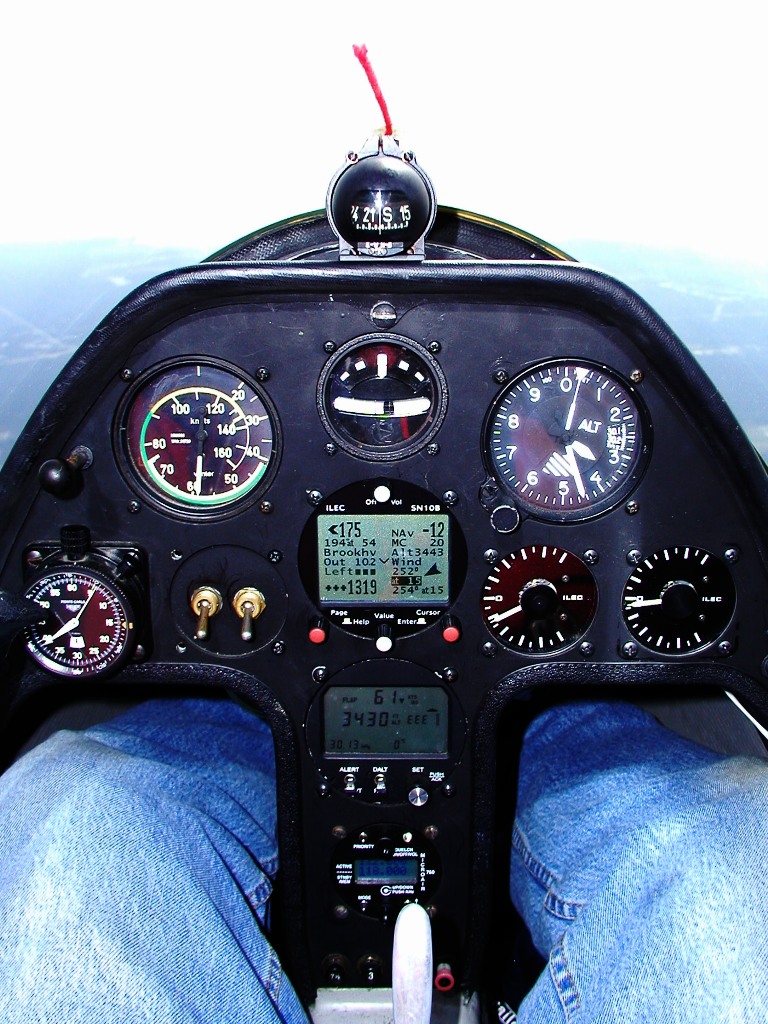
A last point of nuance: the airspeed indicator shows indicated airspeed, which is what the wing feels, not the aircraft's speed over the ground. True airspeed corrects for altitude and temperature, and ground speed adds the wind. All three are quoted in knots, and the distinction is exactly why the unit matters: a pilot planning a 600 NM leg at 450 kn ground speed knows, without a calculator, that it will take one hour and twenty minutes.
More questions
Physics of flight
Why does the sound barrier exist?
The sound barrier exists because pressure disturbances travel through air at the speed of sound. Below Mach 1 the air ahead of an aircraft receives warning… more…
Physics of flight
Why does the speed of sound change with altitude?
The speed of sound changes with altitude because it depends on air temperature, and temperature falls as you climb through the troposphere. Colder molecules… more…
Physics of flight
Why do planes need airplane mode?
Airplane mode is required mainly by regulation and caution, not by a proven history of accidents. Regulators such as the FAA and EASA require devices to stop… more…
Physics of flight
How far is the speed of sound?
The speed of sound is a speed, not a distance: in air at 20 °C and sea level it is about 343 m/s (1,235 km/h, 667 kn), so sound covers one kilometre in… more…
Physics of flight
How much is the sound barrier?
The sound barrier is not a price or a quantity: it is the speed of sound, which an aircraft meets at Mach 1. That speed is about 343 m/s (1,235 km/h, 667 kn)… more…
Physics of flight
How does the sound barrier break?
The sound barrier is not broken so much as crossed: an aircraft with enough thrust and a shape that tolerates shock waves accelerates through Mach 1. Chuck… more…