Did you know…
Where do passenger planes carry their fuel?
Short answer
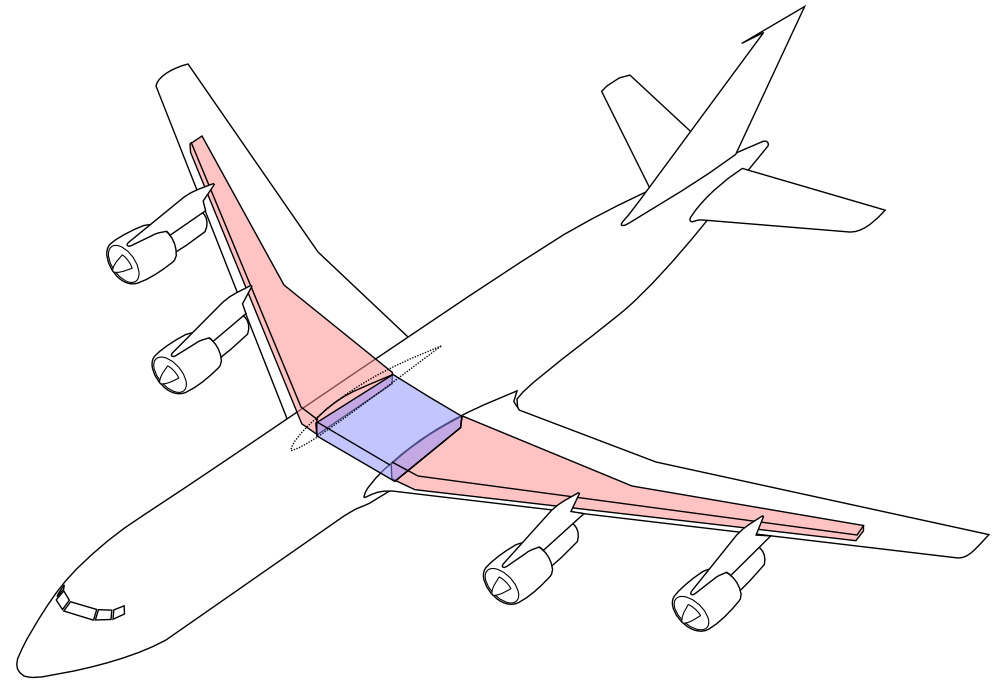
A passenger plane's fuel is stored inside the wings, in integral tanks formed by the wing's own sealed structure, and in a center tank under the fuselage, within the wing box. Some long-haul aircraft, such as the A330, A340 or A380, add a trim tank in the tail.
The wing, the main tank
In the vast majority of commercial aircraft, fuel does not travel in separate tanks as in a car, but in "integral tanks": the wing's own interior structure, between spars and ribs, is sealed and turned into a large tank. It is an efficient solution in terms of weight and space, because it makes use of a structure that has to exist anyway to hold the aircraft up in flight, and it places the fuel's weight near the center of lift, where the wing flexes less.
A center tank and, sometimes, one in the tail
Many wide-body aircraft and some large single-aisle jets add a center tank, located in the lower part of the fuselage, right where the two wing halves meet the central structure known as the torsion box. It is used for long flights that cannot be covered by the wings alone. Some very long-haul aircraft, such as the Airbus A330, the A340 or the A380, also incorporate a trim tank in the horizontal tail stabilizer: besides adding capacity, it allows fuel to be shifted aft during cruise to move the center of gravity, reduce tail drag and save fuel.
Why it doesn't go in the central passenger fuselage
Storing fuel under the passenger cabin, far from the wings, would complicate the structure and weight distribution, and would increase the risk in the event of an impact. That is why engineers concentrate fuel in the wings and in the wing box, the structurally most reinforced area of the aircraft and one protected against external damage by the very design of its ribs and spars, and only resort to tail tanks in designs optimized for very long transoceanic routes.
More questions

Foto: 4300streetcar (CC BY 4.0) Commercial aviation
Which 747 carried Enterprise "piggyback"?
The first Shuttle Carrier Aircraft was a Boeing 747-123 registered N905NA, originally built for American Airlines and acquired by NASA in 1974. Boeing… more…

Commercial aviation
Was there an amphibious DC-3?
Yes: the Douglas XC-47C was created by fitting Edo Model 78 floats onto a standard C-47. The single-step metal floats carried retractable wheels that also… more…

OTFW, Berlin (CC BY SA), vía commons Commercial aviation
Was a C-47 converted into a glider?
Yes: the Douglas XCG-17 was an assault glider created by converting a twin-engine C-47 Skytrain during World War II. Its engines were removed and the nacelles… more…
Commercial aviation
What did the USSR build from the DC-3?
The USSR built a version of the DC-3 under a licence granted to its government on 15 July 1936. It was designated PS-84 and, in 1942, renamed Lisunov Li-2… more…
Commercial aviation
What was "Puff, the Magic Dragon"?
It was the nickname of the Douglas AC-47 Spooky, the first in a series of fixed-wing gunships developed by the United States Air Force during the Vietnam War… more…
Commercial aviation
How did the RAF refer to the C-47?
The RAF called it Dakota: the Dakota I was the designation for 53 C-47s received under Lend-Lease. The Dakota III designated 962 C-47A Skytrains. The Dakota… more…


