Did you know…
When does a rocket launch into space?
Short answer
A rocket launches when its launch window opens, the interval during which Earth's rotation lines up the pad with the desired orbit, and only if weather and systems give the all clear. Once airborne, it crosses the Kármán line at 100 km in about two to three minutes and reaches orbit at roughly 7.8 km/s around nine minutes in.

The launch window
A rocket can't lift off at just any time. Earth rotates, and the pad only passes through the target orbit's plane once or twice a day. To reach the International Space Station the window is practically instantaneous: a margin of seconds. For a geostationary satellite it usually lasts an hour or two, and for an interplanetary probe the window is measured in weeks, recurring every 26 months in Mars's case, when the geometry between the planets allows the trip with the least propellant. Within the window, liftoff also requires winds, clouds, and electrical activity within limits, a safety range clear of ships and aircraft, and a rocket whose thousands of sensors show no anomaly during the countdown.
The minutes of ascent
After ignition, the vehicle climbs vertically for a few seconds and then tilts its trajectory toward the horizon to build horizontal speed, which is what actually sustains an orbit. At around one minute it passes through the zone of maximum dynamic pressure, where the structure is under the greatest stress. Around the three-minute mark it crosses 100 km in altitude, the Kármán line conventionally used as the boundary of space; around there the first stage separates and the payload fairing is jettisoned, no longer needed once there's no air to protect against.
Reaching orbit
Being in space isn't the same as being in orbit. To avoid falling back down, the second stage keeps accelerating to about 7.8 km/s (28,000 km/h), usually achieved eight to ten minutes after liftoff for low Earth orbit. A sounding rocket, by contrast, passes 100 km for a few minutes and comes back down: it has been in space without having orbited. Missions to higher orbits or to the Moon add further engine burns, sometimes hours later.
More questions
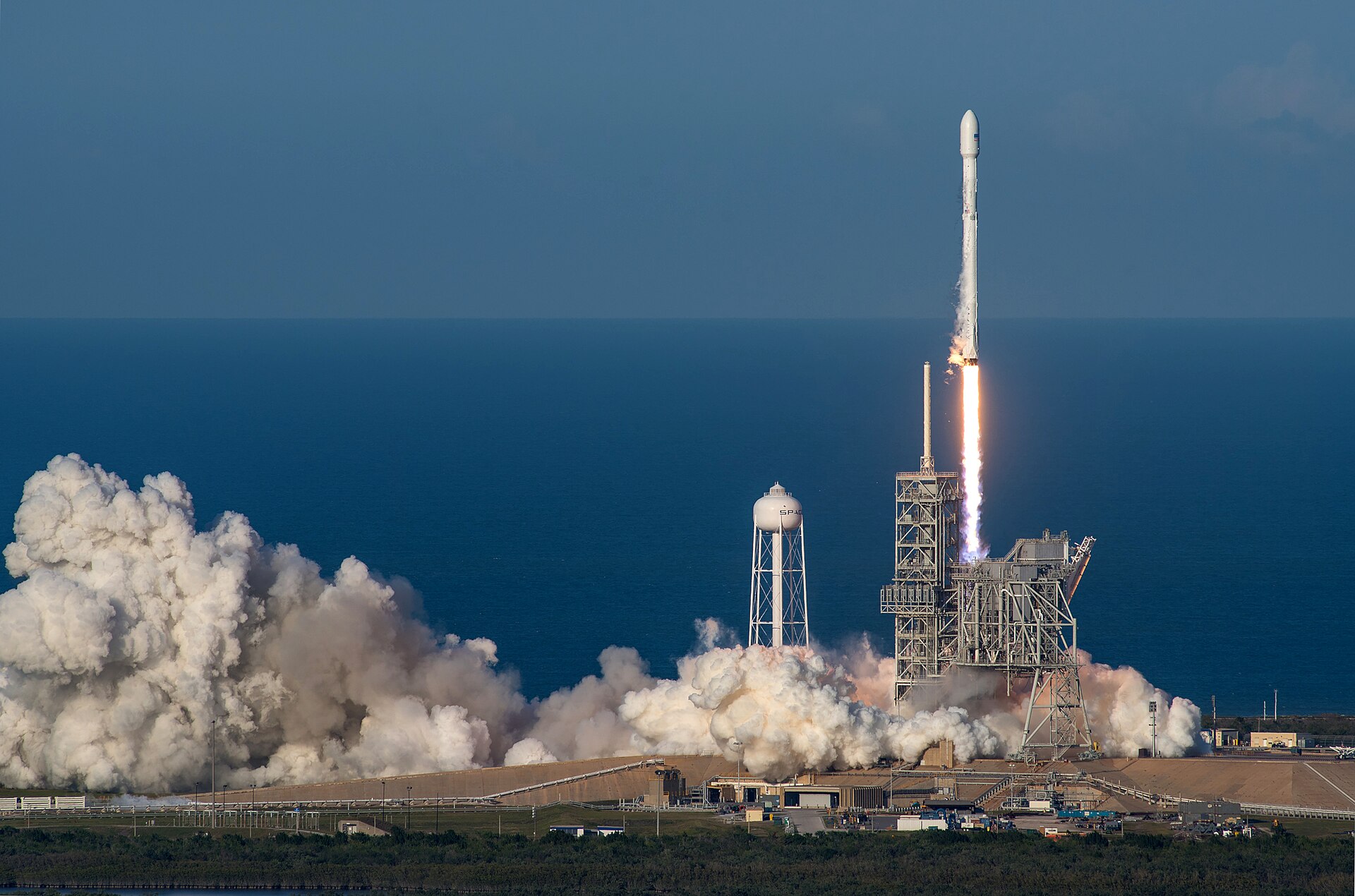
Foto: SpaceX (CC0) Rockets and launches
How many horsepower does the Falcon 9 have?
Rockets aren't measured in horsepower, but in thrust: the Falcon 9's first stage's nine Merlin engines deliver 7,686 kN (1,710,000 lbf) combined at sea level… more…
Foto: SpaceX (CC0) Rockets and launches
How much a rocket weight?
Rockets range from about 13 t for Rocket Lab's Electron to roughly 549 t for Falcon 9, 2,800 t for Saturn V and close to 5,000 t for Starship with its Super… more…

Rockets and launches
What does the saturn v look like?
Saturn V looked like a white needle 110.6 m (363 ft) tall and 10.1 m wide at the base, painted with black roll-pattern stripes, the words UNITED STATES and… more…
Foto: SpaceX (CC0) Rockets and launches
Why do rockets launch from florida?
Rockets launch from Florida because the Cape sits at 28.5 degrees north, low enough to gain about 410 m/s from the Earth's rotation on an eastward launch, and… more…
Foto: SpaceX (CC0) Rockets and launches
How much falcon 9 launch cost?
SpaceX lists a standard Falcon 9 mission at 69.75 million dollars, with the booster recovered (data as of January 2025). Small satellites can share a ride… more…
Rockets and launches
How does the saturn v work?
Saturn V worked by staging: a kerosene first stage with five F-1 engines (about 34,000 kN) lifted the 2,800 t rocket for two and a half minutes, a… more…

