Did you know…
When do launches to the Moon take place?
Short answer
There's no regular schedule: each trip launches within the window set by orbital mechanics. Apollo 11 departed on July 16, 1969, at 13:32 UTC, and the most recent crewed launch toward the Moon was Artemis II, on April 1, 2026. Artemis III will fly in 2027, but without leaving Earth orbit (as of October 2026).

Orbital mechanics dictates the launch
There's no open-ended date for heading to the Moon. Every mission has brief launch windows, shaped by the Moon's position in its orbit, by the energy the rocket can deliver, by the lighting expected at the target site, and by the conditions forecast at the splashdown point on return. If a countdown is scrubbed, the next opportunity usually isn't the following day, but days or weeks later, once the geometry lines up again.
How it was in Apollo
Apollo 11, the flight of the first Moon landing, launched on July 16, 1969, at 13:32 UTC from Pad 39A at Kennedy Space Center. It entered lunar orbit on July 19 at 17:21:50 UTC with a retrograde burn of the main engine, landed on July 20 at 20:17:40 UTC, and splashed down in the Pacific on July 24 at 16:50:35 UTC. The program's entire schedule was built around windows of this kind, which recurred every lunar month.
What's planned now
The most recent crewed launch toward the Moon was Artemis II, which departed on April 1, 2026, looped around the Moon without entering orbit, and splashed down on April 10 after 9 days, 1 hour and 32 minutes of flight. The next mission, Artemis III, is scheduled for 2027, but it will not head to the Moon: it will meet its objectives in low Earth orbit, where it will test docking with one or both crewed landing systems and the surface suits. The program's Moon landings will begin with Artemis IV, so the next launch bound for the lunar surface will come after that test.
More questions
Moon and Mars
How does neil armstrong look like?
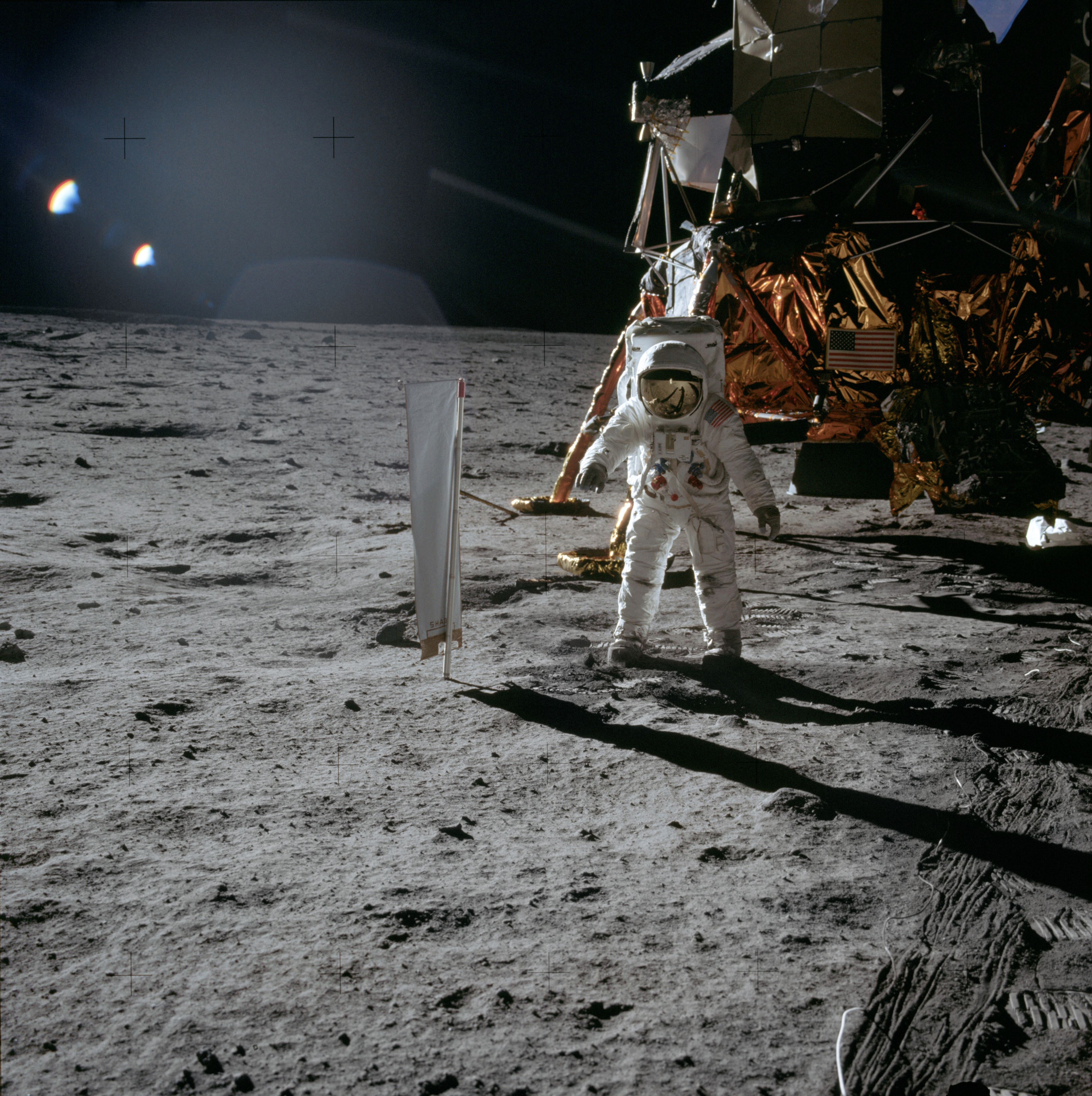
The face most people picture is not his: the gold-visored astronaut in the famous Apollo 11 photograph is Buzz Aldrin, shot by Armstrong. Armstrong himself is… more…

Richard Dorrell (CC BY SA), vía commons Moon and Mars
How does the moon affect the tides?
By pulling unevenly on it. Tidal forces vary inversely as the cube of the distance, so the near side of the Earth is tugged harder than the far side: one… more…
Moon and Mars
Why does neil armstrong have a hollywood star?
Strictly he does not have a star. Armstrong, Aldrin and Collins share four circular monuments resembling the Moon, one at each corner of Hollywood and Vine… more…

Foto: SpaceX (CC0) Moon and Mars
Why did falcon 9 hit the moon?
Because a spent upper stage on a lunar trajectory has no mission and no way to steer. A Falcon 9 upper stage from the January 2025 Firefly Blue Ghost 1 launch… more…
Moon and Mars
How much apollo 11 cost?
NASA never published a price for Apollo 11 on its own; what is documented is the program. The United States spent $25.8 billion on Project Apollo between 1960… more…
Moon and Mars
How much time neil armstrong spent on moon?
Armstrong and Aldrin spent 21 hours, 36 minutes on the Moon's surface, almost all of it inside the lunar module Eagle. Armstrong stepped onto the surface… more…
