Did you know…
What was the Budd Conestoga made of?
Short answer
Mainly stainless steel: fearing a potential aluminum shortage, the War Department sought alternative materials, and Budd, a railcar maker in that metal and creator of shotweld welding, developed a twin-engine transport built mostly from stainless steel with the Navy.
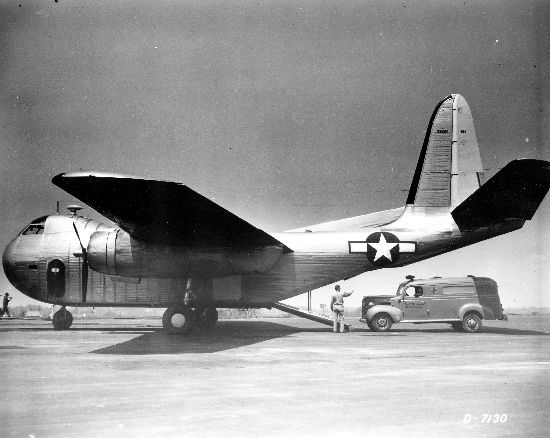
Stainless steel over fears of an aluminum shortage
Amid early fears that aluminum would become scarce, the War Department explored using other materials to build aircraft. Budd, creator of the shotweld technique for welding stainless steel and a manufacturer of railcars, car, bus and truck bodies made from that metal, hired aeronautical engineering staff and worked with the U.S. Navy on a new twin-engine transport aircraft built mainly from stainless steel. The Navy accepted the proposal and ordered 200 aircraft, designated RB-1; the Army Air Forces (USAAF) followed with an order for 600, designated C-93.
A cargo plane with a ramp under the tail
Its powerplant consisted of two 14-cylinder air-cooled Pratt & Whitney R-1830-92 Twin Wasp radials, each rated at 1,200 hp (890 kW), and the landing gear was tricycle type. The nose formed a distinctive, almost hemispherical section. Cargo could be loaded and unloaded in two ways: through 40 x 60 inch (102 x 152 cm) doors on each side of the fuselage, or via an electrically powered 10 x 8 foot (3.0 x 2.4 m) ramp at the rear of the hold, under the raised tail — a development similar to the one initially fitted on the German Ju 290 as the Trapoklappe ramp in 1939.
From war surplus to Flying Tiger
In 1945, the WAA sold 12 Conestogas to National Skyway Freight Corp for $28,642 each. In 1947, the U.S. Army — and later the Air Force — awarded National Skyway Freight a large transpacific cargo contract, for which the company leased military aircraft, and it changed its name to Flying Tiger.
More questions

Aviation history
Which was the most-produced American fighter of the Second World War?
The Republic P-47 Thunderbolt, of which 15,636 or 15,683 units were built, depending on the source. It was also one of the heaviest fighters of the conflict… more…

Aviation history
Who flew the E-66 at 2,149 km/h?
Konstantin or Vladimir Kokkinaki, depending on the source. Konstantin is credited with the absolute record on a closed 100 km circuit, at 2,148.66 km/h, set… more…

Fly-by-Owen (CC BY SA), vía commons Aviation history
How many I-11Bs were built?
Between 208 and around 450, depending on the source: one of the AISA I-11 reference sheets gives 208 examples built, while All-Aero speaks of around 400 built… more…

Aviation history
How many HH-53s could be converted to Pave Low III?
Eight HH-53C aircraft received an improved systems package and were redesignated HH-53H Pave Low III. The other figure in circulation, nine MH-53H and 32… more…

SCDBob (CC BY SA), vía commons Aviation history
What did the A129 Mangusta's armor protect?
The fuselage: the A129's airframe is armored and, according to All-Aero, designed to protect against 12.7 mm rounds, with partial protection against 23 mm… more…
Fly-by-Owen (CC BY SA), vía commons Aviation history
What landing gear and canopy did the AISA I-11B have?
According to one account, AISA reduced the cockpit canopy and fitted tailwheel gear on the production I-11B. All-Aero claims the opposite: the I-11B was… more…


