Did you know…
What is a rocket?
Short answer
A rocket is a vehicle or engine propelled by expelling the gases of its own combustion at high speed, without drawing in outside air: it carries its own fuel and oxidizer on board, which is why it works in the vacuum of space. It relies on Newton's third law, action and reaction, and is today the only means of putting objects into orbit.
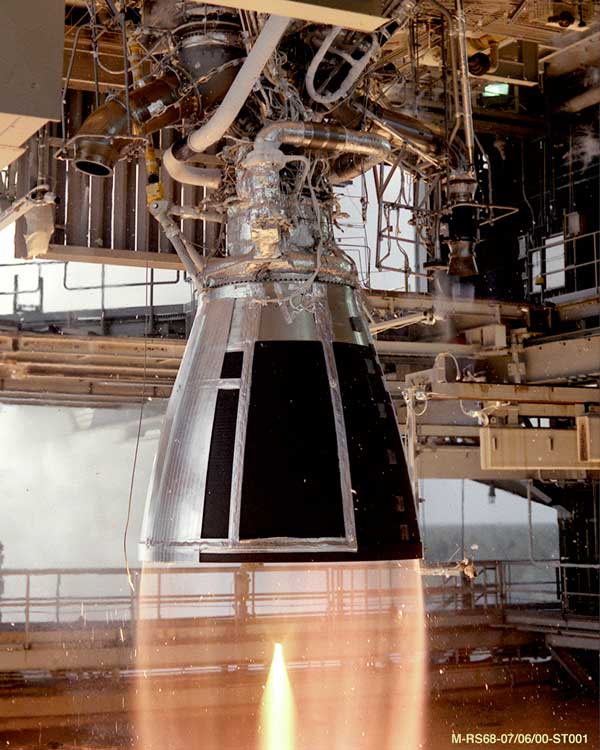
Action and reaction
Rocket physics fits within Newton's third law: by expelling mass backward at high speed, the vehicle receives an equal and opposite thrust forward. Unlike a jet engine, which draws oxygen from the atmosphere, a rocket carries its own oxidizer, whether liquid oxygen, nitrogen tetroxide, or one mixed into a solid propellant. That's why it's the only propulsion system that works in a vacuum and the only one capable of reaching orbital velocity, about 7.8 km/s in low Earth orbit.
Types of propulsion
Solid-propellant rockets, like the strap-on boosters of the SLS or Ariane 6, are simple and powerful, but cannot be shut off once ignited. Liquid-propellant rockets, like the Falcon 9's Merlin engines or Starship's Raptors, can be throttled and restarted, which is why they dominate main stages and landing stages. Hybrids combine a solid with a liquid oxidizer, and electric thrusters, with tiny but highly efficient thrust, move satellites already in orbit.
Stages and orbits
An orbital launch vehicle is divided into stages that separate as their tanks empty, so the rocket doesn't carry useless mass. The first stage overcomes gravity and dense air; the second accelerates the payload to orbital velocity. Since 2015 some first stages have returned and landed to fly again. The same principle, in a much smaller version, powers everything from signal flares to amateur rockets, and in giant version, vehicles over 100 m tall that carry people and satellites to space.
More questions
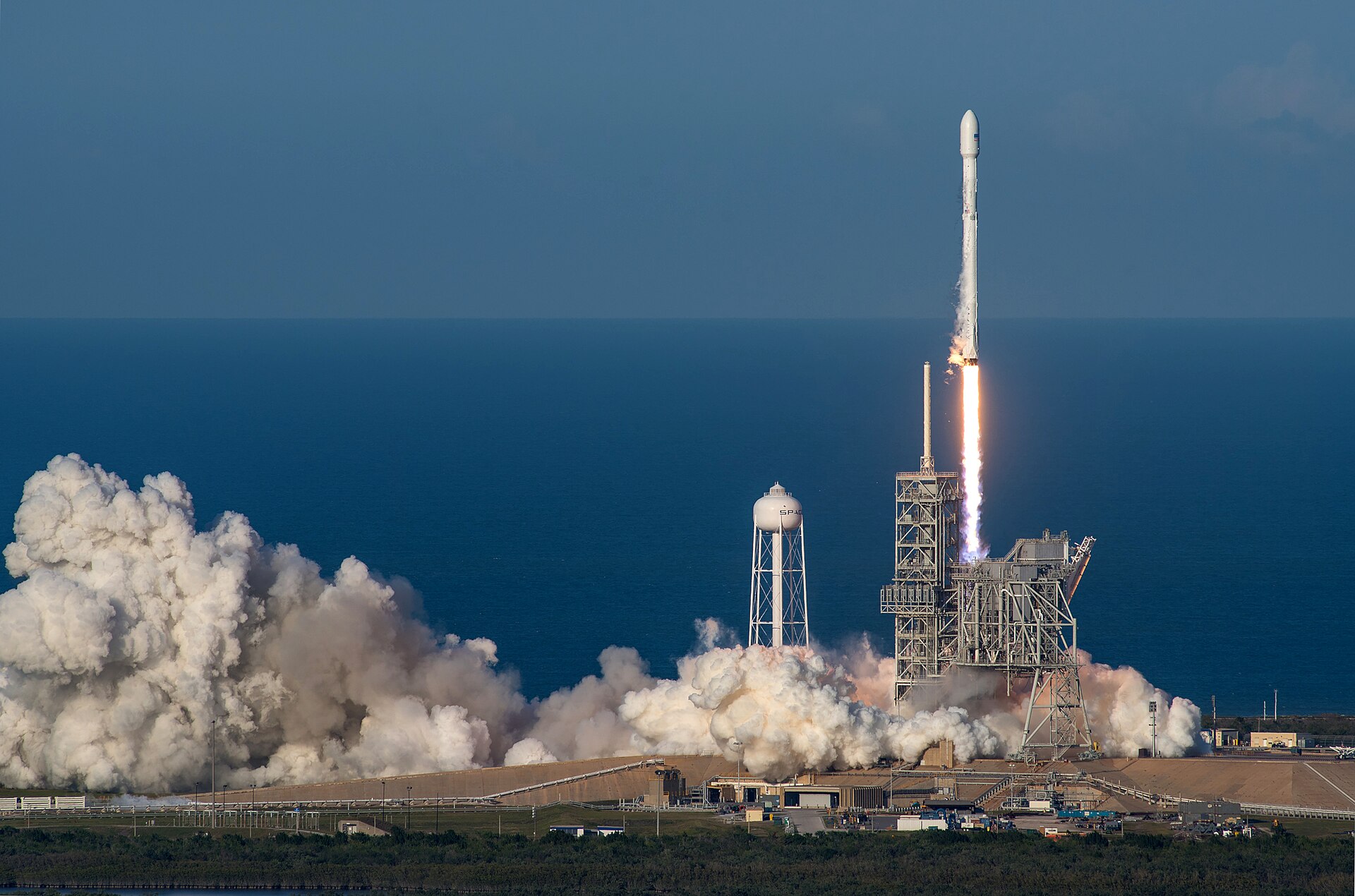
Foto: SpaceX (CC0) Rockets and launches
How many horsepower does the Falcon 9 have?
Rockets aren't measured in horsepower, but in thrust: the Falcon 9's first stage's nine Merlin engines deliver 7,686 kN (1,710,000 lbf) combined at sea level… more…
Foto: SpaceX (CC0) Rockets and launches
How much a rocket weight?
Rockets range from about 13 t for Rocket Lab's Electron to roughly 549 t for Falcon 9, 2,800 t for Saturn V and close to 5,000 t for Starship with its Super… more…

Rockets and launches
What does the saturn v look like?
Saturn V looked like a white needle 110.6 m (363 ft) tall and 10.1 m wide at the base, painted with black roll-pattern stripes, the words UNITED STATES and… more…
Foto: SpaceX (CC0) Rockets and launches
Why do rockets launch from florida?
Rockets launch from Florida because the Cape sits at 28.5 degrees north, low enough to gain about 410 m/s from the Earth's rotation on an eastward launch, and… more…
Foto: SpaceX (CC0) Rockets and launches
How much falcon 9 launch cost?
SpaceX lists a standard Falcon 9 mission at 69.75 million dollars, with the booster recovered (data as of January 2025). Small satellites can share a ride… more…
Rockets and launches
How does the saturn v work?
Saturn V worked by staging: a kerosene first stage with five F-1 engines (about 34,000 kN) lifted the 2,800 t rocket for two and a half minutes, a… more…

