Did you know…
What are space rockets?
Short answer
Space rockets are vehicles propelled by expelling the gases from their own combustion at high speed, without needing outside air, which lets them work in a vacuum. They are the only known way to put something into orbit: they must accelerate their payload to about 7.8 km/s (28,000 km/h) in a few minutes, burning most of their own mass.

The principle: action and reaction
A rocket works thanks to Newton's third law. It burns fuel and oxidizer in a chamber, and the gases exit through the nozzle at several kilometers per second; the vehicle receives an equal and opposite thrust. Unlike an aircraft jet engine, it carries its own oxidizer on board, so it doesn't depend on the atmosphere and keeps thrusting in space. In fact it performs better in a vacuum, where the nozzle can expand the gases without atmospheric pressure pushing back.
Why stages are needed
Reaching orbit requires about 7.8 km/s, and Tsiolkovsky's rocket equation dictates that to gain that much speed, propellant must make up most of the mass: in a typical launcher it's around 90%. To avoid hauling empty tanks, the vehicle is divided into stages that are jettisoned once spent. Each successive stage is smaller and starts out with the speed given to it by the previous one. This scheme, proposed in the early 20th century, remains the one used by every launcher in service today.
Types and uses
Depending on the propellant, there are solid rockets, simple and powerful but not throttleable, and liquid rockets, more complex but controllable and able to be shut down; many launchers combine both. By mission, suborbital rockets, which go up and come back down without reaching orbit, are distinguished from orbital ones, capable of placing satellites, capsules, or probes into a stable orbit or on an escape trajectory. From Sputnik in 1957 to today's constellations, everything humanity has sent beyond the atmosphere has traveled on one of them.
More questions
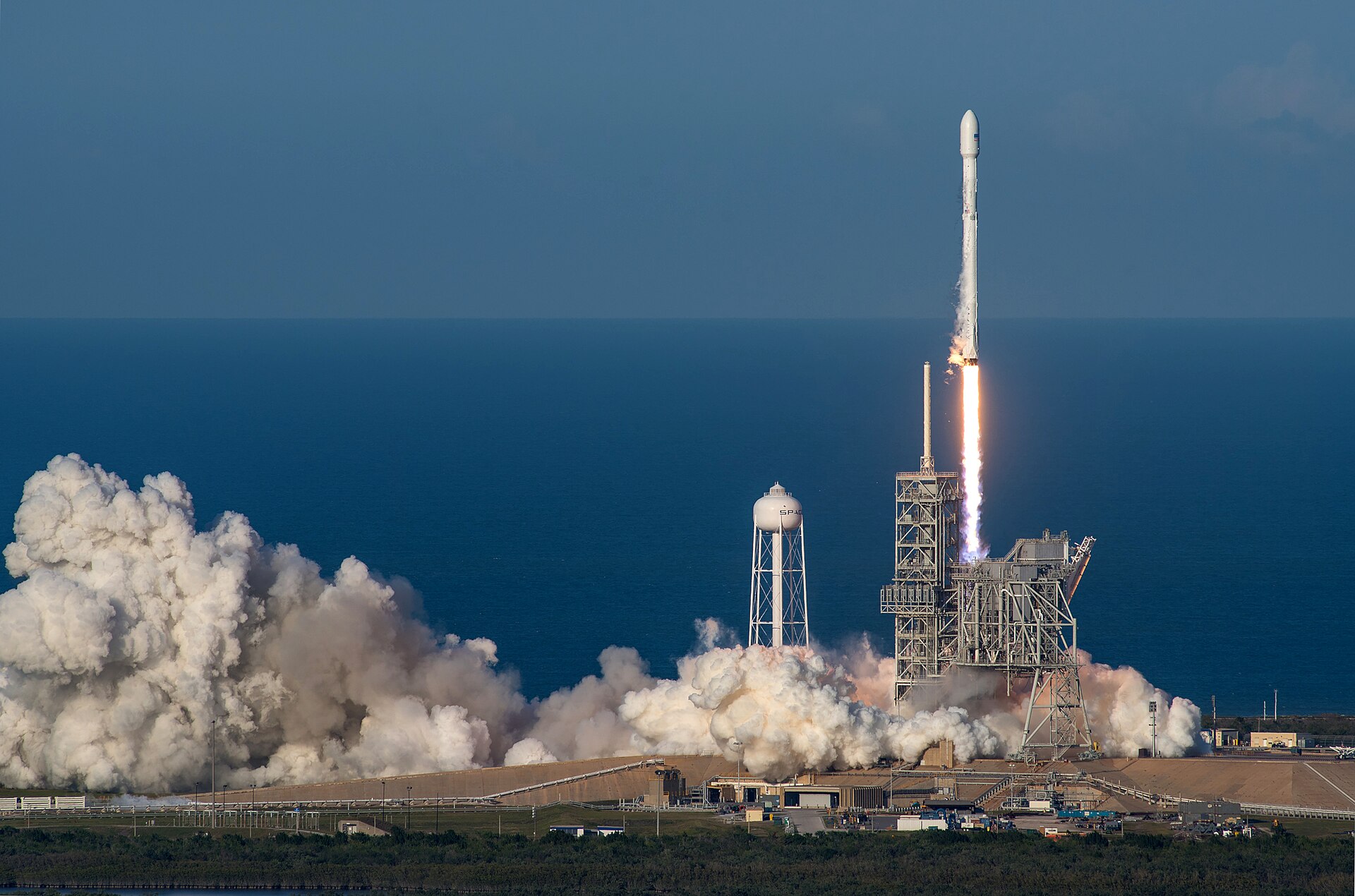
Foto: SpaceX (CC0) Rockets and launches
How many horsepower does the Falcon 9 have?
Rockets aren't measured in horsepower, but in thrust: the Falcon 9's first stage's nine Merlin engines deliver 7,686 kN (1,710,000 lbf) combined at sea level… more…
Foto: SpaceX (CC0) Rockets and launches
How much a rocket weight?
Rockets range from about 13 t for Rocket Lab's Electron to roughly 549 t for Falcon 9, 2,800 t for Saturn V and close to 5,000 t for Starship with its Super… more…

Rockets and launches
What does the saturn v look like?
Saturn V looked like a white needle 110.6 m (363 ft) tall and 10.1 m wide at the base, painted with black roll-pattern stripes, the words UNITED STATES and… more…
Foto: SpaceX (CC0) Rockets and launches
Why do rockets launch from florida?
Rockets launch from Florida because the Cape sits at 28.5 degrees north, low enough to gain about 410 m/s from the Earth's rotation on an eastward launch, and… more…
Foto: SpaceX (CC0) Rockets and launches
How much falcon 9 launch cost?
SpaceX lists a standard Falcon 9 mission at 69.75 million dollars, with the booster recovered (data as of January 2025). Small satellites can share a ride… more…
Rockets and launches
How does the saturn v work?
Saturn V worked by staging: a kerosene first stage with five F-1 engines (about 34,000 kN) lifted the 2,800 t rocket for two and a half minutes, a… more…

