Did you know…
What was "Adlertag"?
Short answer
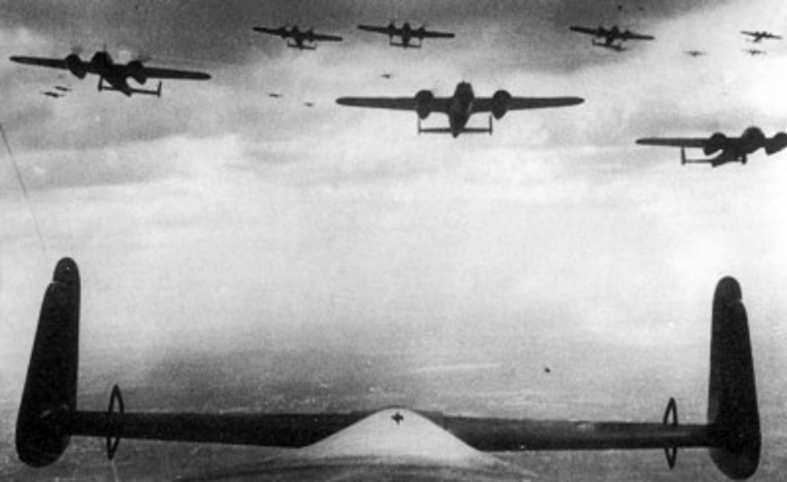
"Eagle Day": the first day of Unternehmen Adlerangriff, the Luftwaffe operation meant to destroy the Royal Air Force. Postponed several times by bad weather, it was finally carried out on 13 August 1940. Neither Adlertag nor the operations that followed destroyed the RAF or secured the local air superiority needed.
Directive No. 17
On 1 August Hitler handed the Luftwaffe commander-in-chief, Reichsmarschall Hermann Göring, and the Oberkommando der Luftwaffe Directive No. 17, "For the Conduct of Air and Naval Warfare Against England," launching the air assault. Adlertag ("Eagle Day") was the first day of Unternehmen Adlerangriff ("Operation Eagle Attack"), devised by Nazi Germany's Luftwaffe to destroy the British Royal Air Force. Göring had promised Hitler that Adlertag and Adlerangriff would deliver the required results within days or, at worst, weeks. The date of the assault was postponed several times due to bad weather and was finally carried out on 13 August 1940.
A morning of crossed orders
On the morning of 13 August the weather was poor and Göring ordered the raids postponed; KG 2's Dornier Do 17s were not informed and took off at 04:50 toward their target. ZG 26 did receive the cancellation order, but II. and III./KG 2 did not. Unable to contact the bombers by radio, Huth tried to warn them by flying ahead of them and performing aerobatics, but Fink ignored him and pressed on. KG 2 lost five Do 17s in the attempt and six other Dorniers were badly damaged.
The outcome
Adlertag and the operations that followed failed to destroy the RAF or secure the local air superiority needed, and as a result Operation Sea Lion was postponed indefinitely.
More questions

Aviation history
Which was the most-produced American fighter of the Second World War?
The Republic P-47 Thunderbolt, of which 15,636 or 15,683 units were built, depending on the source. It was also one of the heaviest fighters of the conflict… more…

Aviation history
Who flew the E-66 at 2,149 km/h?
Konstantin or Vladimir Kokkinaki, depending on the source. Konstantin is credited with the absolute record on a closed 100 km circuit, at 2,148.66 km/h, set… more…

Fly-by-Owen (CC BY SA), vía commons Aviation history
How many I-11Bs were built?
Between 208 and around 450, depending on the source: one of the AISA I-11 reference sheets gives 208 examples built, while All-Aero speaks of around 400 built… more…

Aviation history
How many HH-53s could be converted to Pave Low III?
Eight HH-53C aircraft received an improved systems package and were redesignated HH-53H Pave Low III. The other figure in circulation, nine MH-53H and 32… more…

SCDBob (CC BY SA), vía commons Aviation history
What did the A129 Mangusta's armor protect?
The fuselage: the A129's airframe is armored and, according to All-Aero, designed to protect against 12.7 mm rounds, with partial protection against 23 mm… more…
Fly-by-Owen (CC BY SA), vía commons Aviation history
What landing gear and canopy did the AISA I-11B have?
According to one account, AISA reduced the cockpit canopy and fitted tailwheel gear on the production I-11B. All-Aero claims the opposite: the I-11B was… more…


