Did you know…
Why does a rocket fly?
Short answer
A rocket flies because it expels gases at high speed through the nozzle and receives in return a thrust in the opposite direction, as described by Newton's third law. When that thrust exceeds the vehicle's weight, the rocket accelerates upward; as it burns propellant it loses mass and gains speed until it reaches orbit.

Action and reaction
Inside the combustion chamber, fuel and oxidizer react and generate gas at high pressure and temperature. That gas escapes through a bell-shaped nozzle, which accelerates it to speeds of 2,500 to 4,500 m/s depending on the propellant. Expelling mass downward produces an equal force upward on the vehicle: this is thrust. The greater the gas flow rate and its exit velocity, the greater the thrust, with no involvement at all from the surrounding air.
Overcoming weight
To lift off, thrust must exceed the rocket's total weight, loaded mostly with propellant: in a typical launch vehicle, more than 85% of the mass on the pad is fuel and oxidizer. At first the acceleration is modest, barely above gravity, which is why rockets rise slowly in the first few seconds. But every second the vehicle burns tons of propellant and gets lighter, so the same thrust produces ever greater acceleration. By the end of a stage the load can reach four or five times gravity.
Stages and speed
Reaching orbit requires about 7.8 km/s, and no single-stage rocket achieves that with a useful margin, because empty tanks and engines are dead weight. The classic solution is to divide the vehicle into stages: when the first exhausts its propellant, it separates and the next stage ignites its engines already starting from a high speed and a much smaller mass. The Tsiolkovsky equation, formulated in 1903, sums up this logic: final velocity depends on the exhaust velocity of the gases and the ratio between initial and final mass. For a rocket, flying means managing that ratio with precision.
More questions
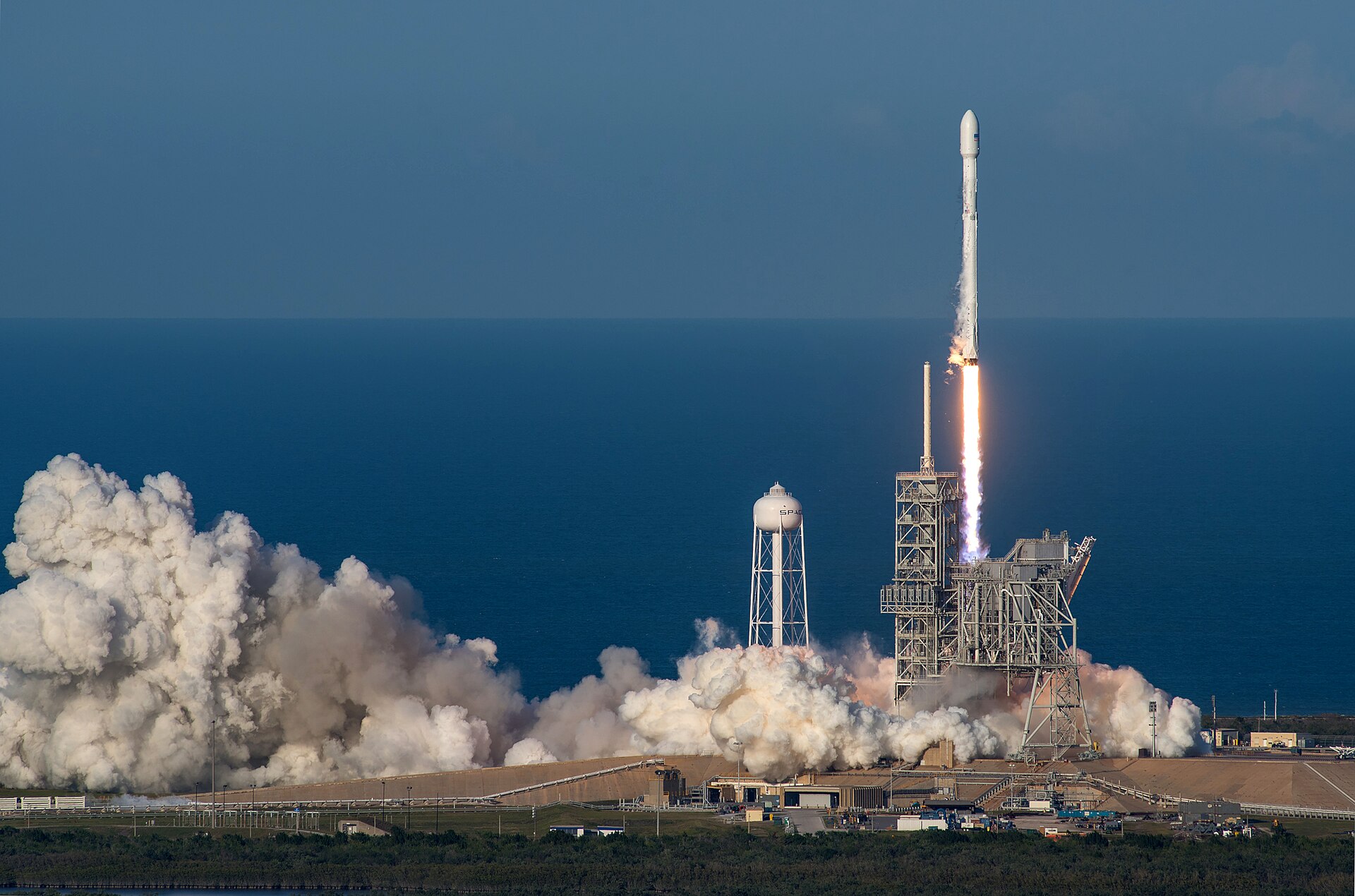
Foto: SpaceX (CC0) Rockets and launches
How many horsepower does the Falcon 9 have?
Rockets aren't measured in horsepower, but in thrust: the Falcon 9's first stage's nine Merlin engines deliver 7,686 kN (1,710,000 lbf) combined at sea level… more…
Foto: SpaceX (CC0) Rockets and launches
How much a rocket weight?
Rockets range from about 13 t for Rocket Lab's Electron to roughly 549 t for Falcon 9, 2,800 t for Saturn V and close to 5,000 t for Starship with its Super… more…

Rockets and launches
What does the saturn v look like?
Saturn V looked like a white needle 110.6 m (363 ft) tall and 10.1 m wide at the base, painted with black roll-pattern stripes, the words UNITED STATES and… more…
Foto: SpaceX (CC0) Rockets and launches
Why do rockets launch from florida?
Rockets launch from Florida because the Cape sits at 28.5 degrees north, low enough to gain about 410 m/s from the Earth's rotation on an eastward launch, and… more…
Foto: SpaceX (CC0) Rockets and launches
How much falcon 9 launch cost?
SpaceX lists a standard Falcon 9 mission at 69.75 million dollars, with the booster recovered (data as of January 2025). Small satellites can share a ride… more…
Rockets and launches
How does the saturn v work?
Saturn V worked by staging: a kerosene first stage with five F-1 engines (about 34,000 kN) lifted the 2,800 t rocket for two and a half minutes, a… more…

