Did you know…
What defensive armament did the Vulcan carry?
Short answer
None. The Vulcan carried no defensive armament: at first it relied on flying high and fast to avoid interception, and from around 1960 the B.1A and B.2 defended themselves with electronic countermeasures — radar and communications jammers and a tail-warning radar.

A bomber without turrets
Unlike the bombers of the Second World War, the Vulcan carried no defensive guns or machine guns. Its original concept relied on flying at high speed and high altitude to escape fighters and anti-aircraft fire. That is why, when the prototype trials revealed a dangerous tendency to pitch into a dive near the Mach limit, this was considered unacceptable precisely because the bomber was unarmed.
Electronic defence
From around 1960, the Vulcan B.1 (which, with these upgrades, became known as the B.1A) and the B.2 received electronic countermeasures equipment. The B.1 XA895 served as a testbed for a system with jammers housed in a bulged tail cone and a tail-warning radar. The original equipment of the B.1A and B.2 included a Green Palm voice-communications jammer, two Blue Diver metric-band jammers and three Red Shrimp S-band jammers, among other items.
From the sky to ground level
Soviet defences improved, and altitude ceased to be sufficient protection. In the mid-1960s the Vulcan switched to low-level tactics, flying high en route and descending to penetrate defences. Even in the Falklands War, in 1982, the aircraft still carried no defensive armament of its own: some examples carried Shrike anti-radar missiles, but as an offensive weapon against Argentine radars, not for protection against fighters.
The aircraft originated from Air Ministry specification B.35/46. The first prototype flew on 30 August 1952, and the RAF received its first Vulcan B.1 in September 1956.
More questions
Aviation history
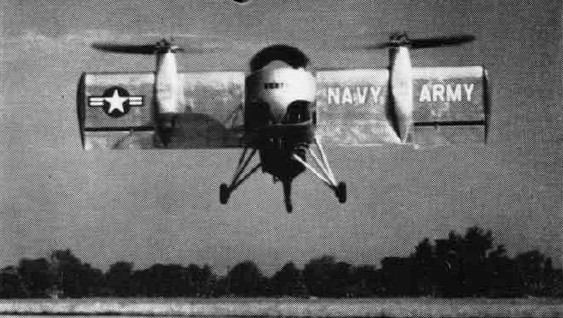
What was special about the Vertol 76?
Vertol's VZ-2 tested the tiltwing concept for vertical take-off and landing. After ground trials beginning in April 1957, it first took off on 13 August only… more…

Aviation history
Which was the most-produced American fighter of the Second World War?
The Republic P-47 Thunderbolt, of which 15,636 or 15,683 units were built, depending on the source. It was also one of the heaviest fighters of the conflict… more…

Aviation history
Who flew the E-66 at 2,149 km/h?
Konstantin or Vladimir Kokkinaki, depending on the source. Konstantin is credited with the absolute record on a closed 100 km circuit, at 2,148.66 km/h, set… more…

Fly-by-Owen (CC BY SA), vía commons Aviation history
How many I-11Bs were built?
Between 208 and around 450, depending on the source: one of the AISA I-11 reference sheets gives 208 examples built, while All-Aero speaks of around 400 built… more…

Aviation history
How many HH-53s could be converted to Pave Low III?
Eight HH-53C aircraft received an improved systems package and were redesignated HH-53H Pave Low III. The other figure in circulation, nine MH-53H and 32… more…

SCDBob (CC BY SA), vía commons Aviation history
What did the A129 Mangusta's armor protect?
The fuselage: the A129's airframe is armored and, according to All-Aero, designed to protect against 12.7 mm rounds, with partial protection against 23 mm… more…


