Did you know…
How many days did it take Apollo 11 to reach the Moon?
Short answer
Four calendar days: Apollo 11 launched on July 16, 1969, at 13:32 UTC, and the Eagle landed on July 20 at 20:17:40 UTC, at 102 hours and 45 minutes into the mission. Between those two milestones, it entered lunar orbit on July 19 at 17:21:50 UTC. The full flight lasted 195 hours, 18 minutes, and 35 seconds.

From July 16 to July 20
Liftoff took place on July 16, 1969, at 13:32 UTC, and the landing on July 20 at 20:17:40 UTC: four calendar days between the two dates, and, in mission time, 102 hours and 45 minutes. The itinerary was tightly scripted: leaving Earth orbit on the first day, a couple of days cruising toward the Moon with the lunar module docked to the command module, entering lunar orbit on July 19 at 17:21:50 UTC via a retrograde burn of the main engine, and, on the 20th, separation of the Eagle and the powered descent.
Why it takes that long and not less
The duration isn't set by distance but by trajectory. A faster flight requires spending more propellant on departure and, above all, much more on arrival, because you have to slow down what you've accelerated: the higher the approach speed, the bigger the burn needed to avoid overshooting. Apollo used an almost energy-free path, letting the spacecraft fall toward the Moon and adjusting course with small burns. Robotic probes can afford slow routes, taking weeks or months, with increasingly wide Earth orbits; a crew cannot, because it consumes water, oxygen, and safety margin.
What came after the landing
Armstrong and Aldrin spent 21 hours and 36 minutes on the surface before firing the ascent engine and rejoining Columbia. The mission ended on July 24 at 16:50:35 UTC with splashdown in the Pacific, after 195 hours, 18 minutes, and 35 seconds of flight and 953,054 miles traveled between the outbound trip, the lunar orbits, and the return.
More questions
Moon and Mars
How does neil armstrong look like?
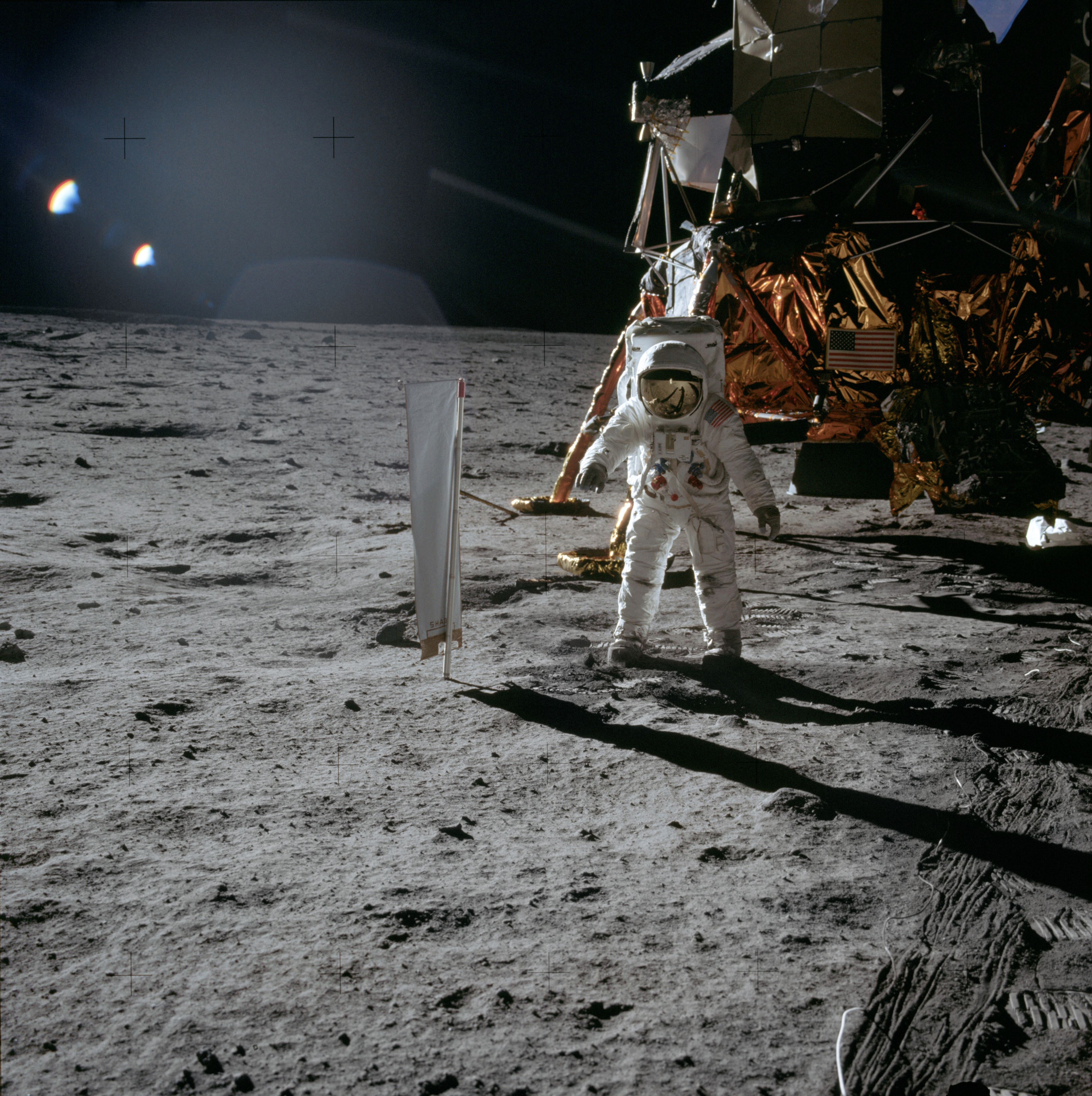
The face most people picture is not his: the gold-visored astronaut in the famous Apollo 11 photograph is Buzz Aldrin, shot by Armstrong. Armstrong himself is… more…

Richard Dorrell (CC BY SA), vía commons Moon and Mars
How does the moon affect the tides?
By pulling unevenly on it. Tidal forces vary inversely as the cube of the distance, so the near side of the Earth is tugged harder than the far side: one… more…
Moon and Mars
Why does neil armstrong have a hollywood star?
Strictly he does not have a star. Armstrong, Aldrin and Collins share four circular monuments resembling the Moon, one at each corner of Hollywood and Vine… more…

Foto: SpaceX (CC0) Moon and Mars
Why did falcon 9 hit the moon?
Because a spent upper stage on a lunar trajectory has no mission and no way to steer. A Falcon 9 upper stage from the January 2025 Firefly Blue Ghost 1 launch… more…
Moon and Mars
How much apollo 11 cost?
NASA never published a price for Apollo 11 on its own; what is documented is the program. The United States spent $25.8 billion on Project Apollo between 1960… more…
Moon and Mars
How much time neil armstrong spent on moon?
Armstrong and Aldrin spent 21 hours, 36 minutes on the Moon's surface, almost all of it inside the lunar module Eagle. Armstrong stepped onto the surface… more…
