Did you know…
What engine did an Iris V flight-test?
Short answer
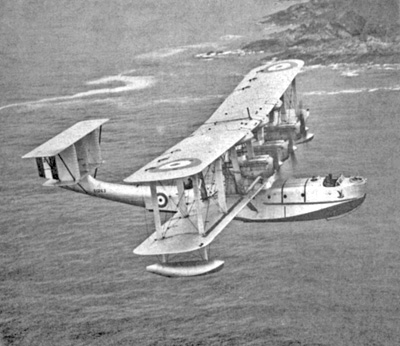
One of the Blackburn Iris V flying boats was converted into a flying test bed for the Napier Culverin, a licence-built Junkers Jumo 204 diesel; it flew in that configuration in June 1937 and remained under test until April 1938. The Culverin, built by D. Napier & Son, was a liquid-cooled, six-cylinder vertically opposed engine.
The Culverin, a German diesel under British licence
The Napier Culverin was a version built under licence by D. Napier & Son of the Junkers Jumo 204, a six-cylinder vertically opposed, liquid-cooled aviation diesel engine. Its rated power was 821 hp at 2,050 rpm. The engine's tests were carried out in a Blackburn Iris V biplane flying boat.
An Iris V as a test bed
One of the Iris Vs was converted to serve as a test bed for the Napier Culverin and flew in that configuration in June 1937; flight testing continued until April 1938.
The Iris and its time with No. 209 Squadron
The Iris V was the final variant of the Blackburn Iris: three Iris Mk IIIs received 825 hp (615 kW) Rolls-Royce Buzzard IIMS piston engines. The three re-engined aircraft returned to service in 1932 as the Iris V and were replaced in squadron service in 1934. Although only five Irises were built, the Royal Air Force used them as long-range maritime reconnaissance aircraft. The first Iris III had flown on 21 November 1929, and the three Iris IIIs equipped No. 209 Squadron, re-formed at RAF Mount Batten, Plymouth, in January 1930. One Iris III, S1263 of No. 209 Squadron, based at Mount Batten, sank on 12 January 1933 after colliding with a dockyard launch after landing in Plymouth Sound: of nine airmen, one drowned and seven were injured.
More questions

Aviation history
Which was the most-produced American fighter of the Second World War?
The Republic P-47 Thunderbolt, of which 15,636 or 15,683 units were built, depending on the source. It was also one of the heaviest fighters of the conflict… more…

Aviation history
Who flew the E-66 at 2,149 km/h?
Konstantin or Vladimir Kokkinaki, depending on the source. Konstantin is credited with the absolute record on a closed 100 km circuit, at 2,148.66 km/h, set… more…

Fly-by-Owen (CC BY SA), vía commons Aviation history
How many I-11Bs were built?
Between 208 and around 450, depending on the source: one of the AISA I-11 reference sheets gives 208 examples built, while All-Aero speaks of around 400 built… more…

Aviation history
How many HH-53s could be converted to Pave Low III?
Eight HH-53C aircraft received an improved systems package and were redesignated HH-53H Pave Low III. The other figure in circulation, nine MH-53H and 32… more…

SCDBob (CC BY SA), vía commons Aviation history
What did the A129 Mangusta's armor protect?
The fuselage: the A129's airframe is armored and, according to All-Aero, designed to protect against 12.7 mm rounds, with partial protection against 23 mm… more…
Fly-by-Owen (CC BY SA), vía commons Aviation history
What landing gear and canopy did the AISA I-11B have?
According to one account, AISA reduced the cockpit canopy and fitted tailwheel gear on the production I-11B. All-Aero claims the opposite: the I-11B was… more…


