Did you know…
What is a space rocket?
Short answer
A space rocket is a reaction-propelled vehicle that carries both its fuel and oxidizer on board, letting it accelerate outside the atmosphere. Its job is to carry a payload, from a satellite to a crewed spacecraft, into orbit or beyond, which requires reaching at least 7.8 km/s (28,000 km/h).

Definition and components
A space rocket is, in essence, a reaction engine with tanks and a payload on top. The combustion chamber and nozzle generate thrust; the tanks store fuel (kerosene, hydrogen, methane) and oxidizer (liquid oxygen in almost every case); the structure ties the whole vehicle together and the payload fairing protects the payload during the pass through the atmosphere. A guidance system, with gyroscopes and computers, steers the flight by aiming the nozzles or small auxiliary thrusters.
A bit of history
Gunpowder rockets have existed since medieval China, but the space rocket was born with the theory: Konstantin Tsiolkovsky formulated the equation relating velocity, mass and propellant in 1903, and Robert Goddard launched the first liquid-fueled rocket in 1926. Germany's V-2, in 1944, was the first object to pass 100 km in altitude. After the war, the Soviet R-7 placed Sputnik into orbit on October 4, 1957, and the Saturn V carried the Apollo astronauts to the Moon between 1968 and 1972.
What sets it apart from an airplane
An airplane needs air both to generate lift and to burn fuel; a rocket needs neither. That's why an airplane flies at most around 20 or 30 km of altitude, while a rocket crosses that zone in just over a minute and keeps accelerating in vacuum. The price is inefficiency: an orbital rocket burns several hundred tonnes of propellant in nine minutes to place a few dozen tonnes into orbit. The reusable launchers of the past decade try to bring back at least part of that investment to fly again.
More questions
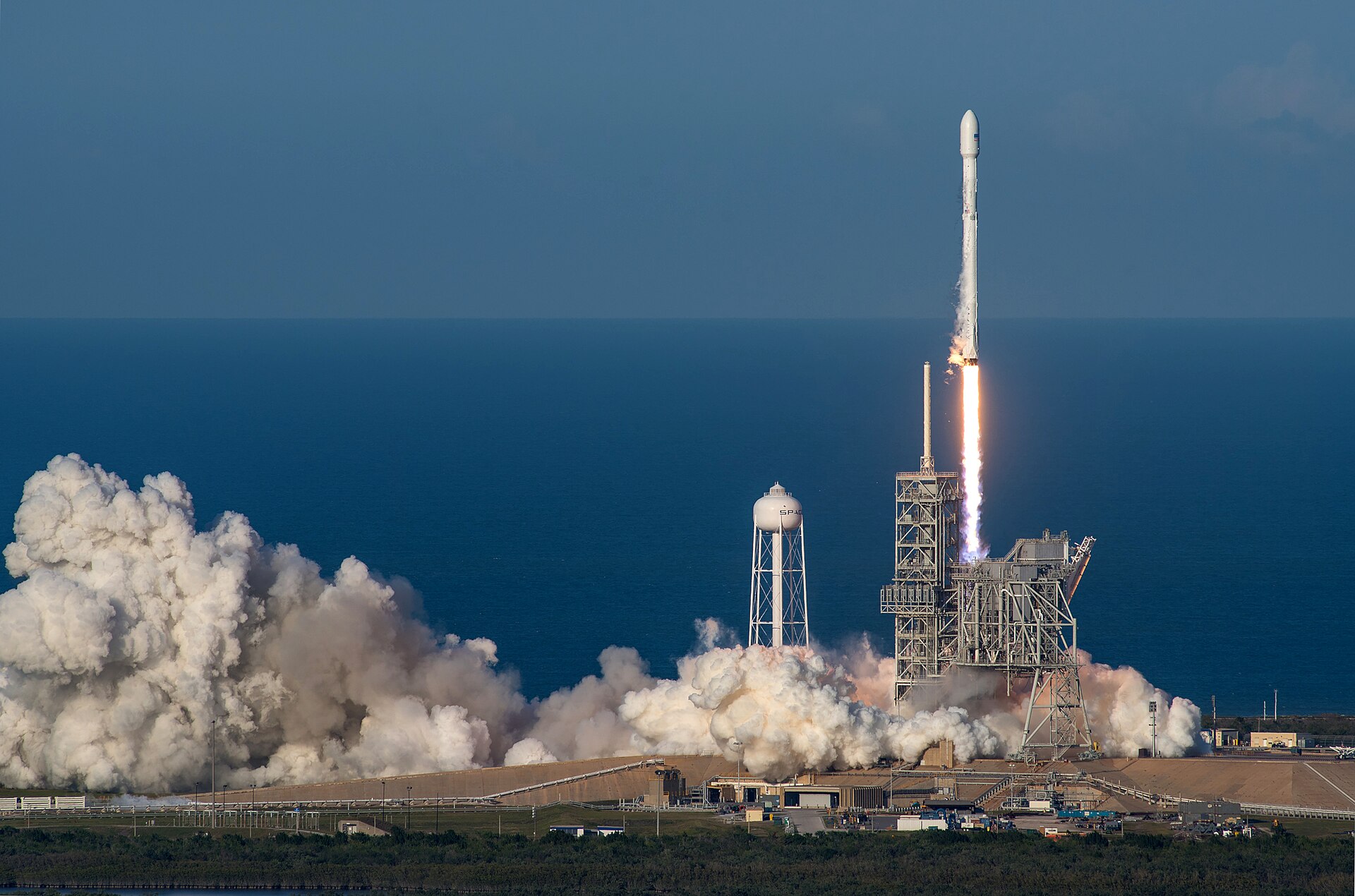
Foto: SpaceX (CC0) Rockets and launches
How many horsepower does the Falcon 9 have?
Rockets aren't measured in horsepower, but in thrust: the Falcon 9's first stage's nine Merlin engines deliver 7,686 kN (1,710,000 lbf) combined at sea level… more…
Foto: SpaceX (CC0) Rockets and launches
How much a rocket weight?
Rockets range from about 13 t for Rocket Lab's Electron to roughly 549 t for Falcon 9, 2,800 t for Saturn V and close to 5,000 t for Starship with its Super… more…

Rockets and launches
What does the saturn v look like?
Saturn V looked like a white needle 110.6 m (363 ft) tall and 10.1 m wide at the base, painted with black roll-pattern stripes, the words UNITED STATES and… more…
Foto: SpaceX (CC0) Rockets and launches
Why do rockets launch from florida?
Rockets launch from Florida because the Cape sits at 28.5 degrees north, low enough to gain about 410 m/s from the Earth's rotation on an eastward launch, and… more…
Foto: SpaceX (CC0) Rockets and launches
How much falcon 9 launch cost?
SpaceX lists a standard Falcon 9 mission at 69.75 million dollars, with the booster recovered (data as of January 2025). Small satellites can share a ride… more…
Rockets and launches
How does the saturn v work?
Saturn V worked by staging: a kerosene first stage with five F-1 engines (about 34,000 kN) lifted the 2,800 t rocket for two and a half minutes, a… more…

