Did you know…
Why can't they land on the Moon?
Short answer
Yes, they can: the Apollo 11 module touched down in the Mare Tranquillitatis on July 20, 1969 at 20:17:40 UT, and the crew spent 21 hours and 36 minutes on the surface. The hard part is that the Moon has no atmosphere to slow descent: with no parachutes, both descent and ascent rely entirely on engines and propellant.

It's already been done, with 1969 technology
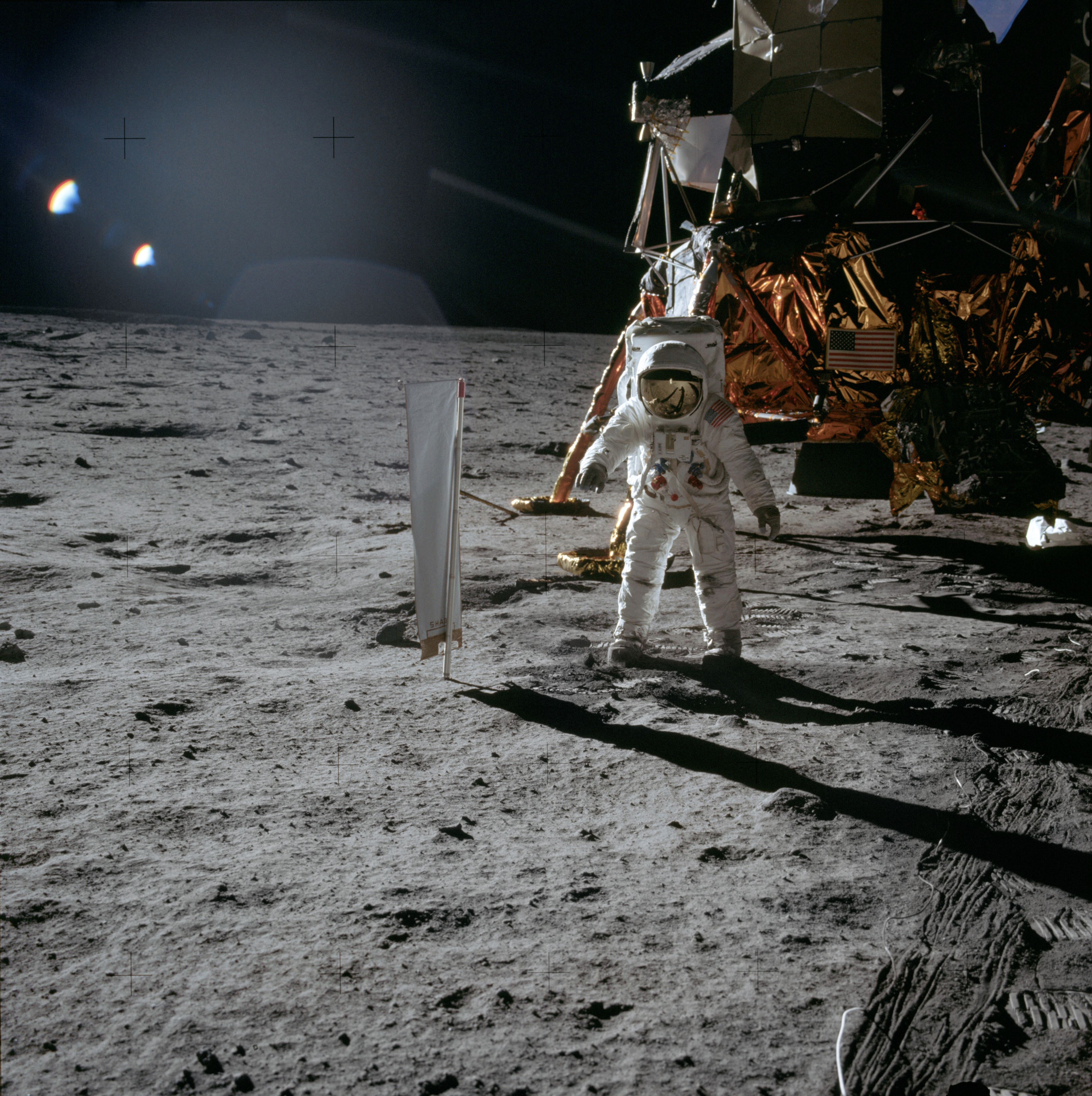
The premise is false: it is possible to land on the Moon, and it has been done with a crew on board. Apollo 11 lifted off on July 16, 1969, at 13:32 UT atop a Saturn V SA-504, and its lunar module touched down in the Mare Tranquillitatis on July 20 at 20:17:40 UT, after a 756.3-second burn of the descent engine. The crew spent 21 hours and 36 minutes on the lunar surface and lifted off again at 17:54:01 UT on July 21.
Without an atmosphere, there's no parachute
What is true is that a Moon landing is more demanding than a return to Earth. The Moon has no usable atmosphere, only an exosphere so thin that it isn't breathable, doesn't cushion impacts, and offers no protection from radiation. That removes at a stroke the two resources that make an Earth reentry cheaper: the heat shield that converts speed into heat, and parachutes. On the Moon, every meter per second of speed that must be shed has to be paid for with propellant, firing the engines against the motion, and the vehicle must also carry the fuel needed to lift off again.
That's why Artemis is moving forward in stages
The current program reflects that difficulty. The Moon landing doesn't depend on the Orion spacecraft, which only reaches lunar orbit, but on a separate human landing system that is tested beforehand on its own. Under the current schedule (as of October 2026), Artemis's first Moon landing is Artemis IV, planned for early 2028: two crew members will descend to the surface and spend close to a week in the lunar south pole region, an area where NASA identified nine candidate landing regions in 2024, then intended for Artemis III.
More questions
Moon and Mars
How does neil armstrong look like?
The face most people picture is not his: the gold-visored astronaut in the famous Apollo 11 photograph is Buzz Aldrin, shot by Armstrong. Armstrong himself is… more…

Richard Dorrell (CC BY SA), vía commons Moon and Mars
How does the moon affect the tides?
By pulling unevenly on it. Tidal forces vary inversely as the cube of the distance, so the near side of the Earth is tugged harder than the far side: one… more…
Moon and Mars
Why does neil armstrong have a hollywood star?
Strictly he does not have a star. Armstrong, Aldrin and Collins share four circular monuments resembling the Moon, one at each corner of Hollywood and Vine… more…

Foto: SpaceX (CC0) Moon and Mars
Why did falcon 9 hit the moon?
Because a spent upper stage on a lunar trajectory has no mission and no way to steer. A Falcon 9 upper stage from the January 2025 Firefly Blue Ghost 1 launch… more…
Moon and Mars
How much apollo 11 cost?
NASA never published a price for Apollo 11 on its own; what is documented is the program. The United States spent $25.8 billion on Project Apollo between 1960… more…
Moon and Mars
How much time neil armstrong spent on moon?
Armstrong and Aldrin spent 21 hours, 36 minutes on the Moon's surface, almost all of it inside the lunar module Eagle. Armstrong stepped onto the surface… more…
