Did you know…
Why is the universe so big?
Short answer
The universe is so big because it has been expanding for about 13.8 billion years since the Big Bang, and that expansion is accelerating. The observable universe spans about 93 billion light-years in diameter; beyond that, light hasn't had time to reach us yet, so the total size remains unknown.

An expansion that never stops
The size of the universe isn't an accident of its birth, but the result of a process still underway. Since the Big Bang, about 13.8 billion years ago, space itself has been stretching: galaxies aren't fleeing through it, it's the distance between them that grows. Edwin Hubble measured this in 1929 when he observed that distant galaxies recede faster the farther away they are. In 1998, two teams discovered, using supernovae, that this rate is also accelerating, an effect attributed to dark energy.
Why we see farther than light has traveled
The age of the cosmos sets a horizon: only light emitted less than 13.8 billion years ago can reach us. But because space has expanded while that light was traveling, the sources that emitted it are now much farther away. That's why the observable universe has a radius of about 46 billion light-years, roughly 93 billion in diameter. That isn't the real size of the universe, but the size of the portion that physics allows us to see.
What lies beyond
Nothing suggests the universe ends at that edge. Measurements of the cosmic microwave background, taken by missions like WMAP and Planck, show a flat geometry with great precision, suggesting the cosmos is much larger than the visible portion, perhaps infinite. A phase of inflation in the first fractions of a second would explain why regions so far apart share the same temperature and why space looks so uniform on large scales.
The short answer, then, is that the universe is big because it's old, and because it has never stopped growing.
More questions
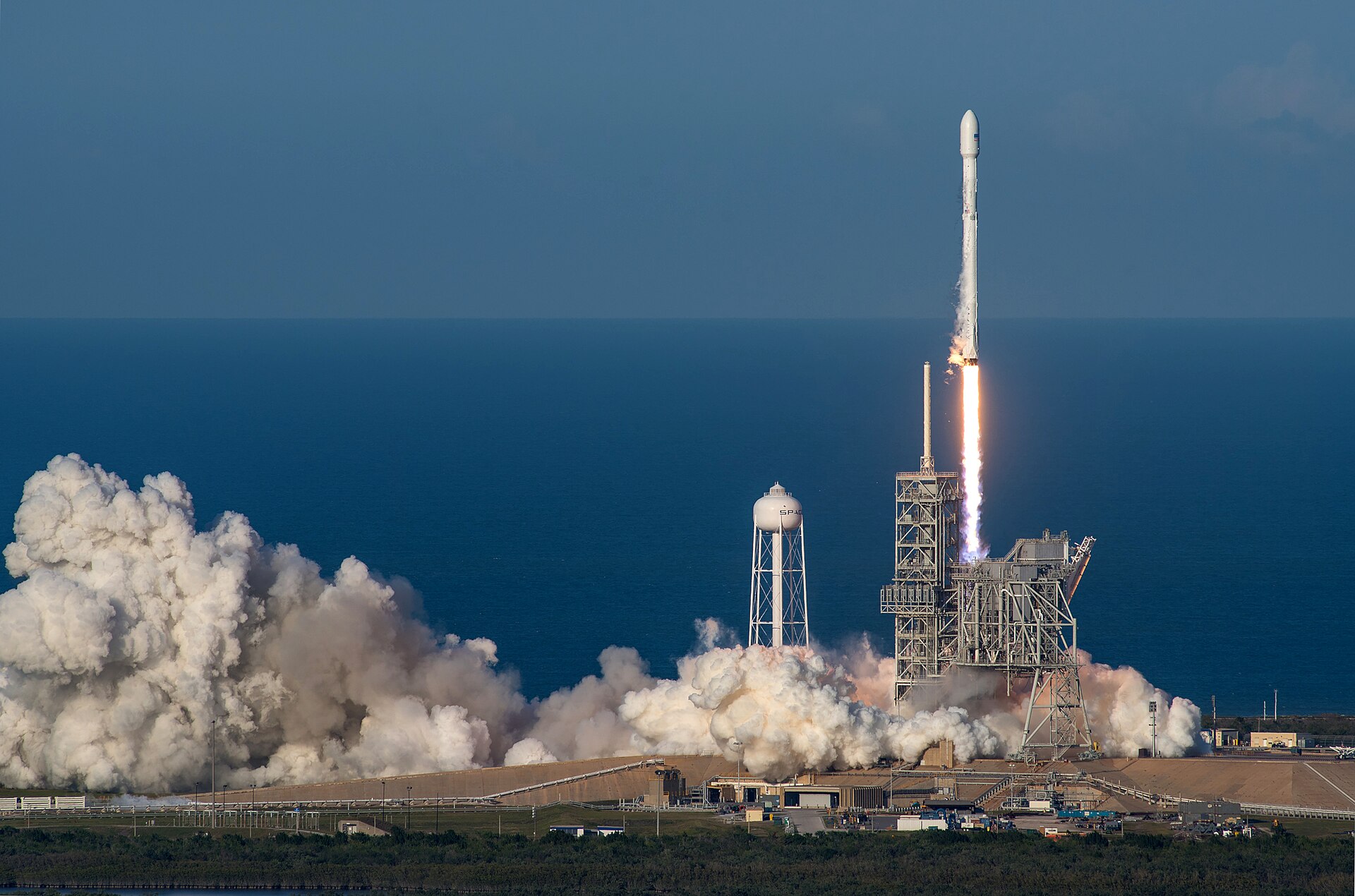
Foto: SpaceX (CC0) Rockets and launches
How many horsepower does the Falcon 9 have?
Rockets aren't measured in horsepower, but in thrust: the Falcon 9's first stage's nine Merlin engines deliver 7,686 kN (1,710,000 lbf) combined at sea level… more…
Foto: SpaceX (CC0) Rockets and launches
How much a rocket weight?
Rockets range from about 13 t for Rocket Lab's Electron to roughly 549 t for Falcon 9, 2,800 t for Saturn V and close to 5,000 t for Starship with its Super… more…

Rockets and launches
What does the saturn v look like?
Saturn V looked like a white needle 110.6 m (363 ft) tall and 10.1 m wide at the base, painted with black roll-pattern stripes, the words UNITED STATES and… more…
Foto: SpaceX (CC0) Rockets and launches
Why do rockets launch from florida?
Rockets launch from Florida because the Cape sits at 28.5 degrees north, low enough to gain about 410 m/s from the Earth's rotation on an eastward launch, and… more…
Foto: SpaceX (CC0) Rockets and launches
How much falcon 9 launch cost?
SpaceX lists a standard Falcon 9 mission at 69.75 million dollars, with the booster recovered (data as of January 2025). Small satellites can share a ride… more…
Rockets and launches
How does the saturn v work?
Saturn V worked by staging: a kerosene first stage with five F-1 engines (about 34,000 kN) lifted the 2,800 t rocket for two and a half minutes, a… more…

