Did you know…
Where is Airbus made?
Short answer
Airbus assembles its aircraft at several plants in Europe and around the world: Toulouse (France) assembles the A320, A330 and A350; Hamburg (Germany) assembles the A320; and there are also final assembly lines in Mobile (Alabama, US) and Tianjin (China) for the A320 family. Headquarters are in Toulouse.
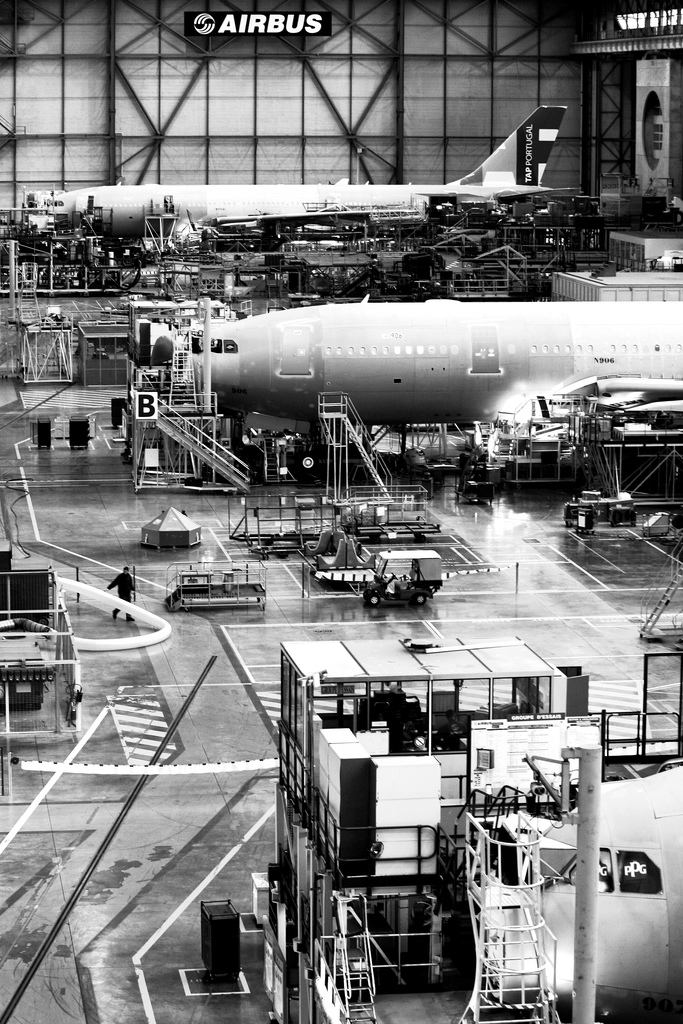
Toulouse and Hamburg, Europe's two pillars
Airbus is actually a consortium born in 1970 from the merger of French, German, Spanish and British manufacturers, and that heritage shows in its industrial geography. Toulouse, in southwestern France, houses the headquarters and the final assembly line for the A320, A330 and A350, and was also the only plant that assembled the A380 throughout its entire production run. Hamburg, in northern Germany, is the second major European plant and also assembles the A320 family, sharing the workload with Toulouse according to demand.
Final assembly outside Europe
To get closer to its markets and customers outside Europe, Airbus opened an A320 final assembly line in Tianjin, China, in 2008, and another in Mobile, Alabama, in 2015, which today also assembles the A220, the regional jet Airbus acquired from Bombardier. Both plants assemble nearly complete aircraft rather than building them from scratch: they receive large sections already built in Europe.
Parts made in many countries, assembled in a few
The fuselage, wings and other structures are built in specialized plants spread across France, Germany, Spain and the United Kingdom — the wings for the A320 family and for the A330 and A350, for example, are built in Broughton, Wales, while those for the A220 come from Belfast and China — and they travel to the final assembly line aboard special cargo aircraft, the Belugas, or by ship and road. Only at the end of the process, in Toulouse, Hamburg, Mobile or Tianjin, do these parts become a complete aircraft, a logistics system unique in the aerospace industry. This network also includes the Spanish plants at Getafe and Illescas, which specialize in composite structures and the tail empennage, and the German plants at Bremen and Stade. It is a geography inherited from the division of labor of the original consortium, which Airbus has kept because each plant has built up half a century of specialization.
More questions

Foto: 4300streetcar (CC BY 4.0) Commercial aviation
Which 747 carried Enterprise "piggyback"?
The first Shuttle Carrier Aircraft was a Boeing 747-123 registered N905NA, originally built for American Airlines and acquired by NASA in 1974. Boeing… more…

Commercial aviation
Was there an amphibious DC-3?
Yes: the Douglas XC-47C was created by fitting Edo Model 78 floats onto a standard C-47. The single-step metal floats carried retractable wheels that also… more…

OTFW, Berlin (CC BY SA), vía commons Commercial aviation
Was a C-47 converted into a glider?
Yes: the Douglas XCG-17 was an assault glider created by converting a twin-engine C-47 Skytrain during World War II. Its engines were removed and the nacelles… more…
Commercial aviation
What did the USSR build from the DC-3?
The USSR built a version of the DC-3 under a licence granted to its government on 15 July 1936. It was designated PS-84 and, in 1942, renamed Lisunov Li-2… more…
Commercial aviation
What was "Puff, the Magic Dragon"?
It was the nickname of the Douglas AC-47 Spooky, the first in a series of fixed-wing gunships developed by the United States Air Force during the Vietnam War… more…
Commercial aviation
How did the RAF refer to the C-47?
The RAF called it Dakota: the Dakota I was the designation for 53 C-47s received under Lend-Lease. The Dakota III designated 962 C-47A Skytrains. The Dakota… more…


