Did you know…
How much the speed of sound?
Short answer
In air at 20 °C the speed of sound is about 343 m/s, or 1,235 km/h (767 mph, 667 kn). It depends on temperature, not pressure: in the standard atmosphere it is 340 m/s at sea level (15 °C) and falls to 295 m/s (1,062 km/h, 573 kn) at 11 km, where airliners cruise. In water it is around 1,480 m/s and in steel close to 5,900 m/s.
_(14781934745)-1600.webp)
The standard figures
The speed of sound in dry air at 20 °C is 343 m/s. Converted, that is 1,235 km/h, 767 mph, 667 kn or about 1,125 ft/s. Aviation uses the International Standard Atmosphere instead, which fixes sea level at 15 °C, giving 340.3 m/s (1,225 km/h, 661 kn). The two numbers are often quoted interchangeably; the difference is the 5 °C between them.
The formula behind these values is the square root of γRT/M, where γ is the ratio of specific heats (1.4 for air), R the gas constant, T the absolute temperature and M the molar mass. A useful rule of thumb follows from it: sound speed in air changes by about 0.6 m/s for each degree Celsius.
Why it changes with altitude
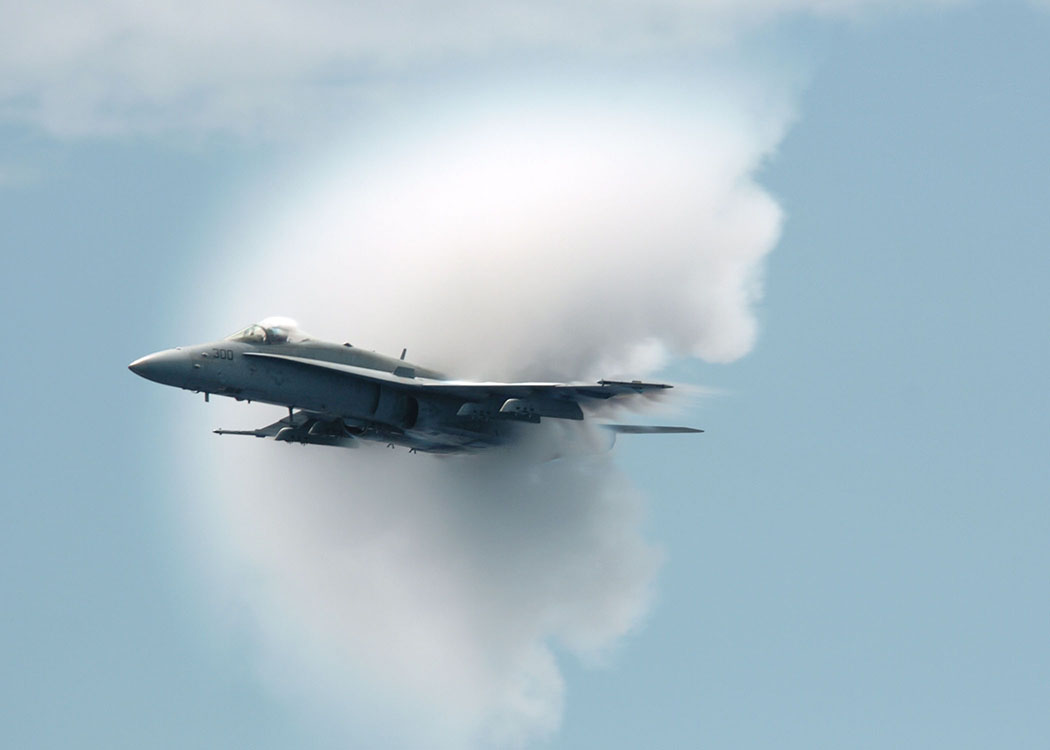
Because only temperature matters, the speed of sound tracks the atmosphere's temperature profile. In the standard atmosphere it falls steadily through the troposphere, reaching 295.1 m/s (1,062 km/h, 573 kn) at the tropopause at 11 km, then holds constant up to 20 km where temperature is uniform, before rising again higher in the stratosphere as ozone warms the air. This is why an airliner cruising at 900 km/h true airspeed at 11 km is at Mach 0.85, whereas the same speed at sea level would be only Mach 0.73. Pilots and flight computers use local Mach number, not a sea-level constant, because the aerodynamic limits of the wing depend on it.
Humidity has a small effect, adding a few tenths of a metre per second in very moist air, because water vapour is lighter than the nitrogen and oxygen it displaces. Pressure alone has none: on a mountain top the air is thinner but sound is slower only because it is colder.
Other media
Liquids and solids carry sound much faster because their molecules are closer and more tightly bound. In fresh water at 20 °C the figure is about 1,480 m/s; in sea water slightly more, around 1,530 m/s, which sonar systems must correct for with temperature and salinity. In steel it is close to 5,900 m/s, in aluminium about 6,300 m/s and in diamond over 12,000 m/s. Among gases, hydrogen at about 1,270 m/s and helium at around 1,000 m/s are the fastest; carbon dioxide, denser and with a lower γ, is slower than air at about 270 m/s.
Speed of sound versus Mach number
Mach number is the ratio of an aircraft's true airspeed to the local speed of sound, so the same Mach 1 corresponds to different speeds in different conditions. Concorde's Mach 2.02 cruise at 17 km was about 2,150 km/h, whereas Mach 2 at sea level on a hot day would be closer to 2,500 km/h. When a figure for the sound barrier is quoted without an altitude, it is almost always the sea-level standard value of 1,225 km/h.
More questions
Physics of flight
Why does the sound barrier exist?
The sound barrier exists because pressure disturbances travel through air at the speed of sound. Below Mach 1 the air ahead of an aircraft receives warning… more…
Physics of flight
Why does the speed of sound change with altitude?
The speed of sound changes with altitude because it depends on air temperature, and temperature falls as you climb through the troposphere. Colder molecules… more…
Physics of flight
Why do planes need airplane mode?
Airplane mode is required mainly by regulation and caution, not by a proven history of accidents. Regulators such as the FAA and EASA require devices to stop… more…
Physics of flight
How far is the speed of sound?
The speed of sound is a speed, not a distance: in air at 20 °C and sea level it is about 343 m/s (1,235 km/h, 667 kn), so sound covers one kilometre in… more…
Physics of flight
How much is the sound barrier?
The sound barrier is not a price or a quantity: it is the speed of sound, which an aircraft meets at Mach 1. That speed is about 343 m/s (1,235 km/h, 667 kn)… more…
Physics of flight
How does the sound barrier break?
The sound barrier is not broken so much as crossed: an aircraft with enough thrust and a shape that tolerates shock waves accelerates through Mach 1. Chuck… more…