Did you know…
How fast does Artemis 2 land?
Short answer
Artemis II didn't land: it splashed down. Orion hit the atmosphere at 400,000 ft traveling at 35 times the speed of sound and reached the water at about 20 mph, the splashdown speed NASA designed its parachute system for. It happened on April 10, 2026, in the Pacific off San Diego.

From hypersonic flight to splashdown
The question starts from a false premise: Artemis II never landed anywhere. It was a crewed lunar flyby lasting 9 days, 1 hour and 32 minutes, from April 1 to April 10, 2026, and it ended with a splashdown in the Pacific off the coast of San Diego at 8:07 p.m. EDT. The relevant speed, then, is that of the Orion capsule on its way home, and it drops dramatically within minutes: it hit the atmosphere at 400,000 ft traveling at 35 times the speed of sound and touched the water at about 20 mph, the design figure for NASA's parachute system.
Who does the braking
The air does almost all the work. The heat shield converts the energy of hypersonic flight into heat and brings the capsule down to subsonic speed; only then do the parachutes come into play. On Artemis II the two drogue parachutes opened at 23,400 ft, when Orion was descending at 479 ft/s, and the three main parachutes deployed at 5,400 ft, slowing it to below 200 ft/s. That sequence is what brings the spacecraft down to the 20 mph of water contact.
A moon landing is nothing like this
These figures shouldn't be carried over to the Moon. There's no atmosphere to brake the descent and no parachutes to open: the descent is done entirely with engines and propellant, and so is the ascent. That's why landing on the Moon isn't Orion's job, since it only reaches lunar orbit — it falls to a separate human landing system. Under the current schedule (as of October 2026), the program's first Moon landing is Artemis IV, planned for early 2028.
More questions
Moon and Mars
How does neil armstrong look like?
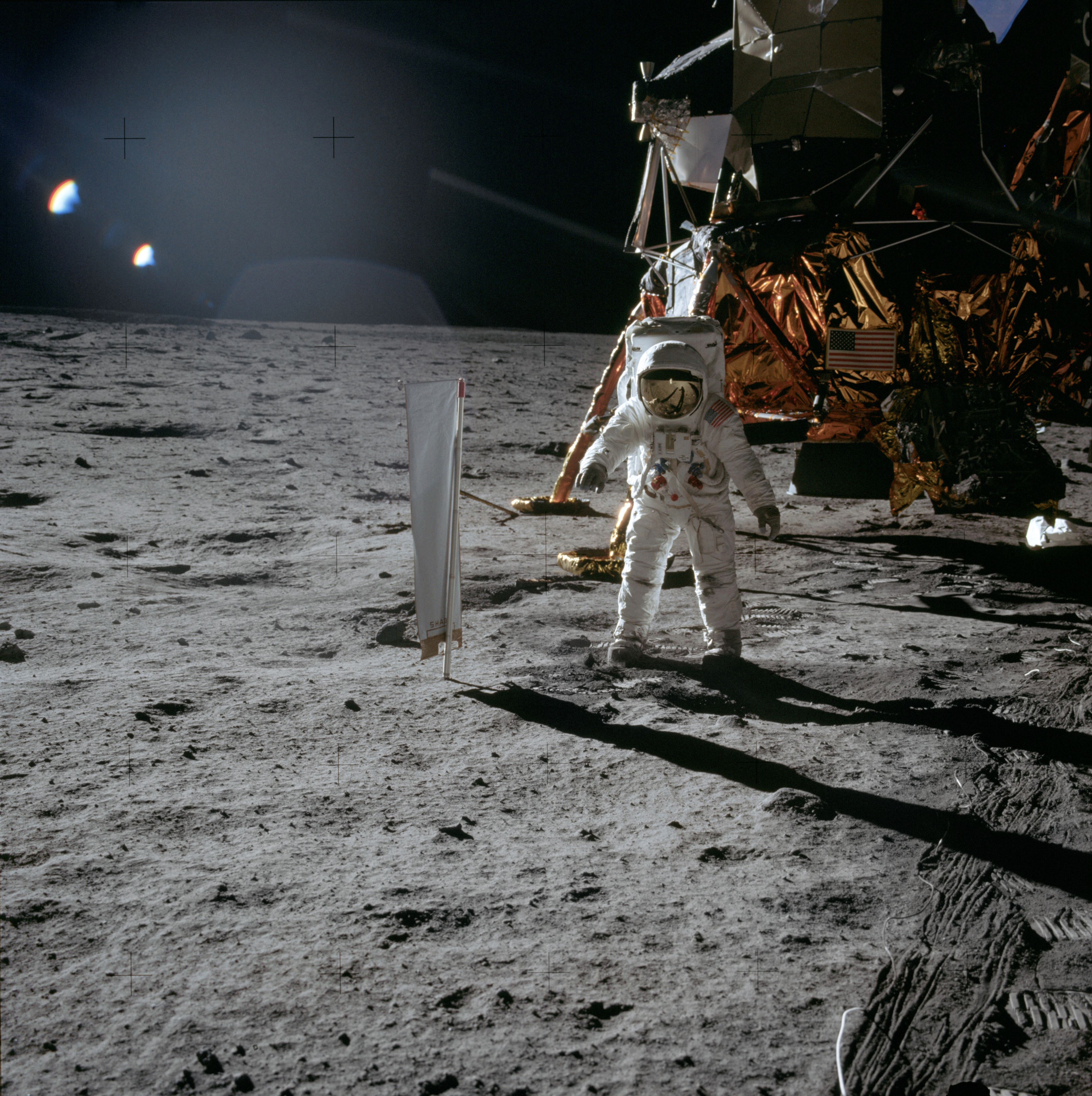
The face most people picture is not his: the gold-visored astronaut in the famous Apollo 11 photograph is Buzz Aldrin, shot by Armstrong. Armstrong himself is… more…

Richard Dorrell (CC BY SA), vía commons Moon and Mars
How does the moon affect the tides?
By pulling unevenly on it. Tidal forces vary inversely as the cube of the distance, so the near side of the Earth is tugged harder than the far side: one… more…
Moon and Mars
Why does neil armstrong have a hollywood star?
Strictly he does not have a star. Armstrong, Aldrin and Collins share four circular monuments resembling the Moon, one at each corner of Hollywood and Vine… more…
Foto: SpaceX (CC0) Moon and Mars
Why did falcon 9 hit the moon?
Because a spent upper stage on a lunar trajectory has no mission and no way to steer. A Falcon 9 upper stage from the January 2025 Firefly Blue Ghost 1 launch… more…
Moon and Mars
How much apollo 11 cost?
NASA never published a price for Apollo 11 on its own; what is documented is the program. The United States spent $25.8 billion on Project Apollo between 1960… more…
Moon and Mars
How much time neil armstrong spent on moon?
Armstrong and Aldrin spent 21 hours, 36 minutes on the Moon's surface, almost all of it inside the lunar module Eagle. Armstrong stepped onto the surface… more…

