Did you know…
How far is the sound barrier?
Short answer
The sound barrier is not a distance but a speed: Mach 1, the local speed of sound, about 1,225 km/h (661 kn) at sea level and 1,062 km/h at 11 km. Airliners cruise just below it at Mach 0.78 to 0.85. The term dates from the 1940s, when the transonic drag rise seemed an impassable wall until the Bell X-1 exceeded Mach 1 on 14 October 1947.
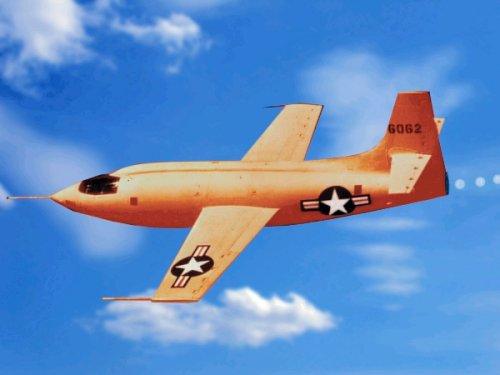
A speed, not a place
The phrase suggests a wall somewhere in the sky, but the sound barrier is a speed: the point at which an aircraft's airspeed equals the local speed of sound, Mach 1. That speed depends on air temperature. In the standard atmosphere it is 340 m/s, or 1,225 km/h (661 kn), at sea level and 295 m/s, or 1,062 km/h (573 kn), at 11 km where the air is at −56.5 °C. So the barrier is 'closer' at altitude, which is one reason high-speed record flights and airliner cruise both happen high up. There is no distance to it, only a margin: an Airbus A350 or Boeing 787 cruising at Mach 0.85 is about 160 km/h short of it, and will never go faster because its wing is not designed to.
Where the wall came from
The expression dates from the late 1930s and 1940s. As fighters dived toward Mach 0.8, air over their wings went locally supersonic, shock waves formed, controls froze or reversed and drag rose so sharply that some aircraft were lost. Early wind tunnels choked at these speeds and gave no useful data, so the transonic region looked like a wall. In fact the drag rise is a hump, not a barrier, and had been crossed by artillery shells and bullets for a century. The task was to build an aircraft strong enough, with enough thrust and with controls that still worked, to push through the hump.
The first crossing
On 14 October 1947 Chuck Yeager flew the rocket-powered Bell X-1, dropped from a B-29 over the Mojave Desert, to Mach 1.06 at about 13,000 m (43,000 ft). The X-1 had a fuselage shaped like a .50-calibre bullet, thin straight wings and an all-moving tailplane, the feature that solved the control problem and was later copied onto the F-86 and every supersonic aircraft since. Within a decade fighters such as the F-100 exceeded Mach 1 in level flight, and by 1976 Concorde carried passengers at Mach 2.
What crossing it feels like
Inside a supersonic aircraft there is no bump at Mach 1; the Mach meter simply passes it, with a small trim change as the centre of lift moves aft. The dramatic part happens outside: the shock waves trail to the ground as a sonic boom, and in humid air a condensation cloud can flash around the airframe as the pressure drop behind the shocks chills the air. That cloud, often photographed on aircraft at airshows, appears at high subsonic speed as well and is not itself proof that the barrier has been crossed.
More questions
Physics of flight
Why does the sound barrier exist?
The sound barrier exists because pressure disturbances travel through air at the speed of sound. Below Mach 1 the air ahead of an aircraft receives warning… more…
Physics of flight
Why does the speed of sound change with altitude?
The speed of sound changes with altitude because it depends on air temperature, and temperature falls as you climb through the troposphere. Colder molecules… more…
Physics of flight
Why do planes need airplane mode?
Airplane mode is required mainly by regulation and caution, not by a proven history of accidents. Regulators such as the FAA and EASA require devices to stop… more…
Physics of flight
How far is the speed of sound?
The speed of sound is a speed, not a distance: in air at 20 °C and sea level it is about 343 m/s (1,235 km/h, 667 kn), so sound covers one kilometre in… more…
Physics of flight
How much is the sound barrier?
The sound barrier is not a price or a quantity: it is the speed of sound, which an aircraft meets at Mach 1. That speed is about 343 m/s (1,235 km/h, 667 kn)… more…
Physics of flight
How does the sound barrier break?
The sound barrier is not broken so much as crossed: an aircraft with enough thrust and a shape that tolerates shock waves accelerates through Mach 1. Chuck… more…