Did you know…
How does the sound barrier break?
Short answer
The sound barrier is not broken so much as crossed: an aircraft with enough thrust and a shape that tolerates shock waves accelerates through Mach 1. Chuck Yeager did it first on 14 October 1947 in the rocket-powered Bell X-1, reaching Mach 1.06 at about 13,000 m (43,000 ft). Thin wings, a pointed nose and an all-moving tailplane made it possible.
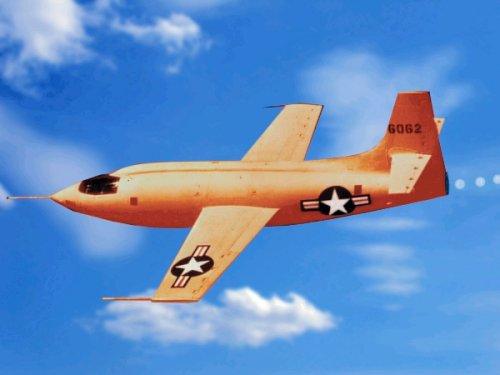
The first crossing
On 14 October 1947, over the dry lakebed of Muroc in California, a small orange aircraft was released from the bomb bay of a B-29 at around 6,000 m. Its pilot, Air Force captain Charles Yeager, lit the four chambers of its rocket engine in sequence and climbed. At roughly 13,000 m (43,000 ft) the Machmeter needle passed 1 and the ground stations heard a boom: the Bell X-1 had become the first aircraft to fly faster than sound in level flight, at about Mach 1.06, and it had done so without the destructive buffeting many engineers had feared. The flight lasted only a few minutes on rocket power, but it settled a question that had cost lives in wartime dives.
What the X-1 got right
The X-1 was designed to survive the transonic region rather than avoid it. Its fuselage was modelled on a .50-calibre bullet, a shape known to be stable above the speed of sound. The wings were straight but unusually thin, which delayed the formation of shock waves. A rocket engine gave it thrust that did not fall off at high speed, as propellers do. Most important was the horizontal tail, which could be moved as a single surface: on earlier aircraft the hinged elevator lost its effect when a shock formed ahead of it, and Yeager's team had found on previous flights that trimming the whole stabiliser restored control. That feature became standard on every supersonic aircraft afterwards.
How aircraft cross it now
Modern supersonic aircraft use the same recipe with better tools. Afterburning turbojets and turbofans supply thrust that grows with speed; swept or delta wings and slender fuselages shaped according to the area rule keep transonic drag manageable; flight-control computers handle the shifts in trim. A fighter typically accelerates through Mach 1 in a shallow dive or level flight at high altitude, where the speed of sound is lower and the air thinner, and the transition is felt mainly as a change in the trim and a smoothing of the airflow rather than as a jolt. Concorde carried passengers through it routinely, accelerating over the sea to spare people on the ground the sonic boom, the pressure wave that follows any aircraft flying supersonic and that remains the main obstacle to overland supersonic travel.
More questions
Physics of flight
Why does the sound barrier exist?
The sound barrier exists because pressure disturbances travel through air at the speed of sound. Below Mach 1 the air ahead of an aircraft receives warning… more…
Physics of flight
Why does the speed of sound change with altitude?
The speed of sound changes with altitude because it depends on air temperature, and temperature falls as you climb through the troposphere. Colder molecules… more…
Physics of flight
Why do planes need airplane mode?
Airplane mode is required mainly by regulation and caution, not by a proven history of accidents. Regulators such as the FAA and EASA require devices to stop… more…
Physics of flight
How far is the speed of sound?
The speed of sound is a speed, not a distance: in air at 20 °C and sea level it is about 343 m/s (1,235 km/h, 667 kn), so sound covers one kilometre in… more…
Physics of flight
How much is the sound barrier?
The sound barrier is not a price or a quantity: it is the speed of sound, which an aircraft meets at Mach 1. That speed is about 343 m/s (1,235 km/h, 667 kn)… more…
Physics of flight
How does the sound barrier work?
The sound barrier is the sharp rise in drag and control difficulty an aircraft meets as it nears Mach 1, about 1,062 km/h (573 kn) at cruise altitude. Air… more…