Did you know…
How does a plane fly?
Short answer
A plane flies by using engine thrust to move its wings through the air fast enough to generate lift greater than or equal to its weight. The wing's shape and angle deflect air downward and lower the pressure above it. Control surfaces on the wings and tail let the pilot pitch, roll and yaw the aircraft, steering that lift wherever it needs to go.
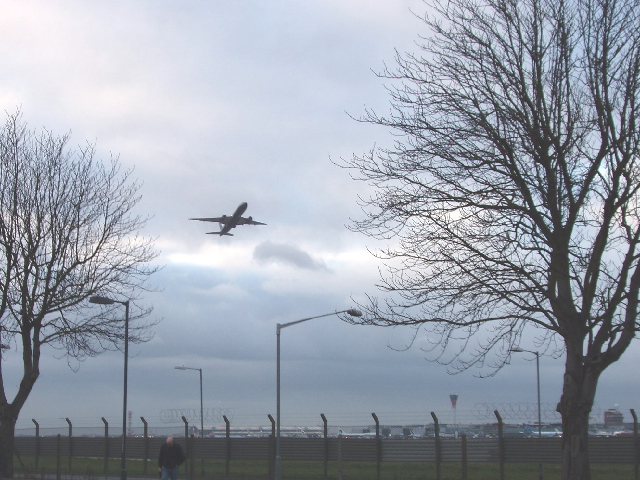
Making lift
Flight begins with the wing. Its cross-section, the aerofoil, is curved on top and set at a slight angle to the oncoming air. As the aircraft moves forward, the wing deflects the airflow downward and, in the same motion, the air over the upper surface speeds up and its pressure drops. The higher pressure beneath and the lower pressure above produce a net upward force: lift. The faster the wing moves, the more lift it generates, in proportion to the square of the speed. That is why an aircraft must accelerate along a runway before it can leave the ground, and why it can carry more when it is flying fast in dense, cold air than when it is slow or in thin air.
Producing thrust
The wing only works if something keeps it moving, and that is the job of the engines. A propeller accelerates a wide column of air backward; a turbofan does the same with a large fan and adds a hot exhaust jet. In both cases the reaction to pushing air backward drives the aircraft forward. Thrust must overcome drag, which comes from the friction of air over the surfaces, the pressure of the air being pushed aside and the cost of generating lift itself. Once thrust exceeds drag the aircraft accelerates; once they are equal it holds a steady speed.
Steering with the air
An aircraft is controlled by shaping the airflow rather than by pushing against anything solid. Hinged ailerons near the wingtips move in opposite directions to roll the aircraft and bank it into a turn. The elevator on the tailplane pitches the nose up or down, changing the wing's angle of attack and therefore its lift. The rudder on the fin yaws the nose left or right and keeps turns coordinated. Flaps extend from the trailing edge to add lift at low speed for takeoff and landing, and spoilers rise from the wing to dump lift and slow the aircraft on the ground.
From takeoff to touchdown
A flight ties these elements together. On the runway the engines run up to full power and the aircraft accelerates until the wings can lift it, typically at 250 to 300 km/h for an airliner. Climbing, the pilot holds a nose-up attitude so that lift exceeds weight. In cruise, everything settles into balance. On approach, the flaps come out, power is reduced and the aircraft descends along a shallow path, touching down at the lowest safe speed before brakes, spoilers and reverse thrust bring it to a halt.
More questions
Physics of flight
Why does the sound barrier exist?
The sound barrier exists because pressure disturbances travel through air at the speed of sound. Below Mach 1 the air ahead of an aircraft receives warning… more…
Physics of flight
Why does the speed of sound change with altitude?
The speed of sound changes with altitude because it depends on air temperature, and temperature falls as you climb through the troposphere. Colder molecules… more…
Physics of flight
Why do planes need airplane mode?
Airplane mode is required mainly by regulation and caution, not by a proven history of accidents. Regulators such as the FAA and EASA require devices to stop… more…
Physics of flight
How far is the speed of sound?
The speed of sound is a speed, not a distance: in air at 20 °C and sea level it is about 343 m/s (1,235 km/h, 667 kn), so sound covers one kilometre in… more…
Physics of flight
How much is the sound barrier?
The sound barrier is not a price or a quantity: it is the speed of sound, which an aircraft meets at Mach 1. That speed is about 343 m/s (1,235 km/h, 667 kn)… more…
Physics of flight
How does the sound barrier break?
The sound barrier is not broken so much as crossed: an aircraft with enough thrust and a shape that tolerates shock waves accelerates through Mach 1. Chuck… more…