Did you know…
What material were the fuel tanks of the Beech AT-10 trainer made of?
Short answer
Made of wood: the AT-10's fuel tanks were wood coated with neoprene, a synthetic rubber. Beech built the fuselage from plywood and kept only the engine cowlings and cockpit enclosure in aluminum, to save scarce metals needed for combat aircraft.
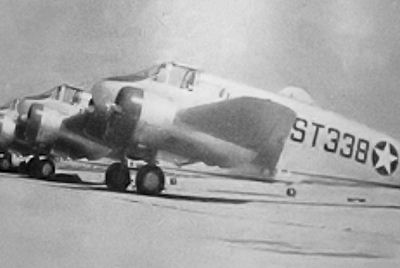
Wood instead of aluminum
Beechcraft began designing the Model 25 in early 1940 in response to a requirement from what was then called the United States Army Air Corps (USAAC) for a small twin-engine aircraft suitable for training students in handling multi-engine aircraft with retractable landing gear. Since there was concern at the time about a possible future shortage of aluminum, part of the requirement was that the aircraft be built using "non-strategic" materials. Beechcraft met that condition by designing the aircraft to be built mainly of wood. To conserve the scarce metals needed by combat aircraft, the fuselage was made of plywood, and only the engine cowlings and cockpit enclosure remained aluminum. The fuel tanks were also made of wood, coated with neoprene, a synthetic rubber.
From lost prototype to production
The Model 25 prototype was delivered to the USAAC for evaluation, but it was destroyed in an accident on May 5, 1941. The following day Beechcraft began work on the Model 26, which was soon ready and made its first flight on July 19 of that same year. By the end of 1942, 748 aircraft had been delivered, taking part in training crews for the huge fleets of bombers and transports.
More questions

Aviation history
What was special about the Vertol 76?
Vertol's VZ-2 tested the tiltwing concept for vertical take-off and landing. After ground trials beginning in April 1957, it first took off on 13 August only… more…

Aviation history
Which was the most-produced American fighter of the Second World War?
The Republic P-47 Thunderbolt, of which 15,636 or 15,683 units were built, depending on the source. It was also one of the heaviest fighters of the conflict… more…

Aviation history
Who flew the E-66 at 2,149 km/h?
Konstantin or Vladimir Kokkinaki, depending on the source. Konstantin is credited with the absolute record on a closed 100 km circuit, at 2,148.66 km/h, set… more…

Fly-by-Owen (CC BY SA), vía commons Aviation history
How many I-11Bs were built?
Between 208 and around 450, depending on the source: one of the AISA I-11 reference sheets gives 208 examples built, while All-Aero speaks of around 400 built… more…

Aviation history
How many HH-53s could be converted to Pave Low III?
Eight HH-53C aircraft received an improved systems package and were redesignated HH-53H Pave Low III. The other figure in circulation, nine MH-53H and 32… more…

SCDBob (CC BY SA), vía commons Aviation history
What did the A129 Mangusta's armor protect?
The fuselage: the A129's airframe is armored and, according to All-Aero, designed to protect against 12.7 mm rounds, with partial protection against 23 mm… more…


