Did you know…
What was designed first on the P-47?
Short answer
The powerplant and its air system: Kartveli didn't draw an airframe first and then find an engine for it. He started with the 18-cylinder, turbosupercharged Pratt & Whitney R-2800 Double Wasp. The air-flow system was designed before anything else, and the fuselage structure was built around it.
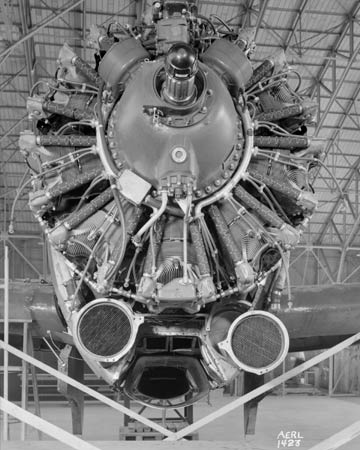
Engine first, then the airplane
The starting point wasn't the airframe: instead of drawing it and then looking for an engine to fit, Kartveli started with the powerplant, the huge 18-cylinder, turbosupercharged Pratt & Whitney R-2800 Double Wasp. The air-flow system was designed first, and the fuselage structure was built around it. That twin-row radial produced up to 2,000 hp (1,500 kW) and drove a four-blade, constant-speed Curtiss Electric propeller 146 in (3.7 m) in diameter.
The turbo, in the rear fuselage
Kartveli placed the General Electric turbosupercharger in the rear fuselage, not on top of the engine. It was mounted inside the fuselage, about 22 feet behind the propeller, with the exhaust gases carried from the engine to the turbine through jacketed ducts under the fuselage. Exhaust from the 18 cylinders was routed rearward to spin the turbine, and the compressed air returned forward through an intercooler to the carburetor. The ducts, fitted with waste gates, ran along both sides of the cockpit and glowed red at their forward ends at full power, while the turbine spun at 21,300 rpm. An oil-operated regulator governed those waste gates and automatically adjusted turbine speed to maintain the manifold pressure chosen by the pilot.
What had to be adapted around it
To accommodate the large-diameter propeller without sacrificing wing armament or structural efficiency, Republic developed a telescoping main landing gear that extended 9 in (23 cm) when deployed and folded inward into compact wheel wells when retracted. That mechanism also reduced the size and weight of the gear legs and allowed the machine guns to be mounted in the wings. The armament consisted of eight .50 caliber (12.7 mm) Browning AN/M2 machine guns, four per wing, staggered to feed from adjacent ammunition boxes holding 350 rounds each, with a combined rate of about 100 rounds per second. The self-sealing main and auxiliary fuel tanks sat beneath the cockpit, with a total capacity of 305 US gallons (254 imp gal; 1,155 L).
More questions

Aviation history
Which was the most-produced American fighter of the Second World War?
The Republic P-47 Thunderbolt, of which 15,636 or 15,683 units were built, depending on the source. It was also one of the heaviest fighters of the conflict… more…

Aviation history
Who flew the E-66 at 2,149 km/h?
Konstantin or Vladimir Kokkinaki, depending on the source. Konstantin is credited with the absolute record on a closed 100 km circuit, at 2,148.66 km/h, set… more…

Fly-by-Owen (CC BY SA), vía commons Aviation history
How many I-11Bs were built?
Between 208 and around 450, depending on the source: one of the AISA I-11 reference sheets gives 208 examples built, while All-Aero speaks of around 400 built… more…

Aviation history
How many HH-53s could be converted to Pave Low III?
Eight HH-53C aircraft received an improved systems package and were redesignated HH-53H Pave Low III. The other figure in circulation, nine MH-53H and 32… more…

SCDBob (CC BY SA), vía commons Aviation history
What did the A129 Mangusta's armor protect?
The fuselage: the A129's airframe is armored and, according to All-Aero, designed to protect against 12.7 mm rounds, with partial protection against 23 mm… more…
Fly-by-Owen (CC BY SA), vía commons Aviation history
What landing gear and canopy did the AISA I-11B have?
According to one account, AISA reduced the cockpit canopy and fitted tailwheel gear on the production I-11B. All-Aero claims the opposite: the I-11B was… more…


