Did you know…
How is weightlessness produced?
Short answer
Not by switching off gravity—which keeps acting—but through free fall: anyone falling at the same speed as everything around them feels no weight. The space station constantly falls toward Earth without ever arriving; drop towers and parabolic flights produce the same state for brief moments.
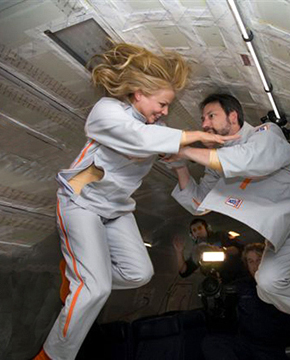
Gravity remains, weight disappears
Weightlessness is not a place but a state. Even at the orbital altitude of the space station, Earth still pulls strongly, with about 90 percent of its surface strength. The sensation of weight only arises when something counteracts that pull: the chair, the floor, the airplane seat. If everything falls freely at the same time, that counterforce is missing, and nothing presses anymore on the scale, the spine, or the inner ear. That is exactly what a crew in orbit experiences permanently, and for an instant, anyone who jumps.
In orbit: falling without arriving
A space station constantly falls toward Earth and never reaches it, because at the same time it flies very fast sideways. Its trajectory curves with the same intensity as the Earth's surface below. Strictly speaking, that is why microgravity reigns and not zero gravity: residual atmosphere brakes it, the station is large enough that small differences exist between its ends, and any movement on board—every fan, every docking maneuver—generates small accelerations. That is why sensitive experiments are suspended in a decoupled way and carried out during calm phases.
How it is recreated on Earth
To run tests, no one needs to launch. In the drop tower, a capsule falls inside an evacuated tube; free fall lasts only seconds—at NASA's facility at the Glenn Research Center, 5.18 seconds—but that is enough for combustion or crystallization experiments. A parabolic flight aircraft climbs steeply and then follows the trajectory its own weight would describe, so that the cabin and its occupants fall together, for much longer than in the tower, about 20 to 30 seconds each time. Water tanks, on the other hand, do not generate weightlessness but buoyancy: they serve to practice maneuvers, not physics.
More questions

Lviatour (CC BY SA), vía commons Astronauts and life in space
What did Neil Armstrong see in the Cueva de los Tayos?
An enormous cave full of life, not an extraterrestrial structure. According to an account by a caver on the team, published in 1979, Armstrong was the guest… more…

Astronauts and life in space
Why do astronauts grow taller in space?
In microgravity, the spine is no longer compressed by body weight: it lengthens and the back's natural curves flatten out. The crew gains a few centimeters… more…

Astronauts and life in space
How do astronauts sleep in space?
Each astronaut on the International Space Station has an individual cabin about the size of a phone booth, with a sleeping bag strapped to the floor, ceiling… more…
Astronauts and life in space
How long do astronauts sleep?
The International Space Station's schedule reserves 8.5 hours of sleep per night for each crew member. In practice, they sleep less: a study published in 2014… more…

Astronauts and life in space
How do astronauts eat in space?
Meals on board are mostly dehydrated foods rehydrated with water from a dispenser, and ready-to-eat thermostabilized dishes warmed in the galley oven, along… more…

Astronauts and life in space
How much money does Alexander Gerst have?
There is no reliable figure for Alexander Gerst's fortune; the amounts on celebrity websites are estimates without basis. What is documented is his… more…


