Did you know…
How to land an airplane?
Short answer
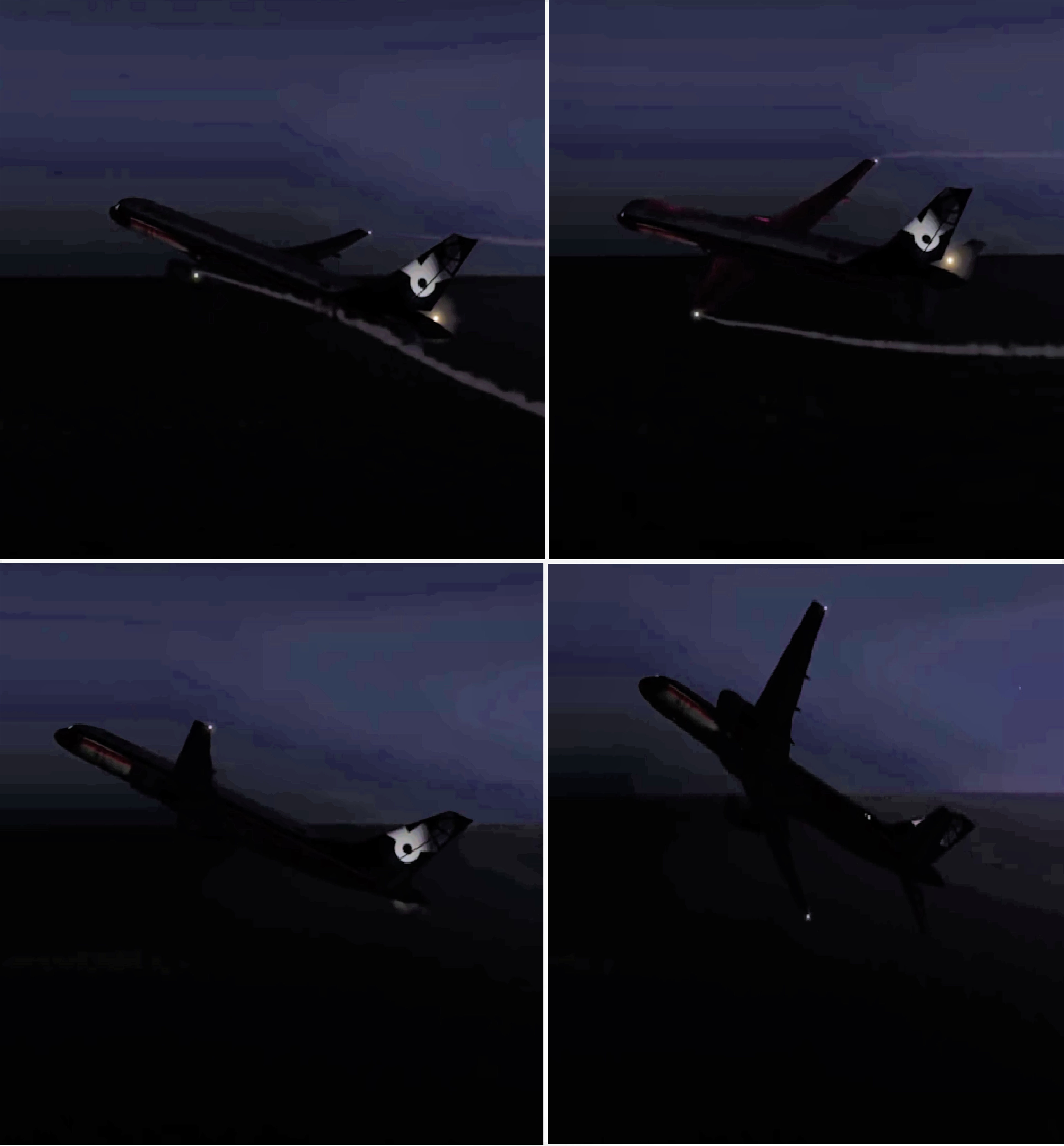
Landing an airplane means descending along a stable path of about 3° toward the runway, with speed, flap setting and landing gear set before reaching 300 m (1,000 ft) of height. A few meters above the ground the pilot reduces power and gently raises the nose (the flare) to touch down first on the main gear, then slows down using spoilers, brakes and reversers.
Preparing the approach
A landing begins long before the runway comes into view. During descent, the crew checks the airport's weather report, chooses the runway and approach procedure, calculates the reference speed (Vref) based on weight and flap setting, and checks the available landing distance against what the aircraft needs on a dry or wet runway. The checklist sets the altimeter setting, initial flaps and target speeds, and the go-around procedure is briefed aloud in case the approach must be aborted.
The glide path and the stabilized approach
Most runways at commercial airports are flown on a 3-degree glide path, guided by ILS or satellite, equivalent to descending about 300 m (1,000 ft) for every 5.7 km covered. The aircraft extends flaps in stages and lowers the landing gear about 8 km from the runway. At 300 m above the ground, the approach must be stabilized: on the glide path and localizer, in final configuration, at a speed between Vref and Vref plus 10 to 20 kn depending on wind, and with a descent rate below 300 m/min (1,000 ft/min). If any of those limits is exceeded, the rule is to go around. In general aviation the pattern is similar: a downwind leg parallel to the runway, base and final, with approach speed set at 1.3 times the stall speed.
The flare and touchdown
At around 6 to 9 m (20 to 30 ft) above the runway the pilot reduces power to idle and gently raises the nose to slow the descent, a maneuver known as the flare. The goal is for the aircraft to touch down on the main landing gear, with the nose slightly up, in the touchdown zone, at a descent rate of one or two meters per second. In a crosswind, the nose is aligned with the rudder and one wing is lowered into the wind. A light tricycle-gear aircraft lands the same way; a tailwheel aircraft is brought to the stall just above the runway to touch down on all three wheels at once.
Braking and runway exit
At touchdown, the spoilers deploy automatically to kill lift and load the wheels, the brakes are applied, with anti-skid and, on jets, a selectable autobrake, and the thrust reversers are opened to redirect engine exhaust forward. The nose wheel is lowered gently and, below about 110 km/h (60 kn), the pilot switches from the rudder to the nosewheel steering tiller to leave the runway via the planned exit taxiway and clear it for the next flight.
More questions

Physics of flight
Why can't a Corsair pilot apply full power when going around after a failed carrier landing?
Because at low speed and high power the Corsair would drop its left wing suddenly and with almost no warning, due to propeller torque. If the throttle was… more…

Physics of flight
What did the phrase "banking with intent to turn" mean among F-104 pilots?
It was a joke among Canadian F-104 pilots: banking the aircraft "with intent to turn" referred to its poor low-speed turning. Its sustained turn capability… more…

Julian Herzog (Website) (CC BY), vía commons Physics of flight
What is "flight envelope protection," which the A320 pioneered?
A set of limits embedded in the flight control software: it calculates the flight envelope, adds a safety margin, and blocks pilot inputs that would take the… more…
Julian Herzog (Website) (CC BY), vía commons Physics of flight
What is the A320's SHARP package for?
SHARP (SHort AiRfield Package) improves takeoff and landing performance on short runways and is designed to increase low-speed lift. It combines aerodynamic… more…
Physics of flight
What flaw sank Vought's all-metal V-141 fighter?
It wasn't a single flaw: tests showed the V-141 still flew poorly, was prone to spinning, and also suffered tail flutter, which is why it was rejected. It… more…
Physics of flight
What wind tunnel did NACA use to study the Corsair, and how big was it?
The full-scale 30- by 60-Foot Tunnel at the Langley Research Center, in Hampton, Virginia. NACA dedicated the facility on 27 May 1931 and used it to test the… more…


