Did you know…
How were the Hs 123s supplied in Poland?
Short answer
By air, with Junkers Ju 52/3m transports. During the 1939 Polish campaign, the ground-attack group II.(Schlacht)/LG 2, equipped with Henschel Hs 123A-1 biplanes, changed airfields again and again as the German advance progressed, and the Ju 52s carried ground crews, spare parts, fuel and ammunition to each new base.

A ground-attack group always on the move
In the Polish campaign of September 1939, one of the most notable roles in German air support fell to a unit specialised in ground attack: II.(Schlacht)/LG 2, equipped with Henschel Hs 123A-1 biplanes and assigned to Luftflotte IV. Around 37 Hs 123s flew out from Alt-Rosenberg to attack concentrations of Polish troops. Their mobility was extraordinary for the time: in a very brief campaign they first used Alt-Rosenberg, then Witkowice, then Wolborz and later four other bases, including Piastow and Zalesie-Uleniec.
The logistics travelled by Ju 52
A close-support aircraft is only useful if it can operate near the front, and that required moving everything it needed along with it. According to the Illustrated Encyclopedia of Aviation, ground personnel, spare parts, fuel, oil and ammunition were transported on Junkers Ju 52/3m to each new base immediately after the German advance. The trimotor, born as a 17-seat airliner and adopted by the Luftwaffe as its basic transport, thus allowed the Hs 123s to jump from airfield to airfield without waiting for the ground columns.
A model for the following campaigns
The Polish campaign was also the Ju 52's first major combat use in the Second World War, in which it also took part in the bombing of Warsaw. The scheme of supplying advanced units by air would be repeated on a larger scale: in the invasion of Norway in 1940 the Ju 52s flew 3,018 sorties and carried 29,280 people, and in May of that year, in the Netherlands, they landed directly on enemy territory with assault troops. Its great limitation was always the same: with a top speed of only 265 km/h, half that of a Hurricane, it needed escort whenever it flew over a combat zone.
More questions
Aviation history
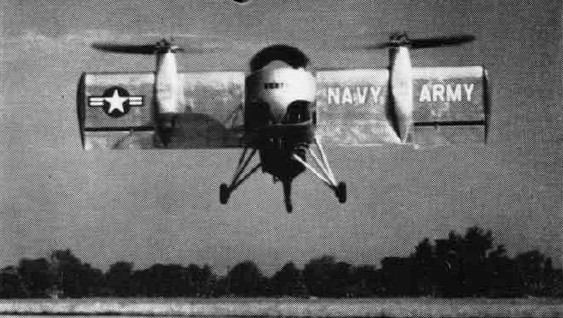
What was special about the Vertol 76?
Vertol's VZ-2 tested the tiltwing concept for vertical take-off and landing. After ground trials beginning in April 1957, it first took off on 13 August only… more…

Aviation history
Which was the most-produced American fighter of the Second World War?
The Republic P-47 Thunderbolt, of which 15,636 or 15,683 units were built, depending on the source. It was also one of the heaviest fighters of the conflict… more…

Aviation history
Who flew the E-66 at 2,149 km/h?
Konstantin or Vladimir Kokkinaki, depending on the source. Konstantin is credited with the absolute record on a closed 100 km circuit, at 2,148.66 km/h, set… more…

Fly-by-Owen (CC BY SA), vía commons Aviation history
How many I-11Bs were built?
Between 208 and around 450, depending on the source: one of the AISA I-11 reference sheets gives 208 examples built, while All-Aero speaks of around 400 built… more…

Aviation history
How many HH-53s could be converted to Pave Low III?
Eight HH-53C aircraft received an improved systems package and were redesignated HH-53H Pave Low III. The other figure in circulation, nine MH-53H and 32… more…

SCDBob (CC BY SA), vía commons Aviation history
What did the A129 Mangusta's armor protect?
The fuselage: the A129's airframe is armored and, according to All-Aero, designed to protect against 12.7 mm rounds, with partial protection against 23 mm… more…


