Did you know…
Who invented rockets?
Short answer
No single person: rockets emerged in China around the 13th century as gunpowder arrows. The modern rocket has three theoretical fathers, Tsiolkovsky, Goddard and Oberth; Goddard launched the first liquid-fueled rocket on March 16, 1926, and Wernher von Braun's team built the first to reach space, the V-2, in 1944.

From Chinese gunpowder to European wars
The earliest reliable references to rockets come from China's Song dynasty, in the 13th century: bamboo or paper tubes filled with gunpowder and tied to arrows, used in battle. The technique traveled across Asia and the Middle East and reached Europe in the 14th century. In the late 18th century the Kingdom of Mysore, in India, used iron-cased rockets against British troops, and engineer William Congreve copied and improved them for the Royal Navy; the "Congreve rockets" bombarded Copenhagen in 1807 and Fort McHenry in 1814.
The three theorists
The rocket as a means of leaving Earth was formulated, each independently, by three pioneers. The Russian Konstantin Tsiolkovsky published in 1903 the equation relating attainable velocity to propellant mass, and already proposed liquid fuel and multiple stages. American Robert Goddard turned theory into hardware: on March 16, 1926, in Auburn, Massachusetts, he flew the first liquid-fueled rocket, using gasoline and liquid oxygen, which rose 12.5 m in 2.5 seconds. German Hermann Oberth published in 1923 the treatise that inspired the next generation of engineers in his country.
From the V-2 to space
That generation, led by Wernher von Braun, developed the A-4 for the German army, known as the V-2, the first large ballistic missile. A test V-2 exceeded 100 km in altitude in June 1944, becoming the first human-made object to reach space. After the war, its engineers and captured rockets became the foundation of the US and Soviet space programs.
More questions
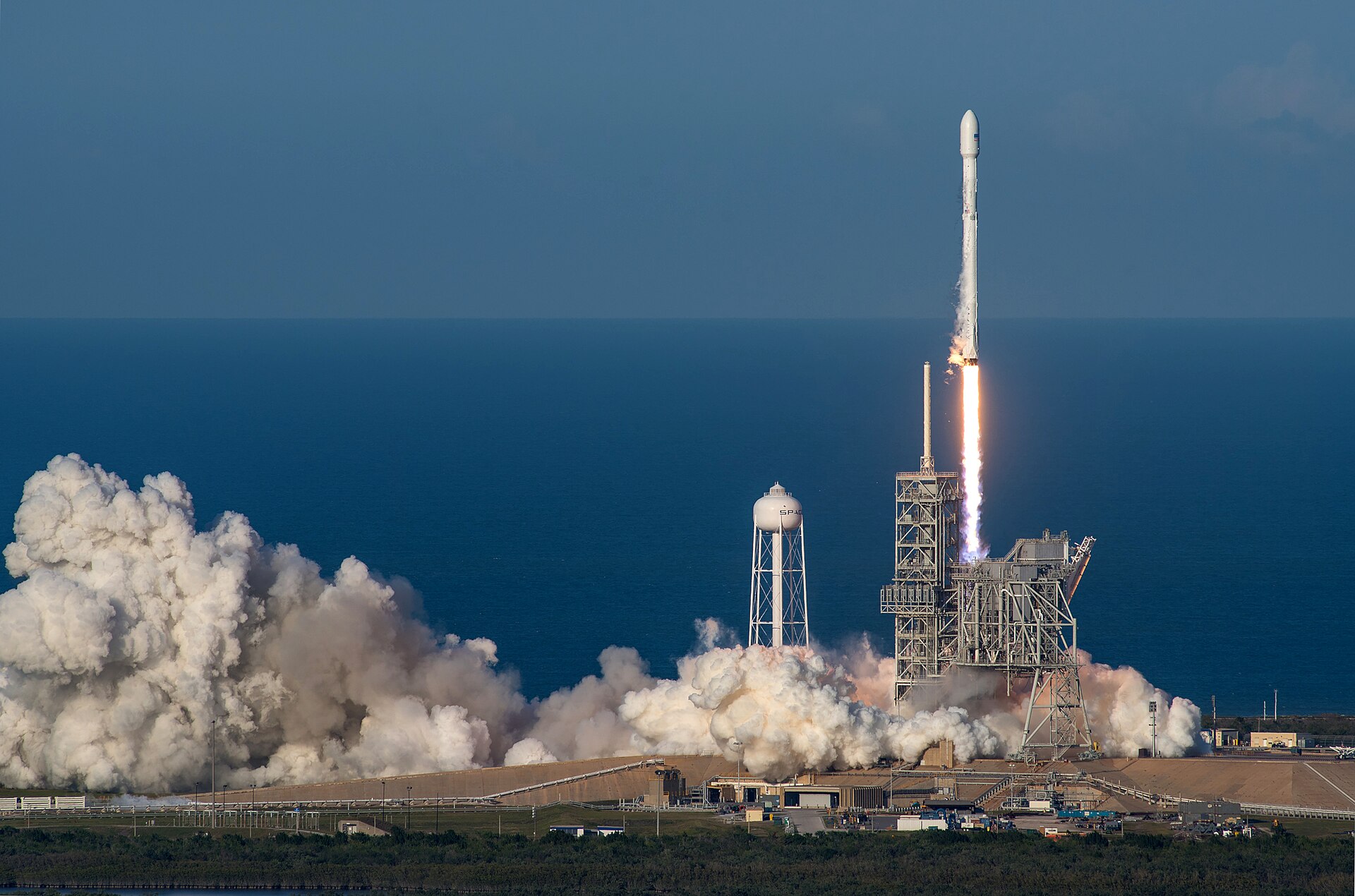
Foto: SpaceX (CC0) Rockets and launches
How many horsepower does the Falcon 9 have?
Rockets aren't measured in horsepower, but in thrust: the Falcon 9's first stage's nine Merlin engines deliver 7,686 kN (1,710,000 lbf) combined at sea level… more…
Foto: SpaceX (CC0) Rockets and launches
How much a rocket weight?
Rockets range from about 13 t for Rocket Lab's Electron to roughly 549 t for Falcon 9, 2,800 t for Saturn V and close to 5,000 t for Starship with its Super… more…

Rockets and launches
What does the saturn v look like?
Saturn V looked like a white needle 110.6 m (363 ft) tall and 10.1 m wide at the base, painted with black roll-pattern stripes, the words UNITED STATES and… more…
Foto: SpaceX (CC0) Rockets and launches
Why do rockets launch from florida?
Rockets launch from Florida because the Cape sits at 28.5 degrees north, low enough to gain about 410 m/s from the Earth's rotation on an eastward launch, and… more…
Foto: SpaceX (CC0) Rockets and launches
How much falcon 9 launch cost?
SpaceX lists a standard Falcon 9 mission at 69.75 million dollars, with the booster recovered (data as of January 2025). Small satellites can share a ride… more…
Rockets and launches
How does the saturn v work?
Saturn V worked by staging: a kerosene first stage with five F-1 engines (about 34,000 kN) lifted the 2,800 t rocket for two and a half minutes, a… more…

