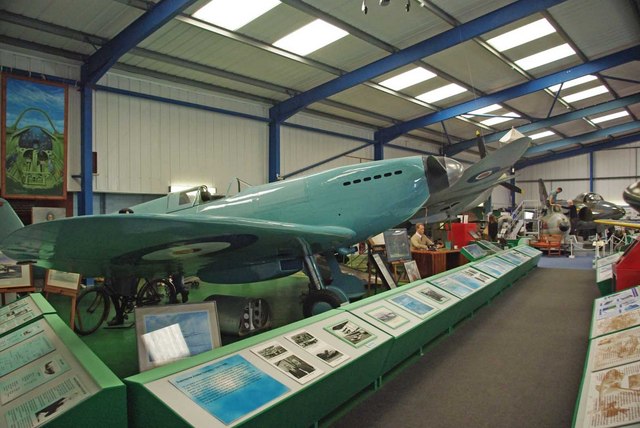
Supermarine Spitfire variant
Supermarine Spitfire Type 300 prototype K5054
Vickers-Supermarine Type 300 prototype, serial K5054, in which Reginald J. Mitchell turned his elliptical-wing monoplane fighter into hardware. It first flew at Eastleigh on 5 March 1936 with “Mutt” Summers at the controls, served as a development testbed for three and a half years and was written off in a landing accident at Farnborough on 4 September 1939.

- March 5, 1936
- First flight
- 1
- Units built
History
K5054 was not a production mark but the single example of the Vickers-Supermarine Type 300, the aircraft from which the whole Spitfire family grew. Its origin lay in the failure of the Type 224, the gull-winged, open-cockpit, fixed-and-spatted-undercarriage monoplane powered by a 600-horsepower evaporatively cooled Rolls-Royce Goshawk that Supermarine offered against specification F.7/30 and which first flew in February 1934: of the seven designs tendered, the Air Ministry chose the Gloster Gladiator biplane. The disappointment pushed Mitchell and his team into a series of cleaned-up designs drawing on their Schneider Trophy racing seaplanes, and from those came the Type 300, with retractable undercarriage and a wingspan cut by 1.8 metres. The proposal went to the Air Ministry in July 1934 and was not accepted; only after an enclosed cockpit, oxygen equipment, smaller and thinner wings and the new Rolls-Royce PV XII engine — the future Merlin — had been worked in did detailed design begin in November 1934, backed by Supermarine's owner Vickers-Armstrong. On 1 December 1934 the Air Ministry issued contract AM 361140/34, providing £10,000 for the construction of the prototype; specification F.37/34 was written around the existing design rather than the other way round.
Construction of K5054 began in December 1934 and absorbed changes as it went, the most important being to the Merlin's cooling system: ethylene glycol coolant was adopted together with a ducted radiator based on Frederick Meredith's work at the Royal Aircraft Establishment, Farnborough. The elliptical wing, whose aerodynamic parentage belongs to Beverley Shenstone, was chosen because it gave the lowest induced drag and, above all, because it allowed the thinnest possible section while leaving room at the root for the retracted undercarriage and the guns. The section was adapted from the NACA 2200 series to a thickness-to-chord ratio of 13 per cent at the root falling to 9.4 per cent at the tip, with 6° of dihedral for lateral stability. Published figures for the prototype give a length of 9.119 metres, a span of 11.227 metres, a height of 3.861 metres and a wing area of 22.48 square metres, with an angle of incidence of 2.1° at the root and 0° at the tip; empty weight was 1,852 kilograms and loaded weight 2,419 kilograms.
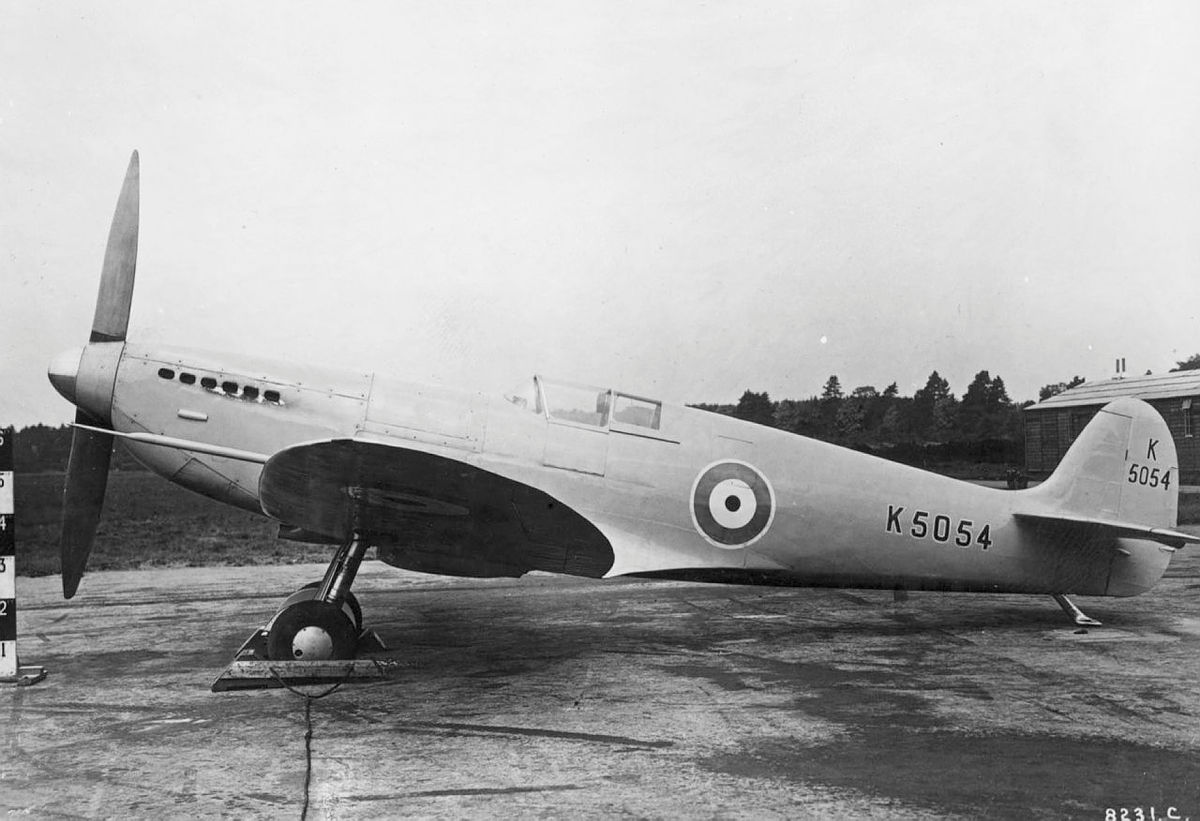
The first flight took place on 5 March 1936 at Eastleigh Aerodrome, near Southampton, at 4:35 that Thursday afternoon. Captain Joseph "Mutt" Summers, Vickers' chief test pilot, landed after eight minutes and left behind the celebrated remark "don't touch anything"; Jeffrey Quill later pointed out that Summers meant only that nothing needed adjusting before the next flight, not that the aeroplane was finished. It flew unpainted and unarmed, with the undercarriage locked down and unfaired, behind an experimental Merlin C of about 990 horsepower. The flight came four months after the Hawker Hurricane's maiden flight. Summers flew it again on 10 March 1936 with a new propeller and with the retractable undercarriage in use. After the first few sorties the aircraft went back to the works and reappeared some ten days later in an overall gloss pale blue-grey finish, with altered engine cowlings, the angled fin tip made straight-topped, the rudder balance correspondingly reduced and fairings fitted to the undercarriage legs.
Testing exposed an over-sensitive rudder and an initial top speed of only 528 kilometres per hour, barely better than the Hurricane; airflow over the fixed-pitch two-blade propeller was found to be going supersonic and generating wave drag. With a better-shaped wooden propeller the machine reached 557 kilometres per hour in level flight in mid-May 1936, and Summers flew it to Martlesham Heath to hand it over to the Aeroplane & Armament Experimental Establishment, where Flight Lieutenant Humphrey Edwardes-Jones took it up for the RAF and reported favourably, his only request being an undercarriage position indicator. A week later, on 3 June 1936, the Air Ministry ordered 310 Spitfire Mk I, before the full A&AEE report was available. A summary of the prototype's flight testing described it as simple and easy to fly and free of vices, with good visibility, a comfortable cockpit and stability as a gun platform.
Later in 1936 the standard armament of eight 7.7-millimetre Browning machine guns was fitted, a fit decided on the recommendation of Squadron Leader Ralph Sorley. The liquid-cooled Merlin C of 1,648.9 cubic inches (27.04 litres) was later replaced by a Merlin F of 1,035 horsepower and finally by the production Merlin II; by September 1937 the prototype stood close to Mk I production standard. On 22 March 1937 it lost oil pressure and made a wheels-up belly landing at Martlesham Heath, and during repair it was repainted in the standard Dark Earth and Dark Green upper-surface camouflage with silver dope beneath. On 19 September 1938 it flew for the first time with ejector exhausts, worth some 70 pounds of extra thrust — a 7 per cent gain over the propeller alone — and with "fish tail" stacks the tested top speed rose to roughly 579 kilometres per hour. K5054 was also the testbed for the gun-heating system which, from the 61st production Mk I, cured the freezing of the guns above about 4,572 metres. It was damaged during night-flying trials in March 1938, was repaired again and then used for armament and gun-camera work.
The end came on 4 September 1939, the day after war was declared, during testing at the Royal Aircraft Establishment, Farnborough: after a misjudged landing the aircraft bounced several times and tipped over onto its back. The pilot, Flight Lieutenant Gilbert Stanbridge "Spinner" White, was severely injured and died on 9 September. K5054 never flew again and was dismantled and scrapped, although the damaged airframe was kept at Farnborough through the war and used in experiments fitting photographic reconnaissance cameras. The production line it opened ran on to a total of 20,351 Spitfires in twenty-four marks between 1938 and 1948, the first production aircraft being delivered to the RAF on 4 August 1938. Mitchell, who died of cancer on 11 June 1937 aged 42, barely saw the beginning of that story; Joseph Smith succeeded him as chief designer. Decades later Jeffrey Quill promoted the building of an exact replica of K5054 as a memorial to Mitchell: a team of former Supermarine designers worked for ten years with Aerofab Restorations at Andover, and the aircraft was unveiled to the public in April 1993 at the RAF Museum, Hendon.
Multimedia