Short Empire variant
Short Empire S.23 Mk III Atlantic
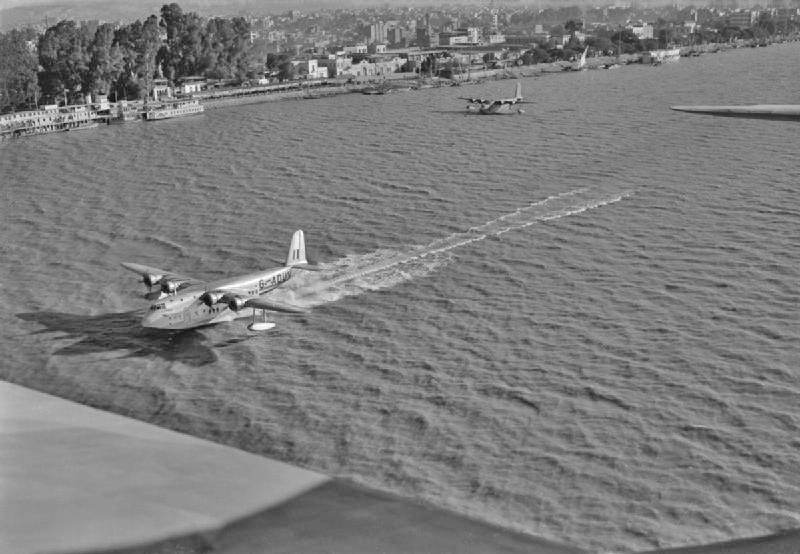
Two lightened S.23s with long-range tanks, Caledonia and Cambria, which flew Imperial Airways' experimental North Atlantic survey crossings in 1937.
- 2
- Units built
History
A long-range Empire for the North Atlantic
The Short S.23 was designed for Imperial Airways' routes to South Africa and Australia, where no stage was much over 500 miles (about 800 km). Once production was under way it was recognised, partly under American pressure, that a service across the Atlantic would also be desirable, but the standard S.23 had less range than its American counterpart, the Sikorsky S-42, and could not offer a true transatlantic service. The answer was the S.23 Mk III, known as the "Atlantic" boat: two aircraft, G-ADHM *Caledonia* and G-ADUV *Cambria*, lightened and fitted with long-range tanks at the cost of passenger and cargo capacity. Both kept the four 920 hp (about 690 kW) Bristol Pegasus Xc poppet-valve radial engines of the standard boat.
The two boats carried the "Type M1B" fuel system: two wing tanks of 326 gallons, two of 179 and two of 380 (the last between the fuselage and the inner engines), plus two hull tanks of 280 gallons each, for a total of 2,330 imperial gallons. That gave an endurance of about 17 hours 40 minutes: 2,754 nautical miles (5,110 km) in still air, or 1,911 nautical miles (3,545 km) against a 35-knot headwind. *Caledonia*'s all-up weight was 50,500 lb (about 22,906 kg) and it cruised at roughly 164 mph (some 264 km/h).
Caledonia (G-ADHM)
*Caledonia* was the second Empire boat completed by Short Brothers at Rochester and the first long-range S.23. It was launched on the Medway and first flown by Short's chief test pilot John Lankester Parker in September 1936, then went to the Marine Aircraft Experimental Establishment at Felixstowe as the aircraft submitted for the type's certificate of airworthiness. It was delivered to Imperial Airways on 4 December 1936. On 18 December it carried some 40 bags of Christmas mail from Hythe to Alexandria, and on the way back Captain W. N. Cumming flew the Alexandria–Marseilles leg of 1,700 miles (about 2,736 km) non-stop in 11 hours 15 minutes. On 18 February 1937 it flew the Calshot–Alexandria route non-stop.
_on_the_river_at_Boucherville%2C_Quebec%2C_1_August_1937.jpg)
It then flew Imperial Airways' first survey of the North Atlantic. Leaving Southampton on 4 July 1937 as flight EX1 under Captain A. S. Wilcockson, it crossed from Foynes, on the Shannon, to Botwood, Newfoundland — 1,993 miles (3,207 km) — in just over 15 hours, including time spent looking for a place to alight, flying between 460 and 1,520 m at an average of about 210 km/h, while a Pan American Sikorsky S-42 crossed in the opposite direction. It reached Port Washington, New York, via Montreal on 6 July and was back at Hythe on 17 July. Sources disagree on this flight: English Wikipedia names Captain W. N. Cummings as pilot and dates the return to 22 July, in 12 hours, whereas the aircraft's own history puts Captain A. S. Wilcockson in command of EX1, leaving New York on 12 July and reaching Hythe on 17 July. Further crossings followed as flights EX3 (13–21 August) and EX5 (10–24 September 1937). In October Captain G. J. Powell flew it to Lisbon and Horta, in the Azores, and concluded that the open-sea swell there made the route unsuitable for the S.23.
Cambria (G-ADUV)
*Cambria*, the sixth Empire boat and second long-range S.23, first flew on 11 January 1937 and was delivered on 21 January. On 22 February 1937 Captains G. J. Powell and E. N. Gurney flew it non-stop round Britain from Hythe and back, and three days later it went to Foynes to test the Shannon site as the future "Atlantic airport". After a survey flight to Durban and a non-stop 2,300-mile (3,700 km) return from Alexandria, it made the second experimental crossing: it left Foynes on 29 July 1937 under Powell, took 17 hours 35 minutes to Botwood and reached New York on 2 August; the eastbound Botwood–Foynes leg took 11 hours 55 minutes. A second trip from 26 August included a goodwill tour of Canada, during which the hull was damaged by a submerged object at Toronto; the Port Washington–Foynes return on 28 September took 10 hours 38 minutes. *Cambria* then received in-flight refuelling equipment and, working with the Armstrong Whitworth AW.23 K3585, achieved its first successful fuel transfer on 20 January 1938. English Wikipedia credits both Atlantic boats with in-flight refuelling trials; the aircraft histories document them only for *Cambria*.
Back to the standard boat
The Mk III was a transitional configuration. After the Azores flight *Caledonia* was returned to standard Mk I specification and its extra tanks were installed in G-ADUT *Centaurus* for the survey flight to Australia and New Zealand; *Cambria* was converted to Mk I at Hamble and entered commercial service on 18 May 1938. During the Second World War both flew for BOAC from Durban: *Cambria* made six round trips from Cairo to Suda Bay between 24 April and 1 May 1941 to evacuate troops from Crete, and *Caledonia*, re-engined with 1,010 hp Pegasus XXII and cleared to 52,500 lb, located the crew of a ditched Catalina off Mozambique on 13 October 1942. Both returned to Britain in 1947 and were broken up at Marchwood by R. J. Coley and Sons; *Caledonia* had logged 15,143 flying hours and *Cambria* 13,892. Scheduled transatlantic airmail was later entrusted to in-flight-refuelled S.30 boats, a different sub-type.
Multimedia
_on_the_river_at_Boucherville%2C_Quebec%2C_1_August_1937-800.webp)
_moored_at_a_wharf%2C_Boucherville%2C_Quebec%2C_8_July_1937-800.webp)
%2C_Imperial_Airways%2C_Felixstowe%2C_September_1936-800.webp)