Bomber · Military · United States
Northrop Grumman B-2 Spirit
- July 17, 1989
- First flight
- 1997
- Introduced
- In service
- Status
- 21
- Units built




_160514-F-UQ796-165-1600.webp)


-800.webp)


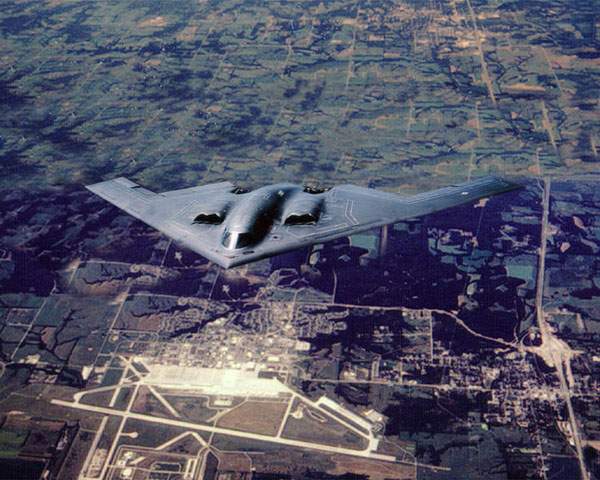
The Northrop Grumman B-2 Spirit is a subsonic, nuclear-capable stealth strategic bomber flown exclusively by the United States Air Force. It is a pure flying wing — no distinct fuselage, no tail — of lambda planform, powered by four turbofans buried inside the wing and normally crewed by two, with provision for a third. Its purpose fits in a sentence: to go unseen where no other bomber could go, carrying nuclear or conventional ordnance in two internal bays. Its 52.4-metre span and barely 21 metres of length produce a silhouette unlike anything else in service, and one that is genuinely disorienting in the air precisely because it lacks an aircraft's usual visual references. The Spirit came out of the Advanced Technology Bomber programme, a black project launched in 1979 under the Carter administration, just as stealth stopped being a laboratory promise. That promise was among the arguments used to cancel the supersonic B-1A, and the competition was settled on 20 October 1981 in favour of the Northrop/Boeing team over Lockheed/Rockwell. Northrop arrived with an advantage nobody else had: it was the house that had built the YB-35 and YB-49 flying wings in the late 1940s, cancelled then without reaching operational service. The B-2 shares exactly the same wingspan as the YB-49, a detail that sums up thirty years of technical stubbornness. The aircraft was rolled out publicly on 22 November 1988 at Palmdale and first flew on 17 July 1989. The B-2's stealth comes not from a single trick but from the sum of many: a continuously curved shape with no vertical surfaces to throw back a lateral echo; carbon-graphite composites that absorb radar energy; special coatings; intakes and exhausts that bury the engines and mix hot efflux with cold boundary-layer air to cut the infrared signature; no afterburners; and unusually tight assembly tolerances to prevent fluid leaks. Flying an inherently unstable flying wing demands a quadruplex fly-by-wire control system, and directional control is achieved with split brake-rudders and differential thrust instead of fins. All of it carries a steep operating price: maintaining the low-observable skin requires climate-controlled hangars big enough for the full span, and in 1997 each flight hour called for 119 hours of maintenance, against 53 for the B-52 and 60 for the B-1B. Cost was also the reason the B-2 never became a fleet. From the 165 aircraft the Air Force once contemplated and the 132 approved in the mid-1980s, the number fell to 75, then to 20 in the 1992 State of the Union address, and finally settled at 21 when a test prototype was authorised in 1996 for conversion to operational Block 30 standard. Opposition in Congress was broad and bipartisan, and the end of the Cold War drained the urgency from the mission the aircraft had been designed for. The cost figures in circulation are several, and they do not measure the same thing: the whole programme was estimated at $44.75 billion in 1997 dollars, an average of $2.13 billion per aircraft; unit procurement cost was $737 million in 1997 dollars, or $929 million including spares and software support; and in 1995 Northrop offered twenty additional aircraft at a flyaway cost of $566 million each. In combat, the B-2 debuted in 1999 over Yugoslavia in Operation Allied Force: six aircraft flying non-stop from Missouri, missions of some thirty hours, just 50 of NATO's 34,000 sorties and yet 11 per cent of the bombs dropped and a third of selected targets destroyed in the first eight weeks. It was also the first aircraft to employ GPS-guided JDAM weapons in combat. Afghanistan followed in 2001, Iraq in 2003, Libya in 2011 and 2017, Yemen in 2024 and strikes on Iran in 2025 and 2026. On 23 February 2008 the first and only Spirit lost in an accident, Spirit of Kansas, crashed on take-off from Andersen Air Force Base on Guam; both crew ejected unhurt and the cause was moisture in the air-data sensors. Two more aircraft suffered serious landing accidents in 2021 and 2022, and one of them was divested in 2024 as uneconomical to repair. The Air Force keeps the rest of the fleet at Whiteman, Missouri, and plans to retire it around 2032 as its successor — the equally Northrop Grumman B-21 Raider — enters service.
Related events
- First flight of the Northrop Grumman B-2 Spirit
- Delivery of the first Northrop B-2 Spirit to Whiteman
- Service entry of the Northrop Grumman B-2 Spirit
- First combat use of the B-2 Spirit over Kosovo
- Loss of the B-2 Spirit «Spirit of Kansas» at Guam
- Fire and loss of the B-2 Spirit «Spirit of Hawaii»
- Operation Midnight Hammer: B-2 Spirit strike on Iranian nuclear facilities
Related sheets
Category
Three-view drawing

History
The flying wing, an idea Northrop had chased for thirty years
The B-2 is not a 1980s brainwave. It is the third time Northrop tried to persuade the Air Force that a strategic bomber could do without a fuselage and a tail. The first two attempts were the piston-engined YB-35 and its jet derivative the YB-49, both cancelled in development in the early 1950s — for political rather than technical reasons, according to the version that has stuck in the company's memory. The aerodynamic argument had always been sound: with no fuselage and no empennage there are no surfaces generating drag without generating lift, so for a given weight a flying wing offers more range and more payload than a conventional layout.
What was missing in the 1940s was the electronics. A flying wing is inherently unstable in yaw and awkward in pitch, as the YB-49 crews learned at their cost, and computer-generated artificial stability did not yet exist. When the 1970s brought fly-by-wire and enough processing power to correct the aircraft's attitude dozens of times a second without pilot input, the obstacle disappeared.
And a new reason to return to the flying wing appeared alongside it. An aircraft with no vertical surfaces approaches what radar-signature engineers call an infinite flat plate: theoretically the perfect low-observable shape, because it has no angles to throw the signal back at the emitter. What in 1947 was aerodynamic elegance became, by 1977, a first-order tactical advantage. That the B-2 and the YB-49 have exactly the same wingspan — 172 feet, 52.4 metres — is neither coincidence nor homage: it is confirmation that the optimum size for a flying wing of that class had not changed. Jack Northrop, who lived long enough to be briefed under secrecy on the project that revived his idea, died before he could see it fly.
The ATB programme: a competition in the dark
The institutional starting point was a 1974 DARPA request to American aviation firms: what was the largest radar cross-section an aircraft could have and still remain effectively invisible to the radars of the day. Northrop and McDonnell Douglas were first selected for further development. Lockheed, which had applied partial low-observable solutions to the A-12 and SR-71, took the sole award in the second round of the Experimental Survivability Testbed in April 1976, leading to Have Blue and through it to the F-117. Northrop, having lost that round, pressed on with a classified demonstrator of its own, Tacit Blue, in development in 1979 at Area 51, where it matured the continuous-curvature technique — curved surfaces instead of flat facets — that would later define the B-2.
By 1976 a long-range stealthy strategic bomber looked viable. President Jimmy Carter learned of the state of the work in 1977, and that knowledge appears to have been one of the main reasons for cancelling the B-1. It was a politically expensive decision: throughout the 1980 campaign Ronald Reagan repeatedly cited the cancelled B-1 as evidence of Carter's supposed weakness on defence. The answer came on 22 August 1980, when the administration publicly acknowledged that the Department of Defense was developing stealth aircraft, a bomber among them.
The Advanced Technology Bomber programme formally began in 1979 and was funded as a black project under the code name "Aurora". After proposals were evaluated, the competition narrowed to two teams: Northrop with Boeing — proposal "Senior Ice" — and Lockheed with Rockwell — "Senior Peg". Both offered flying wings; Northrop's was larger with curved surfaces, Lockheed's smaller, faceted and fitted with a small tail. A 1979 sketch by designer Hal Markarian already bore a strong resemblance to the final aircraft. The Air Force planned at the time to procure 165 aircraft.
On 20 October 1981 the Northrop proposal was selected. The aircraft received the B-2 designation and the name Spirit. The mid-1980s brought the programme's most expensive change: the mission profile shifted from high-altitude penetration to low-altitude, terrain-following flight, forcing a structural redesign that delayed the first flight by two years and added about a billion dollars to the cost. By 1989 the United States was estimated to have secretly spent some $23 billion on research and development alone. MIT engineers and scientists assessed the aircraft's mission effectiveness under a five-year classified contract. ATB technology also fed the Advanced Tactical Fighter programme that produced the YF-22 and YF-23. Northrop was prime contractor; major subcontractors included Boeing, Hughes Aircraft, General Electric Aviation and Vought.
Industrial secrecy, Pico Rivera and two espionage cases
Through design and development the B-2 was a black project and all programme personnel needed clearance, though the compartment was somewhat less tightly held than the F-117's: more people inside the federal government knew it existed and more information circulated. Production was organised in a former Ford automobile assembly plant at Pico Rivera, California, acquired and substantially rebuilt, whose employees were sworn to secrecy. Components were often bought through front companies, military officials visited out of uniform, staff were routinely polygraphed, and the business unit was given the deliberately vague name "Advanced Systems Division". Until the mid-1980s, nearly all information on the programme was kept from the Government Accountability Office and from members of Congress.
The public rollout on 22 November 1988 at Air Force Plant 42 in Palmdale was an exercise in damage control, meticulous and yet defeated on one specific point. Guests were not allowed near the rear of the aircraft, where the suppressed engine exhausts were. But Aviation Week's editors established that there was no airspace restriction above the presentation area, hired an aircraft and photographed from above exactly what was meant to stay hidden. The first flight, of the aircraft with serial 82-1066, took place on 17 July 1989 from Palmdale to Edwards Air Force Base.
Secrecy had its criminal underside too. Thomas Patrick Cavanagh, then on the Northrop payroll, was arrested in 1984 while trying to hand the Soviet Union classified material taken out of Pico Rivera. More than twenty years later, in October 2005, Noshir Gowadia, a design engineer whose work had been on the aircraft's propulsion, was arrested on charges of selling classified material to China, and drew a 32-year sentence. The effort to preserve secrecy did not end with entry into service: much of the staff who touch the aircraft still need special-access clearance and background checks carried out by a dedicated branch of the Air Force.
How you make a fifty-metre bomber invisible, and what it costs to keep it that way
The B-2's low observability is a problem solved by accumulation. In radar terms, shape does the heavy lifting: a flying-wing configuration with no vertical surfaces removes the lateral reflectors, and the continuous curvature of the whole skin scatters beams rather than returning them. The technique only became possible when 1980s computing power allowed radar returns to be simulated over complex curved surfaces, and not merely over flat facets as on the F-117. The resulting radar cross-section has been publicly reported at around 0.1 square metres. Onto that base go absorbent materials: the aircraft is built mostly from a carbon-graphite composite stronger than steel, lighter than aluminium and capable of absorbing much of the incoming radar energy, complemented by specific coatings. Assembly tolerances are unusually tight so that no fluid leaks can raise the signature.
In the infrared, the answer was to bury the engines inside the wing. At the intake, cold boundary-layer air enters below the main inlet and is mixed with hot exhaust just before the nozzles; the resulting flow is then led over heat-resistant carbon-fibre-reinforced polymer and titanium elements that disperse it laterally to hasten cooling. The B-2 has no afterburners for the same reason, and breaking the sound barrier is ruled out both by the sonic boom and by the aerodynamic heating of the skin. Visually, the aircraft carries anti-reflective paint and dark tones, because at 50,000 feet a dark grey blends into the sky; it also carries a contrail sensor that tells the crew when to change altitude. At less than twenty nautical miles, however, the aircraft can be seen.
That invisibility is paid for in the hangar. Each B-2 is kept in a climate-controlled hangar costing some five million dollars and large enough for its 172-foot span, because the low-observable skin does not tolerate prolonged exposure to the weather. Every seven years the coating is washed away with crystallised wheat starch so the surface can be inspected for dents and scratches. Much of the later effort went precisely into cutting that burden: Northrop Grumman developed an absorbent coating called alternate high-frequency material, AHFM, sprayed on by four independently controlled robots, which reduces signature-maintenance time sharply. An August 1995 Government Accountability Office report revealed that the aircraft had trouble operating in heavy rain, which could damage the stealth coating, and that its terrain-following radar had difficulty distinguishing rain from obstacles; by October 1996 the Air Force reported progress on software fixes. The figure that best captures the problem is from September 1997: 119 hours of maintenance for every hour of flight, against 53 for the B-52 and 60 for the B-1B. Maintenance ran to about $3.4 million per month per aircraft, and by 2010 the flight hour was estimated to reach as much as $135,000, roughly twice that of the B-52 or the B-1. When the aircraft leaves home the problem travels with it: portable environmentally controlled hangars exist, the B-2 Shelter Systems built by American Spaceframe Fabricators at similar cost, whose necessity became clear in 1998 when it was found that Andersen did not offer the required conditions; they have been deployed to Diego Garcia and to RAF Fairford. Finally, the composite structure obliges the aircraft to stay 40 miles clear of thunderstorms to avoid static discharge and lightning strikes.
From 132 to 21 aircraft: the cut and the unit-cost controversy
The planned buy in the mid-1980s was 132 aircraft — the Air Force had at one point contemplated 165 in the ATB phase — and it was later reduced to 75. Then the enemy disappeared. With the dissolution of the Soviet Union in the early 1990s, the Spirit's primary mission of penetrating deep into Soviet airspace lost its object. In his 1992 State of the Union address, President George H. W. Bush announced that production would be limited to 20 aircraft. In 1996 the Clinton administration, though originally committed to that figure, authorised the conversion of a twenty-first aircraft — a test prototype — to operational Block 30 standard at a cost of nearly $500 million. That was the last one. In 1995 Northrop had proposed building twenty more at a flyaway cost of $566 million each; the offer went nowhere.
Congressional opposition was broad and bipartisan. In the fiscal year 1990 defence budget, the House Armed Services Committee trimmed $800 million from research and development while narrowly staving off a motion to end the project. Congressmen Ron Dellums, John Kasich and John G. Rowland authored that motion; in the Senate, Jim Exon and John McCain were among the opponents. Dellums and Kasich worked together from 1989 into the early 1990s to cap production at 21 aircraft, and succeeded. Committee chair Les Aspin summed up the arithmetic of the peak production schedule specified in 1989 — seven to eight billion dollars a year — by saying it "won't fly financially". The Pentagon added trouble of its own in 1990, charging Northrop with fitting defective parts into the flight control system; separately, engine fan blades had to be redesigned so that a bird strike would do less damage. In 1995 the Congressional Budget Office calculated that twenty additional B-2s would cut munitions costs by less than two billion dollars over the first two weeks of a conflict, against a projected life-cycle cost of $26.8 billion. That same year, General Mike Ryan and General John Shalikashvili strongly recommended against funding more aircraft. In 1997 Dellums offered an amendment capping production at the existing 21; it was narrowly defeated, but Congress approved no funding for further aircraft either.
The B-2's cost has become a textbook case in how little a bare figure means, because the ones in circulation measure different things. The total "programme cost" projected through 2004 was $44.75 billion in 1997 dollars and includes development, procurement, facilities, construction and spares; spread across 21 aircraft it yields an average of $2.13 billion apiece, the figure usually quoted to underline how expensive the programme turned out to be. The "procurement cost" per aircraft, computed solely against the $15.48 billion fleet cost, was $737 million in 1997 dollars. Government Accountability Office reports, which add spares and software support, raise that unit procurement figure to $929 million. And the "flyaway cost" — the aircraft without spares, support or a share of development — is what Northrop offered in 1995: $566 million. To all of this must be added $553.6 million in 1997 dollars of military construction associated with the programme. None of the four numbers is false; they simply answer different questions, and it is worth saying which one is being used before comparing it to any other aircraft.
Entering service and a baptism of fire over Yugoslavia
The first operational aircraft, christened Spirit of Missouri, was delivered on 17 December 1993 to Whiteman Air Force Base, Missouri, which remains the type's only operational base. Deliveries were staged in three successive configurations: Block 10 aircraft had limited combat capability and could carry only conventional Mk-84 bombs or free-fall nuclear weapons, and were used mainly for training; Block 20 added an interim capability to deliver GAM guided munitions; and Block 30 reached full configuration, with almost twice as many radar modes, improved terrain-following and the ability to deliver JDAM and JSOW. The first factory Block 30, AV-20 Spirit of Pennsylvania, was delivered on 7 August 1997. Conversion of the rest of the fleet to Block 30 standard began in July 1995. Sources do not entirely agree on the initial operational capability date: some place it on 1 January 1997, others in April of that year. In their first three years of service the operational aircraft achieved a 90 per cent sortie reliability rate, and a USAF assessment held that two B-2s carrying precision weapons could do the work of seventy-five conventional aircraft.
The baptism of fire came in 1999 with the NATO air campaign over Yugoslavia. Six B-2s flew non-stop from Missouri to the Balkans and back on missions of some thirty hours supported by air refuelling. The disproportion between effort and result is the statistic that made the aircraft's name: the Spirits flew 50 of the 34,000 allied sorties and dropped 11 per cent of the bombs, destroying a third of selected Yugoslav targets in the first eight weeks of American involvement. It was also the first combat use of GPS-guided JDAM weapons, a technology that made militarily unnecessary the saturation bombing that had drawn so much criticism in earlier conflicts. The campaign also produced the type's gravest episode: on 7 May 1999 a B-2 dropped five JDAMs on the Chinese Embassy in Belgrade, killing three people and injuring twenty; the official explanation was an error in targeting instructions. By then the type had dropped five hundred bombs over Yugoslavia.
Afghanistan, Iraq, Libya: the trade of bombing from Missouri
The B-2 opened the Afghanistan campaign in October 2001 with one of the longest missions in its history, out and back from Whiteman with air refuelling. From 2003 it began operating routinely from forward locations in the Middle East. During the Iraq War it flew from Diego Garcia and from an undisclosed "forward operating location", as well as sorties launched directly from Missouri: in 2003 it flew 27 sorties from Whiteman and 22 from a forward location, releasing more than 1,500,000 pounds of munitions including 583 JDAMs. The formal declaration of full operational capability, in December 2003, came after real combat use; that year's operational test and evaluation annual report noted that serviceability remained inadequate, mainly because of the maintainability of the low-observable coatings, and that the defensive avionics suite had shortcomings against pop-up threats.
On 1 February 2010, in response to organisational problems and high-profile mistakes within the Air Force, the B-2s were transferred along with the nuclear-capable B-52s and the intercontinental ballistic missiles to the newly formed Air Force Global Strike Command. A year later, in March 2011, the Spirits were the first American aircraft committed to Operation Odyssey Dawn: three aircraft dropped forty bombs on a Libyan airfield in support of the UN-mandated no-fly zone, flying directly from the continental United States across the Atlantic with four refuellings on each leg. In August that year it emerged that, before the special forces raid into Abbottabad that killed Osama bin Laden, using one or more B-2s had been considered; the option was rejected because of potential damage to nearby civilian buildings and the difficulty of identifying the remains.
On 28 March 2013, two B-2s flew a 13,000-mile round trip from Whiteman to South Korea and dropped inert ordnance on the Jik Do range, the type's first appearance over the Korean Peninsula; it formed part of the annual South Korean–American exercises and drew a protest and threats of nuclear retaliation from North Korea. A B-2 put down in Australia for the first time on 22 March 2016, at RAAF Base Tindal. On 18 January 2017 two aircraft struck an Islamic State training camp thirty kilometres south-west of Sirte, Libya, dropping 108 500-pound JDAMs on a 33-hour mission from Whiteman. In March 2022 a Spirit flew to Australia again, this time to Amberley. On 16 October 2024 B-2s struck five underground weapons storage facilities in Yemen as part of the campaign against the Houthis over attacks on Red Sea shipping, staging through Tindal; the strikes were also read as a demonstration of capability aimed at Iran. On 22 June 2025 six B-2s dropped twelve GBU-57 bunker-busters on the Fordow enrichment plant while a seventh dropped two more on Natanz. On 1 March 2026 the type again took part in strikes on Iran against missile and underground facilities. The longest recorded combat mission, as of September 2013, had been 44.3 hours.
Accidents: Spirit of Kansas and those that followed
On 23 February 2008, B-2 AV-12 Spirit of Kansas crashed on the runway shortly after taking off from Andersen Air Force Base on Guam. The aircraft belonged to the 393rd Bomb Squadron of the 509th Bomb Wing and had logged 5,176 flight hours. Both crew ejected unhurt; the aircraft was destroyed, a hull loss valued at $1.4 billion. The investigation determined that moisture had entered the Port Transducer Units during air-data calibration, distorting the information sent to the air data system: the flight control computers worked from a wrong airspeed and read the angle of attack as negative, and the aircraft pitched thirty degrees nose-up on take-off. After the accident the Air Force took the whole fleet off operational status for 53 days, until 15 April 2008. It was the first and only total loss of a B-2 in an accident.
It was not the only serious mishap. In February 2010, also at Andersen, AV-11 Spirit of Washington was severely damaged by a fire on the ground; eighteen months of repairs were needed simply to let it fly back to the United States mainland for comprehensive work, and it did not return to service until December 2013. At the time the Air Force had no specific training for tailpipe fires on the B-2. On the night of 13–14 September 2021, Spirit of Georgia made an emergency landing at Whiteman, went off the runway and came to rest on its left side; the cause was faulty landing gear springs and microcracking in hydraulic connections, with repair costs above ten million dollars. On 10 December 2022 an in-flight malfunction forced AV-16 Spirit of Hawaii into an emergency landing at Whiteman, with a post-crash fire quickly extinguished and no injuries. The whole fleet was grounded until 18 May 2023, when the Air Force lifted the stand-down without publicly disclosing details. In May 2024 it was announced that the aircraft would be divested as "uneconomical to repair". The comparison with 2010 is telling: back then almost four years and more than a hundred million dollars went into recovering an aircraft, because keeping every one of the handful of penetrating bombers then available was reason enough; with the B-21 on the way and B-2 retirement expected sometime after 2029, the calculation changed.
Modernising an aircraft conceived in the 1980s
Keeping a stealth aircraft designed with 1980s tools relevant has required a continuous run of upgrades. In July 2008 the onboard computing architecture was extensively redesigned: an integrated processing unit was fitted, communicating with the rest of the systems over a newly installed fibre-optic network, and the operational flight program was rewritten with legacy code converted from JOVIAL to standard C. Many of the 136 standalone distributed computers aboard, including the primary flight management computer, were replaced by a single system. The upgrades also reached the weapon control systems, enabling strikes on moving targets.
On 29 December 2008 the Air Force awarded Northrop Grumman a $468 million contract to modernise the fleet's radars. The change answered an administrative rather than a tactical need: the Department of Commerce had sold the slice of radio spectrum in which the AN/APQ-181 operated to another operator, so its frequency had to change. In the process the radar received new antenna arrays and became an active electronically scanned array. The work went back some way: in November 2002 Raytheon was contracted to develop a Ku-band active electronically scanned array antenna that would not interfere with commercial satellite systems after 2007, flight tests of the new radar began in October 2007, and the first operational aircraft with the modernised radar was handed over at Whiteman in April 2009. Word came in 2010 that the Air Force Research Laboratory had come up with a replacement material for the stretch of trailing edge that sits in the engine exhaust, the earlier one having degraded too fast. In March 2012 the Pentagon announced a ten-year, two-billion-dollar modernisation focused mainly on replacing outdated avionics and equipment.
In 2013 the Defensive Management System Modernization programme, DMS-M, was contracted to replace the antenna system and associated electronics and widen the aircraft's frequency awareness; software difficulties led to its cancellation by 2020, and the work already done was repurposed for cockpit upgrades. The Common Very Low Frequency Receiver upgrade lets the B-2 receive the same transmissions as Ohio-class submarines so it can continue in the nuclear mission. In 2014 the Air Force outlined a package that took in nuclear warfighting capability, the new integrated processing unit, cruise-missile carriage and better threat warning. More recent work is directed at communications — secure, jam-resistant satellite links, NATO interoperability, in-flight retasking via Link 16 — at replacing the primary cockpit displays, at weapons integration and at improving the maintainability of the radar signature through new coatings, materials and absorptive structures. In June 2007 Northrop Grumman was contracted to integrate Boeing's Massive Ordnance Penetrator, a GPS-guided bunker-buster carrying 2,400 kilogrammes of explosive and designed for deeply buried, hardened targets, of which the aircraft can carry two, one in each bay. Integration of the JASSM-ER cruise missile was cleared after a successful test launch. Much of the most recent modernisation is not public: a B-2 commander at Whiteman alluded in April 2021 to "pretty innovative ways" of integrating modern weapons to increase the aircraft's survivability, without going into detail, and said the platform had a lot of life left in it until the B-21 was well on the scene.
The succession: the B-21 Raider and the 2032 horizon
The question of succession is almost as old as the aircraft itself. In 1998 a Congressional panel advised the Air Force to shift resources away from continued B-2 production and towards developing a new bomber, either a clean-sheet design or a Spirit derivative. The 1999 bomber roadmap ignored the recommendation: the Air Force believed it could sustain its fleet into the 2030s and put the start of successor development at 2013, in time to replace ageing B-2s, B-1s and B-52s around 2037. In 2012 the Air Force Chief of Staff, General Norton Schwartz, argued that stealth built to 1980s standards would not keep the Spirit alive in the contested airspace to come, and defended pressing on with the Next-Generation Bomber despite the budget cuts.
That programme took shape in 2015, when the Air Force awarded Northrop Grumman the Long-Range Strike Bomber contract, from which came the B-21 Raider, named in honour of the Doolittle Raiders who struck Japan in April 1942. It is the first American bomber design since the B-2 and, although its flying-wing silhouette is recognisably related to the Spirit's, it differs in significant details: more deeply recessed intakes, dual-wheel main landing gear, trapezoidal windscreens and more advanced low-observable design. It is being developed with digital design techniques and an open-system architecture intended to absorb improvements without rebuilding the aircraft, and as part of a "family of systems" including complementary surveillance, command-and-control and electronic warfare platforms. The first example was unveiled publicly at Palmdale in December 2022 and first flew on 10 November 2023, ferrying to Edwards, where flight testing began in January 2024. The Air Force plans at least a hundred aircraft.
For the B-2, the consequence was an earlier retirement. Although operating it until 2058 was once contemplated, the fiscal year 2019 budget set the date at "no later than 2032". The same decision moved B-1 retirement up to 2036 while extending the B-52's life into the 2050s, because the Boeing veteran is cheaper to maintain, takes a very versatile conventional payload and can carry nuclear cruise missiles that the B-1 is treaty-prohibited from carrying. The reasoning for the Spirit was purely arithmetical: a fleet of twenty is too expensive per aircraft to retain once another type takes over the penetrating bomber role. Of the twenty-one aircraft built, one was lost on Guam in 2008 and another was divested after the 2022 accident, so the inventory quoted for 2024 is either nineteen or twenty depending on whether the source has already deducted the divested airframe. No operational B-2 has yet been retired for display; what can be seen at the National Museum of the United States Air Force near Dayton is the second of two static test articles, built without engines or instruments, taken past its structural limit until the airframe failed and whose fractured structure took over a year to reassemble. It has been on display since 2004, marked to resemble Spirit of Ohio, and it retains that aircraft's nose wheel door with its "Fire and Ice" artwork, painted and signed by the technicians who ran the temperature tests.
Variants
| B-2A Block Test | B-2A Block 10 | B-2A Block 20 | B-2A Block 30 | |
|---|---|---|---|---|
| First flight | July 17, 1989 | — | — | — |
| Aircraft type | Stealth strategic bomber (development and test aircraft) | Stealth strategic bomber (first production configuration) | Stealth strategic bomber (interim configuration) | Stealth strategic bomber |
| Powerplant | Four non-afterburning General Electric F118-GE-100 turbofans of 77 kN thrust each, buried in the wing with shielded intakes and exhausts. | Four non-afterburning General Electric F118-GE-100 turbofans of 77 kN thrust each. | Four non-afterburning General Electric F118-GE-100 turbofans of 77 kN thrust each. | Four non-afterburning General Electric F118-GE-100 turbofans of 77 kN thrust each, a thrust-to-weight ratio of 0.205 and shielded exhausts above the wing. |
| Powerplant | 4 × General Electric F118-GE-100 | 4 × General Electric F118-GE-100 | 4 × General Electric F118-GE-100 | 4 × General Electric F118-GE-100 |
| Thrust per engine | 77 kN Best value in this row | 77 kN Best value in this row | 77 kN Best value in this row | 77 kN Best value in this row |
| Length | 21 m Best value in this row | 21 m Best value in this row | 21 m Best value in this row | 21 m Best value in this row |
| Wingspan | 52.4 m Best value in this row | 52.4 m Best value in this row | 52.4 m Best value in this row | 52.4 m Best value in this row |
| Height | 5.2 m Best value in this row | 5.2 m Best value in this row | 5.2 m Best value in this row | 5.2 m Best value in this row |
| Wing area | 478 m² Best value in this row | 478 m² Best value in this row | 478 m² Best value in this row | 478 m² Best value in this row |
| Empty weight | 71,700 kg Best value in this row | 71,700 kg Best value in this row | 71,700 kg Best value in this row | 71,700 kg Best value in this row |
| MTOW | 170,600 kg Best value in this row | 170,600 kg Best value in this row | 170,600 kg Best value in this row | 170,600 kg Best value in this row |
| Top speed | 1,010 km/h Best value in this row | 1,010 km/h Best value in this row | 1,010 km/h Best value in this row | 1,010 km/h Best value in this row |
| Max speed altitude | 12,000 m | 12,000 m | 12,000 m | 12,000 m |
| Cruise speed | 900 km/h Best value in this row | 900 km/h Best value in this row | 900 km/h Best value in this row | 900 km/h Best value in this row |
| Cruise altitude | 12,000 m | 12,000 m | 12,000 m | 12,000 m |
| Service ceiling | 15,200 m Best value in this row | 15,200 m Best value in this row | 15,200 m Best value in this row | 15,200 m Best value in this row |
| Range | 11,000 km Best value in this row | 11,000 km Best value in this row | 11,000 km Best value in this row | 11,000 km Best value in this row |
| Range conditions | More than 11,000 km unrefuelled and more than 19,000 km with a single midair refuelling. | More than 11,000 km unrefuelled and more than 19,000 km with a single midair refuelling. | More than 11,000 km unrefuelled and more than 19,000 km with a single midair refuelling. | More than 11,000 km unrefuelled and more than 19,000 km with a single midair refuelling; service ceiling 15,200 m. |
| Armament | Used for the flight, radar-signature and weapons-release testing that certified the type's internal bays; after conversion, armament is that of the configuration they were brought to. | Two internal bays with an official limit of 18,000 kg. In this configuration, only Mk-84 2,000-pound conventional bombs or gravity nuclear weapons: no capability to launch guided conventional munitions. | Two internal bays with an official limit of 18,000 kg. Interim nuclear and conventional employment capability including the GAM guided munition; tested with Mk-84 2,000-pound bombs and CBU-87/B cluster bombs. | Two internal bays with an official limit of 18,000 kg (27,000 kg reached operationally): up to 80 bombs of the 500-pound class (Mk-82, GBU-38) on bomb rack assemblies, 36 cluster bombs of the 750-pound class, 16 bombs of the 2,000-pound class (Mk-84, GBU-31) on the rotary launcher, 16 B61 or B83 nuclear bombs, 16 JSOW, JASSM, JASSM-ER or LRASM standoff weapons, or two 14,000 kg GBU-57 penetrators. |
| Max weapons load | 18,000 kg Best value in this row | 18,000 kg Best value in this row | 18,000 kg Best value in this row | 18,000 kg Best value in this row |
| Payload | 0 kg Best value in this row | 0 kg Best value in this row | 0 kg Best value in this row | 0 kg Best value in this row |
| Cargo capacity | No cargo capability: the two internal bays carry weapons only. | No cargo capability: the two internal bays carry weapons only. | No cargo capability: the two internal bays carry weapons only. | No cargo capability: the two internal bays carry weapons only. |
| Crew | 2 Best value in this row | 2 Best value in this row | 2 Best value in this row | 2 Best value in this row |
| Passengers | 0 Best value in this row | 0 Best value in this row | 0 Best value in this row | 0 Best value in this row |
| Units built | 6 | 10 Best value in this row | 3 | 2 |
Images
Elsewhere
- DVIDSManteniendo el B-2 Spirit ↗
- DVIDSB-2 Spirit regresando de Diego Garcia ↗
- DVIDSB-2 Spirits preparándose para despegar en Whiteman AFB ↗
- DVIDSB-2 Spirit despegando de Whiteman AFB durante la pandemia de COVID-19 ↗
- DVIDSB-2 Spirit aterrizando en Whiteman Air Force Base ↗
- DVIDSB-2 Spirit en el Wings Over Whiteman Air Show 2019 ↗
- DVIDSB-2 Spirit ↗
- DVIDSB-2 Spirit ↗
- DVIDSMantenimiento del B-2 Spirit ↗
- DVIDSB-2 Spirit rodando en RAF Fairford ↗
- GlobalSecurity.orgGalería de imágenes del B-2 Spirit ↗
- FlickrB-2 Spirit despegando de Whiteman AFB ↗
Show the 18 more
- FlickrB-2 Spirit "Spirit of New York" aterrizando en RIAT 2012 ↗
- FlickrNorthrop Grumman B-2 Spirit "Spirit of Hawaii" (90-0041) ↗
- FlickrB-2 "Spirit of Texas" (88-0328) ↗
- FlickrB-2 Spirit en el National Museum of the United States Air Force ↗
- FlickrColección de fotografías del B-2 Spirit ↗
- ABPicNorthrop Grumman B-2 Spirit, 82-1069 / AV-4 ↗
- ABPicNorthrop Grumman B-2A Spirit, 82-1068 / AV-3, en RAF Fairford ↗
- ABPicNorthrop Grumman B-2A Spirit, 90-0041 / AV-16 "Spirit of Hawaii" ↗
- ABPicFotografías del B-2 matrícula 82-1068 ↗
- ABPicFotografías del B-2 matrícula 89-0128 ↗
- JetPhotosNorthrop B-2A Spirit, 89-0128 ↗
- Planespotters.netNorthrop Grumman B-2A Spirit, 89-0128 ↗
- Planespotters.netNorthrop Grumman B-2A Spirit, 82-1066 ↗
- AirHistory.netNorthrop Grumman B-2A Spirit, 90-0041 ↗
- Airliners.netNorthrop Grumman B-2A Spirit sobre el Rose Bowl ↗
- Airliners.netNorthrop Grumman B-2A Spirit, 82-1069, en Fairford ↗
- National Museum of the USAFNorthrop B-2 Spirit — National Museum of the USAF ↗
- Key.AeroNorthrop Grumman B-2 Spirit — galería ↗