Fighter · Military · United States
North American F-86 Sabre
- In service
- Status


-1600.webp)
_(5-18-2023)-1600.webp)


-1600.webp)


_on_ground%2C_with_external_fuel_tanks._Also_pictured_is_an_ambulance._-_DPLA_-_d17049a5fb0423aa263464-1600.webp)


-1600.webp)


_Fiat_License_(33792344770)-1600.webp)
-800.webp)
%2C_circa_in_1957-800.webp)

%2C_in_1954_(E-1326)-1600.webp)
-1600.webp)




-1600.webp)

-1600.webp)
-800.webp)
-1600.webp)
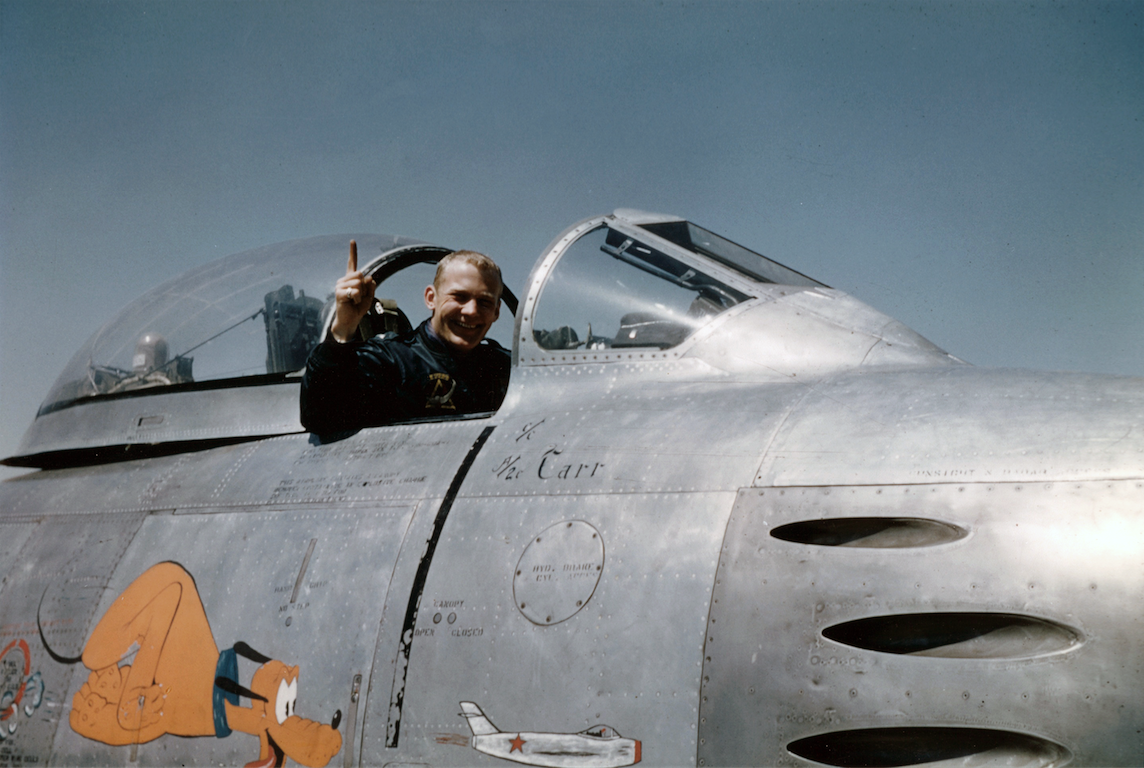


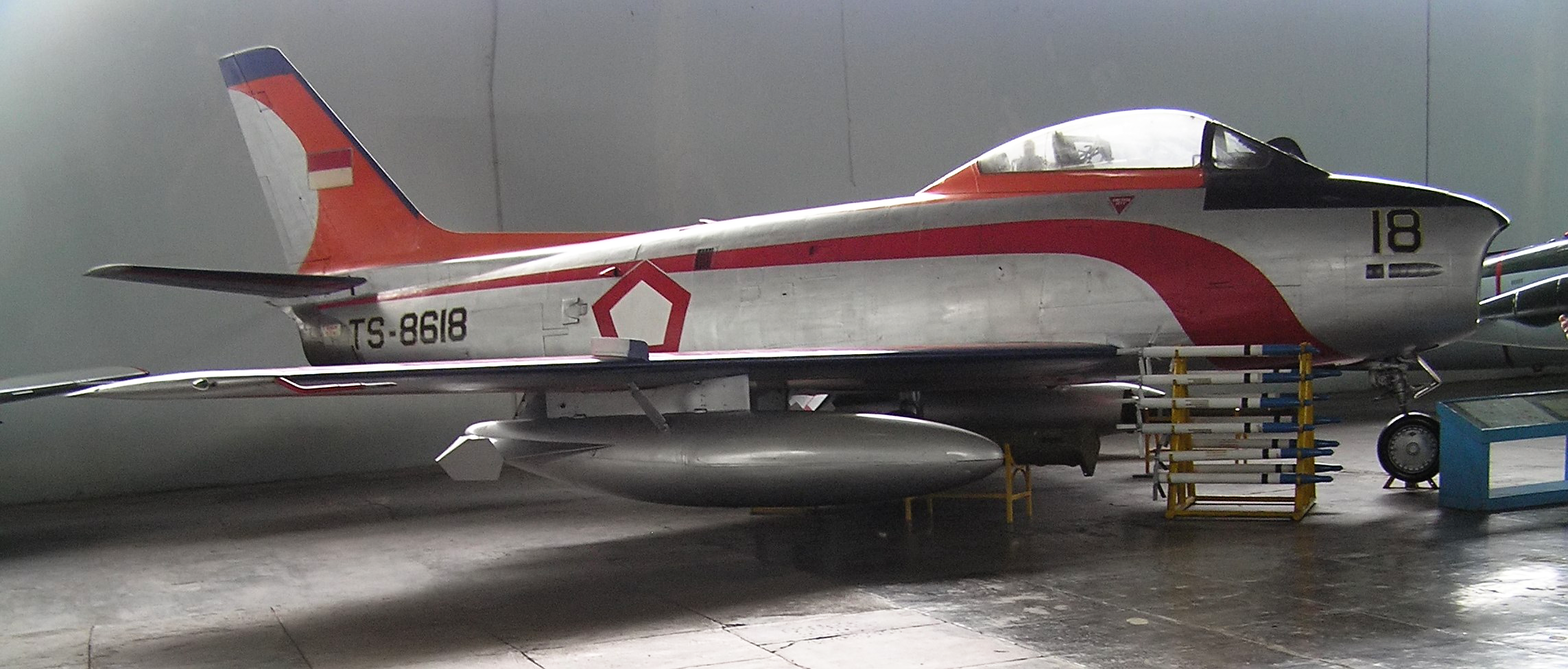
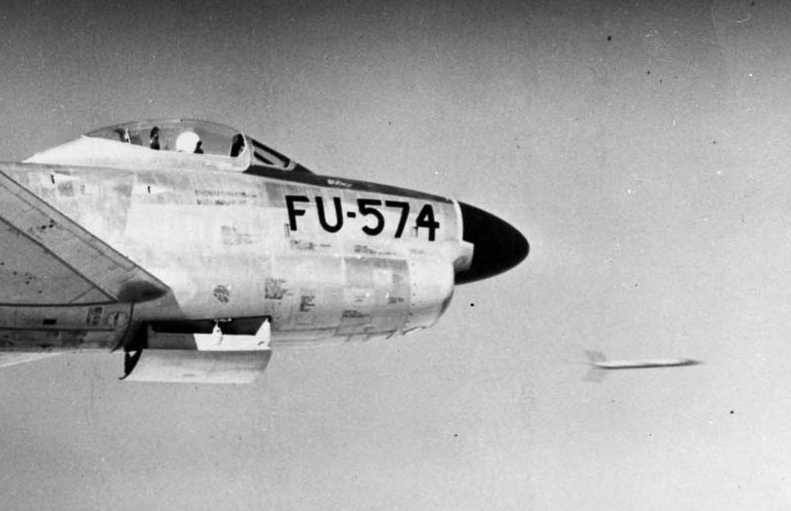
The North American F-86 Sabre was the United States' first swept-wing fighter and the aircraft that carried Western air combat into the transonic regime. Drawn from a US Army Air Forces requirement for a medium-range, single-seat day escort fighter, it first flew on 1 October 1947 and became inseparable from the Korean War, where it met the MiG-15 in the first large-scale jet-versus-jet battles in history. With 9,860 built across all versions, it is by far the most-produced Western jet fighter. Its ancestry lay in the navy FJ-1 Fury: the three XP-86 prototypes contracted in May 1945 were laid out around a straight wing derived from that aircraft, and it soon became clear they would fall short of the 600 mph (965 km/h) the service demanded. The answer was radical — apply the German high-speed aerodynamic research seized at the end of the Second World War and redesign the aircraft around a thin swept wing, with leading-edge slats to preserve its low-speed handling. The design convinced enough that 33 production P-86As were ordered on 20 December 1946, before the prototype was even finished. The first XP-86 was rolled out on 8 August 1947 and George “Wheaties” Welch took it up on 1 October; on 19 October, Welch pushed it past Mach 1 in a shallow dive. On 15 September 1948, Major Richard L. Johnson set the world speed record at Muroc Dry Lake at 671 mph (1,080 km/h). Korea arrived while the Sabre was barely in service. On 10 December 1950 the escort carrier USS Cape Esperance unloaded the 4th Fighter Wing's F-86As in Tokyo Bay, and on 17 December four of them flew into combat from a forward Korean airfield: on that mission Lieutenant Colonel Bruce Hinton shot down the first MiG-15 to fall to a Sabre. Armed with six 0.50 in machine guns firing 1,200 rounds a minute, the F-86 carried the fight for air superiority over the corridor known as MiG Alley. By the end of the war, Sabre pilots had claimed 792 MiG-15s against 78 Sabres lost — a 10:1 ratio — but that figure has not survived scrutiny: the USAF itself halved it in an investigation code-named Sabre Measure Charlie, the work of Dorr, Lake and Thompson puts it nearer 2:1, and a RAND report lowers it to 1.8:1 overall and probably 1.3:1 against Soviet-flown MiGs. The design improved relentlessly through production. The F-86E introduced the all-flying tail, restoring control authority at transonic speeds where the conventional elevator lost its effectiveness; the F-86F, the definitive day fighter, took on the solid “6-3” leading edge and, in the final F-40 blocks, a wing with a 30 cm tip extension and the slats restored. An interceptor branch grew alongside it: the F-86D “Sabre Dog” traded its guns for a Hughes radar and 2.75 in Mighty Mouse unguided rockets fired automatically by the fire-control system (2,506 delivered according to the NMUSAF), and from it came the export F-86K, with the simplified MG-4 fire-control system, and the F-86L. The F-86H was the fighter-bomber version, with a General Electric J73 turbojet and four 20 mm M39 cannon, while the US Navy took 738 FJ-2 and FJ-3 Furys, the carrier branch of the family. The Sabre was built inside and outside the United States: more than 7,800 aircraft between 1949 and 1956 in the United States, Japan and Italy, plus 1,815 Canadair Sabres in Canada and 112 CAC Sabres in Australia, powered by the Rolls-Royce Avon and armed with 30 mm Aden cannon. Mitsubishi assembled 300 F-86F-40s for Japan through 1961, and Fiat 221 F-86Ks in Turin, of which 60 went to France and 88 to West Germany. It flew with dozens of air forces — Spain among them, which assigned it to fighter wings 1, 2, 4, 5 and 6 and retired it in 1972 — and kept fighting long after Korea: in the Second Taiwan Strait Crisis of 1958, Republic of China Sabres made the combat debut of the AIM-9 Sidewinder air-to-air missile, and in the 1965 Indo-Pakistani war the Pakistani F-86s were the only contenders with that capability. Designed in the late 1940s and technically overtaken by the end of the following decade, the Sabre set the benchmark for the first generation of Western jet fighters and left its maker the name it would reuse for the supersonic F-100 Super Sabre.
Category
Three-view drawing
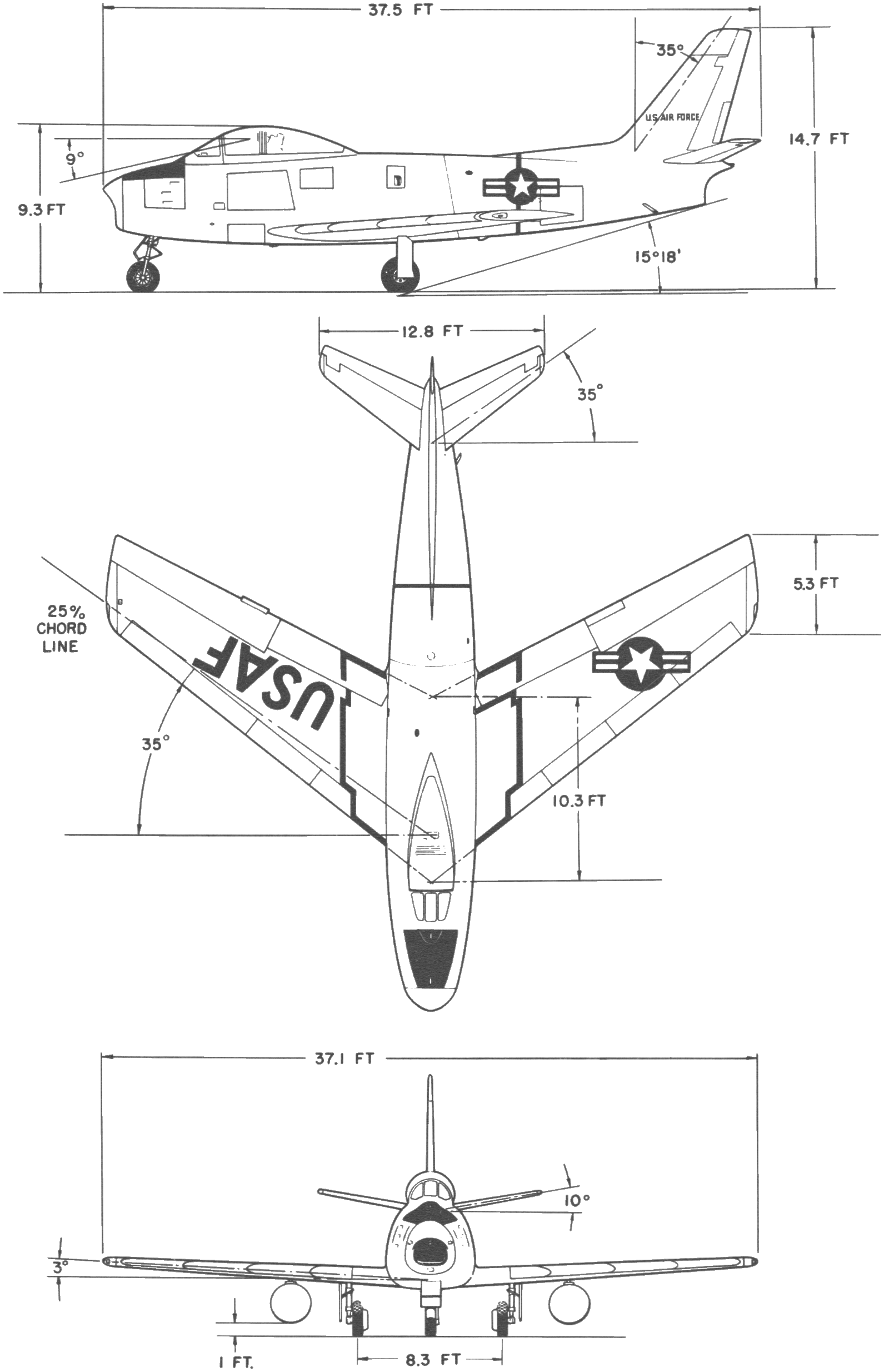
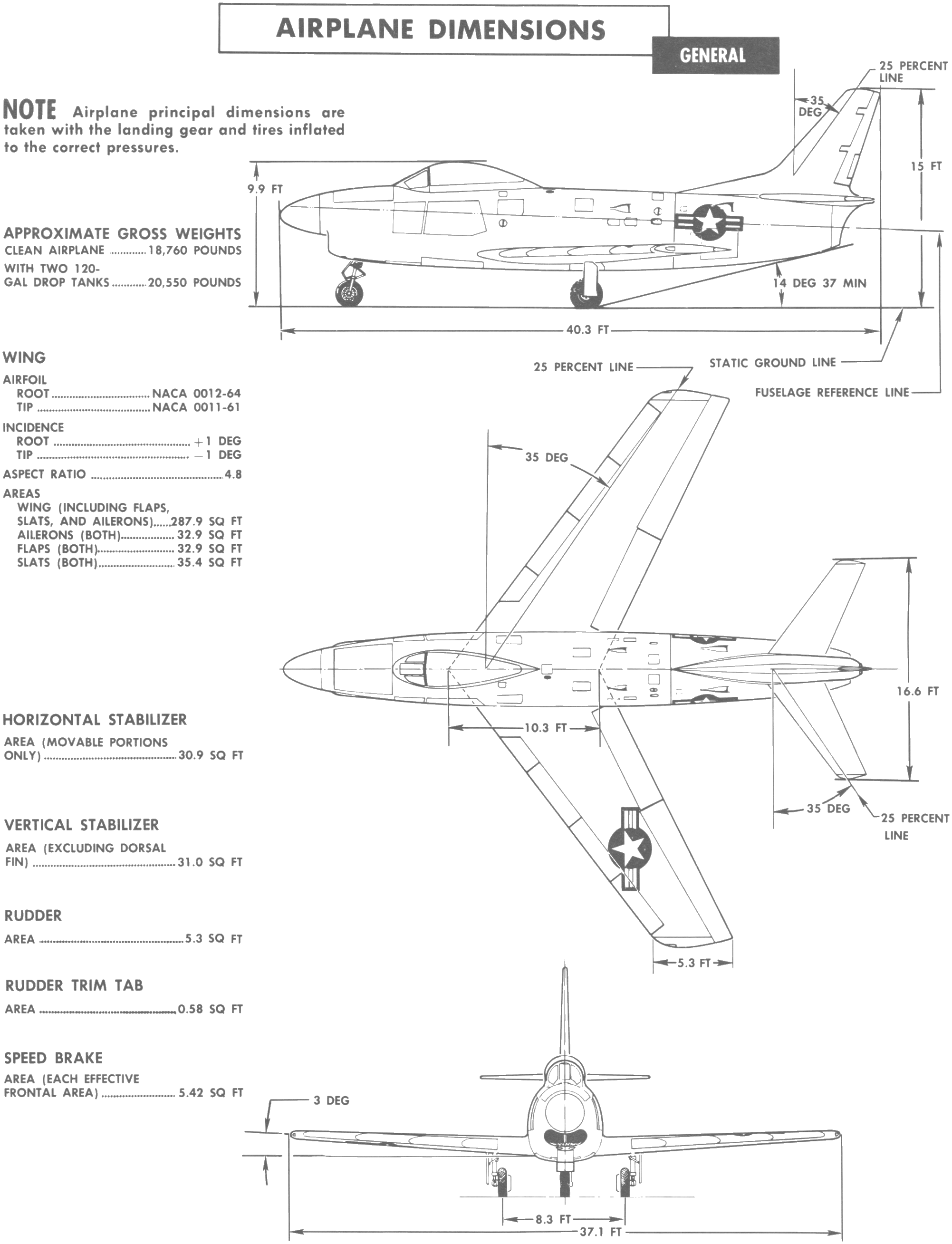
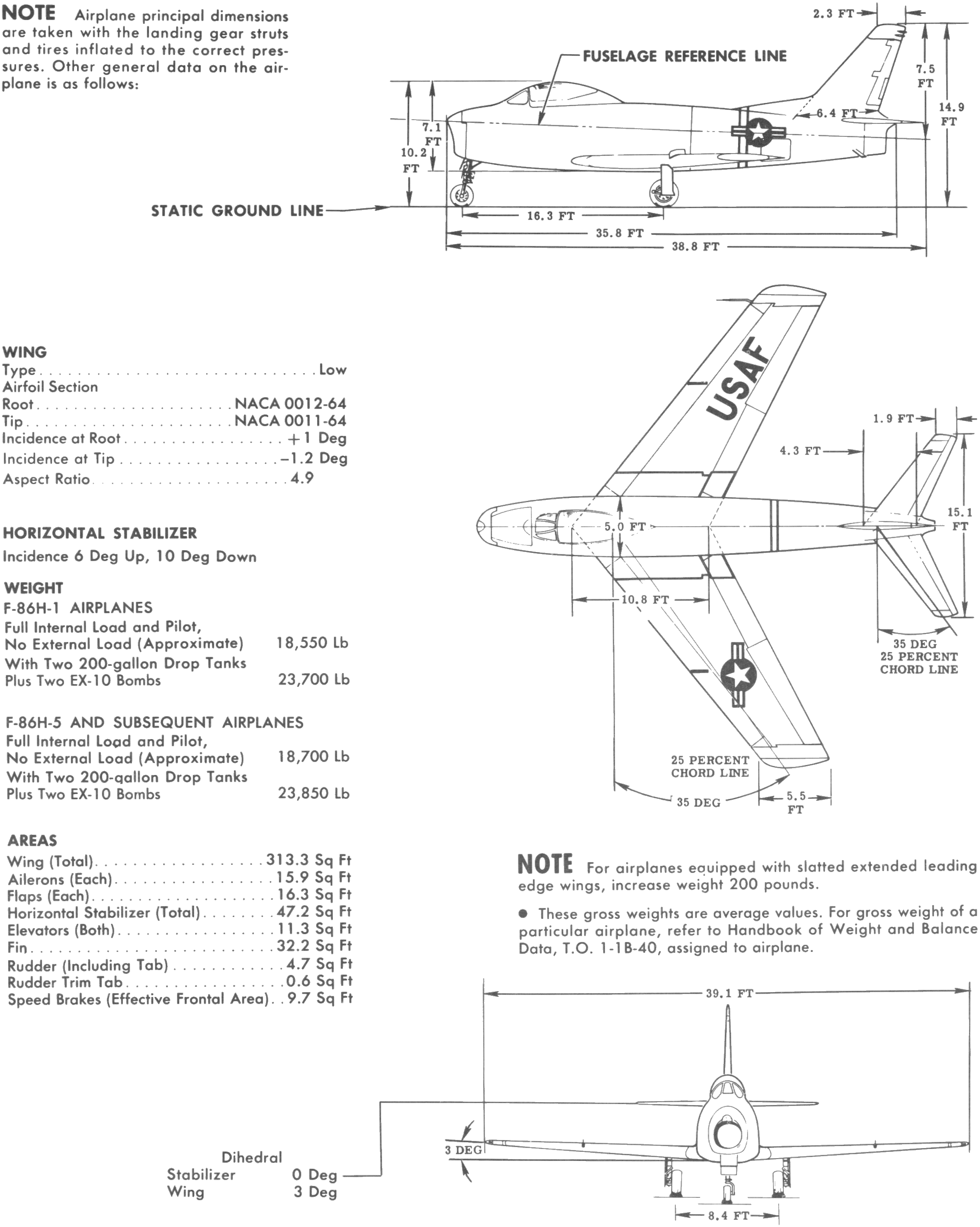
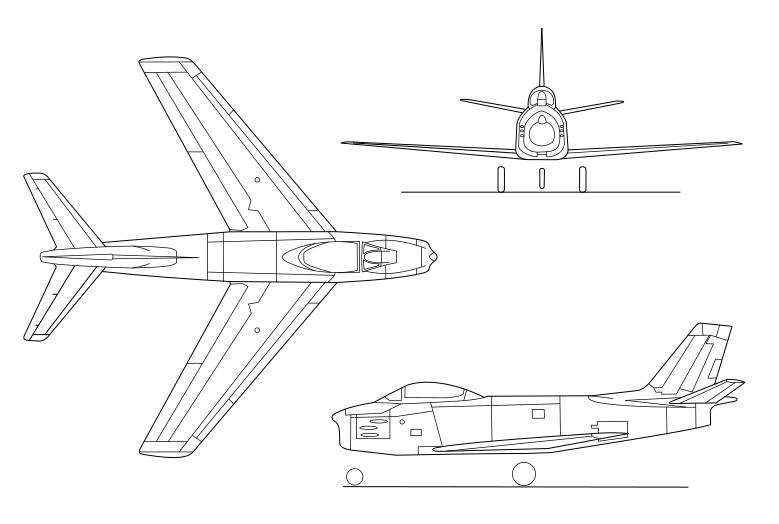
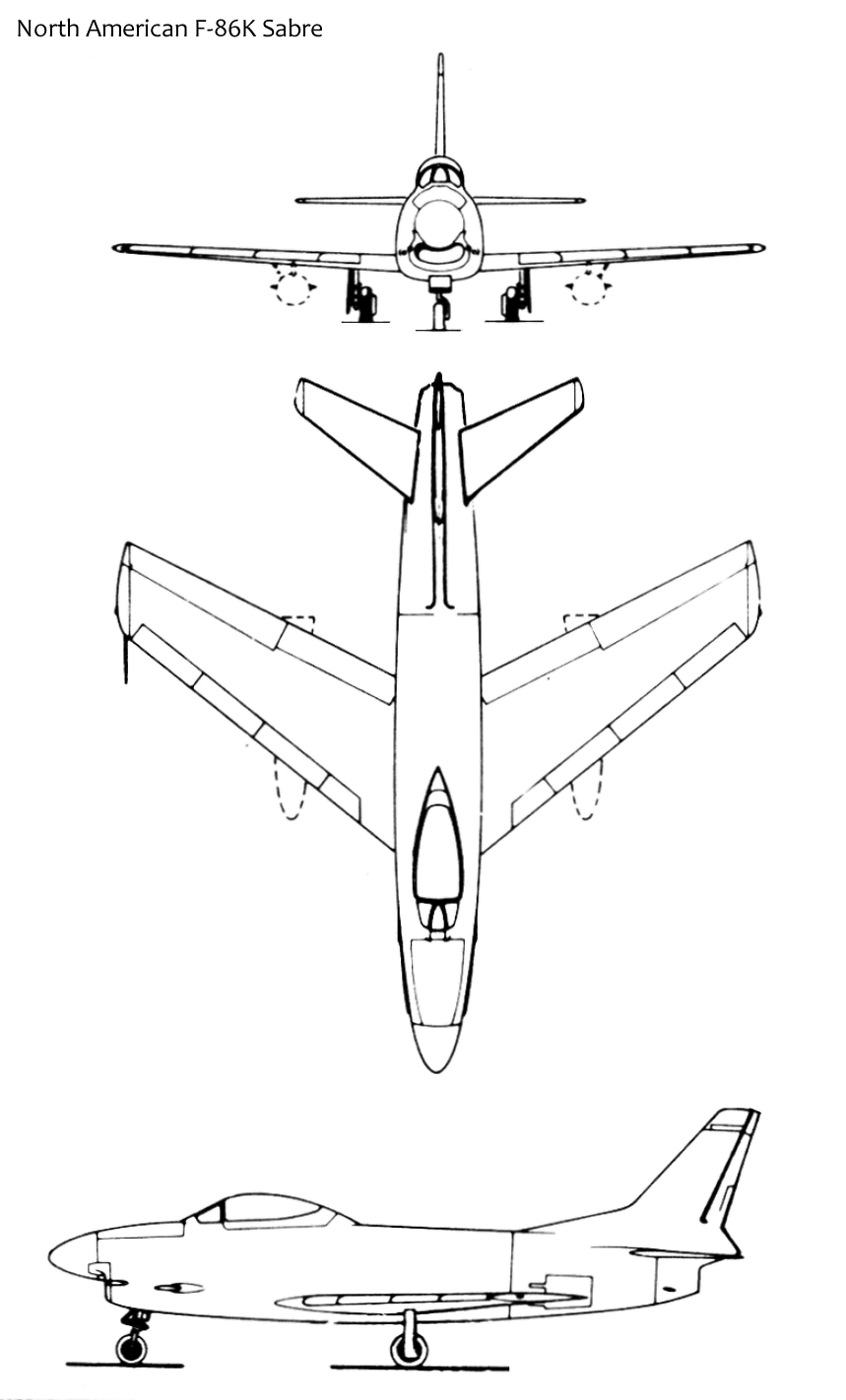
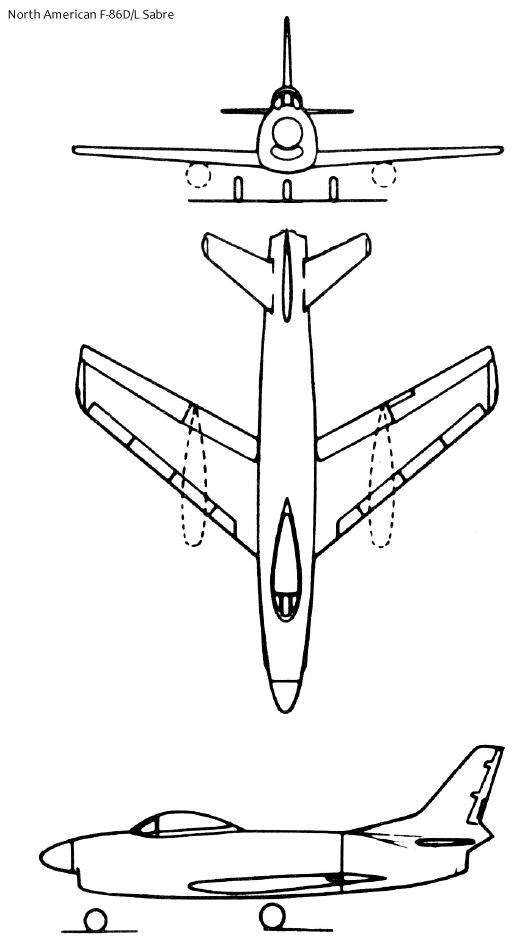
_front_view_at_Jeju_Aerospace_Museum_October_5%2C_2018.jpg)
_right_side_view_at_Jeju_Aerospace_Museum_October_5%2C_2018.jpg)
_right_side_top_view_at_Jeju_Aerospace_Museum_October_5%2C_2018.jpg)
.jpg)
.jpg)
History
From the Mustang to the jet: the FJ-1 Fury
By the closing years of the Second World War it was clear that jet propulsion was the future of high-speed combat aircraft. North American Aviation had just delivered one of the finest piston fighters of the conflict, the P-51 Mustang, and wanted to make the leap into the jet age as well. In late 1944 the company opened a design study under the reference RD 1265 for its first jet fighter and offered it to the United States Navy. On 1 January 1945 it received the contract: one hundred aircraft, with the company designation NA-134 and the Navy designation FJ-1.
The prototype, the XFJ-1, flew in late 1946. It was a stubby cigar with straight wings and a nose air intake, powered by a General Electric TG-180 (J35-GE-2) turbojet of 16.7 kN thrust. The first production FJ-1 "Fury" aircraft were delivered in early 1948, by then with the Allison-built J35. The pilot sat under a bubble canopy set high for good all-round view, and the aircraft had one notable oddity: it could "kneel" on its nosewheel to take up less deck space aboard a carrier.
The FJ-1 was neither a great aeroplane nor a long-lived one, but it was the mould. Everything that followed — the Air Force fighter and, in an almost ironic turn, a second naval family — grew out of that first attempt.
The decisive turn: the swept wing and the captured German data
While the NA-134 was taking shape in 1945, North American was simultaneously investigating a larger derivative, the NA-140, for the US Army Air Forces (which would be split off from the Army as the independent USAF in September 1947). In May 1945 the company won a contract for three prototypes designated XP-86. The original NA-140 design strongly resembled the NA-134: a straight-winged fighter, larger and longer, but from the same school.
Engineers already knew that a thin swept wing could greatly reduce drag and delay the onset of compressibility problems, but they also knew that such a wing tended to be unstable at low speed — precisely when a fighter lands. The hard data needed to resolve that contradiction was not available until early 1945, when the Allies captured German research on swept-wing flight. The Germans had run wind-tunnel tests on small swept-wing models as far back as 1940, and by 1944 their work had demonstrated substantial performance benefits. One of the American engineers who reviewed the material, George Schairer of Boeing, was enthusiastic enough to propose not only that his own company apply it to the new XB-47 bomber but that the information be shared with the other US aviation firms.
At North American it was Larry Green who studied the documents and drew the conclusion that changed the programme: a swept wing was the answer for the XP-86, and a leading-edge slat that extended automatically at low speed would cure the stability problem. Within a few weeks company engineers were running wind-tunnel tests on a 1/23rd scale model of an XP-86 with wings swept at 35 degrees. After further testing, the Army Air Forces approved development of the swept-wing XP-86 on 1 November 1945.
The kinship with the FJ-1 remained visible in the fuselage and the nose intake, but the result looked nothing like it: where the Fury was tubby, the XP-86 was sleek, giving the impression of a flying shark. The decision cost programme time — the fighter fell behind rival straight-winged jets — and it was exactly that decision that saved it five years later over Korea.
XP-86: the prototype that went through the sound barrier
The test pilot was George "Wheaties" Welch, North American's chief test pilot and one of the colourful figures of early jet aviation. Welch had flown with the Army Air Forces over the Pacific until 1944, reaching the rank of major with sixteen kills, and joined North American that same year.
The XP-86's first flight, on 1 October 1947, was uneventful until it was time to land: the nosewheel leg would not lock down. Welch made a nose-up landing and the nosewheel snapped into place as soon as the main wheels hit the runway. His comment over the radio was a laconic "Lucky!".
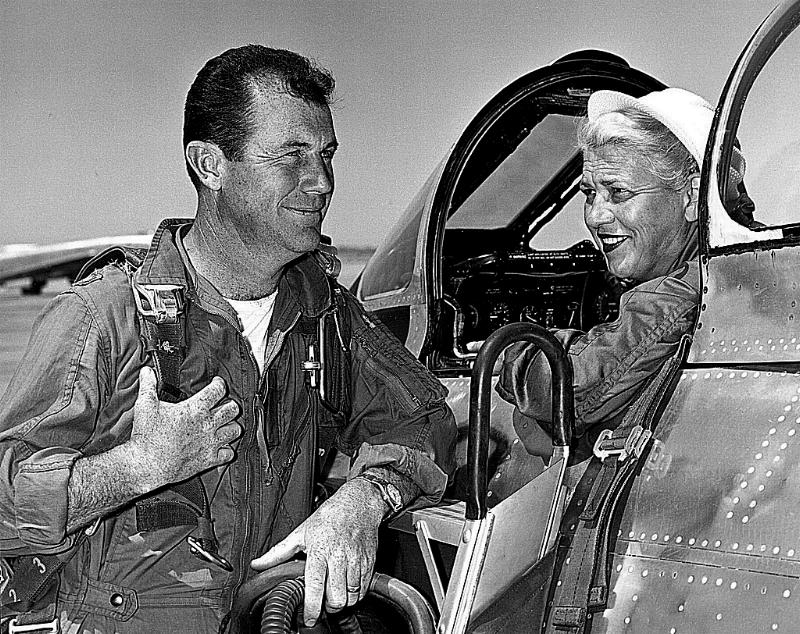
On 19 October 1947 Welch took the first prototype through the sound barrier in a shallow dive, making the XP-86 the first non-experimental aircraft to exceed Mach 1. The date has an awkward side: Chuck Yeager had taken the X-1 through the barrier on 14 October 1947, five days earlier, but Welch had been making high-speed dives for some time and there is every reason to believe that some of them had exceeded Mach 1 before Yeager did. The documentation does not settle the question, and the official record remains the X-1's.
The F-86A enters service and takes the world record
The first P-86A flew on 20 May 1948. It carried a T-4E-1 ejection seat — the canopy jettisoned manually before ejection — plus a self-destruct charge to keep the aircraft from falling intact into enemy hands. Under each wing was a pylon able to carry a 782-litre drop tank or a 450-kilogram bomb, but in practice its useful armament was the six 12.7-millimetre machine guns in the nose: at first it was not a particularly useful aircraft for close support.
On 15 September 1948, at Muroc Dry Lake, an F-86A set the world air speed record at 1,080 km/h (671 mph) flown by Major Richard L. Johnson, beating the previous mark by 32 km/h. The Sabre also went racing: an F-86A won the 1951 Bendix race at an average speed of 891.19 km/h.
Korea: MiG Alley
Nobody chose the war that defined the Sabre. On 10 December 1950 the escort carrier USS Cape Esperance entered Tokyo Bay with a load of F-86As of the USAF 4th Fighter Wing; the official USAF chronology dates that arrival in Japan to 1 December. The opponent was already in place: on 1 November 1950 the Soviet 64th Fighter Aviation Corps had been attached to the Chinese air force under the 1st United Air Army, and that same day Soviet-piloted MiG-15s began operating over North Korea. The Soviet Union never officially entered the war.
The MiG-15 was a serious problem. It was one of the first successful jet fighters to use swept wings to perform near Mach 1, and that wing proved a decisive advantage in Korea over the straight-winged jets the United States had deployed. It had been conceived to intercept bombers such as the B-29, hence its armament: two 23-millimetre cannon with 80 rounds per gun and a single 37-millimetre with 40, fitted in a pack that could be winched out of the bottom of the nose so a pre-prepared pack could be swapped in whole. Against the Sabre that armament hit far harder than six 12.7-millimetre machine guns; in exchange, rate of fire and ease of aiming favoured the American side.
On 17 December 1950, on the Sabre's first day of operations over Korea, Lieutenant Colonel Bruce H. Hinton scored the first MiG-15 kill by an F-86. The first engagements set the pattern for the whole air war: eight Sabres of the 4th Fighter-Interceptor Wing, flying from the forward base at K-14 Kimpo, attacked an estimated fifteen MiGs at 9,100 metres and pursued some to the Yalu, claiming six without loss. That strip of north-western Korea, between the Yalu and the front, became known as "MiG Alley", and most of the air-to-air fighting of the conflict happened there.
The North Korean push south forced the Sabres to withdraw to Japan in January 1951, when their Korean bases were overrun. The reversal of the war in March allowed them to return and renew the contest. Sabre successes against the MiG-15 were marked enough that the Chinese effectively abandoned serious air operations in December 1951 in order to regroup; they returned in May 1952 with improved tactics. The American response included a bounty of 100,000 dollars for any enemy pilot who defected with a MiG: the effort was codenamed MOOLAH — antique slang for "big money" — and was publicised by leaflet drops over airfields. It paid off on 21 September 1953, when North Korean Lieutenant No Kum-Suk flew south and landed his MiG-15 on an American airstrip, finally allowing a detailed examination of the aircraft.
Units rotated too. The F-86As and F-86Es of the 4th Wing were decidedly battle-worn when it was decided that the 51st Fighter-Interceptor Wing would begin operations from Suwon on 1 December; the 51st had converted from the F-80 to the Sabre in December 1951, in a delicate balance between the needs of the Korean front and maintaining an adequate force structure in Western Europe.
The F-86E and F-86F: improving the fighter mid-war
The Sabre was refined while it fought. The F-86E was almost indistinguishable from the A externally, but had improved flight controls, a J47-GE-13 of 24.2 kN and — crucially — an all-flying tailplane with hydraulic actuators. In the F-86A the tailplane was fixed; in the E the whole assembly rotated, with the moving elevator retained. The change came from a real problem: at transonic speeds the fixed tailplane became ineffective and pilots had difficulty pulling out of high-speed dives. Hydraulic actuation removed force feedback to the pilot, so North American engineers devised an "artificial feel" mechanism using bungee connections and counterweights. The first F-86E flew on 23 September 1950, again with Welch at the controls; the first sixty F-86E-1s reached the fighter groups in early 1951 and began replacing war-weary F-86As in combat that spring.
The F-86F was meant to have the J47-GE-27 of 27.1 kN, but General Electric could not deliver it in time and the first airframes went out with the E's J47-GE-13. The first proper F-86F-1, with the GE-27, flew in March 1952. Successive blocks closed specific gaps: the F-86F-5 strengthened the pylon attachments for 758-litre drop tanks, giving extended range and combat endurance; the F-86F-10 introduced the A-4 gunsight in place of the less reliable A-1CM; the F-86F-15 redesigned a hydraulic system that had proved vulnerable — a single hit could disable the aircraft — though only seven were built because of engine delivery problems.
The most celebrated modification was the wing. The new leading edge, without slats and of extended chord, known as the "solid 6-3" wing, also carried leading-edge fuel tanks that added 264 litres; it improved speed and high-altitude manoeuvring at the cost of low-speed handling. The F-86F-40 later combined the best of both: the 6-3 wing with a 30-centimetre wingtip extension and the leading-edge slats restored.
What the victory was worth: the kill ratio and its revision
By the end of hostilities, American sources initially credited F-86 pilots with shooting down 792 MiGs in air combat for the loss of only 78 Sabres — a ratio of 10 to 1. That figure travelled for decades and set the aircraft's reputation.
It did not survive later scrutiny. The USAF itself reviewed its figures in an investigation codenamed *Sabre Measure Charlie* and halved the kill ratio attributed to the F-86 against the MiG-15. Later research went further: the work of Dorr, Lake and Thompson puts the ratio closer to 2 to 1. The count of American losses is also more nuanced than the "78" suggests: of the Sabres lost, 184 were lost in combat — 78 in air-to-air combat, 19 to anti-aircraft guns, 26 to unknown causes and 61 to "other losses" — plus 66 in incidents.
The same applies to the aces. Crediting victories in Korea is notoriously disputed, thanks to poor records, deliberate overestimation and the difficulty of confirming crashes in MiG Alley, where most of the combat took place. The United States was the only United Nations country whose pilots attained ace status: forty of them. On the other side the estimates vary widely — between 34 and 60 possible Soviet aces, between six and nine Chinese and up to four North Korean — and the ace status of dozens of pilots remains in question.
None of this diminishes what the Sabre did. It changes the scale: from crushing dominance to a real superiority, contested and sustained over time by better-trained pilots and by an aircraft that took punishment.
Cannon, cameras and bombs: Gunval, RF-86 and F-86H
The lack of killing power of the six 12.7-millimetre Brownings was apparent to the Soviets and to the USAF alike. Hence the *Gunval* programme: an evaluation batch of Sabres fitted with four T-160 20-millimetre revolver cannon, designated F-86F-2. Ten were built; eight were shipped to Japan in late 1952 and entered combat evaluation in early 1953. The results were promising but not clean: one Gunval Sabre suffered a flame-out while firing on a MiG-15, though the pilot was able to drop to lower altitude and relight.
There were also reconnaissance Sabres — the RF-86 conversions, among them those known as Haymaker — which traded part of the armament for cameras on photographic missions.
The last fighter variant proper, as opposed to the interceptor line, was the F-86H. It kept the classic Sabre lines but with a muscular look thanks to a General Electric J73-GE-3 of 41.2 kN dry thrust. It adopted the clamshell canopy designed for the F-86D — the only Sabre fighter variant without a sliding canopy — along with its ejection seat and a one-piece slab tailplane. It was not an air-superiority fighter: it was conceived as a fighter-bomber able to deliver nuclear weapons as well as conventional bombs, napalm or rockets. Two prototypes were built at Inglewood; the first was rolled out in April 1953 and flew in May.
The interceptor line: F-86D, F-86K and F-86L
An intelligence warning in 1948 prompted the United States to field an all-weather interceptor, and North American started from the basic F-86A airframe to build two unprecedented concepts into the F-86D — initially designated F-95: a single-seat fighter with radar operated by the pilot himself and, for the first time in a production single-seat fighter, air-to-air rocket armament replacing guns. With the intake reshaped to make room for the radome, the "Sabre Dog" had an unmistakable profile. The first prototype, the YF-86D, flew on 22 December 1949.
North American delivered 2,506 F-86Ds before production ended in September 1953, according to the National Museum of the United States Air Force; the Wikipedia entry gives 2,504. The divergence is two aircraft and the available material does not resolve it: both figures are recorded here. The F-86D/K/L documentation, for its part, dates acceptance of the last F-86D-60 to September 1955. The USAF had phased out its F-86Ds by June 1961, but Japan and other nations kept flying them considerably longer.
The interceptor also produced the family's last records: in late 1952 an F-86D set a world speed record of 1,124.6 km/h (698.505 mph), and in July 1953 another raised it to 1,152.3 km/h (715.7 mph).
The F-86K was a simplified version of the D, developed in response to a 1953 USAF request for an export interceptor for Western allies under the Mutual Defense Assistance Program. It gave up the collision-course intercept capability of the E-4 system and reverted to the less demanding tail-chase intercept; otherwise it was generally identical to the F-86D-45. Two F-86D-40s were pulled from production and modified as YF-86K prototypes.
The F-86L closes the line as an update programme for the D interceptors in service. The material consulted treats it alongside the K but does not allow its scope or figures to be detailed here; it is noted as a gap.
The naval Furys: FJ-2, FJ-3 and FJ-4
The irony of the programme is that the Sabre, derived from a naval fighter, ended up returning the favour. The Navy had been slow to adopt swept wings, since such machines seemed too "hot" to land on a carrier, but Korea put its fighters up against a noticeably faster MiG-15 and the change had to be accepted. In early 1951, at the Navy's urging, North American began investigating a navalised Sabre, and in March 1951 was awarded a contract for three prototypes of a navalised F-86E.
Two of them were F-86Es modified with yoke-style arresting hooks, catapult attachment points and a longer nosewheel leg to raise the angle of attack for carrier take-offs and landings; they were unarmed, with the company designation NA-179 and the Navy designation XFJ-2 Fury. The third, NA-181 or XFJ-2B, was basically a stock F-86E with four 20-millimetre cannon and 150 rounds per gun instead of the F-86E's six 12.7-millimetre Brownings; it appears to have been strictly an armament test platform, with no carrier modifications. It was the first to fly, on 27 December 1951, with famed test pilot Bob Hoover at the controls.
From there came the production FJ-2 and FJ-3, and finally the FJ-4, the most heavily modified of the whole line. Work on the NA-209 or FJ-4 began in December 1953, leading to two NA-208 prototypes and production contracts for 177 aircraft. Conceived as an extended-range attack aircraft, it used essentially the same powerplant as the FJ-3 — a J65-W-16A of 34.2 kN — and, despite being larger, matched or bettered its predecessor's performance thanks to cleaner aerodynamics.
Licence production: Canadair, CAC, Mitsubishi and Fiat
The Sabre was built outside the United States in four countries, and in three of them with substantial changes.
In 1948 the Canadian government decided to re-equip the Royal Canadian Air Force with the F-86 and contracted Canadair to produce it in Montreal. Canadair slowly built up a facility able to make all components, with related equipment from Canadian suppliers, and gave the aircraft the project number CL-13. It produced six versions until 1958, 1,815 aircraft in total; the Mk 5, of which 370 were built, already had the Canadian Orenda 10 engine of 28,270 N static thrust and the "6-3" extended leading edge. The RCAF kept them in front-line service until replacing them with the CF-104 in 1962, and the last Canadair Sabres in front-line operation were the Pakistani Mk 6s equipped with AIM-9 Sidewinder missiles.
Australia produced the most distinctive version of all. The CAC Sabre, also known as the Avon Sabre or CA-27, departed from the North American blueprint in the essentials: it was decided to power it with a licence-built Rolls-Royce Avon R.A.7 instead of the General Electric J47, which required reworking much of the fuselage. First deliveries to the Royal Australian Air Force began in 1954 and the RAAF operated the type from 1954 to 1971. Twenty-two Mk 30s were built, with leading-edge slats; a further 20 Mk 31s with an extended leading edge, and the surviving Mk 30s were converted to that standard. Australian production totalled 112 aircraft.
Japan built 300 F-86Fs under licence at Mitsubishi between 1956 and 1961, assigned to ten *hikōtai* or squadrons. Italy produced the interceptor branch: original F-86K production was by Fiat for the Italian Air Force, with fifty kits sent from Inglewood to the Turin factory for assembly. Fiat eventually assembled 221 F-86Ks, of which 60 went to France and 88 to West Germany; late production featured the long slatted F-40 wing, and some Dutch F-86Ks were refitted with it.
Adding it all up, North American built 6,297 F-86s and 1,115 FJs, Canadair 1,815, Australia's CAC 112, Fiat 221 and Mitsubishi 300: 9,860 aircraft of the Sabre/Fury family. It is by far the most-produced Western jet fighter in history.
After Korea: Taiwan, India and Pakistan
The Sabre went on fighting long after the Korean armistice, almost always in other hands.
In the Taiwan Strait, the US Navy modified some F-86s of the Nationalist Chinese Air Force to carry the first AIM-9 Sidewinders. On 24 September 1958, 32 Republic of China F-86s clashed with about a hundred MiGs of the Chinese air force in a series of engagements: it was the first use of the Sidewinder in air-to-air combat, and Western sources credit 25 MiGs shot down by missile, the first kills ever scored by air-to-air missiles. The figure comes from the side claiming it and has not been cross-checked against opposing records.
Pakistan began receiving in 1954 the first of a total of 102 F-86Fs under the Mutual Defense Assistance Program, and its Sabres played a prominent part in the 1965 war with India. Pakistani F-86s forced the Indian Air Force to deploy Folland Gnat fighters to the forward base at Pathankot; India used Mystères flying slowly as bait to lure the Sabres in, with the waiting Gnats taking them on. The fighting was far more even than either side's propaganda suggested: an Indian squadron claimed an F-86 shot down on 3 September as the IAF's first air-combat victory of the war, but the Sabre made it back to base, and its pilot was decorated for surviving the dogfight against six Gnats and bringing the damaged aircraft home. On 4 September an F-86 was indeed lost. The most-cited individual action is that of Pakistani Squadron Leader Mohammed Mahmood Alam, who on 7 September 1965 engaged a formation of Indian Hawker Hunters, shot one down and, after a few minutes of manoeuvring, claimed four more in thirty seconds, becoming an ace in a single sortie; the claim is disputed by Indian sources. Pakistani Sabres saw action again in the 1971 war with India.
Pakistan also gave the Sabre one of its most spectacular non-combat moments: on 2 February 1958 a team of F-86s called the "Falcons" set a world record at PAF Base Masroor by performing a loop in a sixteen-aircraft diamond formation.
The end of service and the survivors
After first-line service in the United States, Canada, Australia, Japan, Italy, Britain, France, West Germany, the Netherlands, Norway, Pakistan and Colombia, used Sabres were passed on to dozens of nations. Second-hand operators included Argentina, Bangladesh, Bolivia, Burma, Denmark, Ethiopia, Greece, Honduras, Indonesia, Iran, Iraq, Malaysia, Peru, the Philippines, Portugal, Saudi Arabia, South Korea, Spain, Taiwan, Thailand, Tunisia, Turkey, Venezuela and Yugoslavia. Colombia, for instance, assembled four F-86Fs from Spain, five USAF F-86Fs and nine Canadair Mk 6s for its fighter-bomber squadron; Honduras acquired ten CL-13 Mk 2s (equivalent to the F-86E) from Yugoslavia in 1976.
A few still fly. In Australia, the CA-27 Mk 32 registered VH-IPN, restored in the 1980s, grounded in the 1990s and restored again for the Temora Aviation Museum, has been displayed regularly since September 2009. In France a privately owned CL-13 Sabre Mk VI, F-AYSB, is kept airworthy at Avignon-Caumont. In the United States a privately owned F-86A, N48178, remains airworthy at Grove, Oklahoma. In South Africa the Air Force Museum keeps a CL-13B Mk 6 stored at AFB Swartkop. Alongside them are dozens of static examples worldwide, from the Slovenian F-86Ds to the American collections.
Declared gaps
This text was written from the captured material and deliberately leaves out what that material does not support:
- **No F-86F flight manual.** The F's performance figures are not quoted here as firm data; the available manuals are those of the F-86D/K/L plus a general performance document. - **Non-anglophone operators poorly covered.** Italy, Japan, Spain, Germany, Argentina and Peru appear only to the extent the material supports: production figures or membership of the operator list. Their national service histories are undocumented here. - **The 1969 war between Honduras and El Salvador.** The material does not support Sabre participation in that conflict; it records that Honduras acquired ten CL-13 Mk 2s from Yugoslavia in 1976. Nothing further is asserted. - **Aerobatic teams.** Only the 1958 Pakistani "Falcons" record is documented; the rest of the Sabre's display use has no source here. - **FAI records of 1952 and 1953.** They are cited from a secondary route (the type entry), not from FAI homologation. - **F-86D: 2,506 against 2,504.** A divergence between the National Museum of the USAF and Wikipedia, recorded unresolved. - **F-86L.** No detail of scope or figures in the material consulted.
Variants
| F-86A | F-86E | F-86D/L | F-86F | F-86H | |
|---|---|---|---|---|---|
| First flight | May 20, 1948 | September 23, 1950 | — | — | — |
| Aircraft type | — | — | — | Single-seat jet fighter | — |
| Powerplant | — | — | — | One General Electric J47-GE-27 turbojet rated at 26.3 kN (5910 lbf) thrust. | — |
| Powerplant | — | — | — | 1 × General Electric J47-GE-27 | — |
| Thrust per engine | — | — | — | 26.3 kN | — |
| Length | — | — | — | 11.3 m | — |
| Wingspan | — | — | — | 11.9 m | — |
| Height | — | — | — | 4.3 m | — |
| Wing area | — | — | — | 29.1 m² | — |
| Empty weight | — | — | — | 5,046 kg | — |
| MTOW | — | — | — | 8,234 kg | — |
| Top speed | — | — | — | 1,106 km/h | — |
| Max speed altitude | — | — | — | 0 m | — |
| Service ceiling | — | — | — | 15,100 m | — |
| Initial climb rate | — | — | — | 46 m/s | — |
| Range | — | — | — | 2,454 km | — |
| Range conditions | — | — | — | Range of 2454 km. On a strike mission with two 454 kg bombs and two 760-litre drop tanks the source gives a combat range of 666 km. | — |
| Armament | — | — | — | Six 12.7 mm M3 Browning machine guns with 1800 rounds in total; rocket launchers (for example two Matra pods with eighteen 68 mm SNEB rockets each) and up to 2400 kg of bombs, napalm or other stores on four external hardpoints. | — |
| Max weapons load | — | — | — | 2,400 kg | — |
| Payload | — | — | — | 0 kg | — |
| Cargo capacity | — | — | — | No cargo or passenger capacity: a single-seat fighter with neither hold nor cabin. The four external hardpoints carry weapons and 760-litre drop tanks only. | — |
| Crew | — | — | — | 1 | — |
| Passengers | — | — | — | 0 | — |
| Units built | 554 | 456 | 2,506 Best value in this row | 2,239 | 473 |
Images
Elsewhere
- Smithsonian National Air and Space MuseumNorth American XP-86 Sabre [Photos] ↗
- Smithsonian National Air and Space MuseumSabre F-86A archival ↗
- Smithsonian National Air and Space MuseumF-86F Sabre restoration ↗
- Smithsonian National Air and Space MuseumNorth American F-86A Sabre Panorama ↗
- Smithsonian National Air and Space MuseumF-86 Sabre Nose ↗
- Smithsonian National Air and Space MuseumNorth American F-86A Sabre ↗
- National Museum of the USAFNorth American F-86H Sabre ↗
- National Museum of the USAFNorth American F-86A Sabre ↗
- U.S. Air ForceF-86 Sabres in Korea ↗
- U.S. Air ForceF-86 Sabre in Korea ↗
- U.S. Air ForceKorean War (F-86 Sabre) ↗
- Naval History and Heritage Command80-G-428463 FJ-1 ↗
Show the 8 more
- Smithsonian National Air and Space MuseumNorth American FJ-1 Fury ↗
- San Diego Air & Space Museum Library & ArchivesNorth American TF-86F Sabre (catalog #00016502) ↗
- Imperial War MuseumsSabre F-86F/K ↗
- Canada Aviation and Space Museum (Ingenium)Canadair Sabre 6 ↗
- South African Air Force MuseumF86 ↗
- Flight Global ArchiveNorth American F-86E Sabre Cutaway Drawing ↗
- Boeing ImagesNorth American F-86 Sabre in Flight ↗
- Boeing ImagesNorth American Aviation F-86 Sabre ↗