Mig-21 facts that might surprise you
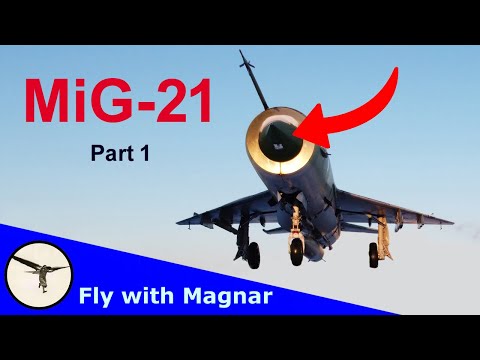
Video from the channel Fly with Magnar about Mikoyan-Gurevich MiG-21, linked on its Above Ten Thousand entry. Duration: 16:38. Language: English. Video type: Documentary.
What it's about
A pilot presents the MiG-21: how it was conceived as an interceptor, its generations, its records, its spread around the world and its handling in flight, with footage of Finnish and Romanian examples.
Historical context
It was developed by the Mikoyan-Gurevich design bureau. It first flew in 1955 and entered service in 1959. Its mission was to take off, climb guided by ground radar and fire missiles at bombers. That's why it was built as small as possible around a large engine, with a delta wing and a movable cone in the air intake. The video distinguishes three generations. The first, from 1959, was a day interceptor without radar, and its most-produced version was the F-13. The second, from 1961, was an all-weather interceptor with the radar inside the cone. The third, from 1968, was a fighter-bomber whose final version was the MiG-21bis. Production ended in 1985.
Key facts
In 1959 a prototype broke the speed record at 2,388 km/h. Two years later, fitted with an added rocket engine, it set an altitude record of 34,740 m. A total of 11,496 units were built, to which more than 2,400 J-7 and F-7 aircraft made in China can be added. It was exported to around 50 countries, with Finland as the first customer. The USAF secretly evaluated it with the 4477th squadron at Tonopah, under the designation YF-110. Its speed is limited to Mach 2.05 and the afterburner can only be used for two minutes at a time. The pilot describes a cluttered cockpit, poor visibility and very demanding landings.