Fighter · Military · United States
McDonnell Douglas F/A-18 Hornet
- November 18, 1978
- First flight
- 1983
- Introduced
- In service
- Status
- 1,480
- Units built


%2C_1979.jpg)
-800.webp)
-1600.webp)
_(8855618338)-1600.webp)

-1600.webp)

%2C_1984.jpg)

-1600.webp)


-1600.webp)
-1600.webp)

-1600.webp)
.jpg)

-1600.webp)
-1600.webp)

-1600.webp)

_Swiss_Air_Force%2C_RIAT_2009._(6844752318)-800.webp)
_de_la_NASA-800.webp)
-1600.webp)
-1600.webp)

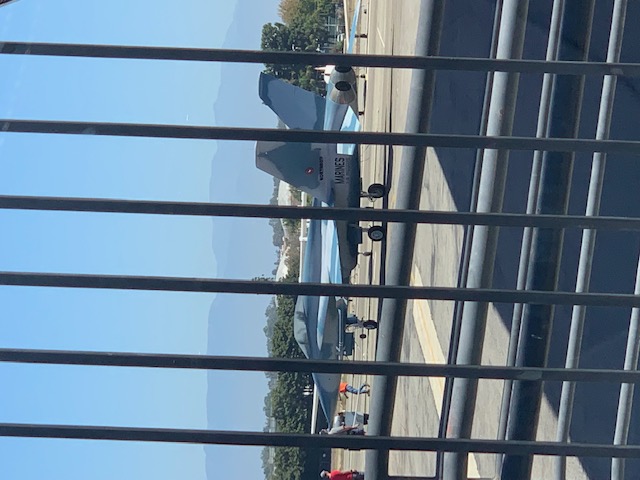
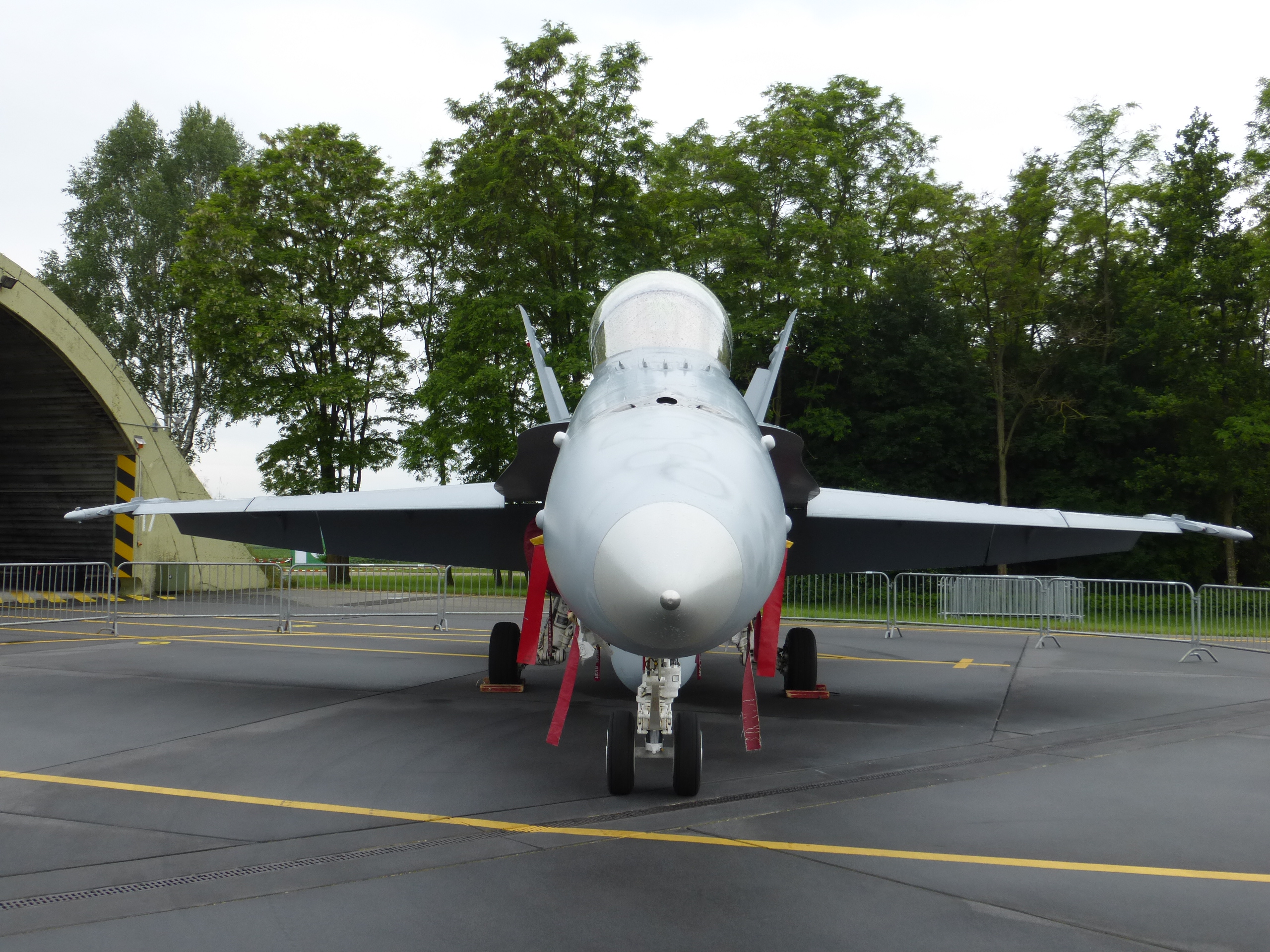
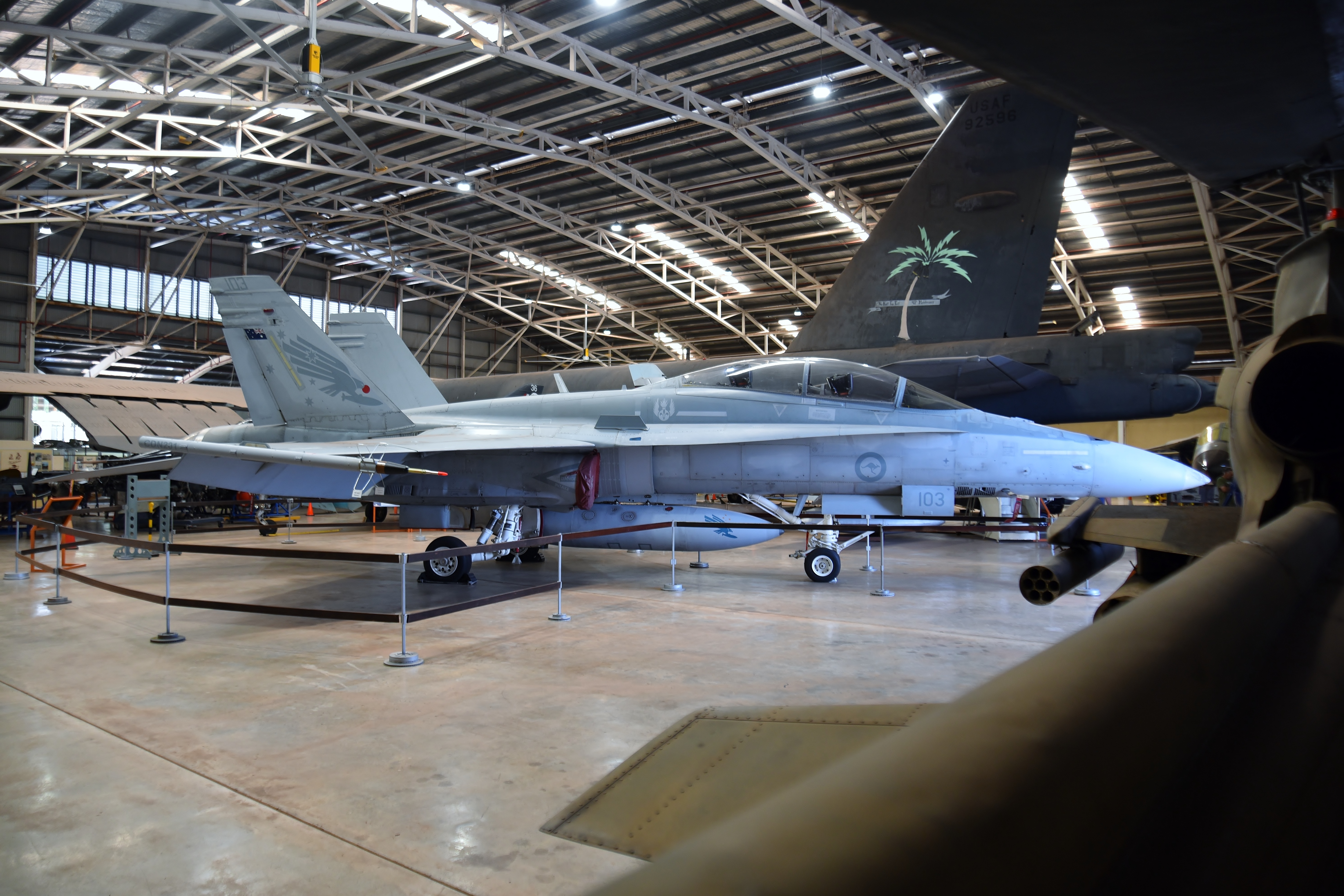
The McDonnell Douglas F/A-18 Hornet is a carrier-capable, supersonic, twin-engined, all-weather combat aircraft conceived as both a fighter and a ground-attack machine, hence the dual F/A designation. It was designed by McDonnell Douglas and Northrop from the YF-17, the prototype beaten by the YF-16 in the Lightweight Fighter contest of the United States Air Force and rescued by the Navy for its Navy Air Combat Fighter programme. This entry covers the legacy Hornet in its A, B, C and D versions; the F/A-18E/F Super Hornet, despite sharing the name, is a new and larger airframe and is treated as a separate model. The requirement grew out of a double need: to replace the A-4 Skyhawk and the A-7 Corsair II along with the Navy's surviving F-4 Phantom IIs, and to complement the expensive F-14 Tomcat. Adapting the YF-17 for the carrier — internally the Model 267 — meant strengthening the airframe, undercarriage and tailhook, folding the wings, adding catapult attachments and increasing fuel capacity by 2,020 kg (4,460 pounds), changes that added 4,540 kg (10,000 pounds) to gross weight. In exchange, the Hornet introduced the first fully digital fly-by-wire control system with quadruple redundancy fitted to a production fighter. It first flew on 18 November 1978 and entered service with VMFA-314, a Marine Corps squadron, on 7 January 1983. Versatility was its great strength: fighter escort, fleet air defence, suppression of enemy air defences, interdiction, close air support and reconnaissance with the same aircraft and, if needed, on the same sortie. The leading-edge extensions, canted vertical stabilizers and digital controls give it exceptional behaviour at high angles of attack, while heavy use of multifunction displays lets the pilot switch from the fighter role to the attack role at the touch of a button. The C/D version is 17.1 m long (56 ft 1 in) with a 12.3 m span (40 ft 4 in), weighs 16,769 kg loaded (36,970 lb), reaches Mach 1.8 — 1,915 km/h — at 12,192 m, has an air-to-air combat radius of 740 km and carries a 20 mm M61A1 cannon with 578 rounds plus 6,200 kg of stores on nine hardpoints. Its General Electric F404 engines can be changed in twenty minutes by a four-person team, and the aircraft's mean time between failures is three times that of any other Navy strike aircraft. Not everything was praise. From 1977 onwards the GAO's reports to Congress documented severe cost growth — from 12.9 billion dollars for 811 aircraft to 24 billion for 1,377 — and, above all, inadequate range, which the independent operational evaluation of 1982 judged serious enough to recommend withholding fleet-use approval for the light attack mission. The Navy chose to compensate with more in-flight refuelling. Even so, the Hornet went into combat over Libya in April 1986, scored two MiG-21 kills on the first day of the 1991 Gulf War during a campaign of 4,551 sorties, and later flew over Bosnia, Kosovo, Afghanistan and Iraq. It was also an export success: Canada, Australia, Spain, Finland, Kuwait, Switzerland and Malaysia all bought it, invariably without the automatic carrier landing system. Between 1974 and 2000, 1,480 A, B, C and D aircraft were built; the United States Navy retired its own in 2019 as the F-35C came into service, while the Marine Corps still operated 179 F/A-18C/Ds in 2024 and intended to keep them until 2030. The versions fall into two generations. The single-seat F/A-18A and two-seat F/A-18B — the latter carrying 6 per cent less internal fuel to make room for the second cockpit, yet fully combat-capable — gave way in 1987 to a block upgrade that produced the F/A-18C and F/A-18D, with updated radar and avionics, the NACES ejection seat, a self-protection jammer and the ability to fire the AIM-120 AMRAAM; from 1989 the C and D models carried a dedicated night-attack fit with AN/AAR-50 and AN/AAS-38A NITE Hawk pods, night vision goggles and colour displays. A models upgraded with the AN/APG-73 radar and AMRAAM were designated F/A-18A+, and sixty two-seaters were configured as F/A-18D (RC) night-attack aircraft with reconnaissance capability. Two projects came to nothing: the F-18(R) reconnaissance version, produced only in small numbers after first flying in August 1984, and the RF-18D, cancelled in 1988 when funding ran out. Beyond combat, the Hornet has been an unusually productive testbed. NASA operates it as a research and chase aircraft at the Armstrong Flight Research Center, and with the F-18 HARV demonstrated controlled flight at angles of attack of 65 to 70 degrees using thrust vectoring vanes; other experiments measured full-scale fin buffet, evaluated side-stick controllers and achieved drag reductions of more than 20 per cent by flying autonomous formation inside the preceding aircraft's wing vortex. One airframe even received the X-53 designation for demonstrating active aeroelastic wing technology. For the general public, however, the Hornet was above all the aircraft of the Blue Angels, the United States Navy's flight demonstration squadron, which flew it from 1986 until late 2020.
Category
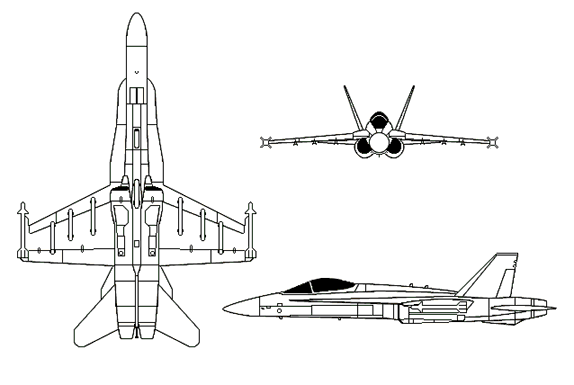
Three-view drawing
History
A fighter born from someone else's defeat
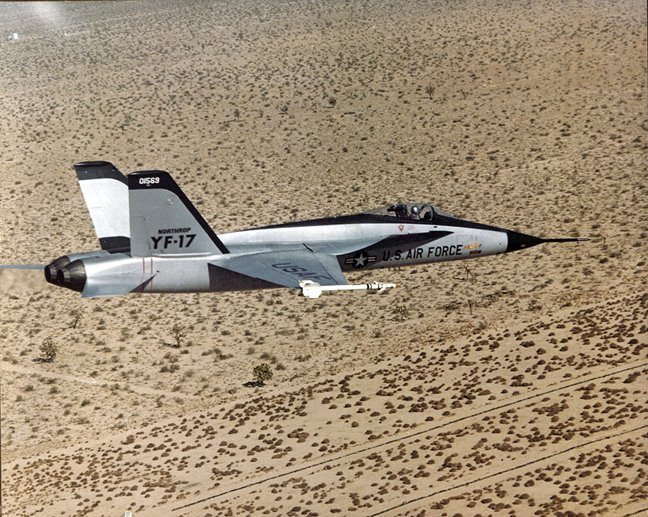
Few combat aircraft owe as much to a lost competition as the F/A-18 Hornet. Its direct ancestor, the Northrop YF-17, had been beaten in 1975 by the General Dynamics YF-16 in the Lightweight Fighter contest run by the United States Air Force. Under normal circumstances that would have been the end of an interesting prototype and nothing more. What saved the design was that, at almost the same moment, the United States Navy was urgently looking for an aircraft of its own and refused to accept the one the Air Force had just chosen.
The Navy had opened the VFAX programme — Naval Fighter-Attack, Experimental — to retire in a single move the Douglas A-4 Skyhawk and the A-7 Corsair II together with the McDonnell Douglas F-4 Phantom IIs still on strength, and to complement the expensive and heavy Grumman F-14 Tomcat. VFAX's leading advocate was Vice Admiral Kent Lee, at the time in charge of Naval Air Systems Command, and his campaign ran into strong opposition from many Navy officers, among them Vice Admiral William D. Houser, who as deputy chief of naval operations for air warfare was the senior naval aviator of the day. The internal quarrel was really an argument about what carrier aviation ought to be: a handful of very high-performance interceptors, or a numerous fleet of versatile aircraft.
Congress settled the matter through the budget. In August 1973 it ordered the Navy to look for a cheaper alternative to the F-14. Grumman put forward a stripped-down version of its own fighter, the F-14X; McDonnell Douglas countered with a naval version of the F-15. Neither turned out to be appreciably cheaper than the Tomcat they were meant to avoid. That same summer the Secretary of Defense, James R. Schlesinger, told the Navy to assess the contenders in the Air Force's Lightweight Fighter programme, the YF-16 and the YF-17, even though that competition called for a day fighter with no strike role — precisely the opposite of what the Navy needed. In May 1974 the House Armed Services Committee moved 34 million dollars away from VFAX to a new programme, the Navy Air Combat Fighter, intended to make maximum use of the technology already developed for the lightweight fighter.
The Navy was sceptical that a single-engined fighter with narrow landing gear could be adapted easily or cheaply to carrier service, and it turned down the naval F-16 derivative — the Vought Model 1600 — offered by Vought and General Dynamics. On 2 May 1975 it announced that it had selected the YF-17. Selecting it, however, did not mean buying it: because the lightweight fighter requirements did not match those of VFAX, the Navy commissioned McDonnell Douglas and Northrop to build a new aircraft on the layout and the design principles of the YF-17. The name came soon afterwards: on 1 March 1977 the Secretary of the Navy, W. Graham Claytor, gave the F-18 the name "Hornet", after the characteristics of the insect — a name also borne by United States Navy ships since the Revolutionary War.
From YF-17 to Model 267: redesigning for the carrier
The division of labour between the two companies mattered as much as the design itself. Northrop had partnered with McDonnell Douglas precisely because the latter had the carrier-aircraft experience Northrop lacked, beginning with the ubiquitous F-4 Phantom II. They agreed to split component manufacturing evenly, with final assembly by McDonnell Douglas: it would build the wings, the stabilators and the forward fuselage, while Northrop built the centre and aft fuselage and the vertical stabilizers. McDonnell Douglas would be prime contractor for the naval versions; Northrop would be prime contractor for the land-based F-18L it hoped to sell abroad.
The aircraft that emerged, initially known as the McDonnell Douglas Model 267, departed drastically from the YF-17. Carrier operations forced the airframe, undercarriage and tailhook to be strengthened, the wings to fold, catapult attachments to be added, the landing gear to be widened and a second wheel to be fitted to the nose gear. To meet the Navy's range and reserve requirements, McDonnell increased fuel capacity by 2,020 kg (4,460 pounds) by deepening the dorsal spine and fitting a 96-gallon tank in each wing. A "snag" was cut into the leading edges of the wings and the stabilators to prevent an aeroelastic flutter that had been discovered in the F-15 stabilator. Wings and stabilators were enlarged, the aft fuselage was widened by 102 mm (4 inches) and the engines were canted outward at the front.
The price of all this was weight: the changes added 4,540 kg (10,000 pounds) to the gross weight, bringing it to 16,800 kg (37,000 pounds). In exchange, the Hornet introduced something no production fighter had carried before: a fully digital fly-by-wire control system with quadruple redundancy, replacing the YF-17's. The airframe was sized for a service life of 6,000 hours of flight — a figure the Marine Corps would stretch decades later to 10,000 hours on selected aircraft as the F-35B slipped.
The initial plan called for three variants, and here the sources disagree. The English-language encyclopaedia records a plan for 780 aircraft split between the single-seat F-18A fighter, the A-18A attack aircraft, which differed only in its avionics, and the two-seat TF-18A, fully mission-capable but with a reduced fuel load. The GAO report of March 1977 (PSAD-77-24), by contrast, puts the Navy's plan at 800 aircraft: 310 attack machines, 430 fighters and 60 two-seat trainers. The discrepancy is worth declaring rather than resolving by fiat; it reflects programme figures that moved from one month to the next. What did happen is that improvements in avionics and multifunction displays, together with a redesign of the external stores stations, allowed the A-18A and F-18A to be merged into a single aircraft. From 1980 the machine began to be called the F/A-18A, and the designation became official on 1 April 1984, and the TF-18A turned into the F/A-18B.
The F-18L and the lawsuit between partners
Northrop never gave up on its own aeroplane. It developed the F-18L as a land-based export version, lighter because it did not have to withstand catapults and arrested landings, and therefore — it hoped — faster and more agile than the naval model, and a direct competitor to the F-16 the United States was then offering its allies. At normal gross weight the F-18L was 3,490 kg (7,700 pounds) lighter than the F/A-18A thanks to lighter landing gear, the absence of a wing-folding mechanism, reduced part thickness in some areas and a smaller fuel load. It retained a lightened tailhook, but its most obvious external difference was the deletion of the snags from the leading edges of wings and stabilators. Commonality with the F/A-18 stood at 71 per cent by weight of parts and at 90 per cent of the high-value systems — avionics, radar and electronic countermeasures — though alternatives were on offer. Unlike the Hornet it carried no fuel in the wings and had no weapons stations on the intakes; instead it had three underwing pylons on each side.
An intermediate proposal, the F/A-18L, amounted to an F/A-18A shorn of roughly 1,130 to 1,360 kg (2,500 to 3,000 pounds), with the folding wing and its actuators deleted, simpler landing gear — single nose wheel and cantilever oleo main gear — and a land-based tailhook, while keeping the wing tanks and the fuselage stations of the F/A-18A. The weapons load would have grown from 6,210 to 9,070 kg (from 13,700 to 20,000 pounds), largely through a third underwing pylon and strengthened wingtips that gave eleven stations against the F/A-18A's nine. Those strengthened tips allowed the rails to carry not only the AIM-9 Sidewinder but also the AIM-7 Sparrow or the medium-range Skyflash. And, tellingly about what each aircraft was for, the F/A-18L was stressed to a design load factor of 9 g, against 7.5 g for the F/A-18A.
The partnership broke down exactly where one might expect: foreign sales. Northrop concluded that McDonnell Douglas was setting the F/A-18 against the F-18L in the same markets. In October 1979 it filed a series of lawsuits charging that its partner was exploiting, in export sales of the Hornet, the Northrop technology created for the F-18L, contrary to their agreement, and requesting that those sales be suspended. McDonnell Douglas countersued, alleging in turn that Northrop had made unlawful use of F/A-18 technology in the F-20 Tigershark. A settlement closing all the litigation was announced on 8 April 1985: McDonnell Douglas paid Northrop 50 million dollars for the right to market the F/A-18 anywhere, and the two agreed on McDonnell Douglas as prime contractor with Northrop as principal subcontractor. Northrop went on producing the rear section of every Hornet — the A/B first, later the C/D and in the end the E/F Super Hornet — leaving McDonnell Douglas to build the rest and to close the final assembly line. By the time the settlement was signed Northrop had already shut down the F-18L; most of the export orders it had hoped for went to the F-16 or to the F/A-18 itself. The F-20 Tigershark never entered production either: the programme was not officially terminated until 17 November 1986, but it was functionally dead by mid-1985.
Testing, fixes and the GAO's warnings
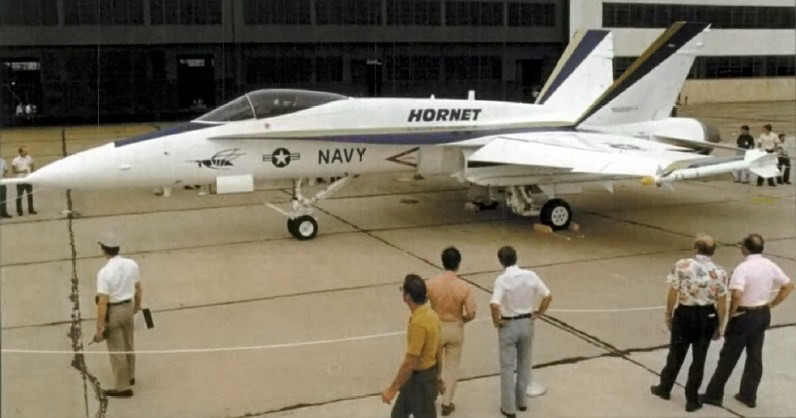
The first F/A-18A was rolled out by McDonnell Douglas on 13 September 1978, painted blue on white and lettered "Navy" to port and "Marines" to starboard — a detail that summed up the programme's double clientele. It first flew on 18 November that year. Breaking with tradition, the Navy applied what it called the "principal site concept": nearly the whole test programme ran at Naval Air Station Patuxent River instead of alongside the production plant, and with Navy and Marine Corps test pilots from early in development instead of civilians. In March 1979 Lieutenant Commander John Padgett flew the F/A-18 as the first Navy pilot to do so.
Flight testing forced aerodynamic revisions. The stabilator snag was faired over, and the slot separating the leading-edge extensions (LEX) from the fuselage was for the most part sealed. Those slots — boundary layer air discharge slots — kept the LEX vortices in order and fed clean air to the fins when the aircraft was flying at high angles of attack; the price was a heavy penalty in parasitic drag, which aggravated the shortcoming that would follow the aircraft throughout its career: inadequate range. McDonnell closed 80 per cent of the gap and left a narrow slot to bleed intake air. That decision may have contributed to early fatigue cracks on the vertical stabilizers caused by extreme structural loads, which forced a short fleet grounding in 1984 until the stabilizers were strengthened. From May 1988 a small vertical fence was fitted on top of each LEX so as to spread the vortices and carry them clear of the fins, with a minor gain in controllability as a bonus. Early versions also suffered from an insufficient rate of roll, made worse by insufficient wing stiffness, especially with heavy underwing loads.
While the aircraft was being fixed, the General Accounting Office — Congress's auditing arm — published a series of reports that remain the best available X-ray of the programme. The first, of March 1977, described development as apparently on schedule but noted that the preliminary contracts with McDonnell Douglas and General Electric had not been definitized as planned because of cost problems, that replacing the electronic countermeasures with new systems could add between 86 and 196 million dollars to the programme, and that a reconnaissance version would add more. Unit procurement cost, as of 30 September 1976, was estimated at 13.7 million dollars, with development and production together running to some 13 billion.
Report PSAD-80-24 was far harsher. Using test data as of 21 November 1979, it found that the acceleration threshold had not been met: the aircraft was required to accelerate between Mach 0.8 and Mach 1.6 at 10,700 m (35,000 feet) within a specified time, and in testing it was taking between 9 and 27 per cent longer than allowed. Neither the Navy nor the contractor could explain why. Navy officials played the problem down, arguing that it appeared in a speed band that would rarely be flown and that increasing engine thrust would suffice, even though that would hurt reliability and durability — two qualities the programme had made its highest priorities. By that date McDonnell had reported that minor design changes had already brought the acceleration time down to just above the threshold.
Range was the more serious failure. There too thresholds had been set by the Department of Defense and by the Navy, and as of 21 November 1979 the F/A-18 met neither by test nor by analytical projection. Navy officials conceded that range could be increased with additional external tanks but acknowledged that this was not desirable, and the GAO recorded that it knew of no solution proposed either by the Navy or by the manufacturer. In parallel, a contractor programme had been approved to shed 155 kg (341 pounds) which, if successful, would return the aircraft to the weight approved by the Navy. The same report put figures on the financial slippage: buying and developing 1,377 aircraft would cost 24 billion dollars, or 17.4 million per aircraft, 11.1 billion more than the Navy's first estimate, 12.9 billion for 811 aircraft, or 15.9 million apiece; Navy officials added that their actual requirement would be 1,845 aircraft, at a total programme cost of approximately 30 billion. Note that this figure of 811 aircraft is a third version of the purchase plan, different from the 780 and the 800 cited earlier: all three coexist in the source material and are recorded here without choosing between them.
Later reports kept up the pressure. MASAD-82-20, of February 1982, warned that cost increases remained the programme's principal problem, anticipated further growth from understated escalation and from contractor and subcontractor increases, and noted that the large reductions the Navy had promised had not materialised as real savings. The same report recorded logistics problems that rarely appear in histories of the aircraft but decide its usefulness: delays in and shortcomings of the pilot simulators, delays in automatic test equipment at operational units, and inadequate spares support. Alongside the criticism it acknowledged that the F/A-18 was performing well against contract specifications and across a wide temperature range, and that the improvements introduced had been enough to correct deficiencies such as the roll rate, though those in range and single-engine rate of climb remained.
MASAD-83-28 documents the outcome. In March 1983 the Secretary of Defense cleared the F/A-18 for full-rate production in the Navy's light attack role. The decision came after an independent evaluation which the Navy's Operational Test and Evaluation Force carried out between May and October 1982, whose evaluators had identified several deficiencies — range being the most serious — and had recommended that fleet-use approval for that mission be withheld. The Navy maintained that the problems were or would be corrected; the GAO replied that range might well remain a problem. The Under Secretary of Defense and the Navy themselves acknowledged that improving operational range was necessary for long-range wartime interdiction and for peacetime carrier training, and the independent evaluators went so far as to write that, unless the demonstrated limitation was resolved, the gains from swapping the A-7 for the F/A-18 would not offset the losses. Two remedies were studied: more in-flight refuelling from the carrier, or larger external tanks. On 6 April 1983 the Department of Defense told the GAO it had chosen in-flight refuelling, a solution about which the GAO itself expressed reservations. It was with those limitations that the Hornet entered the fleet.
The first production F/A-18A took to the air on 12 April 1980. Once 380 F/A-18As had been built — the nine devoted to flight systems development among them — the line changed over to the F/A-18C in September 1987.
How the Hornet is built
The F/A-18 is a twin-engined, midwing, multimission tactical aircraft. Its manoeuvrability comes from three decisions working together: a good thrust-to-weight ratio, the digital fly-by-wire control system and the leading-edge extensions, which keep the aircraft controllable at high angles of attack. Its trapezoidal wing carries 20 degrees of leading-edge sweep and a trailing edge without sweep, with full-span leading-edge flaps and, at the rear, single-slotted flaps and ailerons across the entire span.
The outward-canted vertical stabilizers are the aircraft's visual signature and one more of the elements that underpin its high-alpha behaviour, alongside oversized stabilators, outsized trailing-edge flaps doubling as flaperons, generous full-span leading-edge slats, and control-computer logic that amplifies the travel of every surface at low speed and toes the rudders inboard rather than simply left and right.
The Hornet was among the first aircraft to make heavy use of multifunction displays, which let the pilot switch between the fighter and attack roles — or perform both — at the touch of a button. That force-multiplier quality gives the operational commander far more flexibility in employing tactical aircraft in a fast-changing battle. It was also the first Navy aircraft built around a digital multiplexed avionics bus, which made its later upgrades far easier.
The design was aimed from the start at reducing maintenance, and there it scored its most emphatic success: it spends far less time out of service than the heavier F-14 Tomcat and A-6 Intruder. Its mean time between failures triples that of any other Navy strike aircraft, and it asks for half the maintenance hours. The air intakes follow the F-16's example: a simple fixed pitot design, without the variable geometry of the F-4, F-14 or F-15: simpler, lighter and less maintenance-intensive, at the cost of pressure recovery at higher Mach numbers — a trade-off judged worthwhile in an aircraft designed to operate mainly at subsonic and transonic speeds.
A 1989 Marine Corps study of single-seat versus two-seat fighters concluded that the former were well suited to air-to-air combat, while the latter were preferable for complex strikes against heavy air and ground defences in adverse weather. The question, the study noted, was less whether a second pair of eyes was useful than whether the second crewman should sit in the same aircraft or in a second one; and it added that single-seat fighters without wingmen were especially vulnerable.
The C/D figures, taken from the United States Navy fact file, the F/A-18A/B/C/D NATOPS manual and the reference literature, describe a compact fighter: 17.1 m long (56 ft 1 in), 12.3 m in span with Sidewinders on the LAU-7 wingtip rails (40 ft 4 in), 8.4 m with wings folded (27 ft 7 in) and 4.7 m high (15 ft 5 in). Wing area is 38 m² (410 sq ft) with an aspect ratio of 4 and modified NACA 65A005 and NACA 65A003.5 sections at root and tip. It weighs 10,433 kg empty (23,000 lb), 16,769 kg loaded (36,970 lb) and up to 23,541 kg at maximum take-off (51,900 lb), carrying 4,930 kg of internal fuel (10,860 lb). It reaches Mach 1.8 — 1,915 km/h — at 12,192 m and Mach 1.06 — 1,296 km/h — at sea level, cruising at 890 km/h. Range in clean configuration with two AIM-9s is 2,017 km, air-to-air combat radius 740 km and ferry range with three external tanks 3,300 km. Service ceiling is 15,000 m and rate of climb 250 m/s. Wing loading is 450 kg/m² and the thrust-to-weight ratio 0.96, rising to 1.13 at loaded weight with half internal fuel. Fixed armament is a six-barrel 20 mm M61A1 Vulcan rotary cannon in the nose with 578 rounds; the nine hardpoints — two wingtip rails, four underwing and three under the fuselage — take 6,200 kg of external fuel and ordnance, from 70 mm Hydra 70 and 127 mm Zuni rockets to the AIM-7 Sparrow, AIM-9 Sidewinder and AIM-120 AMRAAM missiles and on to the AGM-65 Maverick and the AGM-84H/K SLAM-ER.
The F404 and the APG-65: two quiet successes
General Electric developed the F404 for the Hornet shortly after losing two competitions in a row: the F-15 engine, which went to Pratt & Whitney, and the lightweight fighter, won by a YF-16 powered by the F100. It started from the YJ101 it had built for the YF-17 and, instead of chasing catalogue figures, looked at how pilots actually flew: analysing throttle usage profiles, it found that the throttle was moved far more often than engineers had assumed, with the attendant engine fatigue. The result was a powerplant conceived to avoid compressor stalls and other failures and to respond quickly to the controls. A fan that smooths the flow before it reaches the compressor gives it notable resistance to stall even at high angles of attack.
The results of that philosophy show in the operating figures: the F404 averages under two shop visits for every 1,000 flight hours and 6,500 hours between in-flight events. It hangs on the airframe at ten attachment points alone and needs no special equipment to change: four people pull it in twenty minutes. Almost 4,000 F404 engines power Hornets in service worldwide, and the family had passed 12 million flight hours by 2010. The enhanced-performance F404-GE-402, which delivered roughly 10 per cent more maximum static thrust, became the Hornet's standard engine from 1992, with 49 kN dry (11,000 lbf) and 79.0 kN with afterburner (17,750 lbf). The same technological trunk later produced the Super Hornet's F414 and contributed elements — the fan design, enlarged — to the F110 that General Electric offered the Air Force.
The other quiet success was the radar. The AN/APG-65, designed by Hughes Aircraft, is a pulse-Doppler set working in I-band, 8 to 12 GHz conceived equally for air-to-air and air-to-surface work, operational since 1983. For air combat it combines velocity search, which maximises detection range against nose-aspect targets, range-while-search for targets of any aspect, and track-while-scan, which together with an autonomous missile such as the AMRAAM gives the pilot full look-down, shoot-down capability; in the air-to-surface role it offers Doppler beam-sharpening and mapping modes. In 1992 the APG-65 was replaced on the production line by the faster and more capable AN/APG-73. The APG-65 remained in service on American, Canadian, Kuwaiti and Spanish Hornets, and was even adapted to modernise German and Greek F-4 Phantoms and the AV-8B Harrier II Plus.
Entry into service
After trials and operational testing with VX-4 and VX-5, Hornets started filling the fleet replacement squadrons — VFA-106, VFA-125 and VMFAT-101 — where crews were converted onto the type. The first operational squadron was a Marine Corps unit: VMFA-314, based at MCAS El Toro, from 7 January 1983. The Navy followed a year and a half later, on 1 July 1984, with squadrons VFA-113 and VFA-25, replacing F-4s and A-7Es respectively. Both, assigned to CVW-14, made the type's first deployment aboard USS Constellation between February and August 1985.
The initial fleet reports were complimentary and agreed on one point: the Hornet proved extraordinarily reliable, a sharp change from the F-4J it replaced. In January 1985 the "Wildcats" of VFA-131 and the "Privateers" of VFA-132 left Naval Air Station Lemoore, in California, for Naval Air Station Cecil Field, in Florida, and so became the first Hornet squadrons of the Atlantic Fleet. Four more units — VFA-151, VFA-192, VFA-195 and VFA-161 — converted to the F/A-18A in 1986; all but VFA-161 moved to NAF Atsugi, Japan, to join CVW-5 aboard USS Midway. VFA-146 "Blue Diamonds" and VFA-147 "Argonauts" also switched to the type.
The first squadron and converting the fleet
The move to the Hornet began in the schoolhouse. VFA-125 "Rough Raiders" was established on 13 November 1980 at Naval Air Station Lemoore, California, and became the US Navy's first F/A-18 squadron. Its job was not to fight but to manufacture aircrew: besides teaching new pilots, it converted naval aviators arriving from the A-6 Intruder, the F-14 Tomcat and the S-3 Viking as those types left operational service, and put pilots returning from non-flying assignments back in the cockpit. Decades later, once the replacement of the F/A-18A+, C and D by the Super Hornet and the F-35 made two schools redundant, VFA-125 was merged into VFA-122 "Flying Eagles" to cut administrative costs and streamline training; the Rough Raiders name was suspended until it was revived later.
The Navy's own factsheet compresses the generational handover into a few lines: the Hornet first flew in 1978, reached operational service in 1983 with the Marine Corps and in 1984 with the Navy, and replaced the F-4 Phantom and the A-7 Corsair. Output of the C and D models finished in 2000, with the last F/A-18D going to the Marine Corps that summer. In April 2018 the Navy announced the withdrawal of the F/A-18C from combat roles.
From Libya to the Gulf War
The Hornet's baptism of fire came in April 1986, when aircraft of VFA-132, VFA-131, VMFA-323 and VMFA-314 flying from USS Coral Sea carried out suppression of enemy air defence missions against Libyan air defences during Operation Prairie Fire and the attack on Benghazi that formed part of Operation El Dorado Canyon.
The real test was the Gulf War of 1991, in which the Navy put 106 F/A-18A/C Hornets into the theatre and the Marine Corps a further 84 F/A-18A/C/Ds. Hornet pilots were credited with two kills, both MiG-21s. Both fell on 17 January, the war's opening day: Lieutenant Nick Mongilio and Lieutenant Commander Mark I. Fox were airborne in a four-ship of Hornets launched from USS Saratoga, in the Red Sea, against airfield H-3 in south-western Iraq when an E-2C warned them of approaching Iraqi aircraft. They downed both MiGs with AIM-9 and AIM-7 missiles in a very brief dogfight: only forty seconds elapsed between the bandits appearing on the E-2's radar and both aircraft going down. Each Hornet then resumed its bombing run carrying four 2,000 lb (910 kg) bombs before returning to the carrier. That episode explained better than any brochure what a genuine strike fighter is for: the same aircraft, on the same sortie, fought in the air and attacked on the ground.
The airframe's toughness was illustrated by the Hornet that took hits in both engines and flew 201 km (125 mi) back to base; it was repaired and flying again within a few days. In all, Hornets flew 4,551 sorties with ten aircraft damaged, including three losses, only one confirmed to enemy fire. All three were Navy aircraft and two of their pilots were lost. On 17 January 1991 the Hornet of Lieutenant Commander Scott Speicher, of VFA-81, was brought down and its pilot killed; the unclassified summary of a CIA report of 2001 points to a missile launched by an Iraqi fighter, in all likelihood a MiG-25. On 24 January 1991 the F/A-18A with bureau number 163121, embarked in USS Theodore Roosevelt and flown by Lieutenant H. E. Overs, was lost over the Persian Gulf to engine failure or loss of control; the pilot ejected and USS Wisconsin picked him up. On 5 February 1991 bureau number 163096, flown by Lieutenant Robert Dwyer, was lost over the northern Gulf after a successful mission over Iraq; he was officially declared killed in action, with no body recovered.
The Navy's conclusion was that the Hornet had demonstrated versatility and reliability, breaking records among tactical aircraft in availability, reliability and maintainability. As the A-6 Intruder was retired through the 1990s, its role was taken over by the F/A-18.
The Balkans, Iraq and the Navy's farewell
Navy F/A-18A/Cs and Marine F/A-18A/C/Ds flew without interruption in Operation Southern Watch and over Kosovo and Bosnia during the 1990s. Navy Hornets flew in Operation Enduring Freedom in 2001 from carriers in the North Arabian Sea. In Operation Iraqi Freedom in 2003 both the F/A-18A/C and the newer F/A-18E/F took part, operating from carriers and from an air base in Kuwait, and later in the conflict Marine Corps A+, C and above all D models operated from bases inside Iraq. There were bitter losses too: an F/A-18C was accidentally downed by a friendly Patriot missile as its pilot tried to evade two missiles fired at him, and two more collided over Iraq in May 2005.
The final operational cruise of the F/A-18C in United States Navy service was made aboard USS Carl Vinson and closed on 12 March 2018. The type went briefly back to sea in October that year for routine carrier qualifications, but active Navy service ended for the type on 1 February 2019; reserve units carried on with it, chiefly for adversary training, and the final Navy F/A-18C operational flight took place on 2 October 2019. The legacy Navy Hornets that remained were withdrawn during 2019 as the F-35C Lightning II came into service.
The Marine Corps went much further. In 2024 it still had 179 F/A-18C and D Hornets on strength, and meant to keep them flying with new radars and electronics as far as 2030, when the F-35 is scheduled to replace them entirely.
The variants: A/B, C/D and what followed
The single-seat F/A-18A could employ the AGM-84 Harpoon anti-ship missile, the AGM-65E Maverick, the AGM-88 HARM anti-radiation missile and the AGM-62 Walleye I/II, and it carried the AN/AAS-38 Nite Hawk and AN/ASQ-173 targeting pods with laser spot tracker and strike camera. During the Gulf War, however, Nite Hawk pods were in short supply for Navy and Marine Hornets. The two-seat F/A-18B found room for the second cockpit by relocating avionics equipment and cutting internal fuel by 6 per cent; it is otherwise fully combat-capable, though used mainly for training. In 1992 the original AN/APG-65 gave way to the AN/APG-73; A models upgraded with the new radar and able to fire the AMRAAM were designated F/A-18A+, and in the 2010s the Marine Corps gave them service-life extension improvements that made them F/A-18A++.
The C and D models came out of a 1987 block upgrade that brought updated radar and avionics and the ability to fire the AIM-120 AMRAAM and, later, the AGM-84E SLAM and the infrared AGM-65F Maverick. They also brought in the Navy Aircrew Common Ejection Seat together with a self-protection jammer, plus a synthetic aperture radar mapping capability that allows targets to be located in poor visibility. C and D models delivered from 1989 markedly improved night attack with the AN/AAR-50 thermal navigation pod, the AN/AAS-38A NITE Hawk FLIR targeting pod, night vision goggles, two colour multifunction displays — previously monochrome — and a colour moving map. From 1993 the AAS-38A added a laser designator and rangefinder allowing it to mark targets on its own, and the later AAS-38B enabled attacks on targets designated by other aircraft.
The C is the single-seater and the D the two-seater. The latter is configured either for training or as an all-weather strike aircraft; in the "missionized" version the rear seat is occupied by a Marine Corps naval flight officer working as weapons and sensors officer. The D is above all a Marine aircraft for night attack and airborne forward air control. Sixty were configured as F/A-18D (RC) night attack aircraft with reconnaissance capability, able to receive the ATARS electro-optical sensor package whose equipment is mounted in the space occupied by the M61 cannon.
There were projects that came to nothing. The F-18(R) was a reconnaissance version of the F/A-18A proposed with a sensor package in place of the 20 mm cannon: the first of the two prototypes flew in August 1984 and only small numbers were produced. The RF-18D, a two-seat reconnaissance aircraft with radar pod proposed for the Marine Corps in the mid-1980s, was cancelled when funding ran out in 1988; its capability was later realised in the F/A-18D (RC).
The Navy retired its F/A-18C/Ds in February 2019, but the Marine Corps kept its own and is upgrading their radar to the active electronically scanned AN/APG-79(V)4; it calls that modernised version the F/A-18C+, which consists of bringing Block 25 and Block 30 aircraft up to the more modern Block 35 standard with a longer service life.
A few production landmarks: the first series F/A-18A flew on 12 April 1980; the C and D lines closed in 2000 as the plant transitioned to the Super Hornet. The final F/A-18C was put together in Finland and handed to the Finnish Air Force in August 2000, and the final F/A-18D reached the Marine Corps in the same month. In all, 1,480 F/A-18A/B/C/Ds were built between 1974 and 2000, first by McDonnell Douglas — with Northrop as partner until 1994 — and from 1997 under the Boeing name after the two companies merged.
The F/A-18E/F Super Hornet, though it shares the name and the concept, is a different aircraft and is treated here as a separate model: it was created in the 1990s to cover the retirement of the A-6 Intruder and A-7 Corsair II with no replacement in development, entered production in 1995, and uses an airframe some 25 per cent larger with rectangular intakes and General Electric F414 engines derived from the F404. On the flight deck it is informally called the "Rhino", precisely to avoid confusion with the legacy Hornet during flight operations. From that same trunk came the EA-18G Growler electronic warfare aircraft, in production since 2007, which replaced the EA-6B Prowler.
Canada, the first export customer
The Hornet was a considerable export success, with one peculiarity: since no foreign customer operates aircraft carriers, every exported aircraft was sold without the automatic carrier landing system. Except for Canada, all customers bought through the United States Foreign Military Sales programme, in which the Navy acts as purchasing manager without financial gain or loss. Canada is also the largest Hornet operator outside the United States.
The Canadians wanted a single aircraft to replace three: the Canadair CF-104 Starfighter for reconnaissance and strike, the McDonnell CF-101 Voodoo for interception and the Canadair CF-116 Freedom Fighter for ground attack. They ordered 98 single-seaters — Canadian designation CF-188A, informally CF-18A — and 40 two-seat CF-188Bs. The aircraft as delivered was nearly identical to the American F/A-18A and B, and the Canadian forces deliberately kept several naval features: the robust landing gear, the arrestor hook and the wing folding mechanism.
In 1991 Canada sent 26 CF-18s to the Gulf War, stationed in Qatar and employed mainly on combat air patrol, though late in the air campaign they began striking Iraqi ground targets. On 30 January 1991 a pair of CF-18s on patrol found and attacked an Iraqi TNC-45 patrol boat, repeatedly strafing and damaging it with 20 mm cannon fire; an attempt to sink the vessel with an air-to-air missile failed and the ship was subsequently sunk by American aircraft, though the Canadians received partial credit. In June 1999 eighteen CF-18s deployed to Aviano Air Base in Italy and flew both air-to-ground and air-to-air missions over the former Yugoslavia.
Sixty-two CF-18As and eighteen CF-18Bs went through the Incremental Modernization Project, completed in two phases: the programme opened in 2001 and the final updated aircraft was handed back in March 2010. The purpose was to sharpen air-to-air and air-to-ground capability, renew the sensors and the defensive suite and change the datalinks and the communications equipment, taking the aircraft from the F/A-18A/B standard to the F/A-18C/D standard. In July 2010 the Canadian government made known its plan to replace the fleet with 65 F-35 Lightning IIs, deliveries beginning in 2016. In November 2016 it announced the purchase of 18 Super Hornets as a stopgap while the F-35 order was reviewed, a plan put on hold in October 2017 because of a trade dispute with the United States over the Bombardier C-Series. Canada then sought second-hand Hornets from Australia or Kuwait and in the end bought 25 second-hand Australian F/A-18A/Bs, of which the first two arrived in February 2019: eighteen airframes were to enter active service and the remaining seven to be used for spare parts and testing.
Canada: modernising a 1982 fighter three times over
The CF-18 as delivered was essentially identical to the American F/A-18A and B, but two details give it away. The first is a night identification light of 0.6 megacandela set into the port-side gun loading door; some aircraft have it temporarily removed, but the window is always there. The second is a false canopy painted on the underside, an old trick to confuse an opponent looking up at the aircraft in a turning fight about which way it is pointing.
The first two CF-18s were formally received by 410 Squadron, the operational training unit at CFB Cold Lake, in Alberta, on 25 October 1982. Later deliveries went to 409, 421 and 439 Squadrons at Baden-Soellingen, then in West Germany, to 441 and 416 Squadrons at Cold Lake and to 425 and 433 Escadrons at Bagotville, Quebec. Entry into service was not smooth: early structural fatigue problems delayed the initial deployment, and only once those bugs were worked out did the aircraft begin to fill its intended NORAD interception and NATO roles.
What followed is a textbook case of stretching a fighter across four decades. The need to modernise was demonstrated by the Gulf deployment and by the 1998-1999 Kosovo conflict, when some of the avionics had become obsolete and incompatible with NATO allies; a defence budget increase in 2000 made the work possible. The Incremental Modernization Project began in 2001, split into two phases over eight years, with Boeing as prime contractor and L-3 Communications as principal subcontractor from 2002. Eighty aircraft — 62 single-seat and 18 two-seat — were selected to be taken from F/A-18A and B standard to the equivalent of the C and D. Phase I replaced the AN/APG-65 radar with the AN/APG-73, which offers triple the processing speed and memory along with terrain-following and terrain-avoidance modes and the ability to guide the AIM-120 AMRAAM; it added the AN/APX-111 combined interrogator and transponder for NATO-standard combat identification, AN/ARC-210 radios compatible with HAVE QUICK, HAVE QUICK II and SINCGARS waveforms, AN/AYK-14 XN-8 mission computers, an AN/AYQ-9 stores management system with the MIL-STD-1760 interface for AMRAAM and the JDAM family, and GPS/INS navigation. Outside the project itself the aircraft also received a new infrared sensor pod, full-colour flat-panel LCD displays in place of cathode-ray tubes, a night vision imaging system, new simulators and a landing gear programme to fight corrosion. The first Phase I aircraft was delivered in May 2003 and the last in August 2006. Phase II, awarded to Boeing on 22 February 2005, brought the Link 16 data net, a joint helmet-mounted cueing system, a crash-survivable flight data recorder and an upgraded electronic warfare suite, alongside a centre barrel replacement for forty of the modernised airframes. The first Phase II aircraft was handed over on 20 August 2007 and the last in March 2010, at a total cost for the whole modernisation effort estimated at around C$2.6 billion.
Even that was not the end. The Hornet Extension Program, applied from 2020 to the remaining fleet of 94 CF-188A/Bs, sought to preserve parity and interoperability with NATO and with civil aviation rules until 2032: ADS-B in place of obsolescent transponders, Honeywell GPS/INS systems, sixth-generation AN/ARC-210 radios, airborne joint tactical radios, Sniper pod upgrades and enhanced mission computers. A second phase, concentrated on the 36 airframes with the most life left, added 50 AIM-9X Sidewinder Block II missiles, 38 active electronically scanned array radars of the CA/APG-79(V)4 type and 46 wide-band radomes, at a cost the US Congressional Budget Office put at US$862.3 million; full operational capability was expected by June 2025, and on 5 February 2025 the Royal Canadian Air Force officially began fitting the AIM-9X Block II to those aircraft. Total programme cost for purchase and upgrades to 2011 was around $11.5 billion, with maintenance running at roughly $250 million a year. In March 2024 Arcfield Canada won a CA$211.6 million sustainment contract covering the avionics and weapons systems.
Canada in combat: from the Gulf to Iraq
Canada assigned 26 CF-18s to the Gulf War under Operation Friction, based at Doha, Qatar, with aircraft drawn from the Canadian base at Baden-Soellingen. Its pilots logged over 5,700 hours, 2,700 of those missions being combat air patrols; they began with sweep-and-escort work supporting Allied ground-attack strikes and, during the hundred-hour ground invasion in late February, added 56 bombing sorties, mostly dropping unguided 230 kg bombs on Iraqi artillery positions, supply dumps and marshalling areas. Canadian Hornets could not yet deliver precision guided munitions. Not since the Korean War had the Canadian military taken part in combat operations.
The violence in the former Yugoslavia brought them to the theatre twice: Operation Mirador, from August to November 1997, in support of NATO peacekeepers in Bosnia and Herzegovina, and Operation Echo, from late June 1998 to December 2000. Between March and June 1999, with 18 CF-18s deployed to Aviano, Canada flew both air-to-air and air-to-ground missions and conducted 10 percent of NATO's strike sorties despite contributing a far smaller share of the overall force: 678 combat sorties — 120 defensive counter-air escorts and 558 bombing strikes — over 2,577 combat flying hours, dropping 397 precision guided munitions and 171 unguided bombs on airfields, bridges, fuel storage and surface-to-air missile sites.
In Libya, after the Security Council resolution authorising a no-fly zone, the Canadian government approved on 18 March 2011 the deployment of six CF-18s plus one in reserve under Operation Mobile, based at Trapani-Birgi in Sicily. They went into combat on 23 March, when four aircraft bombed Libyan government targets, and returned to Bagotville on 4 November 2011. In all they flew 946 sorties — again 10% of NATO's strike sorties — and dropped 696 bombs, among them 495 Paveway IIs of 227 kg and 188 of 910 kg, plus eleven 227 kg JDAMs and two of 910 kg. The last campaign came in October 2014, when six CF-18s went to Iraq under Operation Impact; strikes against Islamic State positions began on 2 November 2014 and continued until 15 February 2016. Away from combat, since 2001 CF-18s have reacted to close to 3,000 potential threats to Canadian and American airspace, and have covered events such as the 2002 G8 summit at Kananaskis and the 2010 Winter Olympics, as well as a two-week stint over US airspace in 2007 while the USAF F-15 fleet was grounded for structural defects.
The Canadian replacement: a twelve-year detour
The story of the successor is worth telling because it explains why the CF-18 lasted so long. The F-35, the Eurofighter Typhoon, the Gripen, the Rafale and the Super Hornet were all promoted as contenders, Boeing pitching the last as the cheaper option. In July 2010 Ottawa announced that the F-35 would take over from the CF-18 — Canada had taken part in the programme from 1997 and held Tier 3 partner status from 2002 — with 65 aircraft planned, deliveries from 2016 and a contract estimated at C$9 billion. In December 2012 the government abandoned the deal over escalating costs and opened a fresh competition. In September 2015 Liberal leader Justin Trudeau promised to cancel the F-35 purchase; as prime minister, his defence minister said in May 2017 that 65 jets were not a full fleet, and on 2 June that year the figure was set at 88 advanced multi-role fighters.
Meanwhile the gap had to be filled, and the answer was more second-hand Hornets: in December 2017 Canada agreed to buy 18 F/A-18A/Bs from the Royal Australian Air Force — a mix of flyable airframes and spares — for about C$90 million, later adding seven more to be stripped for parts. The first two arrived in February 2019 and the last in 2021; total cost including modifications, inspections and infrastructure was put at C$360 million. The ending was predictable: on 28 March 2022 Canada made public that talks with Lockheed Martin for 88 F-35s were well advanced, with the Gripen second should they stall, and in December 2022 approved $7 billion for a first batch of 16 F-35As. Twelve years after the first decision the country came back to the same aircraft, with the CF-18 covering the difference.
Australia: twenty-seven years of service
From the late 1970s the Australian government was looking for a successor to the Dassault Mirage IIIO then flown by Royal Australian Air Force fighter squadrons. Several options were considered, notably the F-15A Eagle and the F-16, along with the then new F/A-18. The F-15 fell away because the version on offer lacked any ground-attack capability, and the F-16 was judged unsuitable largely because it had only one engine — the same reservation that had led the United States Navy to reject it. The Hornet was officially chosen in October 1981, with an order for 57 F/A-18As and 18 F/A-18Bs.
The initial differences from the naval model were revealing about what each component is really for: the nose-wheel tie bar for catapult launch was removed — though a dummy version had to be refitted to cure nose wheel shimmy — a high frequency radio, an Australian system for fatigue data analysis and a better video and voice recorder were fitted, and the carrier landing system was replaced by an instrument landing system and VOR. Only two aircraft were completed in the United States; the rest were assembled in Australia at the Government Aircraft Factories by Aero-Space Technologies of Australia from kits sent by McDonnell Douglas, the local content rising in the later airframes. Deliveries started on 29 October 1984 and ran to May 1990.
The fleet was then upgraded from the late 1990s to reach 2015, and further refits later extended it to 2020. In 2001 Australia sent four aircraft to Diego Garcia for air defence while the coalition operated against the Taliban in Afghanistan. In 2003 it was No. 75 Squadron that took 14 F/A-18s to Qatar under Operation Falconer and saw action during the invasion of Iraq. In 2006 Australia had 71 Hornets in service after four had been lost to crashes. In March 2015 half a dozen F/A-18As of No. 75 Squadron went to the Middle East under Operation Okra, relieving a Super Hornet detachment.
The ending was almost ceremonial. The Hornet gave its last public flying display at Wings Over Illawarra 2021, and Australia formally retired it at RAAF Base Williamtown on 29 November 2021. The next day No. 75 Squadron flew seven of the surviving Hornets from RAAF Base Tindal down to Williamtown, and on 3 December the final aircraft left Tindal for decommissioning; bad weather diverted it to Townsville, and the last leg to Williamtown was completed on 4 December 2021. Twenty-five of those aircraft ended up in Canada.
Australia: how the Hornet was chosen
The Australian search for a Mirage III replacement began in 1968 and took thirteen years to settle. The RAAF issued a requirement in December 1971 and received more proposals than expected; in 1973 a team inspected the F-15 Eagle, YF-17, Saab 37 Viggen and Mirage F1 programmes but recommended waiting for other fighters then coming to market. In August 1974 the government deferred the project and extended the Mirage's life into the 1980s, disbanding one of the four Mirage squadrons in the process. Work resumed in 1975, a Tactical Fighter Project Office was set up in 1976, and the request for proposals issued that November drew eleven responses. By March 1977 the shortlist was the F-15, the F-16, the Mirage 2000, the Tornado and the McDonnell Douglas F-18A along with the F-18L. The F-14 was considered and dropped before reaching the official list. In November 1978 the Tornado went, being principally a strike aircraft with limited air-to-air capability, and so did the F-15, on reasoning that says a great deal about the period: it was an impressive aircraft, meeting or bettering nearly every requirement, but the air force judged it did not need capabilities that advanced and that introducing it could destabilise the region.
Flight testing decided the rest. Wing Commander Bob Richardson took a Mirage 2000 up in April 1979 and reported excellent aerodynamics but avionics, radar, fuel system, cockpit and weapons inferior to the American designs; he also flew the YF-17 serving as the F-18L demonstrator and was impressed, though no F-18L had been ordered and Australia had no wish to be lead customer for an aircraft that did not yet exist. Around the same time the RAAF turned down F-14s originally ordered by Iran and never delivered after the revolution: heavily discounted, but too large and complex. That left the F-16 against the F-18A. Australian pilots who flew USAF F-16Bs in 1979 and 1980 reported excellent performance but an aircraft that could be difficult to control, with concerns about engine reliability, technological immaturity, an inferior radar and no capability for the beyond-visual-range missiles and long-range anti-shipping weapons the F-18A could carry. The Hornet struck them as more robust and survivable precisely because it had been designed for carriers — a quality that in Australia translated into operating from bare bases in the north. The choice produced a memorable delivery flight: the first two F/A-18s touched down at RAAF Base Williamtown, in New South Wales, on 17 May 1985, met on approach by a flight of Mirages that escorted them in; on the leg from California to Hawaii each Hornet refuelled seven times from the accompanying KC-10 — south of Hawaii a second KC-10 flew out to refuel the first tanker — and after passing the islands each took on fuel another eight times before the crossing was over.
Australia: HUG, the radar codes and the deployments
The Australian fleet received few modifications until the late 1990s; essentially the only new system fitted was the AN/AAS-38 Nite Hawk targeting pod. One episode from that period is revealing: Australia cracked the codes that locked the Hornet's radar software once Washington had refused to hand them over, allowing the software to be adjusted so that every aircraft flown by Australia's neighbours could be designated hostile. Former Defence Minister Kim Beazley put it bluntly in his final address to Parliament: he had pressed Washington on the matter throughout the 1980s and that, in the end, the Australians spied on the Americans and extracted the codes themselves.
The arrival of MiG-29s in several Asian countries during the 1990s raised fears the Hornet would be outclassed. Replacing it with the Eurofighter Typhoon or the Super Hornet was considered, but both were judged technologically immature, so the fleet was upgraded instead. The Hornet Upgrade Program began in 1999 in three main phases: Phase 1, from mid-2000 through 2002, replaced computers, navigation system and radio and cleared the ASRAAM in place of the Sidewinder; Phase 2, the most important, swapped the APG-65 for the APG-73 and added secure voice encryption and further computer updates. Maintenance followed a parallel path of outsourcing: the air force did nearly everything until the 1990s, after which much of the deeper maintenance passed to industry, with BAE Systems as lead contractor from 2003 and Boeing Australia from 2010; in August 2017 the Boeing contract was stretched to the retirement planned for 2021 and widened to include weapons integration, freeing service personnel for the F-35 introduction.
Australian Hornets were slow to see combat. In 1990 sending a squadron to the Gulf was considered, but Defence objected that it would strain home air defence, so their only role in that war was flying mock attacks against Australian warships sailing from Sydney to Perth. In 1999 No. 75 Squadron was placed on alert for East Timor without being needed. The first operational deployment came after 11 September 2001: four No. 77 Squadron Hornets and seventy personnel left on 9 November to protect the US base on Diego Garcia, from which operations over Afghanistan were mounted; No. 3 Squadron relieved them in February 2002 and the detachment came home on 21 May. The real war was Iraq in 2003. No. 75 Squadron left Tindal on 13 February and reached Al Udeid in Qatar on the 16th with fourteen F/A-18As carrying the HUG 2.1 package and freshly serviced. After the war began on 20 March they escorted high-value aircraft, and from the 21st, with the Iraqi Air Force clearly no threat, moved to air interdiction and then close air support, first for the US Army's V Corps and then for I Marine Expeditionary Force. They flew about twelve sorties a day for the first fortnight and six to ten from 5 April. On 12 April they supported Australian special forces and the 4th Battalion, Royal Australian Regiment, in the occupation of Al Asad Airbase, and in the final week made low, fast passes over Iraqi positions to encourage surrender. The last combat sorties came on 27 April: 350 combat missions comprising 670 individual sorties and 122 laser-guided bombs, no casualties, and all fourteen aircraft back at Tindal on 14 May 2003. Then came years of air defence over set-piece events at home — the 2002 Commonwealth Heads of Government Meeting, George W. Bush's visit that October, the 2006 Commonwealth Games, the 2007 APEC summit — and, from March 2015, Operation Okra: six No. 75 Squadron F/A-18As replaced a Super Hornet detachment in the Middle East, and the three squadrons of No. 81 Wing rotated through with six or seven aircraft on station until May 2017, striking Islamic State targets in Iraq and Syria including in support of the Battle of Mosul. The wing flew 1,973 sorties and released 1,961 munitions, with a very high serviceability rate despite the aircraft's age and the harsh conditions.
What became of the Australian Hornets
Retirement began in 2018 as the F-35A arrived. What happened to the surplus airframes afterwards is an unglamorous and instructive story. Twenty-five went to Canada: the first two flew to Cold Lake in mid-February 2019 after taking part in a Red Flag exercise in the United States, the rest following through to 2021; in August 2020 it was reported that 18 of the former Australian aircraft would be included in the 36 RCAF Hornets due to receive AN/APG-79 active array radars, AIM-9X missiles and AGM-154 standoff weapons. In March 2020 the Minister for Defence Industry announced the sale of up to 46 aircraft, together with the entire spares and test equipment inventory, to the American company Air USA, which provides contract air combat training; a specialist journalist noted that if the sale went through not a single Hornet would be preserved in an Australian museum. It never happened: by 2021 it was unclear the deal would proceed, in February 2023 nothing had been transferred although the contract remained in place with the firm now rebranded RAVN Aerospace, and by that March it was reported to have fallen through. Meanwhile there was a public argument about donating them to Ukraine, with talks between the Australian, Ukrainian and US governments during 2023; it would have been the largest transfer of Australian military equipment ever made to another country. In January 2024 it emerged that the Ukrainian Air Force did not want them, unwilling to support donated fleets of F-16s and F/A-18s at once. The RAVN contract lapsed in December 2023 with no aircraft handed over. The Australian Hornets were broken up.
Spain: the C.15
Spain ordered 60 EF-18As and 12 EF-18Bs — the "E" for España — designated locally C.15 and CE.15, the "C" standing for caza, fighter. Deliveries ran from 22 November 1985 to July 1990. Those aircraft were later brought to F-18A+/B+ standard, close to the F/A-18C/D, with later mission and armament computers, new databuses, a data-storage set, new wiring, modified pylons and new software, and added capabilities such as the AN/AAS-38B NITE Hawk targeting FLIR pod.
In 1995 Spain obtained 24 second-hand F/A-18As from the United States Navy, with an option on six more, delivered between December 1995 and December 1998 and modified to EF-18A+ standard before delivery. This was the first sale of surplus Navy Hornets, opening a market that others would later use.
Spanish employment has been mixed from the outset: the Hornets act as all-weather interceptors about 60 per cent of the time and as all-weather day and night attack aircraft for the remainder. In war each frontline squadron would take a primary role: 121 for tactical air support and maritime work; 151 and 122 for all-weather interception and air combat; and 152 suppression of enemy air defences. Air refuelling comes from KC-130Hs and Boeing 707TTs. Conversion of pilots onto the EF-18 is concentrated in 153 Squadron of Ala 15, while 462 Squadron handles the air defence of the Canary Islands with fighter and attack missions from Gando air base.
Spanish EF-18s have flown real combat missions under NATO command. Over Bosnia and Kosovo they carried out ground attack, suppression of enemy air defences and combat air patrol from the Aviano detachment, where they shared the base with Canadian and United States Marine Corps Hornets. On 25 May 1995, within Operation Deny Flight, Spanish EF-18s carrying laser-guided bombs, with American F-16s in support, destroyed an ammunition dump at Pale, a Bosnian Serb stronghold on the outskirts of Sarajevo. In 1999 eight EF-18s based at Aviano took part in the bombing raids of Operation Allied Force and were among the first aircraft to strike Yugoslav targets; over Bosnia they also flew combat air patrol, close air support, photo reconnaissance and forward and tactical airborne air control. Over Libya four Spanish Hornets took part in enforcing a no-fly zone. By 2003 Spain had lost six Hornets in accidents.
Spain then followed its own modernisation path. Without acquiring licences, it developed the upgrades locally: between 2004 and 2013 EADS CASA and Indra Sistemas carried out a mid-life programme that renewed avionics, databuses, data presentation — in the style of the F/A-18C — navigation, communications, software and countermeasures suite, upgraded the AN/APG-65 radar to the V3 version, added the AL-400 radar warning receiver together with the ASQ-600 emissions detector, and certified the aircraft for the Iris-T, the GBU-48 and the Taurus, with a structural and engine overhaul included. That version is known locally as the EF-18MLU, C.15M or EF-18M, its two-seat equivalent as the EF-18BM.
Spain: from the Ícaro detachment to Libya
Spain's upgrades were largely carried out by the air force itself through its armament and test centre, CLAEX. The plan to bring the fleet up to F/A-18C/D level was announced in 1993: McDonnell Douglas modernised 46 aircraft and CASA the remainder, the changes being mostly computing and software plus some work on the weapons pylons, after which they were redesignated EF-18A+ and EF-18B+; the new flight software altered some handling characteristics and cleared new weapons, the AMRAAM among them. A second round, carried out by EADS CASA and completed on 31 October 2009, produced the EF-18M with a new VOR/ILS and the MIDS communications system. Spanish-run weapons integrations followed: in July 2008 the engineering firm Sener completed the integration of the short-range IRIS-T missile on both the EF-18 and the Typhoon — structural behaviour, supersonic flight, electromagnetic compatibility, target acquisition and tracking, and separation trials — the first time the missile had been integrated on a Hornet anywhere; and in October 2008 Raytheon and the air force completed integration of the GBU-48 Enhanced Paveway II laser-guided bomb, designed for bunkers and hardened targets, with seven successful releases during test flights.
Ala 15 received the first four EF-18s on 10 July 1986, reached 75,000 flying hours on the type in October 1999 and 100,000 on 14 November 2003. Between 1994 and 2002 Spanish Hornets took part in NATO operations over the Balkans through the Ícaro detachment at Aviano: eight EF-18s of what was then Grupo 15, two C-130 Hercules and some 240 personnel, whose deployment was completed on 28 November 1994 and which thereafter rotated every three months, later every four, with aircraft from Ala 12 at Torrejón and Ala 15 at Zaragoza. Ícaro served through Deny Flight (April 1993 to December 1995, policing Bosnian airspace in support of UNPROFOR), Deliberate Force (August-September 1995, NATO's first offensive action in forty-six years of existence), Joint Endeavour, Joint Guard and Joint Forge supporting IFOR and SFOR, Joint Guardian supporting KFOR, and Allied Force from March to June 1999. During Operation Determined Falcon, mounted to intimidate the Milošević government, Spain deployed the detachment's maximum — twelve aircraft, eight of them airborne simultaneously — with the EF-18s designated to enter the area first and leave last. These were the Spanish air force's first combat operations since the Ifni War of 1958, and the detachment received a collective award of the Medalla Aérea.
The last real operation was Libya. On the afternoon of 19 March 2011 Spain sent four EF-18Ms and a Boeing 707 tanker from Torrejón to the Italian base at Decimomannu, Sardinia, to join the international no-fly-zone operation authorised by Security Council resolution 1973. On 21 March they began patrolling Libyan airspace armed with medium-range AMRAAMs and short-range Sidewinders, tasked with shooting down any aircraft violating the ban. The other end of the aircraft's life is illustrated by Ala 46 at Gando: being second-hand airframes, their operational life is shorter than that of the aircraft at Zaragoza or Torrejón, and they were expected to reach the end of their cycle between 2022 and 2024 as they hit the manufacturer's limits on flying hours and landings. Despite inspections to extend individual airframes, attrition forced the air force to keep topping up Gando with aircraft sent from the mainland. In late 2021 the government approved the purchase of twenty new Eurofighters to replace the Canary Islands EF-18A+ fleet.
Finland, Kuwait, Switzerland and Malaysia
The Finnish Air Force ordered 64 aircraft in 1992: 57 single-seaters and seven two-seaters. The two-seaters were built at St. Louis while the single-seaters were assembled in Finland at Patria's facilities. Deliveries began in November 1995 and ended in August 2000, and the type replaced the MiG-21bis and the Saab 35 Draken. There is a political detail in the designation: Finland called them F-18, without the "A" for attack, because a post-war treaty with the Soviet Union barred it from offensive weaponry, even though the aircraft retained air-to-ground capability. The Finnish F-18C included the ALQ-165 airborne self-protection jamming pod, equipment the United States Navy itself would later add to its Super Hornet procurement.
The Finnish fleet passed through a mid-life upgrade in two stages. The first, from 2006 to 2010, focused on air combat: it brought in the AIM-9X along with the JHMCS helmet sight, new radios, a fresh IFF interrogator and a moving map display. The second, from 2012 to 2016, enabled standoff air-to-ground weapons — JDAM, JSOW and JASSM — added the Litening targeting pod, new chaff and flare dispensers, a modernised cockpit, Link 16 and a new version of the AMRAAM. In all, 62 aircraft — the whole Finnish fleet as of 2016 — were modernised. Because the upgrade gave the aircraft a ground-attack capability, the air force itself began calling it the F/A-18 rather than the F-18. Given a service life of 30 years, the Hornets were meant to stay in the front line until 2025-2030; in October 2014 the national broadcaster Yle reported that a replacement was under consideration, in 2015 the HX Fighter Program began, and on 10 December 2021 the Finnish government selected the F-35A. The first retired Hornet, HN-401, was withdrawn on 26 April 2024. Finland lost three aircraft: one in a mid-air collision in 2001; another — the machine rebuilt from a damaged F-18C and the forward section of a Canadian CF-18B, nicknamed the "Frankenhornet" and converted into an F-18D — which crashed on a test flight in January 2010 owing to a faulty tailplane servo cylinder; and a third at Rovaniemi during display training in May 2025.
Kuwait ordered 32 F/A-18Cs and eight F/A-18Ds in 1988, delivered between October 1991 and August 1993 to replace the A-4KU Skyhawk and the Mirage F1CK-2. Kuwaiti Hornets flew over Iraq in Operation Southern Watch during the 1990s and have taken part in exercises with the air forces of other Gulf states. Kuwait had 39 aircraft in service in 2008. In February 2017 the head of the Kuwait Air Force disclosed that the F/A-18s stationed at King Khalid Air Base had flown some 3,000 sorties over Yemen.
Switzerland bought 26 single-seaters and eight two-seaters, delivered between January 1996 and December 1999. In late 2007 it requested inclusion in the Upgrade 25 programme to extend its aircraft's useful life, with significant avionics and mission computer improvements, twelve ATFLIR pods for surveillance and targeting and 44 Raytheon AN/ALR-67(V)3 countermeasures sets. In October 2008 the Swiss fleet reached the 50,000 flight hour milestone. By 2016 three two-seaters and one single-seater had been lost in crashes; on 14 October 2015 an F/A-18D came down in France while training alongside two Swiss Northrop F-5s in the EURAC25 training area, the pilot ejecting safely.
Malaysia received eight F/A-18Ds between March and August 1997. On 5 March 2013 three of them, together with five BAE Hawk 208s, took part in an airstrike against militants who styled themselves the security forces of the self-proclaimed Sultanate of Sulu and North Borneo, just before Malaysian army and police units launched their all-out assault in Operation Daulat; the Hornets handled close air support in the Lahad Datu no-fly zone in Sabah. In July 2024 Malaysia intended to acquire Kuwait's legacy Hornets — around 30 F/A-18C/Ds — as Kuwait replaced them with Super Hornets and Eurofighter Typhoons; the United States granted export clearance in June 2025 and in November that year a team of eight Malaysian personnel travelled to Ahmad al-Jaber Air Base to evaluate the aircraft, but in February 2026 Malaysia formally cancelled the procurement because of projected delivery delays and uncertainty over future maintenance and support arrangements.
Finland: what a fighter fleet really costs
The Finnish case teaches something that rarely appears in a specification table: how far the financial estimates for a fighter purchase can miss. The economic calculations behind the selection were classified until the Hornet leaves service, around 2030. Buying the aircraft and operating them for thirty years will cost an estimated 8 billion euros, more than double the roughly 3.9 billion — in today's money — with which the deal was sold to the decision-makers. The purchase price was pushed up by exchange rate movements (262 million), indexation payments (453 million) and customs duties paid to the European Union together with interest on late payment (over a hundred million). A one hundred percent industrial offset obligation was negotiated, but on follow-on procurement the offsets came to less than ten percent of the value of the deals. Operating costs in 2020 ran at some 170 to 180 million euros a year depending on how they were counted; a flying hour cost between 8,079 and 8,566 euros in 2016-2019 excluding salaries and facilities, and more than 27,000 euros all-inclusive. The Finnish press concluded that the country could not afford to use its Hornets and kept annual spending near 250 million by flying them very little.
Criticism also came from inside. Lieutenant General Veikko Vesterinen argued Finland should have bought fifteen fewer aircraft and spent the savings first on paying down public debt and then on the mobility of the army: the planned backbone of the defence was ten jäger brigades and two armoured brigades, and the fighter purchase left half of them without equipment while ruling out new defence investment for a decade.
The ending was equally sober. Four options were on the table for the retired aircraft — scrapping, storage, museums, and sale or donation to a recipient approved by Washington — and none was comfortable: scrapping the entire fleet would raise at most just under half a million euros; Defence Minister Antti Häkkänen warned there was no money to store them; Finnish aviation museums have neither space nor the resources to expand; and any sale requires written American permission, though the minister maintained the aircraft are at the end of their life and unfit for onward transfer. Museum director Kai Mecklin expected a few to end up as gate guardians exposed to the weather, in the manner of the Draken and the Fokker Friendship, one or two more to go to a museum's outdoor area and the rest to be scrapped. The first aircraft, HN-401, was withdrawn from service on 26 April 2024, when the air force commander, Major General Juha-Pekka Keränen, flew it from Pirkkala to Halli, in Jämsä.
Switzerland and Kuwait: two late Cold War purchases
Switzerland came to the Hornet in the late 1980s, when the changing political and military situation argued for a multirole aircraft. What proved decisive in the evaluation was a trait inherited from the carrier: designed for deck operations, the F/A-18 was optimally suited to very short runways with steep take-offs, which matters a great deal in a country of narrow valleys, and its radar could detect multiple targets and engage them simultaneously with medium-range missiles. Thirty-four licence-built Hornets came off the Emmen assembly lines between 1996 and 1999. Because the Hornet is larger than either the Mirage III or the F-5 Tiger II, the caverns bored into the mountains to shelter the aircraft had to be enlarged, work still going on as of 2011. Swiss air defence then rested on 30 Hornets alongside 53 F-5s, with a telling difference in manning: the F/A-18 pilots are career military, while the F-5 pilots are reservists, mostly airline or freight pilots rated on the type. In 2008 the Swiss F/A-18 component passed 50,000 flying hours, and on 31 December 2020 the country achieved round-the-clock quick reaction alert with two armed fighters. The replacement was settled by a competition between the Typhoon, the Super Hornet, the Rafale, the F-35A and the Gripen E, within a combined fighter and long-range ground-based air defence programme worth CHF8 billion, the largest arms procurement in the country's modern history: on 30 June 2021 the F-35A was declared the winner, 36 aircraft being planned.
Kuwait ordered forty Hornets — eight F/A-18Ds and 32 F/A-18Cs — before the Iraqi invasion, and received them as its air force was rebuilding after the war. In the two years following the conflict its personnel grew from a thousand to about two thousand five hundred and its combat aircraft from 34 to 74; the A-4 Skyhawks and Mirage F1s were phased out in favour of the Hornet, which equipped 9th and 25th Squadrons at Ahmad al-Jaber. The succession was decided twice over: in September 2015 the Eurofighter consortium revealed that Kuwait had selected the Typhoon to renew its fleet with 28 aircraft, and in November 2016 a deal for forty aircraft valued at $10.1 billion was signed, with a firm order for 28 Super Hornets and an option on up to twelve more.
The Hornet as a flying laboratory
Few fighters have served aeronautical research so extensively. NASA operates several F/A-18s as research and chase aircraft at the Armstrong Flight Research Center — formerly Dryden — in California, and received three two-seat F/A-18Bs in 2018. On 21 September 2012 two of its Hornets escorted the NASA Boeing 747 Shuttle Carrier Aircraft ferrying the Space Shuttle Endeavour over parts of California to Los Angeles International Airport, before its delivery to the California Science Center.
The best-known programme was the F-18 HARV, the High Alpha Research Vehicle: a single-seater modified with thrust vectoring vanes, flight control changes and nose strakes, with which NASA demonstrated flight handling at angles of attack of 65 to 70 degrees. The HARV became the centrepiece of an entire high-angle-of-attack technology programme in which flight data were compared with wind tunnel testing on the leading-edge extension vortices, the effects of Mach and Reynolds number on those flows, and the relationship between vortex burst and aircraft stability. Having HARV flight data made it possible to calibrate the tunnel work, and the HARV itself served as the model for pressure measurements and flow visualisation.
Another line of work attacked the old vertical-fin problem head-on. In the 24 by 36 m (80 by 120 foot) wind tunnel a full-scale production F/A-18 fitted with a removable leading-edge extension fence was tested, with unsteady pressures and fin bending moments measured simultaneously with and without the fence. The result was conclusive: the fence significantly reduces both the effective pressures and the bending moments, and does so at every scale tested. Comparison with sub-scale data further showed that buffet frequency scales well with length and velocity while effective pressures and power spectra scale less well — a reminder of why a model is sometimes not enough.
NASA's Hornets also served for cockpit flow studies in a water tunnel, for the development of an instrumented inlet with a distortion rake that made engine inlet flow characterisation cheaper and faster, for testing research flight control computers, and for evaluating a side-stick minicontroller that drew generally favourable opinions from the five pilots who assessed it in March 1999. One of the most rewarding experiments was autonomous formation flight: an instrumented F/A-18 flew in another's wing vortex and measured fuel flow precisely, yielding drag reductions of more than 20 per cent and fuel flow reductions of a little over 18 per cent, well beyond the project's 10 per cent goal. A NASA F/A-18 was also modified to demonstrate active aeroelastic wing technology, earning the designation X-53 in December 2006. Hornet stabilators even served as canards on another demonstrator, the F-15S/MTD.
The Blue Angels and the aircraft's public life
In 1986 the United States Navy's Flight Demonstration Squadron, the Blue Angels, exchanged its A-4 Skyhawks for the Hornet, and flew it at air shows across the United States and around the world until transitioning to the Super Hornet in late 2020. They flew the A, B, C and D models; the two-seat B and D were normally used to give rides to guests, though they also filled in for other aircraft when needed. Flying with the squadron requires a minimum of 1,250 flight hours and a carrier qualification. For most of the public, for nearly thirty-five years, the Hornet was above all that blue and yellow aeroplane.
Assessment
The F/A-18 Hornet is an uncommon case of an aircraft that delivered on its least glamorous promises — availability, reliability, maintainability — and fell short precisely where it had been criticised from the beginning: range. Congress's auditors said so before it entered service, the independent operational evaluation of 1982 repeated it in the bluntest terms by recommending that fleet-use approval for the light attack mission be withheld, and the remedy adopted — more in-flight refuelling — was a patch about which the GAO itself had reservations. That the aircraft worked anyway is because its virtues lay elsewhere: a machine that could be turned around twice as fast, with an engine that could be changed in twenty minutes and avionics that let the same pilot shoot down a fighter and bomb an airfield on the same sortie.
Its progeny was long. The Super Hornet inherited the name and the concept on a new and larger airframe, the Growler took the design into electronic warfare, and the legacy Hornet itself served for decades with the Marine Corps and with foreign air forces long after the Navy retired it in 2019. In all, 1,480 A, B, C and D models were built between 1974 and 2000; by the mid-2020s they were still flying with the United States Marine Corps and with several European and Middle Eastern air forces, awaiting a successor that in almost every case is called the F-35.
Variants
| Northrop YF-17 | F/A-18A | CF-188A (CF-18A) | (A)F/A-18A (AF-18A) | (A)F/A-18B | CF-188B (CF-18B) | EF-18A (C.15) | EF-18B (CE.15) | F-18C (Finlandia) | F-18D (Finlandia) | F-18 HARV | F-18L | F-18(R) | F/A-18A+ | F/A-18A++ | F/A-18B | F/A-18C | F/A-18C/D (Suiza) | F/A-18D | F/A-18D (Malasia) | F/A-18L | KAF-18C | KAF-18D | RF-18D | X-53 Active Aeroelastic Wing | |
|---|---|---|---|---|---|---|---|---|---|---|---|---|---|---|---|---|---|---|---|---|---|---|---|---|---|
| First flight | June 9, 1974 | November 18, 1978 | July 28, 1982 | — | — | — | — | — | — | — | — | — | — | — | — | — | — | — | — | — | — | — | — | — | — |
| Aircraft type | — | — | — | — | — | — | — | — | — | — | — | — | — | — | — | — | Single-seat carrier-based multirole fighter | — | — | — | — | — | — | — | — |
| Powerplant | — | — | — | — | — | — | — | — | — | — | — | — | — | — | — | — | Two General Electric F404-GE-402 afterburning turbofans, each rated at 49 kN dry and 79.0 kN with afterburner. | — | — | — | — | — | — | — | — |
| Powerplant | 2 × General Electric YJ101-GE-100 | — | — | — | — | 2 × turbofan | — | — | — | — | 2 × turbofan | 2 × turbofan | 2 × turbofan | 2 × turbofan | 2 × turbofan | 2 × turbofan | 2 × General Electric F404-GE-402 | — | 2 × General Electric F404-GE-402 | — | 2 × turbofan | — | — | 2 × turbofan | 2 × turbofan |
| Thrust per engine | 67 kN | — | — | — | — | — | — | — | — | — | — | — | — | — | — | — | 79 kN Best value in this row | — | 79 kN Best value in this row | — | — | — | — | — | — |
| Length | 16.9 m | — | — | — | — | — | — | — | — | — | — | — | — | — | — | — | 17.1 m Best value in this row | — | 17.1 m Best value in this row | — | — | — | — | — | — |
| Wingspan | 10.7 m | — | — | — | — | — | — | — | — | — | — | — | — | — | — | — | 12.3 m Best value in this row | — | 12.3 m Best value in this row | — | — | — | — | — | — |
| Height | 4.4 m | — | — | — | — | — | — | — | — | — | — | — | — | — | — | — | 4.7 m Best value in this row | — | 4.7 m Best value in this row | — | — | — | — | — | — |
| Wing area | 33 m² | — | — | — | — | — | — | — | — | — | — | — | — | — | — | — | 38 m² Best value in this row | — | 38 m² Best value in this row | — | — | — | — | — | — |
| Empty weight | 7,888 kg Best value in this row | — | — | — | — | — | — | — | — | — | — | — | — | — | — | — | 10,433 kg | — | 10,433 kg | — | — | — | — | — | — |
| MTOW | 15,617 kg | — | — | — | — | — | — | — | — | — | — | — | — | — | — | — | 23,541 kg Best value in this row | — | 23,541 kg Best value in this row | — | — | — | — | — | — |
| Top speed | 2,120 km/h Best value in this row | — | — | — | — | — | — | — | — | — | — | — | — | — | — | — | 1,915 km/h | — | 1,915 km/h | — | — | — | — | — | — |
| Max speed altitude | 12,000 m | — | — | — | — | — | — | — | — | — | — | — | — | — | — | — | 12,192 m | — | 12,192 m | — | — | — | — | — | — |
| Cruise speed | — | — | — | — | — | — | — | — | — | — | — | — | — | — | — | — | 890 km/h Best value in this row | — | 890 km/h Best value in this row | — | — | — | — | — | — |
| Service ceiling | 18,000 m Best value in this row | — | — | — | — | — | — | — | — | — | — | — | — | — | — | — | 15,000 m | — | 15,000 m | — | — | — | — | — | — |
| Initial climb rate | — | — | — | — | — | — | — | — | — | — | — | — | — | — | — | — | 250 m/s Best value in this row | — | 250 m/s Best value in this row | — | — | — | — | — | — |
| Range | 4,500 km Best value in this row | — | — | — | — | — | — | — | — | — | — | — | — | — | — | — | 2,017 km | — | 2,017 km | — | — | — | — | — | — |
| Ferry range | — | — | — | — | — | — | — | — | — | — | — | — | — | — | — | — | 3,300 km Best value in this row | — | 3,300 km Best value in this row | — | — | — | — | — | — |
| Combat radius | — | — | — | — | — | — | — | — | — | — | — | — | — | — | — | — | 740 km Best value in this row | — | 740 km Best value in this row | — | — | — | — | — | — |
| Range conditions | — | — | — | — | — | — | — | — | — | — | — | — | — | — | — | — | Clean with two AIM-9s the range is 2,017 km. On an air-to-air mission the combat radius falls to 740 km, while ferry range with three external tanks reaches 3,300 km. | — | — | — | — | — | — | — | — |
| Armament | — | — | — | — | — | — | — | — | — | — | — | — | — | — | — | — | One 20 mm M61 Vulcan cannon in the upper nose with 578 rounds, plus nine hardpoints (two wingtip launch rails, four underwing and three under the fuselage) with a capacity of 6,200 kg of external fuel and ordnance, in combinations that include 70 mm Hydra 70 rockets, air-to-air missiles and guided munitions such as JDAM and laser-guided bombs. | — | — | — | — | — | — | — | — |
| Max weapons load | — | — | — | — | — | — | — | — | — | — | — | — | — | — | — | — | 6,200 kg Best value in this row | — | 6,200 kg Best value in this row | — | — | — | — | — | — |
| Payload | — | — | — | — | — | — | — | — | — | — | — | — | — | — | — | — | 0 kg | — | — | — | — | — | — | — | — |
| Cargo capacity | — | — | — | — | — | — | — | — | — | — | — | — | — | — | — | — | There is no cargo bay and no passenger accommodation: this is a single-seat fighter, and its entire external capacity (6,200 kg across nine hardpoints) is reserved for weapons and fuel tanks. Payload and maximum passengers are therefore recorded as zero. | — | — | — | — | — | — | — | — |
| Crew | 1 Best value in this row | — | — | — | — | 2 | — | — | — | — | 1 Best value in this row | 1 Best value in this row | 1 Best value in this row | 1 Best value in this row | 1 Best value in this row | 2 | 1 Best value in this row | — | 2 | — | 1 Best value in this row | — | — | 2 | — |
| Passengers | — | — | — | — | — | — | — | — | — | — | — | — | — | — | — | — | 0 | — | — | — | — | — | — | — | — |
| Units built | 2 | — | — | 57 | 18 | — | 60 Best value in this row | 12 | 57 | 7 | — | — | — | — | — | — | — | 34 | — | 8 | — | 32 | 8 | — | — |
Images
Elsewhere
- Wikimedia CommonsPrototipo YF-18A Hornet del Cuerpo de Marines de EE. UU. ↗
- Wikimedia CommonsColección fotográfica del CF-18 Hornet canadiense (Royal Canadian Air Force) ↗
- Wikimedia CommonsColección fotográfica del F/A-18 Hornet en la Royal Australian Air Force ↗
- Wikimedia CommonsColección fotográfica del F-18C/D en la Fuerza Aérea de Finlandia ↗
- Wikimedia CommonsColección fotográfica del KAF-18 Hornet en la Fuerza Aérea de Kuwait ↗
- Wikimedia CommonsColección fotográfica del F/A-18D en la Real Fuerza Aérea de Malasia ↗
- Wikimedia CommonsColección fotográfica del EF-18 Hornet (C.15) en el Ejército del Aire español ↗
- Wikimedia CommonsColección fotográfica del F/A-18C/D Hornet en las Fuerzas Aéreas Suizas ↗
- Wikimedia CommonsColección fotográfica del X-53 Active Aeroelastic Wing, banco de pruebas NASA/USAF sobre un F/A-18 ↗
- Wikimedia CommonsColección fotográfica del F/A-18 Hornet de la patrulla acrobática Blue Angels ↗
- Wikimedia CommonsColección fotográfica de los prototipos YF-17/YF-18/F-18 previos a la producción ↗
- Wikimedia CommonsColección fotográfica del F/A-18 Hornet en vuelo ↗
Show the 9 more
- Wikimedia CommonsColección fotográfica del F/A-18 Hornet en tierra y exhibición estática ↗
- Wikimedia CommonsColección fotográfica del F/A-18 Hornet en servicio en EE. UU. (US Navy/USMC) ↗
- DVIDSVMFA(AW)-224 F/A-18 Hornets al atardecer ↗
- Naval History and Heritage CommandColección fotográfica del F/A-18 Hornet ↗
- National Naval Aviation MuseumF/A-18 Hornet (Tactical) — ficha de exhibición ↗
- The Museum of FlightMcDonnell Douglas F/A-18 Hornet — ficha de colección ↗
- San Diego Air & Space MuseumF/A-18A Hornet «Blue Angel 1» — ficha de colección ↗
- NASANASA F/A-18 en vuelo de escolta al laboratorio aéreo DC-8 ↗
- archive.orgF/A-18A Flight Manual (NATOPS, 1983) — despiece y diagramas técnicos ↗