Fighter · Military · United States
McDonnell Douglas F-15 Eagle
- In service
- Status

-1600.webp)
_radome_at_Komaki_Air_Base_March_3%2C_2018-1600.webp)
_missile_during_a_test-1600.webp)


-1600.webp)


-1600.webp)
-1600.webp)


_%E2%80%98818%E2%80%99_(48644369646)-1600.webp)


-1600.webp)
-1600.webp)
-1600.webp)


-1600.webp)
-1600.webp)


_overview-1600.webp)
-1600.webp)


-1600.webp)
-1600.webp)

-1600.webp)
-1600.webp)

_-_A_formation_of_F-15_fighter_planes_flying_above_the_Independence_Day_display_in_Tel_Aviv-1600.webp)
-1600.webp)

-1600.webp)
-1600.webp)
_simulation_cockpit_(EC90-227-1)-1600.webp)
-1600.webp)
-1600.webp)


-1600.webp)
-1600.webp)


-1600.webp)

-1600.webp)

-1600.webp)
The McDonnell Douglas F-15 Eagle is an American twin-engine, all-weather air superiority fighter conceived in the late 1960s and in service since 1976. It was the first aircraft the U.S. Air Force devoted entirely to air-to-air combat since the North American F-86 Sabre, and its design was organised around a single idea: win the sky first, worry about everything else afterwards. Half a century on it is still flying, still being built in derived versions, and its reputation — by the tally usually quoted, one hundred and four aerial victories without a single confirmed air-combat loss — has made it one of the benchmarks of modern military aviation. The Eagle grew out of the F-X programme, opened after the Vietnam experience had exposed the limits of the F-4 Phantom II, a fighter built above all around the long-range missile. The first studies, in 1966, described variable-sweep designs of more than twenty-seven tonnes and Mach 2.7 that looked uncomfortably like the F-111 and were useless for manoeuvring combat; the internal argument, driven by the group known as the "fighter mafia", eventually shifted the priority from outright speed to agility. The arrival of the Soviet MiG-25, superior in speed, ceiling and endurance to anything then flying in the West, settled the 1968 requirement: a twin-engine single-seater of 40,000 lb (18,000 kg) maximum take-off weight, Mach 2.5 and a thrust-to-weight ratio close to 1:1 at mission weight. The Air Force selected the McDonnell Douglas proposal on 23 December 1969 and skipped much of the prototype phase to save time. The first F-15A flew on 27 July 1972, the two-seat F-15B followed in July 1973 and the first Eagle was delivered on 13 November 1974; the type formally entered service on 9 January 1976, and that same month the first aircraft reached a combat unit, the 555th Tactical Fighter Squadron. The technical recipe is visible at a glance: a very large, lightly loaded wing of 608 square feet, two rectangular variable inlets, and two Pratt & Whitney F100 turbofans which in the F-15C deliver 14,590 lbf dry and 23,770 lbf in afterburner each. Low wing loading combined with abundant thrust lets the aircraft turn at up to 9 g without bleeding speed. The single-seat F-15C weighs 29,000 lb (13,154 kg) empty, takes off at up to 68,000 lb (31,000 kg) thanks to the conformal fuel tanks fitted along the fuselage sides, reaches Mach 2.5 — 2,655 km/h at altitude — and climbs to a ceiling of 65,000 ft (20,000 m). Fixed armament is the M61 Vulcan cannon, adopted after the planned 25 mm caseless-ammunition gun failed in development, and the original radar was the Hughes APG-63, replaced over the years by active-array versions. The performance was demonstrated early: between 16 January and 1 February 1975 a stripped-down airframe, the Streak Eagle, broke eight world time-to-climb records at Grand Forks. And between January 1984 and September 1986 two F-15As served as launch platforms for the ASM-135 anti-satellite missile: on 13 September 1985 one of them destroyed the Solwind P78-1 satellite, orbiting at 555 km, in the only satellite kill ever made from an aircraft. In combat the Eagle debuted with the Israeli Air Force, whose F-15As shot down thirteen Syrian MiG-21s and two MiG-25s between 1979 and 1981, and which in the 1982 Lebanon War claimed forty Syrian fighters — twenty-three MiG-21s and seventeen MiG-23s — plus an SA.342L helicopter. In the 1991 Gulf War the F-15 accounted for 36 of the 39 aerial victories credited to the U.S. Air Force, 34 of them confirmed to F-15Cs, while the F-15E Strike Eagle — the all-weather strike derivative, first flown on 11 December 1986 and in service from 1988 — hunted Scud launchers with the LANTIRN system and scored its first air-to-air kill on 14 February 1991, an Iraqi Mi-24 destroyed with a GBU-10 laser-guided bomb. The career has not been free of alarms: the in-flight break-up of a Missouri Air National Guard F-15C on 2 November 2007 grounded the entire fleet, and the investigation concluded that an upper longeron did not meet drawing specifications, causing fatigue cracks and the separation of the forward fuselage; the aircraft returned to flight in stages through 2008 after inspections and repairs. A total of 1,198 aircraft of the A, B, C and D series and the Japanese J and DJ were built between 1972 and 1997, joined by 435 of the strike family (237 U.S. F-15Es, 25 Israeli F-15Is, 72 Saudi F-15Ss, 61 South Korean F-15Ks and 40 Singaporean F-15SGs) up to 2017, plus 137 of the latest Advanced Eagle generation. Japan built the fighter under licence through Mitsubishi Heavy Industries, and South Korea has produced wings and forward fuselages for the line since 2004. Far from closing, the type's story has been extended from an unexpected direction: the curtailed F-22 Raptor purchase pushed the retirement of the last U.S. F-15C/Ds back to 2030 and led the Air Force to order an advanced version from Boeing, the F-15EX Eagle II, which flew on 2 February 2021 and entered service in July 2024; the budget proposed for fiscal year 2026 raised the planned buy to 129 aircraft. Fifty years after its first flight, the Eagle remains the heavy fighter of reference for several air forces and one of the few fighters of its generation still in production.
Category
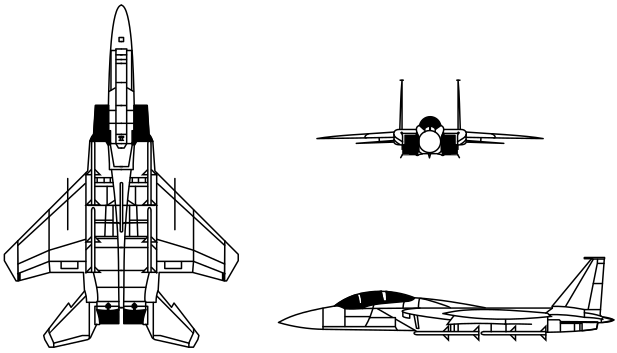
Three-view drawing
_front_view_at_Tsuiki_Air_Base_November_26%2C_2017.jpg)
_left_front_view_at_Tsuiki_Air_Base_November_26%2C_2017_01.jpg)
_right_rear_view_at_Tsuiki_Air_Base_November_26%2C_2017.jpg)
History
F-X: a fighter born from the lessons of Vietnam
The F-15 story begins with a failure. In the mid-1960s the United States Air Force opened the F-X programme to replace the F-4 Phantom II. Eight companies answered the call; after a first screening, four went forward and between them developed some 500 design concepts. When the proposals were reviewed in July 1966 the result was dispiriting: variable-geometry aircraft weighing more than 60,000 lb (27,000 kg), with a top speed of Mach 2.7 and a thrust-to-weight ratio of 0.75. In size and mass they were first cousins of the F-111, and nobody could pretend that was an air-superiority fighter.
Meanwhile the fighting over Vietnam was producing uncomfortable data. Doctrine had bet on long-range missile engagements and on aircraft optimised for that role: heavily laden, with big radars and excellent speed, but limited manoeuvrability and often no gun at all. The canonical example was the F-4 Phantom II itself, the only fighter with the power, range and manoeuvrability to take on the primary task against Soviet fighters under visual rules of engagement. In practice, for political and operational reasons, aircraft ended up closing to visual range and manoeuvring, which put the large American machines at a disadvantage against far cheaper day fighters such as the MiG-21; and the missiles proved considerably less reliable than expected, particularly at close range. Better training and the introduction of the M61 Vulcan cannon on the F-4 corrected part of the imbalance, but the blow to the 1963 Project Forecast doctrine had already landed.
Out of that came John Boyd's energy-manoeuvrability theory, which held that excess power and manoeuvrability mattered more than raw speed. With that idea in hand, and taking advantage of the "failure" of the original F-X, the so-called fighter mafia pushed for a lightweight day fighter that could be built and operated in large numbers. In early 1967 they proposed an ideal design with a thrust-to-weight ratio close to 1:1, a top speed lowered to Mach 2.3, a weight of 40,000 lb (18,000 kg) and a wing loading of 80 lb per square foot (390 kg/m2).
The Navy, for its part, had concluded that the F-111 did not meet its needs and started the VFAX programme. In May 1966 McNamara again asked both services to study whether VFAX could serve the F-X requirement as well. The studies took eighteen months and concluded that the requirements were too different: the Navy insisted on loiter time and mission flexibility, while the Air Force was chiefly after manoeuvrability.
The MiG-25 shock
In 1967 the Soviet Union displayed the Mikoyan-Gurevich MiG-25 at Domodedovo airfield near Moscow. The MiG-25 was in fact a high-speed, high-altitude interceptor, and to excel in that role it made severe concessions: the demand to exceed Mach 2.8 forced the use of stainless steel instead of aluminium in many areas, and the added weight in turn demanded a much larger wing to operate at the intended altitudes. But to a Western observer the aircraft looked remarkably like the big F-X studies: high speed and a large wing, which appeared to imply high manoeuvrability. Alarm spread through the Department of Defense and all three services: the United States seemed to be losing its edge. The MiG-23 was worrying too, and was assumed to be a better aircraft than the F-4. The F-X would beat the MiG-23, but the MiG-25 appeared superior in speed, ceiling and endurance to every existing US fighter, the F-X included. The programme had to be rethought.
Inside the Air Force the argument continued: headquarters and Tactical Air Command still wanted a multipurpose aircraft, while Disosway and Air Force Chief of Staff Bruce K. Holloway pressed for a pure air-superiority design able to face the MiG-25. Fear settled the dispute: the Navy had cancelled VFAX and accepted Grumman's proposal for a smaller, more manoeuvrable design, the VFX, the future F-14 Tomcat, much closer to the requirements the F-X was converging on. Faced with the risk of having the Navy's aircraft imposed on them, in May 1968 the discussion was closed with a line that has stayed with the programme: "We finally decided, and I hope there is no one who still disagrees, that this aircraft is going to be an air superiority fighter."
23 December 1969: McDonnell Douglas wins
In September 1968 the request for proposals went out to the major aerospace manufacturers. The requirements called for a single-seat fighter with a maximum take-off weight of 40,000 lb (18,000 kg) for the air-to-air role, a top speed of Mach 2.5 and a thrust-to-weight ratio near 1:1 at mission weight. A twin-engine layout was required, because it was believed to respond faster to throttle changes and because it might offer commonality with the Navy's VFX. The avionics, by contrast, were deliberately left open: it was unclear whether a larger aircraft with a powerful radar able to spot the enemy at greater range was preferable to a smaller and therefore harder-to-detect one.
Four proposals were submitted. The Air Force eliminated General Dynamics and awarded definition-phase contracts to Fairchild Republic, North American Rockwell and McDonnell Douglas in December 1968; technical proposals were delivered in June 1969, and on 23 December 1969 McDonnell Douglas was announced as the winner. Like the Navy's VFX, the F-X skipped much of the prototype phase and went straight into full-scale development to save time and dodge the risk of cancellation. The winning design resembled the twin-tailed F-14 but with a fixed wing; both drew on configurations tested in NASA wind tunnels.
Formally named "Eagle", its first versions were the single-seat F-15 and the two-seat TF-15; after the first flight of the F-15C the designations became F-15A and F-15B. The engines were the new Pratt & Whitney F100s, chosen to exceed a thrust-to-weight ratio of 1:1 in combat. A 25 mm Ford-Philco GAU-7 cannon firing caseless ammunition ran into development trouble and was dropped in favour of the standard M61 Vulcan. The F-15 inherited the Phantom's conformal carriage of four Sparrows. The fixed wing was mounted on a wide, flat fuselage that also acted as a lifting surface. The airframe was designed for a 4,000-hour life, later extended through testing and service-life extension modifications to 8,000 hours, with some airframes flying longer still.
The F-15A first flew on 27 July 1972; the two-seat F-15B followed in July 1973. A TF-15A flew on 18 October 1973 and was devoted to test and demonstration work: in 1976 it toured abroad on a sales trip in a United States bicentennial paint scheme, served as the F-15E development aircraft and was the first F-15 to use conformal fuel tanks.
The Eagle introduced a radar with look-down/shoot-down capability able to separate low-flying targets from ground clutter, and it bet on onboard computing, with new controls and displays, to cut workload and need only one crew member, saving weight. Unlike the F-14 or the F-4, it has a single canopy structure and an unobstructed forward view. The Air Force presented it as "the first dedicated air-superiority fighter since the North American F-86 Sabre".
Not everyone applauded. The fighter mafia argued that the F-15 was too large for a dogfighter and too expensive to buy in numbers; out of that criticism came the Lightweight Fighter programme, and from it the General Dynamics F-16 Fighting Falcon and the medium-weight McDonnell Douglas F/A-18 Hornet.
The F100: engines at the limit, and the Great Engine War
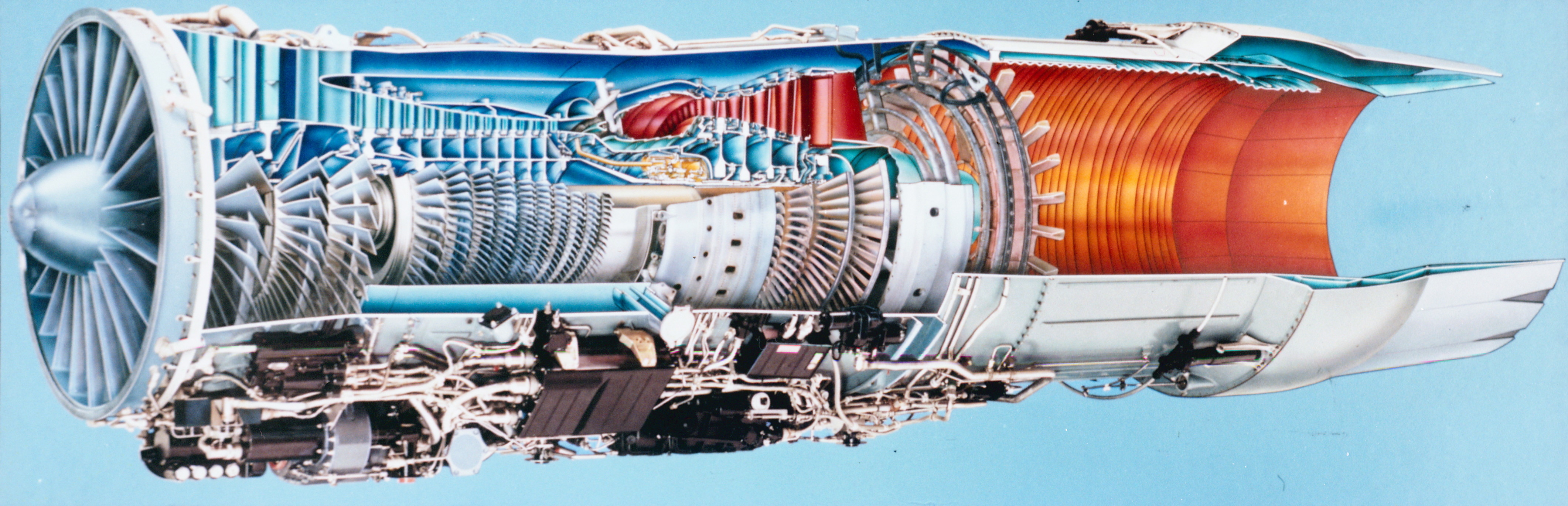
The Eagle's weak point in its early years was not the airframe but the powerplant. In 1967 the Navy and the Air Force issued a joint engine request for proposals for the F-14 Tomcat and for the FX, the parallel fighter competition that led to the F-15 in 1970. That same year the Air Force awarded Pratt & Whitney a contract to develop and produce the 25,000 lbf (110 kN) thrust class F100-PW-100 and the Navy's 30,000 lbf (130 kN) thrust class F401-PW-400.
The specifications were ambitious and critical to the aircraft's performance, but reliability and durability suffered. So-called "hard" afterburner starts appeared: if the afterburner failed to light, or went out after lighting, the large jets of fuel were ignited by the engine exhaust, producing high-pressure waves that stalled the compressor. These stagnation stalls usually occurred at high Mach and high altitude and could seriously damage the turbine if the condition was not corrected. The problem was aggravated because pilots, with that much thrust available, moved the throttles far more abruptly than in earlier fighters.
The fix came with the F100-PW-220 developed in the early 1980s, to which the -100 could be upgraded, and whose first deliveries for the F-15 came in 1986: it eliminated almost all stall-stagnations and augmentor instabilities and doubled the time between depot overhauls. In parallel, seeking to drive unit costs down, the Air Force launched the Alternate Fighter Engine programme in 1984, nicknamed "The Great Engine War": the contract would be awarded through competition, and the -220 was Pratt & Whitney's initial offering against the General Electric F110-GE-100. The rivalry continued into the following decade with the Improved Performance Engine programme, which produced the F100-PW-229 and its competitor the F110-GE-129. From 1997 the original F100-PW-100s were upgraded to an equivalent configuration designated F100-PW-220E, and in 2007 development began on the F100-PW-229EEP to raise reliability and the number of accumulated cycles between depot overhauls.
Streak Eagle: eight records in seventeen days
Even before entering combat service the F-15 set out to show what it could do. An unpainted F-15A-6-MC stripped of most of its avionics, 72-0119, was named Streak Eagle and taken to Grand Forks Air Force Base, North Dakota. Between 16 January and 1 February 1975 it broke eight world time-to-climb records.
On 16 January three test pilots from the F-15 Joint Test Force at Edwards Air Force Base, California, Roger Smith, Willard MacFarlane and Dave Petersen, set five Fédération Aéronautique Internationale records in a single day. Smith took the first: from brake release to 3,000 metres (9,843 feet) in 27.571 seconds. Then came 6,000 metres in 39.335 seconds, 9,000 metres (29,528 feet) in 48.863 seconds and 12,000 metres (39,370 feet) in 59.383 seconds. The last record of the day went to Petersen, who reached 15,000 metres (49,213 feet) in 1 minute 17.042 seconds. On 1 February Smith closed the series with the eighth record: 30,000 metres in 3 minutes 27.799 seconds.
The flight profiles for the record attempts were developed by McDonnell Douglas's chief developmental test pilot. The aircraft was released from a ground hold-back and was airborne in just three seconds. Streak Eagle was delivered to the National Museum of the United States Air Force in December 1980 and is preserved in the museum's research and development hangar.
Entering service and growing the family
The first Eagle delivered was an F-15B, on 13 November 1974. In January 1976 the first aircraft assigned to a combat squadron, the 555th TFS, arrived. Those early machines carried the Hughes APG-63 radar. The first years were marked by the F100-PW-100 reliability problems already described, which were not closed out until the -220 arrived.
The single-seat F-15C and two-seat F-15D entered production in 1978 and first flew in February and June that year. They incorporated the Production Eagle Package (PEP 2000): 2,000 lb (910 kg) of additional internal fuel, provision for external conformal fuel tanks and a maximum take-off weight raised to 68,000 lb (31,000 kg), enough to carry full internal fuel, a full weapons load, conformal tanks and three external tanks at once. The APG-63 later received a programmable signal processor (PSP) allowing the radar to be reprogrammed for new functions, such as integrating additional weapons and equipment; it was the first of its kind in the world. The landing gear was strengthened, a new central computer was fitted, and an overload warning system (OWS) allows the pilot to fly to 9 g at any weight.
The Multistage Improvement Program started in February 1983 and the first production MSIP F-15C rolled out in 1985. It was meant to cover the F-15A (MSIP I) and the F-15C (MSIP II), but the former was abandoned and only the latter went ahead. Improvements included an upgraded central computer, the APG-63 with PSP, a Programmable Armament Control Set opening the way to advanced versions of the AIM-7, the AIM-9 and the AIM-120A, and an expanded tactical electronic warfare system with the ALR-56C radar warning receiver and the ALQ-135 countermeasure set. The final 43 production F-15Cs came off the line with the APG-70 radar developed for the F-15E and are sometimes called Enhanced Eagles; earlier F-15Cs were progressively upgraded. Also from 1985, F-15Cs and Ds received the F100-PW-220 with digital engine controls, giving faster throttle response, less wear and lower fuel consumption.
Although left out of the MSIP, the F-15As ended up with the Air National Guard in the 1990s, which undertook its own upgrade programme in fiscal year 1994: APG-63 with PSP, a larger central computer, countermeasures and AIM-120 capability, matching MSIP II. So configured they served until final retirement in 2011. In 2000 the APG-63(V)2 AESA radar was retrofitted to eighteen USAF F-15Cs; cost prevented wider adoption, and from 2001 the remaining MSIP F-15Cs moved to the APG-63(V)1, beginning with the 27th Fighter Squadron at Langley in March of that year.
Israel: the first kill, Opera and the Bekaa Valley
The Israeli Air Force has operated F-15s since 1977, received under the Peace Fox I, II and III programmes. The type's first kill was scored by Israeli ace Moshe Melnik in 1979. During the Israeli raids against Palestinian factions in Lebanon between 1979 and 1981, F-15As are credited in published accounts with downing thirteen Syrian MiG-21s and two MiG-25s.
On 7 June 1981 a flight of Israeli F-16As escorted by F-15As bombed the Osirak reactor deep inside Iraq: this was Operation Opera. The Israelis had concluded that a squadron of heavily fuelled and heavily armed F-16As, with a group of F-15As providing air cover and fighter support, could carry out a surgical strike on the reactor without refuelling. Six F-15As were assigned to the operation. On reaching Iraqi airspace the formation split, with two F-15s forming close escort for the F-16s and the rest dispersing into Iraqi airspace as a diversion and ready back-up.
The high point came in the 1982 Lebanon War. Israeli F-15s are credited with 41 Syrian aircraft destroyed: 23 MiG-21s, 17 MiG-23s and one Aérospatiale SA.342L Gazelle helicopter. In Operation Mole Cricket 19 over the Bekaa Valley, Israeli F-15s and F-16s together shot down 82 Syrian fighters, MiG-21s, MiG-23s and MiG-23Ms, without losses. The first wave was made up of 96 F-15s and F-16s. The Israeli fighters carried AIM-7F Sparrow radar-guided missiles, AIM-9L Sidewinder infrared-guided missiles and computer-aimed 20 mm cannon, and had head-up displays. The plan chained the pieces together: drones baited the surface-to-air missile crews into firing, the F-15s and F-16s provided air cover while F-4 Phantoms destroyed the batteries with AGM-45 and AGM-78 anti-radiation missiles, and selective airborne communications jamming cut the MiG-21s and MiG-23s off from ground control, leaving them vulnerable to AWACS-directed attacks.
None of those figures was accepted by the other side, and that deserves recording. The Soviet military newspaper Krasnaya Zvezda announced that "sixty-seven Israeli aircraft, including modern US-made F-15 and F-16 fighters, were downed" in the fighting, and the press carried the account of a Syrian airman describing an engagement in which he shot down an Israeli F-15: "the victory had not been easy; the enemy had been subtle".
May 1983: an F-15 lands without its right wing
In May 1983 an Israeli Air Force F-15 and an A-4 Skyhawk collided in mid-air during a training exercise over the Negev. The Eagle's right wing was sheared off roughly 2 ft (60 cm) from the root. The crew of the two-seat trainer version, pilot Zivi Nedivi and navigator Yehoar Gal, did not initially realise the extent of the damage, because fuel leaking profusely and vaporising at the wing attachment obscured their view of the area where the wing had been. Nedivi, who outranked his instructor, decided not to eject and attempted recovery by engaging the afterburner, eventually regaining control thanks to the lift generated by the large areas of the fuselage, the stabilators and the remaining wing. Diverting to Ramon Airbase, he landed at twice the normal speed to maintain the necessary lift; the tailhook was torn off completely during the landing and the aircraft came to a stop about 20 ft (6 m) from the end of the runway.
Wooden Leg and Israel's air-to-ground use of the Eagle
Israel was the only operator to use and develop the air-to-ground capabilities of the air-superiority versions of the F-15, and it did so for a very concrete reason: in the 1980s the Eagle's range far exceeded that of anything else in its inventory. The first known use of the F-15 in a strike mission was Operation Wooden Leg on 1 October 1985, against PLO headquarters in Tunis: six F-15Ds attacked with one GBU-15 guided bomb each, and two F-15Cs re-struck the ruins with six unguided Mk-82s each. It was one of the few occasions on which the air-superiority F-15 models A, B, C and D were used in tactical strike.
The raid left a record of the corridor's tensions: after the first refuelling halfway to the target, and because no problems had arisen, the two reserve F-15s returned to Israel; Algerian and Tunisian radars tracked the incoming aircraft, and according to a Tunisian Air Force officer serving at the time the Israelis probably turned back on detecting that electromagnetic activity in order to complete the mission without losses. Casualty figures vary with the source: between 60 and 70 Palestinians and 25 Tunisians killed, according to some; 56 Palestinians and 15 Tunisians killed and about 100 wounded, according to others. The Tunisian ambassador to France described the attack as "state terrorism", citing the number of deaths including civilians and members of the Tunisian security forces. Israel's air-superiority F-15s have since been upgraded to carry a far wider range of air-to-ground weapons, including GPS-guided JDAM bombs and Popeye missiles.
Outside Israel, the first combat use of an American F-15 was Operation Urgent Fury: F-15s of the 33rd Tactical Fighter Wing provided air cover alongside Navy F-14 Tomcats for the Marines and the 82nd Airborne Division in Grenada. In the Middle East, Royal Saudi Air Force F-15C pilots shot down two Iranian F-4E Phantom IIs in a skirmish on 5 June 1984.
The Eagle as a first stage: the ASM-135 ASAT
The ASM-135 missile was conceived as a stand-off anti-satellite weapon with the F-15 acting as its first stage. The logic was as operational as it was political: the Soviet Union could correlate the launch of an American rocket with the loss of a spy satellite, but an F-15 carrying an ASAT was lost among hundreds of F-15 sorties. Between January 1984 and September 1986 two F-15As served as launch platforms, modified to carry an ASM-135 on the centreline station via a special pylon with added equipment; the flight computer was also updated to control the zoom climb and the release. The profile called for a Mach 1.22, 3.8 g climb at 65 degrees, releasing the missile at 38,100 ft (11,600 m).
The third test flight made history. On 13 September 1985 Major Wilbert D. "Doug" Pearson, flying the F-15A 76-0084 named Celestial Eagle, launched an ASM-135 about 320 kilometres (200 mi) west of Vandenberg Air Force Base and destroyed by kinetic impact the Solwind P78-1 solar observatory, launched on 24 February 1979, orbiting at 555 kilometres (345 mi). The 14-kilogram (30 lb) miniature homing vehicle struck the 910-kilogram (2,000 lb) satellite at a closing velocity of 24,000 kilometres per hour. Pearson remains the only pilot ever to have destroyed a satellite.
The choice of target had an element of urgency: the Department of Defense opted to use the still-operating Solwind science satellite in order to complete the test before the Congressional ban that took effect in October 1985. The debris held a surprise: the fragments turned out to be so dark as to be almost undetectable, and NASA scientists theorised that this was due to carbonisation of organic compounds in the satellite, whose plastics vaporised in the heat of impact and condensed as soot on the metal pieces. The record-high solar maximum of 1989-1991 heated and expanded the atmosphere more than anticipated and accelerated the decay of that debris. The ASAT programme involved five test launches and modified airframes in two squadrons; the Reagan administration cancelled it in 1988 because of technical problems, testing delays and significant cost growth.
The birth of the Strike Eagle
Although the F-X requirements pointed at air superiority, McDonnell Douglas had quietly built a basic ground-attack capability into the F-15 from the start and had run in-house studies to expand it. In 1979 the manufacturer teamed with Hughes, builder of the F-15's radar, to develop a strike version as a private venture. That version entered the Air Force's Dual-Role Fighter competition from 1982 and in 1984 was selected for production over General Dynamics' F-16XL.
The F-15E is a two-seat, fully integrated dual-role aircraft for all-weather air-to-air missions and deep interdiction. The rear cockpit was rebuilt with four multipurpose cathode-ray displays for systems and weapons management. Lear Siegler's triple-redundant digital flight control system allows coupled automatic terrain following, supported by ring-laser-gyro inertial navigation. For high-speed low-level penetration and precision attack on tactical targets at night or in poor weather, the F-15E carries the high-resolution APG-70 radar and LANTIRN pods with thermal imaging.
The first of the type, 86-0183, made its maiden flight on 11 December 1986. The first officially completed F-15E flew on 31 March 1987, aircraft reached Air Force operational units in 1988, and the type achieved initial operational capability on 30 September 1989 at Seymour Johnson Air Force Base, North Carolina, with the 336th Tactical Fighter Squadron of the 4th Tactical Fighter Wing. The F-15E would in time give rise to the fly-by-wire Advanced Eagle family that is the basis of all current F-15 production.
Desert Storm
The Air Force began deploying F-15C, D and E aircraft to the Persian Gulf region in August 1990 for Operations Desert Shield and Desert Storm. During the Gulf War the F-15 accounted for 36 of the USAF's 39 air-to-air victories over Iraqi forces; Iraq has confirmed the loss of 23 of its aircraft in air combat. F-15Cs and Ds flew air superiority, while F-15Es operated mostly at night against ground targets, hunting modified Scud launchers and artillery positions with the LANTIRN system.
According to the Air Force itself, its F-15Cs accumulated 34 confirmed kills of Iraqi aircraft in 1991, most by missile: five MiG-29s, two MiG-25s, eight MiG-23s, two MiG-21s, two Su-25s, four Su-22s, one Su-7, six Mirage F1s, one Il-76 transport, one Pilatus PC-9 trainer and two Mi-8 helicopters. Air superiority was achieved in the first three days of the conflict, and many of the later kills were, by the accounts, of Iraqi aircraft fleeing to Iran rather than aircraft seeking combat.
The F-15E had its own debut. On 17 January 1991, as the campaign opened, 24 F-15Es attacked five fixed Scud installations in western Iraq, and that same night a second wave of 21 aircraft continued the missions against missile sites; at night they flew hunter sorties over western Iraq looking for mobile launchers, and random bombing of suspect areas was used to deter the Iraqis from setting up a launch. On 14 February 1991 an F-15E scored the type's first air-to-air kill, destroying an Iraqi Mi-24 Hind helicopter with a laser-guided GBU-10 bomb. Two F-15Es were lost to ground fire and another was damaged on the ground by a Scud impact at King Abdulaziz Air Base.
The war also left episodes that qualify the record. The Naval History and Heritage Command notes that an F-15 may in addition have mistakenly shot down a friendly F-14 Tomcat. On 11 November 1990, during Desert Shield, a Royal Saudi Air Force pilot defected to Sudan with an F-15C; Saudi Arabia paid 40 million dollars for the aircraft's return three months later. Saudi F-15s shot down two Iraqi Mirage F1s during Desert Storm, and one Saudi F-15C was lost in a crash in 1991: the Iraqi Air Force maintained that the fighter was part of a pair of F-15Cs that engaged two Iraqi MiG-25PDs and that it was hit by an R-40 missile before crashing.
The 1990s: patrols, the Balkans and friendly fire
After the Gulf, F-15s deployed in support of Operation Southern Watch, the patrolling of the no-fly zones over Iraq, Provide Comfort in Turkey, NATO operations in Bosnia and successive expeditionary deployments. In August 1995, as part of Operation Deliberate Force, F-15Es struck Serbian armour and logistics around Sarajevo.
In 1994 two US Army Sikorsky UH-60 Black Hawk helicopters were mistakenly shot down by F-15Cs over northern Iraq. AWACS had not informed the F-15 pilots of the presence of the Black Hawks, and their IFF equipment had not identified the helicopters as friendly. Afterwards Air Force leadership ordered F-15Es not to fly below 10,000 feet (3,000 m) to avoid a repeat incident.
In 1999, during NATO's intervention in Kosovo (Operation Allied Force), USAF F-15Cs shot down four Yugoslav MiG-29s with AIM-120 and AIM-7 radar-guided missiles. Two of those kills were scored by Captain Jeff "Claw" Hwang of the 493rd Fighter Squadron, 48th Fighter Wing, based at RAF Lakenheath.
2007: longeron cracks and a grounded fleet
On 2 November 2007 a 27-year-old F-15C, 80-0034, of the Missouri Air National Guard's 131st Fighter Wing broke up in flight and crashed. The Air Force grounded the entire F-15 fleet; the newer F-15Es were cleared to keep flying shortly afterwards. On 28 November 2007 the Air Force reported that the probable cause lay at a critical location in the F-15C's upper longerons, whose failure caused the fuselage forward of the air intakes, including the cockpit and radome, to separate from the airframe.
F-15A, B, C and D aircraft remained grounded until that location received detailed inspection and any necessary repair. The grounding drew press attention because it began to strain the country's air defence: some states had to rely on fighters from neighbouring states, and Alaska on support from the Canadian Forces. On 8 January 2008 Air Combat Command cleared part of the older fleet to fly and recommended a limited return to flight for units worldwide operating those models. The accident investigation board report, released on 10 January 2008, concluded that the longeron on the crashed aircraft did not meet drawing specifications, which led to fatigue cracks and ultimately to catastrophic failure of the remaining support structure and the break-up of the aircraft in flight; the same report identified nine other F-15s with similar longeron problems. General John D. W. Corley went as far as to say that "the long-term future of the F-15 is in question". On 15 February 2008 ACC cleared all of its grounded F-15A, B, C and D aircraft to fly, pending inspections, engineering reviews and any repairs required.
The 104-kill record and its caveats
By the count recorded in the reference literature, the F-15 holds a combined record of 104 kills with no losses in aerial combat through 2008; the air-superiority versions, A, B, C and D, have suffered no losses to enemy action, and more than half of those kills belong to Israeli Air Force pilots.
That figure is the one given by the operating air forces and should be read alongside the caveats the material itself documents. The Iraqi Air Force claimed the Saudi F-15C lost in 1991. The Soviet military press and a Syrian airman claimed F-15 kills in 1982, which Israel never acknowledged. The NHHC suggests an F-15 may have mistakenly downed a friendly F-14 during the Gulf War, and in 1994 two American Black Hawks were shot down by F-15Cs in a fully acknowledged friendly-fire case. And in 2018, in Yemen, the Houthis claimed Saudi F-15s shot down on two occasions where the hit was indeed recorded on video but the shootdown is not established.
Upgrade or replace: from the 2040C to the F-15EX
From 2006, faced with the threat of cuts to the F-22 buy that was meant to replace all air-superiority F-15s, the Air Force planned to upgrade the 179 F-15Cs in the best material condition by fitting the APG-63(V)3 AESA radar and updated cockpit displays; the first upgraded aircraft was delivered in October 2010. A significant number of F-15s received the JHMCS helmet-mounted cueing system. Lockheed Martin developed an infrared search-and-track sensor for tactical fighters, which became the AN/ASG-34(V)1 IRST21 sensor in the Legion Pod; the AN/AAQ-33 Sniper XR pod was integrated as an interim solution. The next upgrade, the Eagle Passive/Active Warning Survivability System (EPAWSS), was awarded to Boeing as prime contractor in October 2015 with BAE Systems as subcontractor: a fully digital system of electronic countermeasures, radar warning and increased chaff and flare capacity in less space than the 1980s electronic warfare suite. It was planned for more than 400 F-15Cs and F-15Es, but in fiscal year 2020 the Air Force dropped it for the F-15C, having already chosen to buy the F-15EX.
In September 2015 Boeing unveiled the 2040C upgrade, nicknamed Golden Eagle, intended to keep the F-15 relevant to 2040 building on its F-15SE Silent Eagle concept: quad-pack racks to double the load to sixteen missiles, conformal fuel tanks for greater range, a Talon HATE communications pod to talk to fifth-generation fighters, the APG-63(V)3 radar, the long-range Legion IRST pod and EPAWSS. The 2040C was not carried out on the F-15C/D because the age of the airframes made it economically unsustainable, but many of its components went ahead in F-15E upgrades and in the new F-15EX.
Meanwhile the fleet was retiring. On 16 September 2009 the last F-15A, of the Oregon Air National Guard, was retired, ending A and B model service in the United States. With the F-22 capped at 187 operational aircraft, a consequence of the Department of Defense's focus on asymmetric warfare in the 2000s, the Air Force had to stretch the life of the F-15C/D far beyond plan: in 2007 it expected to keep 179 F-15C/Ds and 224 F-15Es in service beyond 2025. Through the 2010s American F-15C/Ds were deployed with Pacific Air Forces at Kadena in Japan and with US Air Forces in Europe at RAF Lakenheath, besides serving as aggressors at Nellis and in test duties at Edwards and Eglin. But structural fatigue made carrying the fleet into the 2030s unsustainable, and in April 2017 the Air Force announced its intention to retire the C/D in the mid-2020s.
Between late 2018 and early 2019, after a series of studies by the Department of Defense's Cost Assessment and Program Evaluation office on how to recapitalise the fighter fleet affordably, the Pentagon requested new F-15EXs in the fiscal year 2020 budget, an advanced variant based on the F-15QA export aircraft then in production, to replace the F-15C and complement the F-22, with a planned total buy of 144. The option exploited the existing export line, whereas restarting F-22 production was judged cost-prohibitive.
The F-15EX made its maiden flight on 2 February 2021. By May 2022 the Air Force had reduced its orders to 80 aircraft, and the proposed fiscal year 2024 budget included funds for 24 more, which would bring the planned fleet to 104. In contrast to some other Advanced Eagle variants, the USAF F-15EX does not carry the BAE Systems AN/AAR-57 Common Missile Warning System, although the blisters for those sensors were retained to minimise production changes and preserve the aerodynamic profile on which the fly-by-wire system depends.
In 2022 the plan was announced to retire the F-15C/D fleet in 2026 and the F-15E in the 2030s. By April 2022 RAF Lakenheath had divested all of its F-15C/Ds, which passed to Air National Guard squadrons. Kadena, which at one point had 48 F-15Cs permanently stationed there, divested its own between December 2022 and January 2025; the last flight of an active-duty USAF F-15C was made by 81-0029 on 24 January 2025.
Exports: the other half of the story
Israel has operated F-15s since 1977 under the Peace Fox programmes; in November 1995 it ordered four additional F-15Is, and 25 aircraft of that F-15E-derived strike version were built between 1996 and 1998. The Royal Saudi Air Force requested the aircraft in 1977 and has operated four squadrons of F-15C/Ds since 1981, received under the Peace Sun programme; a stipulation in the Camp David peace agreement limited the number of Saudi F-15s to 60, with surplus airframes held at Luke AFB for RSAF pilot training. Japan operates licence-built Mitsubishi F-15J and F-15DJ fighters; the Japan Air Self-Defense Force had drawn up its plan to form the first squadron after the shootdown of Korean Air Lines Flight 007 by a Soviet Su-15 on 1 September 1983, and its F-15Js carry the Japanese-built AAM-3 missile. The Republic of Korea Air Force received 61 F-15K Slam Eagles, of which two have been lost in accidents. Qatar ordered 36 F-15QA Ababil aircraft and by July 2023 had received 33 of 48 planned.
Yemen and the Eagle as a drone hunter
The Yemeni civil war, opened in 2015, gave the F-15 a role nobody foresaw in 1969. The Houthis used R-27T missiles modified to serve as surface-to-air weapons. Video released on 7 January 2018 shows one of those R-27Ts striking a Saudi F-15 as seen through a forward-looking infrared camera; the Houthis claimed a shootdown, but the claim is disputed, because the missile appears to have detonated by proximity and the aircraft continued on its trajectory apparently undamaged. The rebels later released images of aircraft wreckage, but the serial numbers on those pieces pointed to a Panavia Tornado, also in Saudi service; on 8 January the Saudis admitted the loss of an aircraft, but for technical reasons. On 21 March 2018 the Houthis published another video in which an adapted R-27T hit, and possibly downed, a Saudi F-15 in Saada province; as before, the target was clearly hit but did not appear to fall, and Saudi forces confirmed the hit, adding that the aircraft landed at one of their own bases, at 3:48 pm local time, after an anti-aircraft missile was launched from inside Saada airport.
After the Houthi attack on Saudi oil infrastructure of 14 September 2019, Saudi Arabia tasked its missile-armed F-15s with intercepting low-flying drones, which are difficult for high-altitude systems such as the MIM-104 Patriot. On 2 July 2020 a Saudi F-15 shot down two Shahed 129s over Yemen. On 7 March 2021, during a Houthi attack on several Saudi oil facilities, F-15s downed several drones with infrared-guided AIM-9 Sidewinders, with imagery confirming at least two Samad-3s and one Qasef-2K. On 30 March 2021 a Saudi border guard video showed an F-15 destroying a Qasef-2K with an AIM-120 AMRAAM fired at short range. In an early phase of the intervention, Saudi F-15s also bombed Sanaa International Airport on 28 April to prevent an Iranian Red Crescent aircraft from landing as it approached.
Testbeds
The first F-15B, 71-0290, became the short take-off and landing / manoeuvre technology demonstrator (F-15 STOL/MTD): in the late 1980s it received canard surfaces in addition to its usual horizontal tail, together with square thrust-vectoring nozzles. That same aircraft was later converted into the F-15 ACTIVE, a research aircraft for advanced flight control technologies with thrust-vectoring nozzles. These experimental uses, and NASA's later trials, are supported in the captured material only by Wikipedia articles; they should be checked against NASA documentation in a later pass.
What this history does not yet cover
This account rests on the reference material captured for this entry and leaves several fronts open for later passes. The export variants, the South Korean F-15K, the Saudi F-15S and F-15SA, the Singaporean F-15SG and the Qatari F-15QA, still lack dedicated sources of their own: what is said about them here comes from general operator articles. The F-15EX rests only on a Congressional Research Service report and Wikipedia. The NASA testbeds (ACTIVE, IFCS, Quiet Spike) are documented by Wikipedia alone. No verified unit costs by variant are available, which is why none are quoted. Two episodes often mentioned when the type's kill record is discussed are likewise absent from the material: the loss of a Japanese F-15J to an accidental launch in 1995 and the suspicion surrounding an F-15C in the Balkans; they are not asserted here for lack of a source in the captured material.
Variants
| F-15C | |
|---|---|
| Aircraft type | Single-seat all-weather air superiority fighter |
| Powerplant | Two Pratt & Whitney F100-PW-220 afterburning turbofans, each rated at 64.9 kN dry thrust and 105.7 kN with afterburner. |
| Powerplant | 2 × Pratt & Whitney F100-PW-220 |
| Thrust per engine | 106 kN |
| Length | 19.4 m |
| Wingspan | 13.1 m |
| Height | 5.6 m |
| Wing area | 56.5 m² |
| Empty weight | 13,154 kg |
| MTOW | 30,844 kg |
| Top speed | 2,655 km/h |
| Cruise speed | 919 km/h |
| Service ceiling | 20,000 m |
| Initial climb rate | 341 m/s |
| Range | 3,971 km |
| Ferry range | 5,600 km |
| Range conditions | Range of 3,971 km with three external fuel tanks and 5,600 km ferrying with conformal tanks plus three external tanks. Combat range is 1,085 km on a counter-air mission with one external tank; 870 km on an area intercept with four AIM-7 and internal fuel only; and 1,965 km on an interdiction mission with three external tanks. |
| Armament | One 20 mm M61A1 Vulcan six-barrel rotary cannon with 940 rounds. Nine hardpoints — two under-wing, each with two additional missile launch rails; four under-fuselage for semi-recessed carriage of AIM-7 or AIM-120, and a single centreline station — with a capacity of 7,300 kg. Typical loads: four AIM-7 Sparrow and four AIM-9 Sidewinder; six AIM-120 AMRAAM and two AIM-9 Sidewinder; or eight AIM-120 AMRAAM. ADM-160 MALD decoys may also be carried. |
| Max weapons load | 7,300 kg |
| Payload | 0 kg |
| Cargo capacity | No cargo or passenger capacity: a single-seat fighter with no hold. Its hardpoints accept the MXU-648 cargo/travel pod, used to carry crew belongings and small pieces of maintenance equipment on deployments. |
| Crew | 1 |
| Passengers | 0 |
| Units built | 483 |
Images
Elsewhere
- NASA Armstrong Flight Research CenterNASA F-15B ACTIVE Research Aircraft Photo Collection ↗
- NASA Armstrong Flight Research CenterNASA F-15 HIDEC Research Aircraft Photo Collection ↗
- NASA Armstrong Flight Research CenterNASA F-15B Photo Collection ↗
- National Museum of the U.S. Air ForceMcDonnell Douglas F-15 Streak Eagle ↗
- National Museum of the U.S. Air ForceMcDonnell Douglas F-15 Streak Eagle (photo) ↗
- National Museum of the U.S. Air ForceMcDonnell Douglas F-15A Eagle ↗
- National Museum of the U.S. Air ForceASM-135 ASAT missile (photo 1) ↗
- National Museum of the U.S. Air ForceASM-135 ASAT missile (photo 2) ↗
- National Museum of the U.S. Air ForcePratt & Whitney F100-PW-220 ↗
- Smithsonian National Air and Space MuseumPratt & Whitney F100-PW-100 Turbofan Engine ↗
- DVIDSF-15EX Eagle II Flies Over the Gulf of America ↗
- DVIDSF-15EX Eagle II Unveiled ↗
Show the 10 more
- DVIDSF-15EX Eagle II Releases Flares Over the Gulf Coast ↗
- DVIDSAir Force Names Its Newest Fighter, F-15EX Eagle II ↗
- DVIDSBoeing Rolls Out New F-15QA for Qatar ↗
- DVIDSQatar Emiri Air Force F-15 Strike Eagles — Exercise Sky Shield ↗
- DVIDSRoyal Saudi Air Force F-15s Join U.S. Air Force Presence Patrol ↗
- DVIDS44th EFS Flies With RSAF F-15SA ↗
- The Aviation Geek ClubThat time an Israeli Air Force F-15 Baz landed with one wing missing ↗
- The AviationistHow an Israeli F-15 Eagle managed to land with one wing ↗
- Eagle Country (skytrailer.nl)71-0280 (YF-15A) — Eagle Country ↗
- This Day in Aviation71-0280 — This Day in Aviation ↗