Airliner · Civil · Germany
Junkers F 13
- June 25, 1919
- First flight
- 1920
- Introduced
- 1951
- Retired
- 322
- Units built





-1600.webp)
-1600.webp)


_at_Kaunas_Airfield%2C_Lithuania-1600.webp)


The Junkers F 13 was the world's first all-metal passenger transport aircraft: a cantilever low-wing monoplane skinned in corrugated duralumin, with an enclosed, heated cabin for four passengers and an open crew position for two. The prototype, works number 531 and named Herta after Hugo Junkers's eldest daughter, was flown at Dessau by test pilot Emil Monz on 25 June 1919, and passed its type test barely four weeks later, on 18 July 1919. It brought together for the first time in a commercial aeroplane everything Junkers had been proving since 1910: the thick, unbraced wing he had patented after building his own wind tunnel at Aachen, the load-bearing corrugated duralumin skin first used as external covering on the J 7, and a cabin fitted out for fare-paying passengers rather than for a second airman. The design team under Otto Reuter took it from November 1918 concepts to a flying aircraft in six months, in the miserable conditions of the first post-war winter, and Monz reported a machine outstanding aerodynamically, in handling and in operating economy. Allied restrictions on German aviation pushed the type abroad almost immediately: the first production aircraft was sold in the United States in October 1919, and F 13s went on to fly in more than thirty countries, from Colombia and Bolivia to Persia, Sweden, Hungary, the Soviet Union, Canada and Spitsbergen, swapping wheels for duralumin floats or skis wherever there were rivers or snow instead of aerodromes. By the mid-1920s the type accounted for something close to 40 per cent of the world's air-traffic network. It was also the backbone of Junkers Luftverkehr and, through it, of the airline that became Luft Hansa: of the 162 aircraft the predecessor companies brought to the merger of 6 January 1926, 48 were F 13s. Production ran at Dessau, with spells at Danzig, Reval and Fürth and a Soviet line at Fili near Moscow, and the total built is disputed between 314 and 351, with 322 the most quoted figure. The last F 13 in commercial service was retired in Brazil in 1951, and faithful reconstructions have been flying again since 2016.
Related events
Related sheets
Category
Three-view drawing
.jpg)
History
The Dessau workshop and the thick-wing obsession
Hugo Junkers came to aviation through thermodynamics and at nearly fifty years of age. In 1908, while teaching at the Technical University of Aachen, he came to know Professor Reissner, who worked on aeronautical engineering and conducted his own flight trials; out of their conversations came Reissner's "Wellblech-Ente", a canard whose metal wings were developed at Junkers's own experimental institute in Aachen and built in his Dessau works, the "Junkers & Co" firm. To prepare the ground, Junkers put up a wind tunnel at Aachen in 1910 devoted to measuring aerofoils, and from those systematic measurement series came the conclusion that governed all his later work: a thick aerofoil can also deliver a high lift-to-drag ratio. That same year he patented the unbraced thick-section wing as the ideal load-bearing structure, an idea the orthodoxy of the day, wedded to thin wings and a forest of wires, held to be absurd.
He paid for all of it himself. From 1892 he had built up prosperous businesses making calorimeters and gas bath heaters — the first patent application dates from 1894 — and with those profits he financed his own ideas about new aircraft configurations and new ways of building them. In 1912 he gave up teaching at Aachen in order to develop metal construction at Dessau: not only the structures themselves but the tooling, machinery and installations needed to make them, and the test specimens from which strengths and design values were determined.
From the J 1 to the J 12: twelve trials before the F 13
Between 1915 and 1918 Junkers produced a dozen designs in quick succession, some of them one-off aircraft and others no more than projects. The J 1 of 1915, the first unbraced all-metal aircraft capable of flight, was a cantilever low-wing monoplane made of sheet iron and welded steel tube. The J 2 lightened the whole by concentrating engine, pilot, undercarriage and the attachments for wing and tail carrier on a central welded steel-tube structure. The J 3 was the first light-alloy project, with corrugated skin, and was abandoned in 1916. The J 4 grew in 1916-17 out of the demands of pilots and the military administration: a sesquiplane with a central armoured steel bathtub protecting engine, crew and fuel tank, of which more than two hundred were built and used until 1919, and which was the world's first series-built all-metal aircraft. The J 5 and J 6 never left the drawing board. The J 7 continued the J 3 in light alloy and introduced corrugated duralumin sheet as external skin; the J 9 developed it in search of better manoeuvrability, the J 8 was its two-seat version, the J 10 came from crossing the two, and the J 11 was the floatplane version of the J 10.
As soon as the armistice was signed on 11 November 1918, the first attempt at a transport aircraft appeared at Dessau: the conversion of a military machine with a covered second seat for a passenger. The J 12 was already the project for a four-seater derived from the J 10. From there to the F 13 was one step, but a decisive one: the first aircraft Junkers conceived with no military consideration whatsoever.
Six months between the armistice and the first flight
In January 1919 Junkers wrote to his director, Dr Mader, that they should set to work with all their might on a cheap, economical, light, simple, operationally safe and durable aeroplane. The design staff, under Otto Reuter, had the new transport ready in six months. The timetable is astonishing even now: first concepts in November 1918, development and design started in January 1919, first flight on 25 June 1919 and the type test passed on 18 July 1919, barely four weeks after the debut. The prototype, works number 531, was built at Dessau in the wretched conditions of the first post-war months; test pilot Emil Monz took it into the air, and it was given the name Herta after Junkers's eldest daughter, officially granted on 30 July together with permission to christen the second aircraft, then under construction, Anneliese after the second daughter. Registered on 18 July 1919 as D-183 under the register then in force, it carried the marking D-1 once the registration procedure was reorganised in May 1920.
Monz's flight report was unequivocal: an outstanding machine aerodynamically, in handling and economically, with a few peculiarities to get used to and only trifles worth criticising. The designation was not casual either. The letter F stood for Flugzeug, aeroplane, and the F 13 was the first Junkers to use that system, having been known internally as the J 13; the aircraft built in the Soviet Union kept the designation Ju 13.
Corrugated duralumin: how it was made
The decisive feature of the F 13 was its cantilever wing. Where its contemporaries hung struts and wires out in the airflow, the F 13 buried all its bracing inside the wing itself, over nine circular-section duralumin spar tubes joined by transverse bracing, and removed a major source of drag at a stroke. The price was an aerofoil far thicker than convention allowed; the advantage was that the polar curve of a thick section behaves reasonably both in speed and in climb, whereas a thin section serves well for one or the other but not both.
The wing was built in three parts to ease transport: two outer panels bolted to the framework of the centre section, which two men could fit or remove in a few minutes. That centre section formed part of the fuselage structure, so the fuselage rested on the wing rather than hanging beneath it — an inversion of common practice that lightened the whole and, incidentally, left the cabin and its occupants in the best-protected position in a heavy landing. The corrugated external skin contributed to torsional strength and absorbed dynamic overloads well. Every control surface was horn balanced, and their generous area benefited manoeuvrability and stability alike.
The controls were conventional — a column with a wheel for elevator and ailerons, pedals for the rudder — with provision for dual controls, considered important on long flights, and sliding inspection doors for reaching cables, levers and piping. One quiet innovation was the trimming tank in the tail: the F 13 was the first aircraft to compensate for shifts in loading by pumping fuel to a rear tank under the pilot's control, instead of resorting to mechanical adjustment of the tailplane. The undercarriage was largely steel tubing, with four faired spring struts arranged in a V and a track wide enough to prevent overturning in an oblique landing; the jointed, shock-absorbing tail skid was easily replaced. Special fittings allowed the wheels to be exchanged for duralumin floats, each divided into six watertight compartments, or for duralumin runners for snow and ice, with a shoe added to the tail skid.
The frontal radiator, of Junkers's own design, was light and efficient, with shutters the pilot regulated in flight; aircraft intended for tropical countries received a supplementary radiator. Propellers were studied closely in pitch, blade section and diameter: the first were of laminated wood with metal protection at the leading edge, and the firm also worked on metal propellers built up from hollow sections, whose merits were that a single blade could be replaced, that they were indifferent to climate, and that pitch could be varied by shaping the hub.
Giving up wood and fabric was no whim. Duralumin sidestepped the uneven quality of aeronautical timber and the difficulty of obtaining it, its tendency to warp — which ruined the interchangeability of parts — and it carried less fire risk. Against wood it aged more slowly, was cheaper to protect against damp, and termites could not eat it; that last point, far from trivial, explains how quickly the type became common in the tropical countries of South America. Despite duralumin being denser than wood, the F 13 weighed less than any other aircraft of its class, wooden or metal, thanks to the firm's aerodynamic work.
A cabin meant for passengers
The internal arrangement was as novel as the structure. The two pilots sat at first in an open cockpit, roofed but without side glazing, behind small windscreens; only later was the flight deck enclosed as well. The four passengers, by contrast, travelled in a closed and heatable compartment with windows and doors, upholstered seats or comfortable wicker armchairs, heating and interior lighting, and seat belts, which in 1919 practically nobody fitted. The cabin was roomy and elegantly finished by the standards of the day, and there was space for a fifth occupant alongside the pilot; baggage went in its own compartment behind the cabin, reached from outside.
The altitude record of 1919
On 13 September 1919, barely three months after the first flight, Monz took the F 13 up to 6750 metres with the aircraft loaded with occupants and set a world altitude record recognised by the FAI. The cockpit at that date held nothing beyond the indispensable monitoring instruments.
Export by compulsion
Any maker of civil aircraft in the immediate post-war years competed against mountains of surplus warplanes that could be converted for very little money. German manufacturers had, on top of that, the restrictions of the Inter-Allied Aeronautical Commission of Control, which banned the production of military aircraft and, in 1921-22, of any aircraft at all. The paradoxical result was that the world's first modern commercial aeroplane could not officially be used in its own country: the first production F 13 was sold on 29 October 1919 in the United States to the entrepreneur John M. Larsen, who as early as September that year had bought twenty-four aircraft for carrying mail. Junkers took foreign orders in 1919 from Austria, Poland and the United States, and in the following years from SCADTA in Colombia and the United States Post Office Department; in 1922 it sold in England, France, Italy and Japan. The pilots Edward Stinson and Lloyd Bertaud took an American-built JL-6 to a world endurance record between 29 and 30 December 1921, staying aloft 26 hours, 5 minutes and 32 seconds.
Junkers Luftverkehr and the embryo of Luft Hansa
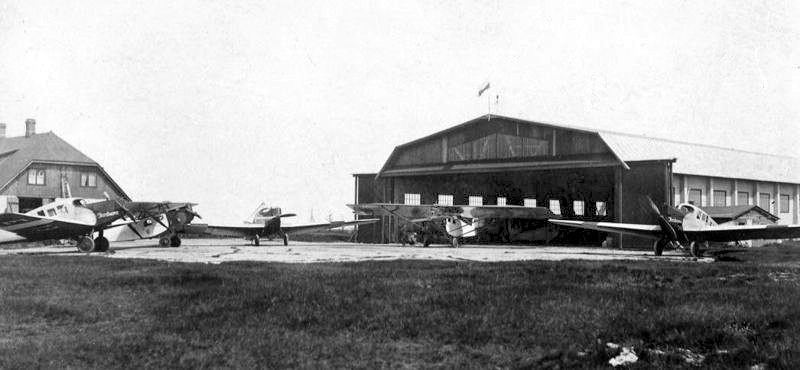
To drive domestic demand, Junkers founded his own airline in 1921, Junkers Luftverkehr AG, which by 1923 was flying sixty F 13s, and opened a branch of it in Iran. To that he added an aggressive commercial policy of cheap leases and free loans, with the result that some sixteen European operators came to fly the type. By the time Junkers Luftverkehr was merged into Luft Hansa in 1926, its F 13s had covered 9.5 million miles. The snapshot of that merger says everything: of the 162 aircraft the predecessor companies contributed to the new company on 6 January 1926, spread over twenty different types, 48 were F 13s, close to a third of the fleet. Luft Hansa itself bought 55 aircraft and by 1928 was working them on 43 domestic routes; as late as 1937 they still covered four routes with more than fifty flights a week, and they were not withdrawn until 1938. In all, around 110 F 13s were registered in Germany. By 1925 the type dominated something like 40 per cent of the world air-transport network.
An aeroplane for anywhere
The ease with which the undercarriage could be exchanged for floats was one key to its spread: in the formative years of commercial aviation there were more rivers, lakes and bays than runways and airports, and the conversion demanded very few modifications, though some models had to lengthen the rudder to offset the directional-control problems the floats introduced. On skis in the snow the F 13 earned its living in Canada; on floats it took part in Arctic research flights at Spitsbergen; in Bolivia it crossed paths with methods of transport thousands of years old; in Russia it was the first aeroplane many inhabitants had ever seen as new routes and territories were opened; in Australia an undercarriage leg once had to be repaired without a crane or any proper equipment. Lloyd Aéreo Boliviano began operations with an F 13 presented by the German community for the centenary of Bolivian independence, and its first flight left Cochabamba on 23 September 1925.
It also did jobs nobody had foreseen. It served as an aerodynamic test bed, carrying instrumented aerofoil surfaces for measurement in real flight; it flew as an air ambulance and on crop-spraying work; it was carried aboard the passenger steamer Lützow, lashed to the deck and craned into the water to give sightseeing flights; and with a faired pilot's seat and suitable instrumentation it spent years as a blind-flying trainer. Three German aircraft, registered D 272, D 583 and D 433, were fitted with floats from the outset and worked the Altona-Dresden water route in 1925-26. In 1921 the Afghan Emir Amanullah Khan bought two examples.
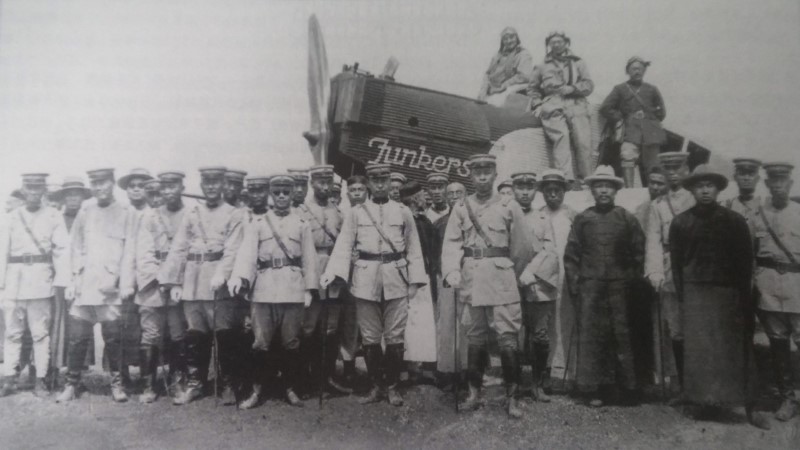
Military users were not lacking, even though the design had answered no military requirement. A military version with a machine-gun position on the cabin roof was built in the Soviet Union for the Persian air force. The Colombian army air arm used four landplanes handed over by SCADTA, fitted with floats, during the Colombia-Peru war. The Republic of China flew F 13s converted into scout bombers until the January 28 Incident of 1932, when they were destroyed by the Japanese along with the Shanghai aircraft factory. The Turkish flying forces had a few. The list of civil and military operators runs through Afghanistan, Argentina, Austria, Belgium, Bolivia, Brazil, Bulgaria, Chile, China, Colombia, the Free City of Danzig, Estonia, Finland, France, Germany, Hungary, Iceland, Iran, Italy, Japan, Latvia, Lithuania, Mexico, Mongolia, Poland, Portugal, Romania, the Soviet Union, South Africa, Spain, Sweden, Switzerland, Turkey, the United Kingdom and the United States.
Production, licences and variants
The bulk of the F 13s came out of Dessau, but that was not the only factory. During the difficult years from 1921 to 1923 production was moved to the Danzig and Reval plants, and an aircraft works acquired at Fürth served as a second German facility. In 1922-23 Hugo Junkers signed a contract with the Soviet Union to build the aircraft at Fili, near Moscow, in what became known as "Plant no. 22": there it was built under the designation Ju 13, and the machines served both with the Dobrolyot airline and with the Red Army. In New York, the Junkers-Larsen Aircraft Corporation assembled from 1919 the F 13s that arrived crated; its American version was designated JL-6, and it also delivered two float-equipped aircraft to the United States Navy. The most extravagant derivative was the JL-12, an armoured ground-attack machine with a 300 kW (400 hp) Liberty L-12 engine, armed with a downward-pointing battery of thirty Thompson submachine guns.
Versions ran into the dozens — more than sixty, by the Dessau count — and were distinguished by a two-letter code in which the first letter identified the airframe and the second the engine. Every variant with the Junkers L5 carried an -e as its second letter, so that an F 13fe was the long-fuselage -f airframe with the L5. Installed power grew in stages from about 160 to 570 hp to answer the demand for more cruising speed and more range: the prototype flew with a 127 kW (170 hp) Mercedes D IIIa; the first production aircraft were given greater span and the 140 kW (185 hp) BMW IIIa, drawn from war surplus; then came the 149 kW (200 hp) Junkers L2 in the ba, ca, da and fa series — the last of these nearly a metre longer — the 186 kW (250 hp) BMW IV in the bi, ci, di and fi series, the 230 kW (310 hp) BMW Va in the co, fo and ko, and the Junkers L5 of the same power in the be, ce, de, fe, dle, fle, ge, he and ke. Armstrong Siddeley Puma inlines and Gnome-Rhône Jupiter and Pratt & Whitney Hornet air-cooled radials were fitted as well.
As to dimensions, a production F 13 measured 9.59 m in length and 14.8 m in span, with a wing area of 34.50 m², a maximum take-off weight of 1,640 kg and a top speed of 173 km/h; the F 13fe, with the L5, stretched the fuselage to 10.50 m and the span to 17.75 m, with 44 m² of wing, 2,318 kg maximum weight and 198 km/h. Capacity was four passengers or 689 kg (1,519 lb) of payload. The total number built was never settled: sources range from 314 to 351, by way of the 318 of a Junkers delivery list dated 12 April 1935, the 322 of a pre-war display board at the Dessau teaching exhibition — the figure most often repeated — and the 328 of an accident investigation report of September 1930.
Withdrawal, survivors and return to flight
From its entry into service in 1919 the F 13 stayed on the airline routes for more than thirty years; the last example in commercial service was retired in Brazil in 1951. Five original airframes survive, all in museums. Works number 574, registered CH-59, was begun on 20 July 1920, impounded at Hamburg that October and ended up in 1921 in the hands of the Swiss operator Ad Astra Aero; in it, on 20 October 1921, the former King Charles IV of Hungary — Emperor Charles I of Austria — flew from Switzerland to Hungary accompanied by Zita of Bourbon-Parma in his attempt to recover the throne by force; when the rising collapsed the Hungarian government seized the aircraft, which since 1922 has belonged to the transport museum in Budapest. Number 609, built in 1920 and first flown on 22 November that year, passed through Holland and reached France as a reparations delivery; it is displayed at the Musée de l'Air et de l'Espace at Le Bourget. Number 715, "Schleiereule", of 1923, registered successively D-343 and SE-AAC, opened A.B. Aerotransport's Stockholm-Helsinki route on 2 June 1924 and is preserved at the Tekniska museet in Stockholm. Number 2018 was sold to the Afghan King Amanullah Khan and flown to Kabul on 2 April 1928; after the king's fall it stood parked at Kabul airport from 1929 to 1937 and was then made airworthy again, until it was rediscovered in 1968 and flown to Germany the following year in a Luftwaffe Transall C-160; restored, it is displayed as "D-366" at the Deutsches Museum in Munich, which catalogues it as an all-metal aircraft with a Junkers L5 inline engine. Number 2050, "Königsgeier", registered CF-ALX and named "City of Prince George", struck a tree on take-off in British Columbia on 23 July 1933; its remains were recovered in 1981 and became the basis of a museum restoration.
In 2009 a German-Swiss project set out to rebuild the type, with a 1930s Pratt & Whitney R-985 Wasp Junior radial and the external appearance of a Junkers-Larsen JL-6, but otherwise as faithful to the original as possible; it was drawn up from the original blueprints and a laser scan of the Le Bourget aircraft, and runs to some 2600 parts and tens of thousands of rivets. Unlike the 1919 machine, the undercarriage has modern springing, a brake and a tailwheel, and there is radio and a transponder aboard. The first flight took place on 15 September 2016. In 2015, with the express authorisation of the Junkers heirs, the marque under which the prototype had been built gave way to a refounded Junkers Flugzeugwerke AG, later moved to Altenrhein; in 2018 the aircraft was officially certified, and by around 2022 two examples were airworthy with a third under construction.
Legacy
The F 13 was not a dead end but a template. Its way of building had proved so sound that whole assemblies — the wing centre section and the outer panels — were carried over unchanged to the Junkers W 33, and the type stands at the origin of both the W 33 and the W 34, with the K 43 and the Ju 46 among its related developments. The family of duralumin structures with load-bearing corrugated skin that it established runs through some thirty-five of the firm's models, from the J 7 of 1918 to the Ju 46 of 1932. And the ease of access and dismantling of the airframe for maintenance, inspection and repair, attended to at Dessau from the very first sketch, remained a model of what a safe and reliable air transport ought to be.
Variants
| F 13 | Rimowa / Junkers Flugzeugwerke F 13 (réplica) | F 13a | F 13ba, ca, da, fa (Junkers L2) | F 13be, ce, dle, fle, ge, he, ke (Junkers L5) | F 13bi, ci, di, fi (BMW IV) | F 13co, fo, ko (BMW Va) | F 13de | F 13fe | F 13W | Junkers-Larsen JL-12 | Junkers-Larsen JL-6 | |
|---|---|---|---|---|---|---|---|---|---|---|---|---|
| First flight | June 25, 1919 | September 15, 2016 | — | — | — | — | — | — | — | — | — | — |
| Aircraft type | Pioneering airliner | Modern replica of a pioneering airliner | Pioneering airliner | Pioneering airliner | Pioneering airliner | Pioneering airliner | Pioneering airliner | Pioneering airliner | Pioneering airliner | Pioneering commercial floatplane | Experimental ground-attack derivative | Pioneering airliner |
| Powerplant | 1 × Mercedes D.IIIa six-cylinder water-cooled inline piston engine rated at 118 kW (158 hp) | 1 × Pratt & Whitney R-985 Wasp Junior nine-cylinder air-cooled radial piston engine rated at 336 kW (450 hp) | 1 × BMW IIIa six-cylinder water-cooled inline piston engine rated at 140 kW (185 hp) | 1 × Junkers L2 upright six-cylinder water-cooled inline piston engine rated at 149 kW (200 hp) | One 230 kW (310 hp) Junkers L5 upright six-cylinder water-cooled inline piston engine. | One 186 kW (250 hp) BMW IV water-cooled inline piston engine. | One 230 kW (310 hp) BMW Va water-cooled inline piston engine. | 1 × Junkers L5 upright six-cylinder water-cooled inline piston engine rated at 230 kW (310 hp) | 1 × Junkers L5 upright six-cylinder water-cooled inline piston engine rated at 230 kW (310 hp) | Water-cooled inline piston powerplant as fitted to the parent series, unchanged from the landplane | 1 × Liberty L-12 twelve-cylinder water-cooled V piston engine rated at 300 kW (400 hp) | 1 × BMW IIIa six-cylinder water-cooled inline piston engine rated at 140 kW (185 hp) |
| Powerplant | 1 × Mercedes D.IIIa | 1 × Pratt & Whitney R-985 Wasp Junior | 1 × BMW IIIa | 1 × Junkers L2 | 1 × Junkers L5 | 1 × BMW IV | 1 × BMW Va | 1 × Junkers L5 | 1 × Junkers L5 | 1 × piston | 1 × Liberty L-12 | 1 × BMW IIIa |
| Power per engine | 158 hp | 451 hp Best value in this row | 188 hp | 200 hp | 308 hp | 249 hp | 308 hp | 308 hp | 308 hp | — | 402 hp | 188 hp |
| Length | 9.6 m | 9.6 m Best value in this row | 9.6 m Best value in this row | 9.6 m Best value in this row | — | — | — | 9.6 m Best value in this row | 9.6 m Best value in this row | — | — | — |
| Wingspan | 14.8 m | 14.9 m | 17.8 m Best value in this row | 17.8 m Best value in this row | — | — | — | 17.8 m Best value in this row | 17.8 m Best value in this row | 17.8 m Best value in this row | — | — |
| Height | 3.5 m | 3.1 m | — | — | — | — | — | 4.1 m | 3.8 m | 4.5 m Best value in this row | — | — |
| Wing area | 34.5 m² | — | 40 m² Best value in this row | — | — | — | — | 40 m² Best value in this row | 40 m² Best value in this row | — | — | — |
| Empty weight | 951 kg Best value in this row | 1,616 kg | — | — | — | — | — | — | 1,350 kg | — | — | — |
| MTOW | 1,640 kg | 2,000 kg | — | — | — | — | — | 2,000 kg | 2,300 kg Best value in this row | — | — | — |
| Top speed | 173 km/h | 226 km/h Best value in this row | 170 km/h | 170 km/h | — | — | — | 185 km/h | 195 km/h | 170 km/h | — | 161 km/h |
| Cruise speed | 160 km/h Best value in this row | 158 km/h | 140 km/h | — | — | — | — | 140 km/h | 160 km/h Best value in this row | — | — | — |
| Service ceiling | 5,000 m | — | 4,600 m | — | — | — | — | 5,000 m | 5,500 m Best value in this row | — | — | — |
| Initial climb rate | 2.4 m/s | — | — | — | — | — | — | 3.3 m/s Best value in this row | — | — | — | — |
| Range | 1,400 km Best value in this row | 639 km | 1,200 km | — | — | — | — | 980 km | 925 km | — | — | — |
| Combat radius | 0 km Best value in this row | 0 km Best value in this row | 0 km Best value in this row | 0 km Best value in this row | 0 km Best value in this row | 0 km Best value in this row | 0 km Best value in this row | 0 km Best value in this row | 0 km Best value in this row | 0 km Best value in this row | — | 0 km Best value in this row |
| Range conditions | 1,400 km range at a 160 km/h cruise, with a 5,000 m service ceiling. | Some 639 km (345 nautical miles) of range at a 158 km/h cruise, on 386 litres of fuel. | 1,200 km range at a 140 km/h cruise and a 4,600 m service ceiling. | No range figure is published for the L2-engined series in the consulted sources; the NACA circular of 1926 lists fuel consumption of about 45 kg/h and oil consumption of about 2 kg/h for the 200 hp F 13, but no still-air range. | No range figure is published for these particular sub-versions in the consulted sources. | No range figure is published for these particular sub-versions in the consulted sources. | No range figure is published for these particular sub-versions in the consulted sources. | 980 km range, a 5,000 m service ceiling and an initial climb of 3.3 m/s. | 925 km range at a 160 km/h cruise, with a 5,500 m service ceiling. | No range figure is published for the floatplane in the consulted sources. The NACA circular of 1926, which describes the F 13 as available on wheels (F 13T), on skis (F 13S) and as a seaplane (F 13W), gives fuel consumption of about 45 kg/h and oil consumption of about 2 kg/h but no still-air range. | — | — |
| Armament | None | None | None | None | None: a civil transport. | None: a civil transport. | None: a civil transport. | None | None | None | Battery of thirty downward-firing Thompson submachine guns | None |
| Max weapons load | 0 kg Best value in this row | 0 kg Best value in this row | 0 kg Best value in this row | 0 kg Best value in this row | 0 kg Best value in this row | 0 kg Best value in this row | 0 kg Best value in this row | 0 kg Best value in this row | 0 kg Best value in this row | 0 kg Best value in this row | — | 0 kg Best value in this row |
| Payload | 689 kg Best value in this row | 384 kg | — | — | — | — | — | — | — | — | — | 680 kg |
| Cargo capacity | Enclosed cabin for 4 passengers with 2 crew in the cockpit; up to 689 kg of payload split between passengers, mail and freight. | Hand-built reconstruction faithful to the original, with an enclosed cabin for 4 passengers and a semi-open cockpit for 2 crew; 384 kg of useful load on a 2,000 kg maximum take-off weight. | First production version, with a wing of greater span and area: 4 passengers in the enclosed cabin plus 2 crew. | Series with assorted structural changes over the same 4-passenger, 2-crew cabin. | Two crew and four passengers, as on the rest of the F 13 family. | Two crew and four passengers, as on the rest of the F 13 family. | Two crew and four passengers, as on the rest of the F 13 family. | Large 17.75 m, 43 m² wing; 4 passengers in the enclosed cabin plus 2 crew, at a 2,000 kg maximum take-off weight. | Fuselage stretched by about a metre over the standard airframe; 4 passengers and 2 crew, at a 2,300 kg maximum take-off weight against 1,350 kg empty. | Float configuration in place of the fixed landing gear; some examples had the rudder extended to compensate for directional control. Cabin for 4 passengers and 2 crew. | Armoured military conversion: the passenger cabin houses the gun battery, with no commercial use. | US licence-built Junkers-Larsen version: eight aircraft, flown by the air mail service with up to 680 kg of mail; cabin for 4 passengers or freight with the seats removed. |
| Crew | 2 Best value in this row | 2 Best value in this row | 2 Best value in this row | 2 Best value in this row | 2 Best value in this row | 2 Best value in this row | 2 Best value in this row | 2 Best value in this row | 2 Best value in this row | 2 Best value in this row | 2 Best value in this row | 2 Best value in this row |
| Passengers | 4 Best value in this row | 4 Best value in this row | 4 Best value in this row | 4 Best value in this row | 4 Best value in this row | 4 Best value in this row | 4 Best value in this row | 4 Best value in this row | 4 Best value in this row | 4 Best value in this row | — | 4 Best value in this row |
| Units built | — | — | — | — | — | — | — | — | — | — | 1 | 8 Best value in this row |
Images
Elsewhere
- San Diego Air & Space Museum Archives (Flickr)Junkers F-13 (JL-6), catálogo SDASM 01_00081777 ↗
- San Diego Air & Space Museum Archives (Flickr)Junkers F-13 (JL-6), catálogo SDASM 01_00081771 ↗
- San Diego Air & Space Museum Archives (Flickr)Junkers F-13 (JL-6), catálogo SDASM 01_00081726 ↗
- San Diego Air & Space Museum Archives (Flickr)Junkers F-13 (JL-6), catálogo SDASM 01_00081744 ↗
- San Diego Air & Space Museum Archives (Flickr)Junkers F-13 (JL-6), catálogo SDASM 01_00081745 ↗
- San Diego Air & Space Museum Archives (Flickr)Junkers F.13 matrícula SE-AAC en Estocolmo, Suecia ↗
- San Diego Air & Space Museum Archives (Flickr)Junkers F 13 conservado en el Tekniska museet de Estocolmo ↗
- Wikimedia CommonsJunkers F 13 conservado en el Deutsches Museum de Múnich ↗
- Wikimedia CommonsJunkers F 13, vista trasera del fuselaje ondulado ↗
- Wikimedia CommonsJunkers F 13, vista frontal del fuselaje ondulado ↗
- Wikimedia CommonsDetalle del Junkers F 13 en el Památník Tomáše Bati, Zlín (Chequia) ↗
- Wikimedia CommonsJunkers F.13 «Annelise» (n.f. 533) requisado en el aeródromo de Kaunas, Lituania, 1919 ↗
Show the 9 more
- Wikimedia CommonsJunkers F 13 matrícula SE-AAC de la aerolínea sueca ABA/SAS ↗
- Wikimedia CommonsJunkers F.13 en fotografía de época ↗
- Wikimedia CommonsJunkers F 13, fotografía del archivo militar finlandés SA-kuva ↗
- Wikimedia CommonsJunkers F 13de matrícula S-AAAC ↗
- National Air and Space Museum (Smithsonian)Junkers F-13 en la colección del National Air and Space Museum ↗
- Deutsches MuseumJunkers F 13 en la colección de aeronáutica del Deutsches Museum ↗
- Közlekedési Múzeum (Budapest)El «avión real»: el Junkers F-13 de la colección histórica de aviación húngara ↗
- Tekniska museetJunkers F 13 matrícula SE-AAC (ABA) conservado en el Tekniska museet ↗
- DigitaltMuseumJunkers F 13 de ABA, ficha de catálogo del Tekniska museet ↗